.png)
.jpg)
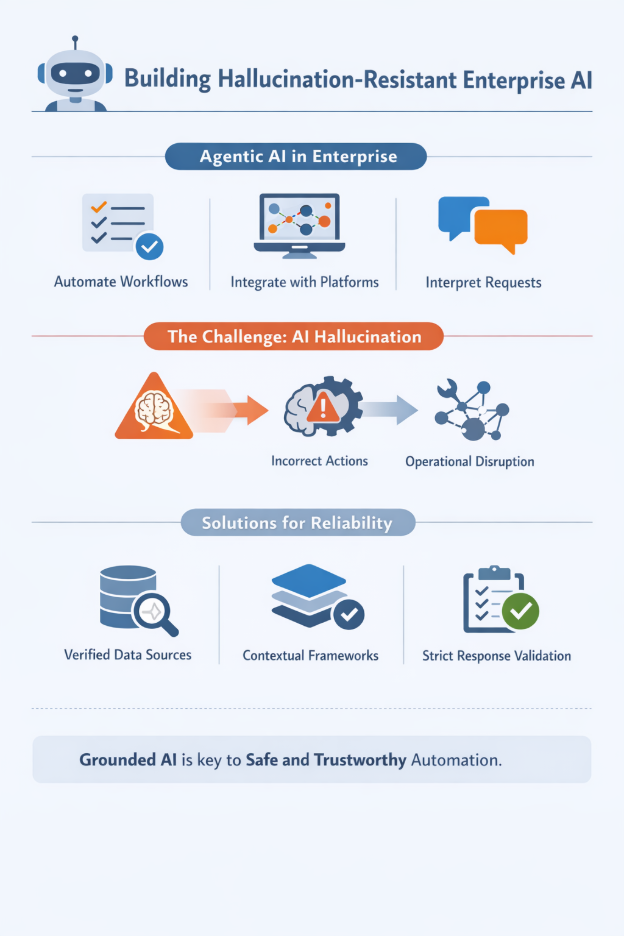
Agentic AI systems can interpret requests, automate workflows, and interact with enterprise platforms, but this capability introduces a serious challenge: AI hallucination. In enterprise environments, hallucinated responses can lead to incorrect actions, operational disruptions, and a loss of user trust. While large language models naturally tend to generate answers even when data is missing, modern enterprise AI architectures can significantly reduce this risk by grounding responses in verified data sources. Approaches such as retrieval-based systems, contextual frameworks, and strict response validation help ensure reliability. Ultimately, building hallucination-resistant AI is essential for safe and trustworthy agentic automation in enterprise operations.
Introduction
Agentic AI represents a significant shift in how organizations use artificial intelligence. Instead of functioning as a passive tool that only retrieves information, these systems are designed to operate as active participants in enterprise workflows. They answer questions, execute actions, and interact with multiple systems to help users complete tasks.
In an IT service management environment, for example, an agentic AI system can interpret a user request, retrieve knowledge from documentation, create a service ticket, initiate automation workflows, and update system records across multiple platforms. The goal is to reduce manual work while accelerating resolution times.
This capability unlocks enormous value for organizations. Employees receive faster assistance; operational teams reduce repetitive tasks, and enterprise systems become more responsive to real-world problems.
However, alongside these benefits comes a serious concern.
As AI systems become more capable and autonomous, organizations are increasingly worried about hallucination. If an AI system can act, automate workflows, and interact with operational systems, then incorrect responses are no longer a minor inconvenience. They can quickly become operational risks.
This raises an important question for enterprises adopting agentic AI.
Is it actually possible to build an AI system that does not hallucinate? Or is hallucination an unavoidable limitation of modern AI models?
What is AI Hallucination?
In simple terms, AI hallucination occurs when an artificial intelligence system generates a response that is not grounded in verified information.
Instead of retrieving facts from a reliable source, the system constructs an answer that appears plausible but is not supported by real data. The response may look correct, but it is effectively invented.
There are several ways hallucination can occur.
In some cases, the AI merges information from multiple sources incorrectly. When a system retrieves fragments of related information, it may combine them into an answer that does not accurately represent any single source.
In other situations, the AI fills gaps in knowledge with assumed details. If the system does not find sufficient information, it may still produce an answer because the model is designed to generate responses rather than acknowledge uncertainty.
Another common scenario occurs when the AI provides a confident response even when no supporting documentation exists. Instead of responding with uncertainty, the model produces an answer that appears authoritative.
This behavior may be acceptable in casual applications such as creative writing or conversational assistants. In enterprise environments, however, it introduces serious reliability concerns.
Why Are Hallucinations Problematic?
For organizations deploying AI in operational environments, hallucination is not simply a technical flaw. It is a business risk.
The most immediate danger is the possibility of incorrect information being provided to employees. If an AI system recommends incorrect troubleshooting steps, provides outdated documentation, or misinterprets a policy, employees may act on that guidance.
Even small inaccuracies can create operational delays. In more serious situations, incorrect actions may trigger service disruptions or configuration errors.
Another major concern is the loss of trust in the system.
Enterprise software succeeds only when users trust it. If employees begin to suspect that an AI assistant occasionally invents answers, they quickly become reluctant to rely on it. Instead of speeding up workflows, the system becomes something users must constantly verify. Once trust is lost, AI adoption declines.
Users begin to bypass the AI and return to traditional support channels. Knowledge bases and automation tools become underutilized, and the organization fails to realize the expected efficiency gains.
Administrators face their own set of challenges. Many AI platforms operate as black-box systems where decision logic is difficult to interpret. When hallucinations occur in such systems, administrators may feel they lack visibility and control.
If they cannot explain how the AI produced an incorrect response, confidence in the platform diminishes even further.
For enterprise IT teams responsible for reliability and governance, this lack of transparency becomes a serious concern.
Why Hallucination Becomes a Bigger Problem with Agentic AI?
Earlier generations of enterprise AI systems had a relatively limited role. Most systems functioned as knowledge assistants that answered questions or retrieved documentation.
If an AI assistant produced an imperfect response, users still had control over the final decision. They could verify the information before taking action.
Agentic AI systems operate in a very different way.
These systems are designed not only to provide answers but also to execute tasks and automate processes. They may create service tickets, trigger automated workflows, retrieve system information, and coordinate actions across multiple enterprise platforms.
This operational capability significantly raises the stakes.
If hallucination occurs within a system that only provides informational responses, the consequences are usually limited to confusion or minor delays. When hallucination occurs in an AI system that can perform actions, the risk increases dramatically.
Imagine an AI system responsible for assisting with infrastructure incidents. If the system incorrectly identifies the root cause of an alert and triggers the wrong remediation process, it may worsen the situation instead of resolving it.
Similarly, an AI assistant that provides inaccurate configuration instructions during a maintenance operation could introduce additional service disruptions.
As organizations move toward agentic automation, the tolerance for incorrect responses becomes extremely low. Enterprises simply cannot allow autonomous systems to act on information that may be fabricated or unsupported.
Can a Hallucination Free AI Product Exist?
Given the limitations of large language models, some observers argue that hallucination can never be fully eliminated. These models generate responses based on patterns learned during training, and they are naturally inclined to produce answers even when information is incomplete.
However, enterprise AI systems rarely rely on language models alone.
Modern enterprise AI architectures combine language models with structured data sources, enterprise systems, and contextual frameworks. When designed correctly, these architectures can significantly reduce the likelihood of hallucination.
A well-designed system does not attempt to answer every question.
Instead, it follows a simple principle. If verified information exists, the system provides an answer grounded in that information. If relevant information cannot be found, the system should acknowledge the absence of data rather than generate a speculative response.
In practical terms, this means the AI should respond with something like:
"I cannot find information related to this request."
Rather than ending the interaction there, the system can guide the user toward useful alternatives.
It may offer to create a support ticket, connect the user with a domain expert, initiate a live chat with a support agent, or escalate the request to the appropriate team. This approach ensures that the AI remains helpful while avoiding the risk of incorrect answers.
For enterprises, this behavior is far more valuable than an AI system that attempts to answer every question but occasionally invents information.
Architectural Approaches to Reducing AI Hallucination
Across the AI industry, several architectural strategies are being used to reduce hallucination. These include but are not limited to;
- One widely adopted approach is retrieval-based architecture, often referred to as Retrieval Augmented Generation or RAG. In this model, the AI retrieves relevant documents from verified data sources before generating a response. This helps ensure that answers are grounded in real information.
- Other approaches focus on contextual frameworks that tightly control how AI systems access and interpret enterprise data. These systems rely on structured knowledge bases, system records, and operational data to guide AI responses.
- Some platforms also implement strict response validation mechanisms. These guardrails ensure that the AI only responds when sufficient evidence exists in the underlying data sources.
Each of these approaches attempts to address the same fundamental challenge: ensuring that AI systems remain grounded in real enterprise data rather than generating speculative responses.
While no single architecture completely eliminates hallucination on its own, combining multiple strategies can dramatically reduce the likelihood of incorrect answers.
Rezolve.ai’s Approach to Hallucination-Free Agentic AI
At Rezolve.ai, addressing hallucination has been a central design consideration in the development of the platform.
Enterprise service environments demand reliability. Systems responsible for assisting employees, managing service requests, and supporting operational workflows must behave predictably and provide responses grounded in verified information.
To support these requirements, Rezolve.ai has developed a proprietary architectural approach designed to ensure that no hallucinations occur and ensure responses remain connected to trusted enterprise data sources.
Because this architecture represents a competitive advantage, the detailed implementation cannot be publicly disclosed.
However, organizations evaluating Rezolve.ai can observe this capability directly during demonstrations and real-world deployments. Customers can test how the system responds when information is available and how it behaves when relevant data cannot be found.
This transparency allows enterprises to verify that the platform behaves responsibly and avoids generating unsupported responses.
Closing Note
Agentic AI has the potential to transform how enterprises manage service operations, automate workflows, and support employees across complex systems. Yet as AI systems become more capable, the expectations placed upon them also increase.
Organizations cannot rely on systems that occasionally invent answers or behave unpredictably. For AI to operate safely within enterprise workflows, it must provide responses grounded in verified data and acknowledge when information is missing.
In other words, solving hallucination is not simply a technical challenge. It is a prerequisite for building trustworthy AI systems. A hallucination-free AI product may not be easy to achieve, but it is essential for the future of agentic automation.
See how Rezolve.ai enables truly hallucination-free Agentic AI for enterprise operations, ITSM, and shared services - Book a Demo


.webp)

.webp)