.png)
.jpg)
Help Desk Software focuses on resolving user issues through ticketing, support channels, and basic automation. ITSM takes a broader approach by managing the full lifecycle of IT services, including incident, change, asset, and configuration management. While help desks are ideal for smaller or simpler environments, ITSM becomes essential as infrastructure and operational complexity grow. Choosing between them depends on your organization’s scale, maturity, and long-term IT service goals.
Introduction
When organizations begin improving their internal IT support, they often encounter two terms that seem interchangeable but are actually very different: ITSM and Help Desk Software.
At first glance, both appear to solve the same problem. Employees need help when systems fail, passwords expire, or applications behave unexpectedly. IT teams need tools to manage those requests efficiently.
So, the natural assumption is simple. Deploy Help Desk Software, create a ticketing workflow, and the problem is solved.
But as organizations grow, many discover that Help Desk Software alone cannot support the complexity of modern IT environments. Infrastructure expands. Applications multiply. Compliance requirements increase. IT teams begin managing services rather than just fixing issues.
This is where ITSM enters the picture.
Understanding the difference between ITSM and Help Desk Software is not simply a matter of terminology. It is a question of operational maturity. One approach focuses on resolving immediate issues, while the other manages the entire lifecycle of IT services across the organization.
Choosing the right level of operational capability can determine whether an IT team remains reactive or evolves into a strategic service organization.
Understanding ITSM
ITSM, short for IT Service Management, refers to the structured management of IT services across their entire lifecycle. It includes planning, delivering, supporting, and continuously improving the technology services that organizations depend on.
Instead of focusing only on fixing technical problems, ITSM focuses on how technology supports business operations.
Within an ITSM environment, IT teams manage several operational processes:
- Incident management
- Problem management
- Change management
- Configuration management
- Service request management
- Asset management
Each of these processes plays a role in ensuring that technology services remain reliable and aligned with business needs.
For example, when an outage occurs, incident management focuses on restoring service quickly. Problem management investigates the root cause so the issue does not repeat. Change management ensures that system updates are reviewed and approved before implementation.
This broader approach makes ITSM fundamentally different from traditional support systems. Instead of reacting to issues after they appear, ITSM aims to improve service quality across the entire environment.
Understanding Help Desk Software
Help Desk Software addresses a more specific operational need.
Its primary purpose is to handle user support requests quickly and efficiently. When an employee encounters a technical issue, Help Desk Software provides a structured system for capturing, tracking, and resolving that request.
Most Help Desk Software platforms focus on several core capabilities:
- Ticket management
- Email and chat support
- Basic automation
- Knowledge base access
- Reporting on support activity
The workflow is pretty straightforward. A user runs into an issue and reports it. The system logs a ticket, and a support agent picks it up, reviews the request, and works toward resolving it.
This approach works really well, especially when handling a high volume of routine requests. That’s why many small and mid-sized organizations rely on help desk software. It offers a simple and efficient way to stay organized and keep support operations running smoothly.
However, Help Desk Software typically focuses on resolving individual incidents rather than managing the entire IT service lifecycle.
The Core Difference Between ITSM and Help Desk Software
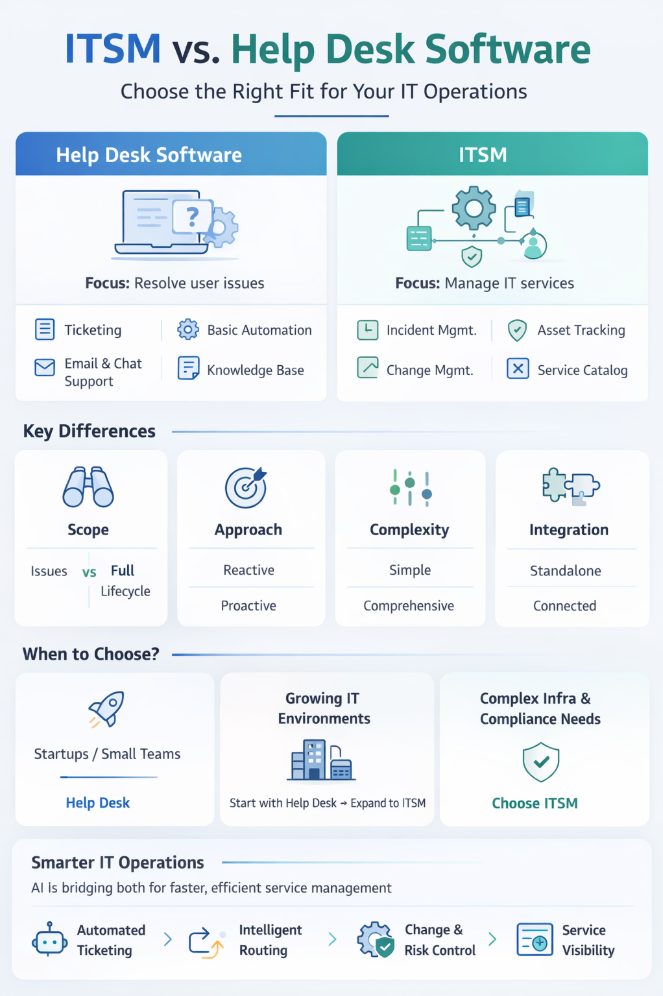
The easiest way to understand the difference between ITSM and Help Desk Software is to look at their scope.
Help Desk Software focuses on resolving issues.
ITSM focuses on managing services.
A help desk environment is reactive by design. A user experiences a problem, submits a request, and the support team fixes it.
An ITSM environment takes a broader view. Instead of waiting for issues to occur, the system tracks infrastructure, manages changes, monitors service quality, and prevents problems before they disrupt users.
Another way to think about it is hierarchy.
ITSM acts as the overarching framework that defines how IT services should be delivered, while help desk systems operate within that framework as a tactical support tool.
In other words, Help Desk Software can exist without ITSM, but ITSM environments almost always include help desk capabilities.
What ITSM Platforms Typically Include?
Modern ITSM platforms go far beyond ticketing. In addition to incident management, these systems provide operational capabilities such as service catalogs, asset tracking, and change governance.
A typical ITSM platform may include:
- Service request management
Employees can request software access, hardware upgrades, or new services through structured workflows.
- Change management
Infrastructure changes are reviewed, approved, and documented before implementation.
- Configuration management database (CMDB)
Infrastructure components and service dependencies are mapped to understand how systems interact.
- Service level management
IT teams track service performance against defined service level agreements.
- Knowledge management
Solutions and documentation are captured so future incidents can be resolved faster.
Because ITSM integrates these processes, it enables IT teams to manage services strategically rather than simply responding to support requests.
What Help Desk Software Does Best?
Despite its limited scope compared to ITSM, Help Desk Software remains extremely valuable.
For organizations with smaller teams or relatively simple infrastructure, implementing a full ITSM environment may be unnecessary. In these cases, Help Desk Software provides a practical solution.
Its strengths include simplicity and speed.
Most Help Desk Software platforms can be deployed quickly. They require minimal configuration and are easy for support agents to learn.
This makes Help Desk Software ideal for environments where the primary goal is resolving user issues efficiently.
Common use cases include:
- Startup companies with small IT teams
- Internal support desks for limited infrastructure
- Customer support environments
- Organizations that prioritize fast issue resolution over complex service governance
In these situations, Help Desk Software can significantly improve response times without introducing operational complexity.
The Cost and Complexity Trade Off
Another important difference between ITSM and Help Desk Software lies in cost and operational complexity.
Implementing ITSM requires a larger investment. Organizations must define service management processes, train teams on those processes, and integrate the platform with existing systems.
The payoff comes in the form of long term efficiency.
By standardizing processes such as change management and asset tracking, ITSM platforms can reduce operational costs significantly over time. Some studies suggest that organizations adopting full ITSM practices can achieve major reductions in operational expenses through automation and prevention strategies.
Help Desk Software, on the other hand, requires far less initial investment. It focuses on immediate operational efficiency rather than long term service governance.
For many organizations, this makes Help Desk Software an attractive starting point.
When Help Desk Software Is the Right Choice?
Organizations often begin their support journey with Help Desk Software.
This approach works best when the IT environment is relatively straightforward and the primary goal is responding to support requests.
You may only need Help Desk Software if:
- Your IT team supports a small number of users
- Infrastructure is simple and stable
- Change management processes are minimal
- Most issues involve routine troubleshooting
In these environments, implementing full ITSM capabilities may create unnecessary overhead. A well designed Help Desk Software platform can manage tickets, track support activity, and improve response times without introducing complexity.
When ITSM Becomes Necessary?
As organizations grow, the limitations of Help Desk Software become more visible.
Infrastructure expands across cloud platforms, internal systems, and third party applications. Security and compliance requirements increase. Teams must coordinate changes across multiple systems.
At this stage, organizations begin shifting toward ITSM practices.
Indicators that it may be time to adopt ITSM include:
- Frequent service outages caused by unmanaged changes
- Lack of visibility into infrastructure dependencies
- Difficulty tracking assets across multiple environments
- Growing support volumes that require automation
- Business leaders demanding measurable service performance
In these situations, ITSM provides the structure needed to manage IT operations at scale.
The Emerging Role of AI in ITSM and Help Desk Software
Artificial intelligence is introducing new capabilities that automate ticket classification, incident resolution, and service request fulfillment. Modern Agentic AI driven systems like Rezolve.ai can autonomously create, route, and resolve tickets, recommend solutions, and perform autonomous actions as intended.
Within ITSM environments, AI can also analyze service dependencies and identify risks before changes are implemented.
At the same time, AI powered Help Desk Software platforms are becoming more sophisticated. Chatbots, knowledge automation, and intelligent ticket routing allow smaller teams to handle much larger support volumes.
This convergence is pushing the industry toward a new model where automation supports both tactical issue resolution and strategic service management.
Choosing for the Right Level of IT Operations Maturity
Ultimately, the choice between ITSM and Help Desk Software is not about which system is better. It is about choosing the level of operational maturity that matches your organization’s needs.
If your goal is simply to resolve user issues efficiently, Help Desk Software may provide everything you need.
If your organization depends heavily on technology services and requires strong governance over infrastructure, ITSM offers a much broader operational framework.
Many organizations follow natural progression. They begin with Help Desk Software, then gradually expand into ITSM practices as their infrastructure and operational complexity grow.
Conclusion
Technology environments rarely stay simple for long.
What begins as a small support function often evolves into a complex ecosystem of applications, infrastructure, and services that must be carefully managed.
Help Desk Software provides the foundation for responding to user issues and managing support requests. It delivers speed, simplicity, and operational efficiency.
ITSM, on the other hand, provides the strategic framework needed to manage IT services across their entire lifecycle.
Understanding the difference between ITSM and Help Desk Software allows organizations to make smarter decisions about how they structure their IT operations.
The right choice is not always the most sophisticated platform. It is the one that aligns with your organization’s scale, complexity, and long-term operational goals.


.webp)

.webp)