
.png)
For decades, developers have been bogged down by the manual labor of connecting mismatched software systems, costing companies massive amounts of time and money. However, the rise of AI-built APIs and the Model Context Protocol is completely eliminating this integration pain by creating self-healing, intent-aware connections. This shift is moving us toward a "No-Ware" future where software writes its own glue code, freeing engineers to focus on real innovation instead of fixing broken pipes.
Introduction
The traditional model of enterprise integration is failing. For decades, the promise of a "connected enterprise" has been held hostage by the sheer manual labor required to maintain the pipes. Developers spend more time fighting with authentication, mapping inconsistent data schemas, and chasing down broken endpoints than they do building core product features.
That being said, integration sits behind every product launch, every workflow automation, every dashboard that claims to give you a “single source of truth.” And despite decades of tooling, integration remains one of the most time-consuming and failure-prone parts of building and running software.
Integration was never really solved
If you look back at how integration evolved, the pattern is clear.
First came direct API integrations. Developers wrote custom code for everything. It was flexible, but brittle and slow. Then came middleware and iPaaS platforms. These introduced connectors, visual builders, and reusable templates. They reduced effort but still required significant human intervention and understanding.
Then came unified APIs and SDK abstractions. These tried to standardize access across tools, especially in domains like HR, CRM, and payments.
Each step improved the experience but did not address the core problem. Because the core problem was never tooling. It was that integration requires humans to constantly translate between systems that were never designed to understand each other – because every API speaks its own language, every data model has its own assumptions, and every system evolves independently.
Historically, an integration followed a linear, rigid path:
- Discovery: A developer hunts for documentation (which is often outdated).
- Authentication: Hours are spent navigating OAuth 2.0, API keys, or custom token exchanges.
- Mapping: System A calls a user "Client," while System B calls them "Account_ID." The developer writes "glue code" to bridge the gap.
- Maintenance: The vendor updates their API version, the glue code snaps, and the workflow dies silently.
In 2026, this linear path is being decimated by the volume of requests. AI-powered workflows have increased API call frequency exponentially. A system that used to sync once a day now needs to run every 30 seconds to support real-time autonomous agents. Manual code simply cannot scale to meet this frequency, nor can it handle the diversity of the modern tech stack.
The integration pain story in numbers
The numbers tell a sobering story. According to the 2025 State of the API Report by Postman, approximately 69% of developers spend more than 10 hours per week on API-related tasks, with 58% specifically citing documentation management as a significant bottleneck. Moreover;
- According to Postman’s State of the API report, over 70% of developers say APIs are critical to their work, yet most still struggle with integration complexity
- MuleSoft reports that organizations use an average of over 1,000 applications, with integration cited as a top barrier to digital transformation
- 77% of engineering leaders identify AI integration within apps as a major challenge, according to a Gartner Survey.
Perhaps most telling is that developing and maintaining a single integration can now cost an organization up to $50,000 annually, as noted by industry research on integration challenges in 2026.
“We are entering a new era where the "hand-coded" API is becoming a liability. The shift toward AI-built APIs is not just a marginal improvement in speed; it is the fundamental end of integration pain.”
What changes when AI enters the loop?
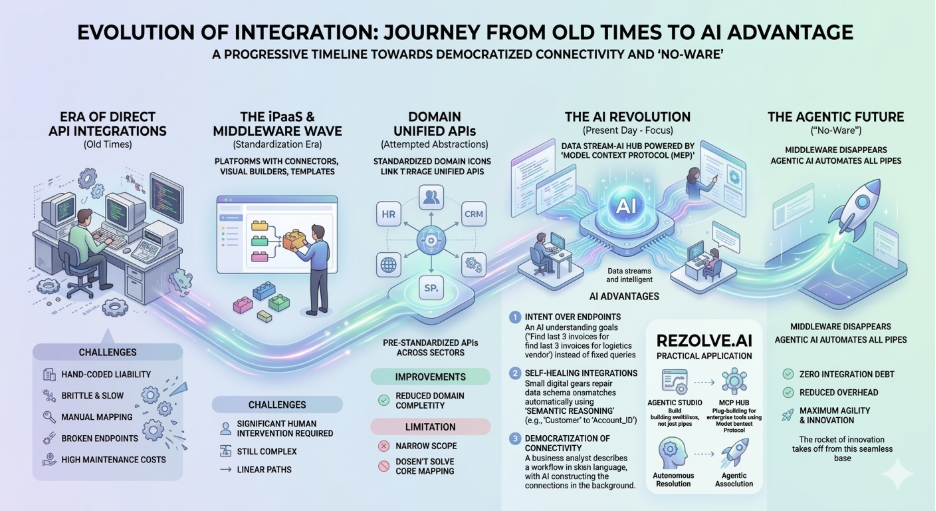
AI changes integration not by making developers faster, but by removing the need for them to do most of the translation work in the first place.
At its core, integration is a problem of understanding and mapping. You need to understand what one system expects, understand what another system provides, and then figure out how to connect the two.
This is exactly the kind of problem modern AI systems are good at.
An AI-built API is not just a script generated by an LLM. It is a dynamic, self-documenting, and intent-aware interface. Unlike traditional REST or GraphQL endpoints that require strict, hard-coded inputs, AI-built APIs leverage Model Context Protocol (MCP) and generative reasoning to understand what a user, or another agent, is trying to achieve.
AI-built APIs offer significant advantage over the ‘traditional’ cross-system integration challenges. This includes;
1. Intent over Endpoints
In the old world, you had to know the exact URL and payload structure to get data. In the new world, AI-built interfaces focus on intent. If an agent needs to "find the last three invoices for the logistics vendor," the AI layer identifies the correct underlying systems, handles the joins between disparate databases, and returns the result without a human ever writing the SQL or the fetch request.
2. Self-Healing Integrations
The greatest cost of APIs is not the build; it is the "rot." When a third-party service changes a field name, manual integrations fail. AI-driven integration layers are designed to be "schema-agnostic." They use semantic reasoning to realize that "Customer_Name" in the new version is the same as "Client_Full_Name" in the old version, adjusting the mapping automatically without human intervention.
3. The Democratization of Connectivity
When APIs are built and managed by AI, the "Integration Specialist" role changes. We are moving toward a reality where business analysts and department leads can describe a workflow in plain language, and the AI constructs the necessary API connections in the background.
Standardizing the chaos with MCP
Think of MCP as a universal translator for AI agents. Instead of each application having a unique, idiosyncratic way of talking, MCP allows tools to expose their capabilities in a standard format that AI can instantly "read" and "use."
In 2026, we are already seeing a surge in APIs exposed as MCP servers. This allows autonomous agents to discover tools on the fly. If an agent is tasked with solving a hardware procurement issue, it doesn't need a pre-programmed integration to the vendor's portal. It discovers the vendor's MCP-compliant tool, understands the permissions, and executes the task.
How Rezolve.ai is solving the systems integration gap?
While many are still talking about the potential of AI-built APIs, practical applications are already hitting the enterprise floor. Rezolve.ai has moved beyond the "chatbot" era by introducing an architecture designed specifically for this agentic future.
Agentic Studio: Building Workflows, Not Just Pipes
Once the tools are connected via the MCP Hub, the next challenge is orchestration. This is where Rezolve.ai Agentic Studio comes in. Instead of writing rigid, "if-this-then-that" logic, Agentic Studio allows users to deploy specialized AI agents that can reason through complex tasks.
- Autonomous Resolution: If an employee asks why their payroll is incorrect, an agent in the Studio can trigger a workflow that queries the payroll API, cross-references it with the time-tracking system, and identifies the discrepancy.
- Speed of Deployment: Because the studio is built on an agentic framework, these automations are "lightning-fast" to deploy. You aren't building a new integration; you are giving an intelligent agent access to an existing tool through a secure, governed interface.
The result is a shift from deterministic automation (where you must account for every possible error) to agentic automation (where the AI handles the edge cases). Moreover, the agentic AI automations within the studio can be created by just talking to a specialized AI agent that builds it for you. Pretty neat, right?
The MCP Hub: Plug-and-Play for the Enterprise
One of the primary hurdles in enterprise AI is the "walled garden" problem. Companies have hundreds of legacy apps that don't talk to each other. Rezolve.ai’s MCP Hub acts as a central nervous system. It allows organizations to connect with their existing enterprise tools, whether it is an ITSM like ServiceNow, an HRIS like Workday, or a proprietary database, using the Model Context Protocol.
By utilizing the Rezolve.ai MCP Hub, the time to "connect" a new tool drops from weeks of development to minutes of configuration. It eliminates the need for custom API development because the AI agents can natively discover and interact with the tools connected to the hub.
Security and governance in an API-first world
The democratization of APIs often brings a fear of "Shadow AI" or security leaks. The 2025 Postman Report also highlights that 51% of developers worry about unauthorized API calls from AI agents.
This is why the shift to AI-built APIs must be accompanied by robust governance. Systems like Rezolve.ai address this by making every tool "disabled by default." Administrators have granular control over what an agent can see and do. Every function call is logged, timestamped, and auditable. This ensures that while the construction of the integration is handled by AI, the authority remains with the human IT or security leader.
The Future is from middleware to "No-Ware"
We are heading toward a future where "middleware" as a category disappears. The goal of integration has always been to move data and trigger actions. If AI can build the APIs, map the data, and execute the workflows autonomously, the need for a separate, complex integration layer vanishes.
For the enterprise, the benefits are clear:
- Zero Integration Debt: No more maintaining thousands of lines of legacy code for old versions of SaaS products.
- Reduced Overhead: Engineering teams are freed from "pipe-fitting" and can return to actual innovation.
- Agility: When a business needs to pivot or add a new tool to its stack, the integration is ready in hours, not months.
The end of integration pain is not about finding a better way to write code. It is about realizing that in the world of Agentic AI, the code should be writing itself. Platforms that embrace the MCP standard and provide the tools to orchestrate these agents, like Rezolve.ai, are setting the stage for an enterprise that is finally, truly connected.
The transition from human-managed APIs to AI-built connectivity is the last hurdle in achieving digital transformation at scale. It is time to stop configuring and start automating.


.webp)

.webp)