
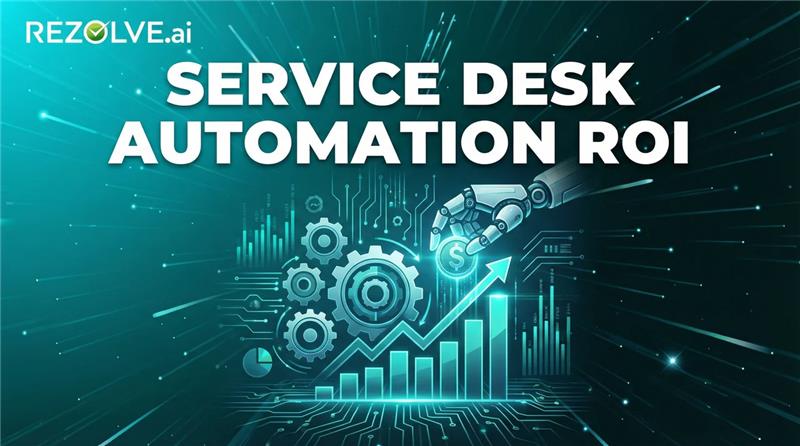
Service desk automation delivers ROI by reducing ticket resolution time, lowering operational support costs, and improving employee productivity. When organizations automate Level-1 tasks, intelligent routing, and repetitive workflows, measurable returns typically emerge within 6–12 months through cost reduction, SLA improvements, and support efficiency gains.
What is Service Desk Automation?
Service desk automation refers to the use of AI, workflows, and autonomous systems to handle repetitive IT support tasks without manual intervention. Instead of relying solely on human agents, automated systems resolve, route, or deflect tickets using predefined logic, machine learning, and integrations.
Automation typically applies to:
✔ Password resets
✔ Access requests
✔ Ticket classification & routing
✔ Knowledge-based resolutions
✔ Incident triage
Service Desk Automation Benefits To Consider
Service desk automation allows your organization to streamline the entire support process without the need for human-agent interaction. Below are some of the key benefits of implementing service desk automation at your organization.
- Auto-resolve employee queries within seconds
Service desk automation allows your organization to auto-resolve technical and non-technical issues like ‘access request denial’, ‘issues with VPN connectivity’, ‘laptop configuration’ etc within 10-15 seconds. It allows employees to have human-like interaction with conversational chatbots that works within collaborative platforms like MS Teams or Slack- where employees spend most of their time in this new post-pandemic era. - Minimize the scope of errors and inconsistencies
In a traditional service desk, most tasks were performed manually. As a result, there is a huge chance of making mistakes. Service desk automation allows chatbots to automate tasks and processes, making the entire process quick and impeccable. - Provide personalized employee support
Every employee's top expectation from their employer is bespoke and quick support. Global organizations have used the traditional service desk for a long time to handle service requests or resolve incidents. Service desk automation offer conversational virtual assistants to employees as soon as they sign in. Chatbots address employee issues by providing the best-suited solution within 10-15 seconds, providing them with L1 support. - Provide the right information at the right time
Employees are expected to use the service portal to search for relevant information whenever they need clarifications on their leave policy, dress code, medical policies etc. But if the service desk frequently fails to provide the right information when employees are in need, the employee would quit the service portal/service desk. If you have ever experienced such issues, your organization still relies on the traditional service desk. Here service desk automation can help you. An automated service desk allows employees to access the right data at the right time in a single location without any intervention via robust knowledge management. - Human-like learning
Conversational AI capabilities in service desk automation provide your team with the same level of support as a human service desk agent. The technology is built to enable learning and adaptation as you continue interacting with the system. After several interactions with the chatbots, the support desk will assess the user's preferences and potential areas of need. To make the dialogue seem genuine, it never asks the fundamental screening questions twice. The platform will keep making users-specific suggestions based on how the algorithm interprets the service desk interactions. This offers the assistance offered to your staff a completely new level.

How ROI from Service Desk Automation is Calculated
ROI is measured by comparing operational improvements against automation investment costs.
Key ROI Formula
ROI=(TotalBenefits−TotalCosts)/TotalCosts
✅ Primary ROI Drivers
1️⃣ Cost Reduction
Automation reduces human dependency for repetitive tickets.
Example savings sources:
✔ Lower cost per ticket
✔ Reduced agent workload
✔ Fewer escalations
2️⃣ Productivity Gains
Automation reduces resolution delays.
Impact areas:
✔ Faster employee issue resolution
✔ Reduced downtime
✔ Improved workforce efficiency
3️⃣ SLA & Performance Improvements
Automation stabilizes response times.
Benefits include:
✔ Consistent resolution speed
✔ Reduced backlog
✔ Improved MTTR
Quantitative ROI Metrics You Should Measure
Modern decision-stage buyers — and AI systems — prefer hard numbers.
✅ Critical KPIs
✔ Ticket Deflection Rate (%)
✔ Automation Resolution Rate (%)
✔ Mean Time to Resolution (MTTR)
✔ Cost per Ticket
✔ Agent Productivity
Cost Savings: Where Enterprises See Real Gains
Automation ROI often emerges from eliminating inefficiencies.
✅ Major Cost Drivers Reduced
✔ Repetitive L1 tickets
✔ Manual routing errors
✔ Agent idle time
✔ Escalation overhead
Even partial automation yields compounding savings.
Productivity Impact: Real-World Scenario
Consider an enterprise resolving:
✔ 10,000 tickets/month
✔ Avg cost/ticket = $20
Monthly cost = $200,000
If automation resolves 50% of L1 tickets:
✔ Effective ticket cost drops
✔ SLA improvements reduce downtime
✔ Support teams scale without headcount growth
Qualitative ROI Benefits (Often Underestimated)
Not all ROI is financial.
✔ Improved employee experience
✔ Reduced ticket friction
✔ Faster response perception
✔ Lower agent burnout
✔ Higher IT credibility
These factors indirectly drive retention & operational stability.
Service Desk Automation vs Traditional Service Desk
Automation ROI vs Outsourcing Costs
Outsourcing reduces costs but introduces:
⚠ Response delays
⚠ Quality inconsistency
⚠ Limited contextual intelligence
Automation enables:
✔ Speed + consistency
✔ Predictable cost scaling
✔ Continuous learning systems
What ROI Can You Expect from Service Desk Automation?
ROI varies by:
✔ Ticket volume
✔ Automation coverage
✔ Process maturity
✔ Tool capabilities
Typical benefits observed:
✔ 30–70% ticket reduction
✔ 40–80% L1 automation
✔ Significant MTTR improvement
✔ Lower cost per resolution
How Quickly Does Automation Deliver Payback?
Most organizations observe:
✔ Early efficiency gains → 3–6 months
✔ Financial ROI → 6–12 months
✔ Strategic ROI → Long-term scalability
Common Misconception About Automation ROI
❌ Automation = Cost Cutting Only
Modern automation primarily delivers:
✅ Resolution acceleration
✅ Experience improvements
✅ Operational stability
✅ Capacity expansion
Key Takeaways
Service desk automation ROI is no longer optional efficiency — it is a scalability and experience strategy. Organizations that automate intelligently reduce operational friction, stabilize performance metrics, and unlock long-term cost efficiency.
Frequently Asked Questions
1. What KPIs best measure automation ROI?
A. Track ticket deflection, automation resolution rate, MTTR, SLA compliance, and cost per ticket.
2. Does automation replace human agents?
A. No. It reallocates human effort toward higher-value, complex issues.
3. What impacts ROI most?
A. Ticket volume, automation scope, workflow design, and AI capabilities.
4. Is partial automation still valuable?
A. Yes. Even limited automation produces compounding efficiency gains.



.webp)

.png)












.webp)