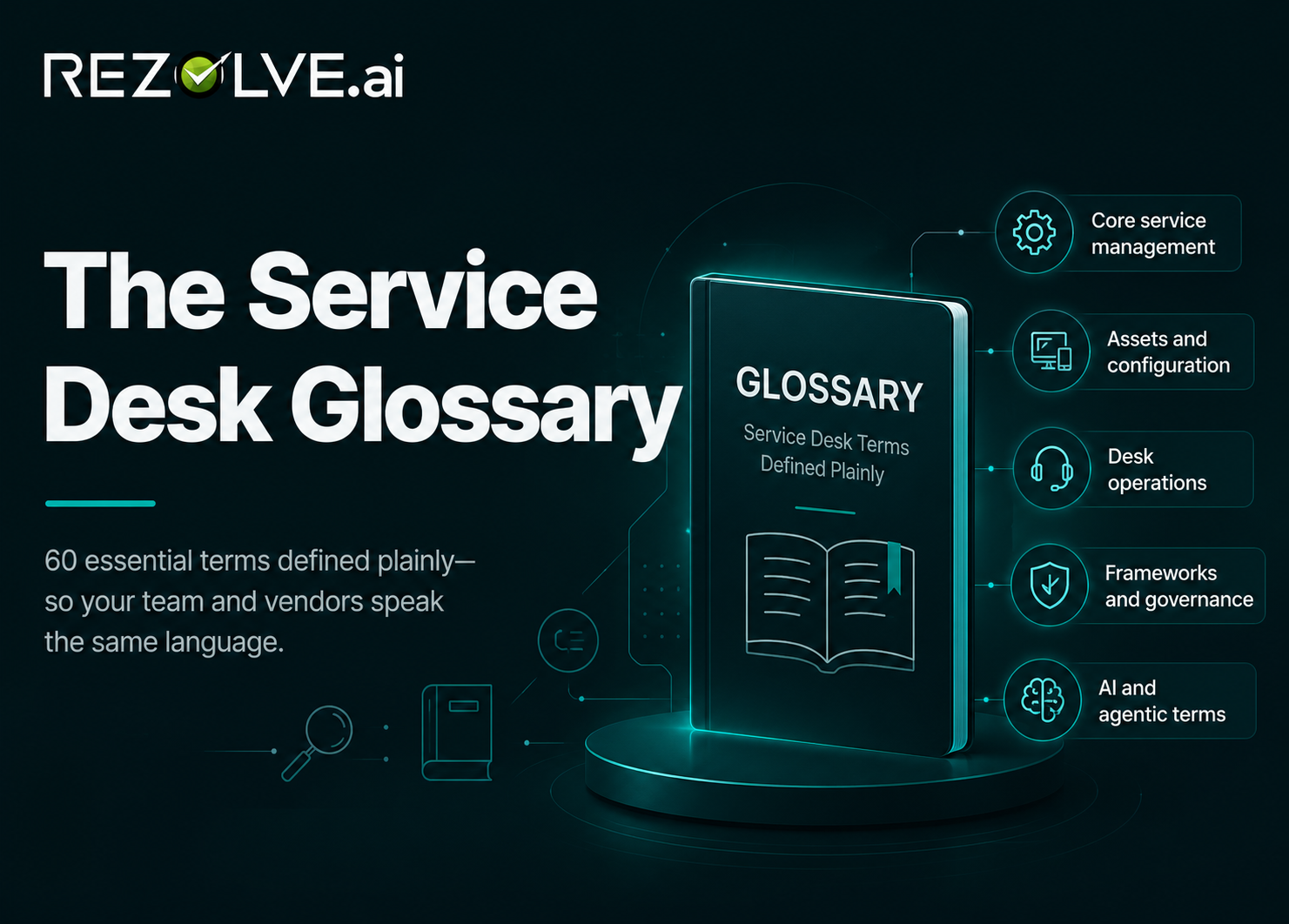
The Service Desk Glossary: 60 Terms, Defined Plainly
Service management vocabulary is unusually prone to jargon inflation, and the agentic AI wave has added a fresh layer. Sixty terms you will meet on a service desk or in a vendor meeting, defined without the marketing.

Key takeaways
- Deflection rate and resolution rate are not synonyms and are often used interchangeably in vendor material
- An incident restores service; a service request delivers something new, the distinction drives most routing decisions
- Agent washing describes rebranding assistants and RPA as agentic AI, which Gartner considers the majority of such claims
- Grounding is the requirement that every AI answer trace to a source document you control
Service management has always generated vocabulary faster than it generates clarity, and the agentic AI wave has added a layer on top. Some of these terms are precise and load-bearing. Some are precise and routinely misused. A few exist mainly to make products sound newer than they are. Those are marked.
Organized by what you would be talking about when the term comes up.
Core service management
Incident, An unplanned interruption or reduction in quality of a service. The goal is restoration, not explanation.
Problem, The underlying cause of one or more incidents. Distinct from an incident: you restore service by fixing the incident and prevent recurrence by fixing the problem.
Known error: A problem with a documented root cause and a workaround, but no permanent fix yet.
Service request: A request for something the catalogue already offers: access, hardware, a password reset, a new mailbox. Delivers something new rather than restoring something broken.
Change, Any modification to a production service. Standard changes are pre-approved and low risk; normal changes go through assessment; emergency changes bypass the queue and get reviewed afterwards.
Request fulfilment, The process of delivering service requests. Where the largest volume usually sits.
Service catalogue: The list of services available to users, with what each includes and how to request it. The customer-facing subset of the service portfolio.
Service portfolio: Everything IT offers, is building, or has retired. Broader than the catalogue.
SLA (Service Level Agreement), A commitment to a customer about service performance. See watermelon effect.
OLA (Operational Level Agreement), An internal commitment between teams that underpins an SLA.
Underpinning contract: The same idea, with an external supplier.
Escalation, Moving a ticket to someone else. Functional escalation moves it sideways to more specialized skills; hierarchical escalation moves it upward for authority or visibility.
Major incident, An incident with sufficient business impact to warrant its own command structure and communications.
Post-incident review, Structured examination after a major incident. Blameless versions produce better information.
Assets and configuration
CMDB (Configuration Management Database): A record of configuration items and, crucially, the relationships between them. Its value is entirely a function of its accuracy.
CI (Configuration Item): Anything tracked in the CMDB: a server, a laptop, an application, a service, sometimes a person.
Discovery, Automated population of the CMDB by scanning the estate. Without it, a CMDB decays into fiction within about two quarters.
Service map, The dependency graph showing which CIs a given service relies on. The main reason a CMDB is worth building.
ITAM (IT Asset Management): Managing assets through their financial lifecycle: procurement, deployment, maintenance, disposal. Overlaps the CMDB but answers commercial rather than operational questions.
SAM (Software Asset Management): ITAM for software, dominated by licence compliance.
Shadow IT, Technology in use without IT's knowledge or approval. A signal about IT's responsiveness as much as about user behaviour.
Configuration drift, Divergence between recorded and actual state. The reason CMDB accuracy is a process rather than a project.
Desk operations
Service desk, The single point of contact between IT and its users. Broader than a help desk, which handles break/fix.
Ticket, A record of a request or incident. Worth remembering it is an artefact of the process, not the point of it.
First contact resolution (FCR), Share of contacts resolved without handoff or callback.
Shift left: Moving resolution closer to the user: L2 work to L1, L1 work to self-service. Shift left to zero extends this to work that reaches no human at all.
Tiering (L0/L1/L2/L3): L0 is self-service, L1 the front line, L2 specialists, L3 engineering or vendor. Increasingly a coordination cost rather than a protection mechanism.
Swarming, An alternative to tiering: relevant people collaborate on a ticket rather than passing it along a chain.
Ticket deflection, Preventing a contact from reaching a human. Counts avoidance, including people who gave up. Not a synonym for resolution.
Deflection rate vs resolution rate, Deflection counts contacts that did not reach an agent. Resolution counts requests actually completed. Vendor material frequently uses the first while implying the second.
Backlog, Open tickets awaiting work. Ageing distribution tells you more than the count.
Ticket volume: Demand, not workload. Falling volume can mean people stopped asking.
Cost per ticket, Total desk cost divided by ticket count. Increasingly misleading, because requests resolved before ticket creation vanish from the denominator. Cost per resolved request is the better construction.
KTLO (Keeping the Lights On): The run-the-business share of IT effort, as opposed to change-the-business. See what KTLO actually costs.
Watermelon effect: Green on the SLA dashboard, red underneath, because the metrics measure process compliance rather than user experience.
CSAT / NPS / CES, Satisfaction with a specific interaction; likelihood to recommend; how much effort the user had to expend. CES correlates most tightly with service desk quality.
Frameworks and governance
ITIL, The dominant service management framework. ITIL 4 replaced v3's rigid processes with "practices" and a service value system.
COBIT, A governance framework. COBIT governs, ITIL delivers.
ISO/IEC 20000, The certifiable international standard for service management.
SIAM, Service Integration and Management: coordinating multiple suppliers delivering one service.
CAB (Change Advisory Board), The body that assesses and authorizes changes.
RACI: Responsible, Accountable, Consulted, Informed. A matrix for assigning ownership.
AI and agentic terms
Agentic AI: Software that pursues a goal across multiple steps, choosing actions rather than following a fixed script. The distinguishing feature is that it acts.
AI agent: A bounded instance of the above, scoped to a domain and a permission set.
Agent washing: Rebranding assistants, chatbots and RPA as agentic AI. Gartner's estimate is that of thousands of vendors claiming agentic capability, roughly 130 are real.
AITSM, Service management where the execution layer is agentic rather than human. See the AITSM guide.
Autonomous resolution, A request completed end to end without human involvement.
Autonomous resolution rate, The share of requests so completed. The metric that most directly indicates a changed operating model.
Grounding, The requirement that every generated answer trace to a source document you control. Ungrounded output is confidently wrong at scale.
RAG (Retrieval-Augmented Generation), Retrieving relevant documents and giving them to a model as context. The common implementation of grounding. Universal enough now that its presence tells you little.
Hallucination: Fluent, confident, false output. Mitigated by grounding and by refusal paths, not eliminated.
Refusal path: What the system does when it should not proceed: low confidence, out of policy, insufficient entitlement. Ask to see it demonstrated.
Human in the loop, A required human approval before an action executes.
Human on the loop: A human monitoring autonomous action, able to intervene, but not gating each one.
Blast radius, How much damage an action could do if wrong. The main input to whether it needs approval.
Guardrails: Constraints on what an agent may do, distinct from how well it does it.
Orchestration: Coordinating multiple agents, tools and systems to complete a multi-step task.
Tool use / function calling, A model invoking an external system. The mechanism by which an agent acts.
Context window, How much text a model can consider at once. Relevant because long, poorly structured knowledge bases push out the parts that mattered.
Model drift, Behaviour changing over time as the underlying model is updated. An argument for regression testing agent behaviour like any other production system.
Time to live, Elapsed time from contract to the system doing useful work in production. Frequently understated by an order of magnitude in vendor material.
Adoption rate, The share of employees who use the service and return to it. The number worth asking about, in place of deflection.
Last updated on August 27, 2026
Get summary with:
See the agentic service desk in action
Watch Rezolve.ai autonomously resolve real IT and HR tickets: governed, auditable, glass-box.
Frequently asked questions
What is the difference between deflection rate and resolution rate?
Deflection rate counts contacts that never reached a human agent, which includes people who gave up and asked a colleague instead. Resolution rate counts requests that were actually completed. Vendor material often reports the first while implying the second.
What is the difference between an incident and a service request?
An incident restores something that broke; a service request delivers something new, such as access, hardware or a password reset. The distinction drives most routing decisions on a service desk.
What is agent washing?
Rebranding chatbots, assistants and RPA as agentic AI. Gartner has estimated that of the thousands of vendors claiming agentic capability, only around 130 genuinely have it. The practical test is whether the software changes a record in a downstream system or only produces text.