6 ServiceNow Challenges That Signal It's Time to Rethink Your Service Desk
High cost of ownership, admin-heavy changes, and bolted-on AI are pushing IT leaders to re-evaluate ServiceNow. Here's what those challenges look like, and what an agentic alternative changes.

Key takeaways
- ServiceNow's breadth often comes with high TCO, specialist admin dependency, and slow time-to-value for new automations
- AI that is bolted onto a legacy platform behaves differently from AI that is the platform, especially for self-service resolution
- Cross-functional IT and HR workflows shouldn't require months of integration work between your ITSM and HRIS
- You don't have to rip and replace on day one: an agentic layer can resolve issues in front of ServiceNow, or run as a full AI-first system of record
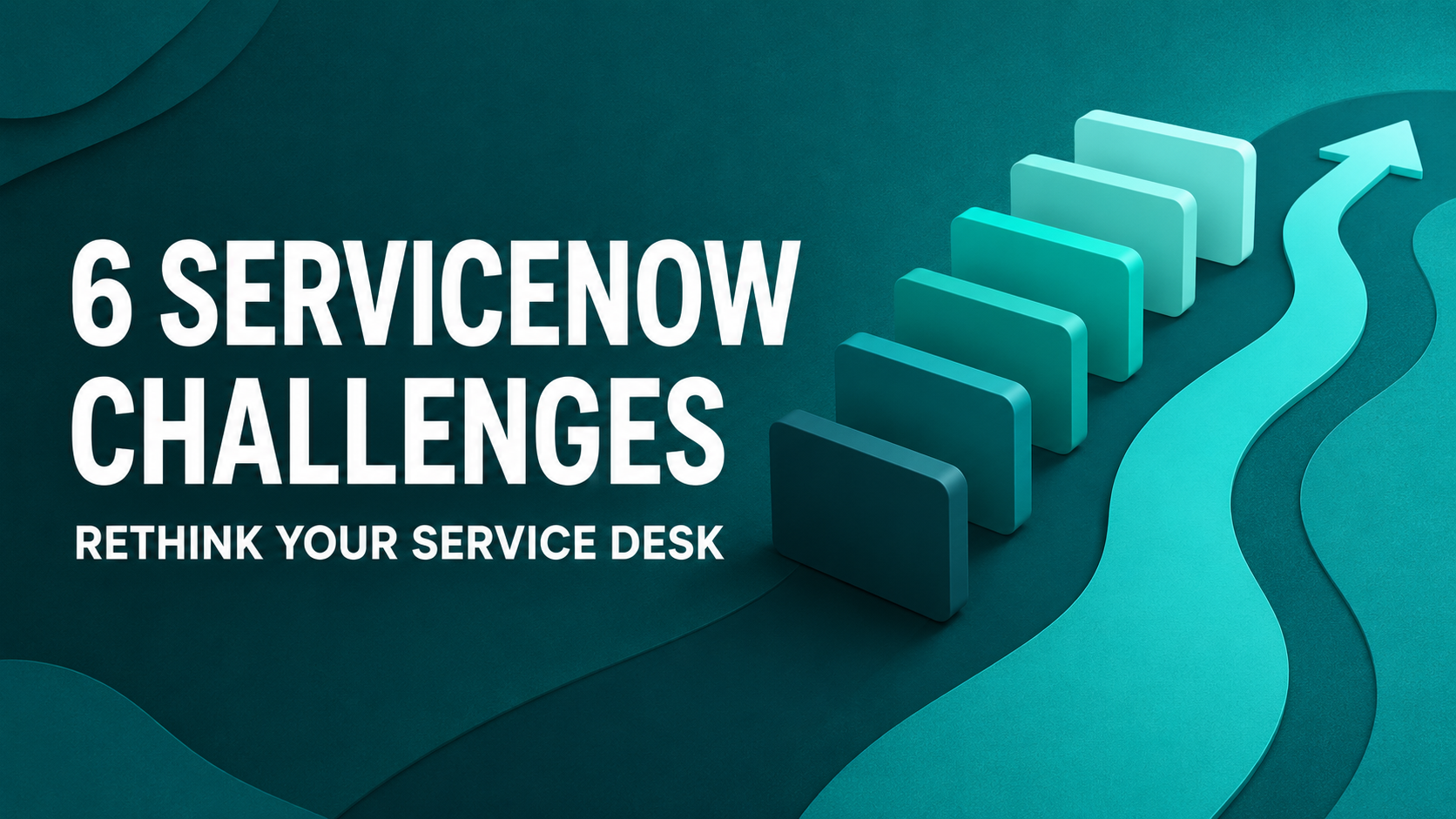
When IT leaders tell us why they're re-evaluating their service desk, the story is remarkably consistent. Recently, a prospective customer walked us through their experience running ServiceNow as their ITSM platform. They acknowledged its breadth, and then listed six challenges driving their evaluation. If you run ServiceNow today, these will probably sound familiar.
1. Total cost of ownership keeps climbing
The license is only the beginning. Implementation partners, module add-ons, upgrade projects, and the ongoing administration burden all stack on top. Many organizations find that the cost of operating the platform rivals the cost of licensing it, and that the budget conversation gets harder every renewal cycle.
The question worth asking isn't "can we afford ServiceNow?" It's "what are we actually getting resolved per dollar spent?" A platform's value should show up in resolved issues and productive employees, not in the sophistication of its configuration options.
2. Every change goes through specialist admins
ServiceNow is powerful, but that power is gated behind certified administrators and, frequently, external consultants. Want to adjust a workflow, add a catalog item, or change routing logic? That's a ticket to the platform team, a backlog, and often a statement of work.
This creates a structural bottleneck: the people closest to the process (service desk leads, HR operations, department managers), can't change the process. With Rezolve.ai's Agent Studio, governed agents are built in plain language or cloned from a marketplace of ready-made agents, with approval gates and audit trails built in. The people who understand the work can automate the work.
Recognize these challenges?
See what switching looks like: Rezolve.ai vs ServiceNow on cost and time to value.
3. AI feels bolted on, not built in
This was the prospect's most pointed observation: the AI capabilities feel like features added to a legacy platform rather than the core of how the platform operates. That distinction matters in practice.
When AI is bolted on, it typically means a chatbot that searches knowledge articles and files tickets. When AI is the foundation, the system reasons over the request, takes governed action across your tools, and resolves the issue in the conversation. That's how Sidekick works (grounded, cited, and able to execute, not just answer), with eight specialized agents reasoning over one shared conversation. Across our customers, roughly 70% of requests are resolved before they ever become tickets.
4. Slow time-to-value for new automations
Every new automation on a heavyweight platform tends to become a project: requirements, development, testing, release windows. By the time it ships, the backlog has grown and the business has moved on. Most changes require significant IT involvement, so most changes simply don't happen.
An agentic approach inverts this. DeskIQ clusters your ticket history into ranked automation opportunities with projected impact, so you know what to automate next, and Agent Studio lets you ship it in days, not quarters, with governance intact.
5. Self-service that employees avoid
Low self-service resolution rates are rarely an employee problem; they're an experience problem. If the portal is a maze of catalog forms and the chatbot mostly says "I've created a ticket for you," employees learn to walk to the service desk or email a human instead.
Employees shouldn't have to leave the tools they already live in. Sidekick meets them in Teams, Slack, email, and even on the phones, and resolves rather than routes. Black Angus Steakhouse cut its after-hours IT dependency from 90% to 10%, and at MyEyeDr issues are resolved in about ten minutes, with roughly 30% never becoming a ticket at all.
6. Integration friction with HR systems
Cross-functional workflows (onboarding, offboarding, role changes), live at the seam between ITSM and HRIS. That seam is exactly where ServiceNow projects tend to stall: connectors to build, data models to reconcile, two platform teams to coordinate.
Rezolve.ai treats IT and HR as one employee-facing service layer. Sidekick answers and acts across both domains, and the underlying system of record handles incident through change through joiner-mover-leaver workflows, with assets and CMDB included. TotalEnergies Denmark launched its first-ever HR chatbot on Rezolve.ai: answering employees in about 30 seconds, around the clock.
You don't have to rip and replace on day one
Here's the part that surprises most ServiceNow customers: this isn't necessarily a migration decision. Rezolve.ai runs as a full AI-first ITSM system of record on its own, or as an agentic resolution layer on top of ServiceNow, resolving issues before they become tickets while your existing platform stays in place. That means you can prove value first and decide the platform question on your own timeline.
Either way, the goal is the same: stop measuring deflection and configuration sophistication, and start measuring resolution. If the six challenges above describe your ServiceNow experience, it's worth seeing what a governed, glass-box, agentic service desk looks like against your own ticket data. Book a demo or explore how customers like JLL (running Ask Ethics for roughly 100,000 employees across 80+ countries), put this into practice in our case studies.
Last updated on August 27, 2026
Get summary with:
See the agentic service desk in action
Watch Rezolve.ai autonomously resolve real IT and HR tickets: governed, auditable, glass-box.