The Ticketless Enterprise
Enterprise service management is priced on the assumption that ticket volume keeps growing. Four separate trends are undoing that assumption at once, and most organizations are not adding them up.

Key takeaways
- Four categories are going quiet for different reasons: applications (SaaS plus AI interfaces), infrastructure (agents that act, not just correlate), devices (investigation at the endpoint) and orchestrated requests like joiner-mover-leaver.
- Applications are 38% of service desk volume, onboarding and movers 17%, identity and access 16% — and devices are undercounted, because device faults get logged as software or collaboration tickets.
- Roughly half of IT issues are never reported at all. The ticket count measures what employees still bother to report, not the size of the problem.
- Enterprise service management is priced per seat and per tier with annual uplift, increasingly metering AI on top — a model that assumes volume keeps rising.
- The end state is one correlation layer across people, devices and infrastructure that intercepts a fault before the ripple reaches anyone, so the tickets are never created rather than resolved faster.
Every service management product your organization has bought in the last twenty years rests on a single assumption: that employees and systems will generate a large and growing volume of requests, and that the job of the software is to receive, classify, route, track and report on them. The licenses, the tiers, the consultants, the annual uplift — all of it is priced against that volume continuing to exist.
I think the assumption is quietly coming apart, and I do not think it is happening in one dramatic shift. It is happening in four separate places at once, each for its own reason, and because they are separate, most organizations are not adding them up.
What follows is my case for why the ticket, as the central artifact of employee service, has less time left than the industry's pricing models assume. I should say plainly that Rezolve.ai is one of the companies building toward the end state I am describing, so read this as a point of view rather than a neutral survey. The four trends underneath it, though, are not ours — they are happening regardless of which vendor anyone chooses.
See how routine IT requests can be resolved before they reach the queue and which issues still need a person. Watch the Video
Where the tickets actually come from
It helps to start with the shape of the queue rather than the total, because the four categories behave very differently.
Fixify's 2026 benchmark, drawn from more than 50,000 tickets across thirty-odd organizations, puts software and applications at 38 percent of all service desk volume — by a wide margin the largest category. Onboarding, offboarding and the mover cases that sit between them account for another 17 percent, and identity and access takes 16 percent.
Devices are harder to pin down, and the spread between sources is instructive rather than noisy. Fixify's cloud-first sample puts hardware at 8 percent and connectivity at 2 percent; HDI's enterprise data runs closer to 20 percent hardware with another 15 to 20 percent in connectivity. The difference is fleet age and sector, not measurement error, and for a traditional enterprise the defensible number sits somewhere between 15 and 25 percent. The real figure is almost certainly higher still, for reasons I will come to.
Infrastructure sits outside that count, because alerts do not arrive as service desk tickets, but it belongs in the picture: in NeuBird's 2026 survey of just over a thousand SRE and IT operations professionals, 57 percent reported that fewer than three in ten of their alerts are actionable, and 83 percent admitted to ignoring or dismissing alerts at least sometimes. (That survey comes from a vendor in the agentic AI space, so weigh it accordingly — though the direction matches what every operations leader I speak to describes.)
Four categories, then: applications, infrastructure, devices, and the orchestrated requests that cross several teams. Each one is getting quieter, and each for a different reason.
Applications are getting quieter on their own
The largest bucket is the one already shrinking without anybody doing anything deliberate about it.
The application estate most enterprises supported in 2010 was installed, versioned, patched locally and broken in ways that generated tickets by the thousand — client upgrades, profile corruption, license files, compatibility failures after a Windows update. Most of that estate has since moved to SaaS, where the vendor runs the upgrade, the client is a browser tab, and the failure modes that produced routine break-fix work simply do not occur any more.
What is left is not break-fix but comprehension. SaaS applications are often more capable than what they replaced, which means the questions reaching the service desk are about how to do something rather than why something is broken — and a question about how to do something is answerable from knowledge, provided the knowledge is good and the employee can reach it where they already work.
The second change is further out but more consequential. As AI interfaces sit in front of applications rather than beside them, the employee stops needing to know how the application works at all; they describe the outcome they want, and something else navigates the software. When that becomes normal, a large share of application support stops being a category — not because the tickets get resolved faster, but because the condition that produced them no longer arises.
Infrastructure is noisy now and will not stay that way
Infrastructure is the loudest of the four today, and the numbers above explain why: teams are drowning in alerts that mostly do not matter, which is a filtering failure rather than a monitoring failure.
The work that makes an alert useful is work a human currently does. Someone looks at the alert, decides whether it is real, correlates it with the other seventeen that fired in the same window, works out which service is affected and who cares, finds the runbook, and either executes it or wakes somebody who can. Each of those steps is judgment applied to context, and each of them is now something an agent can do — triage against what is actually degraded rather than what crossed a threshold, root cause across correlated signals rather than one at a time, and execution of a known remedy under defined authority.
AIOps has promised this before and underdelivered, so the skepticism is earned. What has changed is not better correlation; it is that an agent can now take the action at the end of the correlation, which is where the human hours were always being spent.
Devices are undercounted, and they are the hardest category you have
Every number in the section above understates devices, because the category is defined by how a ticket gets logged rather than by what was actually wrong.
Outlook crashing gets filed as a software ticket, Teams audio breaking up gets filed as collaboration, and a Mac that turned slow after an update gets filed as software again. Every one of those is a device fault wearing another category's label, and they sit inside the two largest buckets on the board — applications at 38 percent and collaboration at 12 percent. Reclassify by root cause rather than by how the employee described the symptom, and the device share climbs well past the 15 to 25 percent that gets reported.
Then there is the volume that never gets logged at all. Nexthink's survey of three thousand employees found that only just over half of IT issues get reported; Lakeside's later survey put the unreported share at 40 percent. People have learned that a slow laptop is slow to fix, so they work around it instead. The ticket count is not measuring the problem; it is measuring what people still bother to report.
What makes this category different from the other three is that it is not getting easier on its own. Device tickets take a median of 80 hours to close — the slowest category on the desk except onboarding — because a technician gets five or ten minutes of remote access to a machine they cannot reproduce the fault on, and the honest endgame is often a reimage or a swap. That costs the employee days without a laptop, costs the organization a desktop-support ticket at several times the price of one closed at first line, and frequently ends with hardware that turns out to have nothing wrong with it. Nobody decided to accept this. It just became normal.
So this is the category where the quiet comes last and has to be worked for. It is the gap Rapport, our agentic endpoint product, is built for: investigating device faults nobody cataloged in advance, on the device itself, rather than inferring them from five minutes of someone else's screen. An employee reports something through Sidekick, Rapport goes and looks, and it either resolves the issue or hands a technician evidence instead of a shrug. The categories around this one are shrinking by attrition. This one shrinks because somebody finally went and found out what was wrong.
The orchestrated requests, which were never really tickets
The fourth category is the most interesting, because these were never support problems at all.
Onboarding, offboarding and role changes account for 17 percent of volume, and every one of them is a coordination task wearing a ticket's clothing. A new joiner needs accounts, entitlements, hardware, software, a desk and a manager's approval, touching four systems and three teams — and the only reason a ticket exists is that somebody needed a way to track who had done what. The ticket is a project plan with a status field.
What that work actually needs is an orchestrator: something that holds the whole sequence, calls each system in turn, collects approvals, chases what has not happened, and knows the difference between a step that failed and a step that is merely waiting. We built Rezolve.ai to be exactly that — an orchestration hub across systems and people, rather than a queue that humans work through. When the orchestration is real, the ticket is not resolved faster; it is never opened, because the event in the HR system started the work and nobody had to ask.
What will still be ticketed
Something will remain, and it is worth being clear about what.
Anything requiring genuine human judgment will stay — the exception to policy, the unusual access request, the decision that carries risk somebody has to own. Anything regulated where the record itself is the point will stay. And the genuinely novel will stay, because by definition nobody has automated a problem the organization has not seen before.
There is also a new category arriving, and I would rather name it than pretend otherwise: the AI estate generates its own support demand. Agents get built and abandoned, employees ask why an agent did what it did, and somebody has to govern the whole thing. That demand is real, and for a period it offsets some of what the four trends remove.
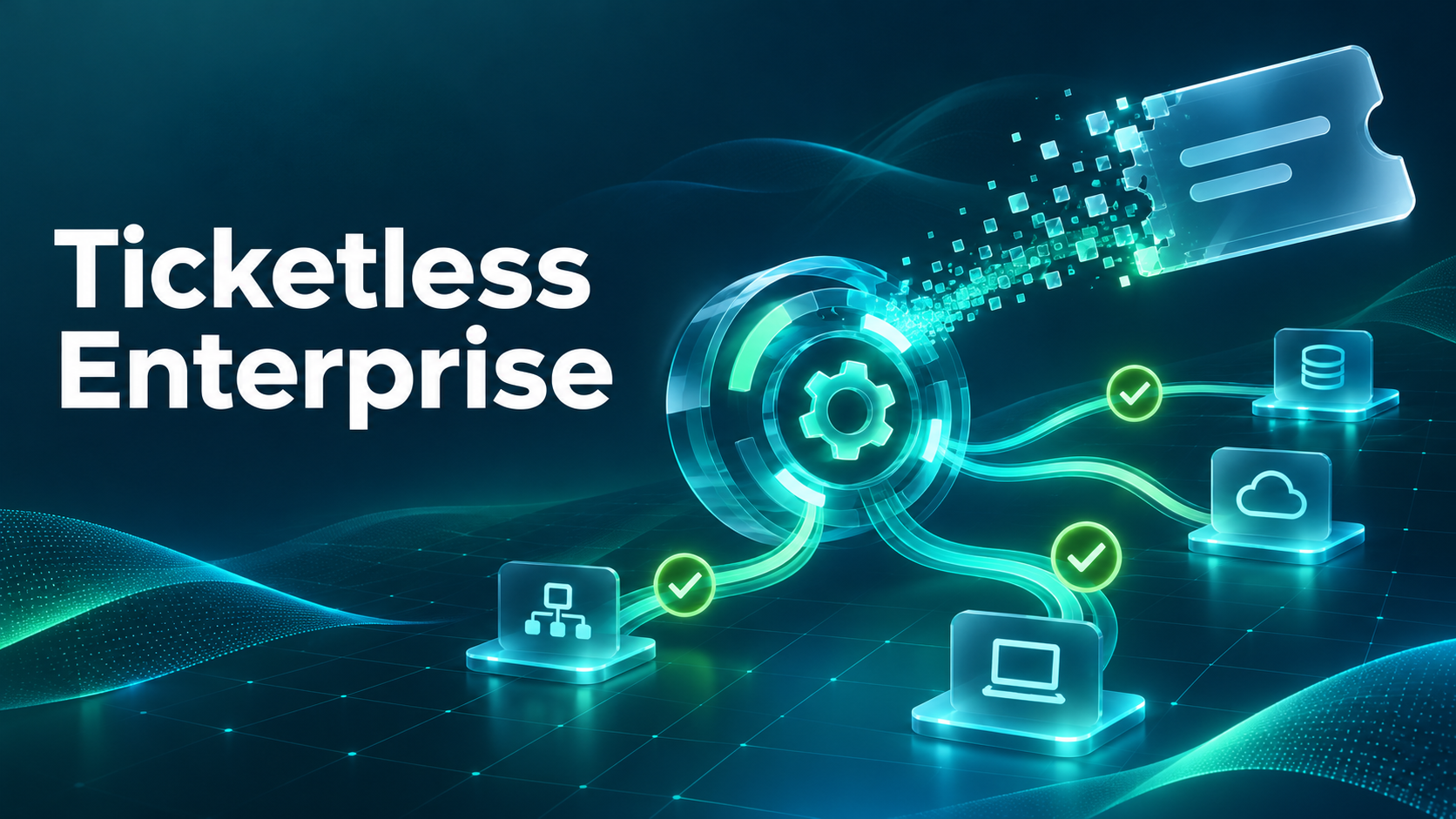
A ticketless enterprise does not mean zero tickets, then. It means tickets only where a human decision is genuinely required — which is roughly what the artifact was invented for, before it became the container for everything.
Why this is a budget question and not a technology question
Here is what makes this urgent rather than interesting.
The commercial model underneath enterprise service management prices your estate per seat, per module and per tier, rising by a contracted uplift every year. More recently it also meters AI consumption on top. That model assumes your ticket volume is stable or growing, because that assumption is what makes the renewal defensible — you are buying capacity to handle work that is going to arrive.
Set that against four categories all heading the other way, and the arithmetic stops working. The assumption held for twenty years and is now failing in four places at once, quietly enough that it does not show up as a crisis in any single quarter. It arrives instead as a queue that is shorter than it was, a year at a time, while the invoice for managing it goes up.
So the question to ask at the next renewal is not what discount is available. It is what, exactly, am I buying capacity for, and what will that volume look like in three years.
The part that has not happened yet
Everything above describes queues going quiet one at a time. The larger prize is what becomes possible once they stop being separate queues at all.
Today most organizations run three disconnected views of the same reality. The service desk sees tickets, chats and calls from people, while the endpoint tools see device telemetry and events and the infrastructure stack sees server, application and network signals. Each is instrumented, each has a dashboard, and nobody correlates across them except manually, after something has already gone wrong — which is why the question "is the network spike behind the Teams complaints?" takes a bridge call and four tools to answer.
Correlation inside one of those views is already valuable, and it is where the industry currently is. We can look across human-reported tickets, see that nine of them describe the same underlying fault, and raise one major incident instead of working nine. That is real, it is in production, and it is ahead of where most of the market sits.
But it is still reactive, because every signal in it arrives after a person noticed something and told us.
The version worth building toward runs the other way. A switch degrades in one segment, or a database starts returning errors under load. The correlation layer sees the event at the moment it happens, understands the topology well enough to know what depends on it — which applications, which sites, which groups of employees — and works out what the next two hours look like if nothing is done. Then it acts before the ripple arrives: executes the remediation it is authorized to execute, escalates the part it is not, tells the affected employees what is happening and when it will be fixed, and tells the affected systems to hold, retry or fail over.
Count the tickets that never get created in that sequence. Not the ones resolved quickly — the ones that never happen, because four hundred people never had to notice that something was broken and go looking for somewhere to report it. The single largest source of ticket volume in any enterprise is one underlying fault being reported independently by everyone it touches, and that entire mechanism disappears when the system sees the cause before the symptoms spread.
That is the end state, and it is the reason the four quiet categories matter more together than separately. One pane of intelligence across people, devices and infrastructure is not a reporting convenience. It is the difference between an organization that processes the consequences of its failures and one that intercepts them — and whichever vendors get there, the enterprises that planned for it will have stopped buying capacity to manage a queue long before the queue finished shrinking.
If you want to see what this looks like in practice, book a conversation with us — or start with our analysis of what your current service management estate actually costs.
Last updated on November 4, 2026
Get summary with:
See the agentic service desk in action
Watch Rezolve.ai autonomously resolve real IT and HR tickets: governed, auditable, glass-box.
Frequently asked questions
What is a ticketless enterprise?
A ticketless enterprise is one where tickets exist only where a human decision is genuinely required — a policy exception, an unusual access request, a regulated record — rather than acting as the container for all employee service. It does not mean zero tickets. It means the artifact returns to the narrow job it was invented for.
Why is service desk ticket volume falling?
Four reasons at once. Applications moved to SaaS and generate less break-fix work. Infrastructure alerting is becoming filterable by agents that can act, not just correlate. Device faults can now be investigated at the endpoint instead of ending in a reimage. And orchestrated requests such as onboarding are being driven by events in HR systems rather than raised as tickets.
What percentage of service desk tickets are device related?
Benchmarks range from about 10 percent in cloud-first organizations to 35 percent in traditional enterprises once connectivity is included, with 15 to 25 percent defensible for most enterprises. The true figure is higher, because device faults are frequently logged as software or collaboration tickets, and roughly half of IT issues are never reported at all.
How does this affect ITSM licensing and renewals?
Enterprise service management is priced per seat, per module and per tier with a contracted annual uplift, and increasingly meters AI consumption on top. That model assumes ticket volume is stable or growing. The question to ask at renewal is not what discount is available, but what capacity you are buying and what that volume will look like in three years.
What will still require tickets?
Anything needing genuine human judgment, anything regulated where the record itself is the point, and anything genuinely novel. There is also a new source of demand arriving: the AI estate itself generates support work as agents are built, abandoned and governed.