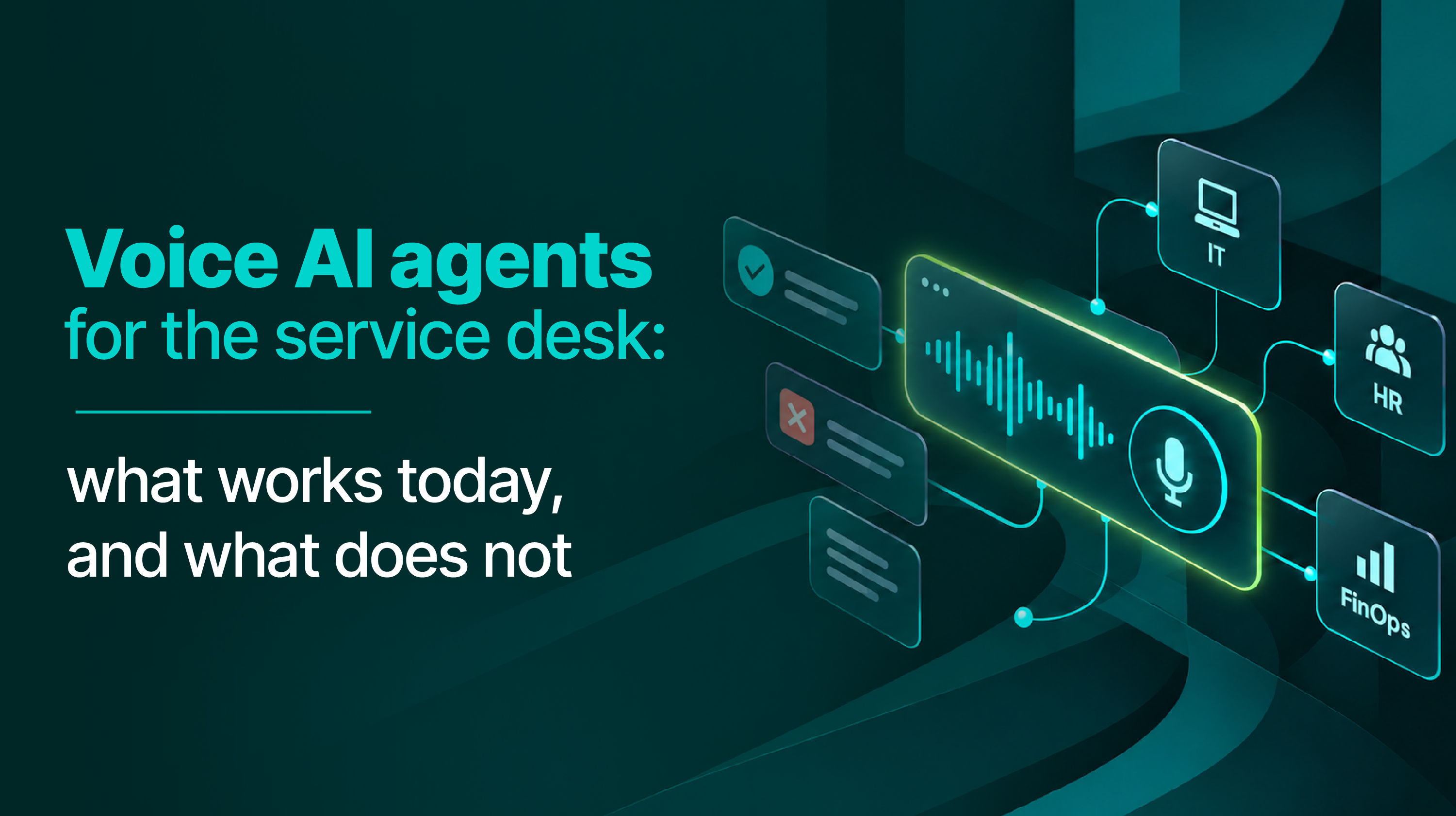
Voice AI agents for the service desk: what works today, and what does not
Most voice AI agents were built to answer customers, not employees who cannot log in to prove who they are. Which service desk calls voice closes end to end today, which it should hand off, and how to report resolution without flattering the number.

Watch almost any voice AI agent demo and you will see the same three calls. Somebody books an appointment. Somebody checks the status of an order. Somebody changes a delivery address. The voice is natural, the latency is low, and it is genuinely impressive.
It is also a demo of a different job. Most voice agents on the market were built to answer customers, and a customer call has a property the service desk does not: the caller usually does not need to prove much about who they are, and the action at the end is low-stakes. An employee calling the service desk because they are locked out of their laptop has, by definition, lost the thing that normally proves who they are. And the action at the end, a password reset, is exactly the kind of thing an attacker would call in to request.
That difference decides which calls voice can close on its own and which it should not touch. The same difference also decides how the results ought to be reported, because the standard contact center measure flatters voice agents in a way that hides the calls they are getting wrong.
Why the phone still matters for employee support
It is tempting to treat the phone as a legacy channel that chat will eventually absorb. For the service desk it is the opposite. The phone is the channel people reach for precisely when the other channels have failed them.
An employee who cannot log in cannot open Microsoft Teams to ask for help. A nurse between shifts, a technician on a site visit or a driver at a depot often has no laptop at all, and some have no corporate account either, which is why the service desk was never really built for deskless workers. Former employees who need a verification letter have no login left to use, which is a problem we looked at in the requests that arrive after offboarding. For all of them, a phone number is the only route that reliably still works.
So the question for a service desk is not whether to support voice. It is whether the calls that arrive get resolved on the line or queued behind an IVR menu until somebody picks up.
The calls voice closes end to end today
Four kinds of call are ready for voice to handle without a person, provided identity is dealt with properly.
Password resets and account unlocks. The single most common reason employees call, and the most repetitive. Once the caller is verified, the reset or unlock runs against the identity provider on the call and the caller hangs up able to work.
Status checks. "What is happening with my laptop order?" "Did my access request get approved?" The answer lives in the ticketing system, and reading it back takes seconds.
Logging a ticket. Not every call can be resolved, but every call can produce a properly categorized ticket with the caller's own description, the right priority and the right queue, instead of an agent typing notes from memory after hanging up.
Simple scheduling. Booking a slot with the desk, a hardware collection, or a callback, directly into the relevant calendar.
What those four have in common is that the answer or the action is already defined. The voice agent is not deciding anything new; it is carrying out something the organization has already agreed to, faster than a queue would.
The calls where handing off is the right result
A handoff is often treated as a failure, a call the AI could not manage. For the service desk that framing is wrong. Some calls should go to a person, and the measure of a good voice agent is how well it hands them over, not how rarely.
Anything involving judgment or exception. A request that falls outside policy, an access request for a sensitive system, or anything where the right answer is "it depends" belongs with a person.
Callers who are upset. Somebody calling because they have lost a day's work, or because something has gone badly wrong, needs a human voice. Detecting that early and transferring is a feature.
Physical problems. A broken screen or a device that will not power on needs a technician, a replacement or a courier. The voice agent can arrange that; it cannot fix it.
Anything where identity cannot be established. If the caller cannot be verified to the level the action needs, the call goes to a person or ends in general information only.
The difference between a good and a bad handoff is what arrives with it. A warm transfer that briefs the person picking up on who is calling, what they said and what has already been tried saves the caller from repeating themselves. A cold transfer into a queue undoes most of the value of answering the call in the first place.
Identity is the whole problem
Voice agents built for customers mostly sidestep identity, because the stakes are low. On the service desk it is the central design question, and it should be graded rather than treated as yes or no.
| What the voice agent knows | What that allows | What it should not allow |
|---|---|---|
| The number calling matches the employee record | Useful context: likely name, department, open tickets | Anything sensitive. Numbers can be spoofed |
| The caller has passed a verification step | Resets, unlocks, status on their own requests | Actions on anybody else's account |
| The caller is authenticated through a trusted channel | The same range of actions as a signed-in session | Exceptions to policy, which still go to a person |
| Nothing can be confirmed | General information and logging a ticket | Any change to an account, device or access |
The failure mode to design against is the confident one: a voice agent that treats a recognized phone number as proof and resets a password for whoever happens to be holding the phone. A slow queue is an inconvenience. A voice channel that can be socially engineered is a security incident waiting to be scheduled.
How to report autonomous resolution honestly
The standard contact center metric for voice automation is containment: the share of calls that ended without reaching a person. Containment is easy to measure and misleading, because a caller who gives up and hangs up counts as contained. So does a caller who got a wrong answer, said thank you and called back an hour later. Containment rewards a voice agent for being hard to get past, which is precisely the wrong incentive.
Resolution is the number that matters, and it needs a stricter definition. A call is resolved when the caller's issue was actually dealt with: the password works, the status was correct, the ticket was logged in the right place. The practical test is repeat contact. If the same person calls, chats or emails about the same issue within a few days, the first call was not resolved, whatever it was counted as at the time.
Three measures together give a fair picture. Resolution rate, with repeat contact subtracted. Handoff quality, meaning whether transferred callers had to repeat themselves. And abandonment, reported separately rather than folded into containment. The same trap applies across service desk reporting, where every indicator can be green while employees are unhappy, and voice makes it easier to fall into because a call that ended looks like a call that worked.
What voice will not do for you
A voice agent inherits every weakness in what sits behind it. If the knowledge it answers from is wrong, it will say the wrong thing fluently. If the approval rules are unclear, it will either block too much or allow too much. And if the systems it needs to act in are not connected, it can only take messages.
Voice also does not remove the need for people on the desk. What goes is the calls that never needed them, which leaves the desk with fewer calls that are, on average, harder. Handing staff the harder calls is a better use of a skilled team, but it means average handle time for the humans will rise even as total volume falls, and anybody reading the numbers needs to expect that rather than treat it as a problem.
Where Rezolve VoiceIQ fits
We build voice for the service desk, so weigh this section as the view of an interested party.
Rezolve VoiceIQ answers the service desk line around the clock in real-time speech rather than an IVR menu. On the call it can reset passwords through Okta or Microsoft Entra ID, raise tickets in Rezolve.ai, ServiceNow or Jira, check status and book meetings, with optional identity verification before anything sensitive happens. When a person is needed, it transfers the call with a briefing on who is calling and what has been tried, and falls back to voicemail if nobody is available. Every call is transcribed with sentiment logged, and because the same agents sit behind Rezolve.ai's chat and email channels, a caller who later messages about the same issue is recognized as the same request rather than counted twice.
That shared record is also what makes honest reporting possible. Repeat contact across channels is visible, so resolution can be measured as resolution, and every decision can be traced from what the caller said to what the agent did.
The demo calls that book appointments are real, and voice is genuinely good at that kind of work. The service desk version is harder, because the caller often cannot prove who they are and the action at the end matters. Built for that, voice closes the calls that are defined, hands over the ones that need judgment with the context attached, and reports its results in a way that survives a repeat call.
Last updated on October 12, 2026
Get summary with:
See the agentic service desk in action
Watch Rezolve.ai autonomously resolve real IT and HR tickets: governed, auditable, glass-box.
Frequently asked questions
What is a voice AI agent?
A voice AI agent is software that answers phone calls in natural speech, understands what the caller wants, and either resolves the request or routes it. Unlike an IVR menu, it does not ask callers to press numbers or follow a fixed tree; the caller describes the problem in their own words.
Is a voice AI agent the same as an IVR?
No. An IVR presents a fixed menu and routes calls based on keypad or simple spoken choices, and it cannot resolve anything itself. A voice AI agent understands free-form speech and can take actions such as resetting a password or checking a ticket's status on the call, transferring to a person only when that is needed.
How long does it take to deploy a voice agent for IT support?
Most of the time goes into connecting the systems the agent needs to act in, such as the identity provider and the ticketing tool, and agreeing the verification rules for sensitive actions. The voice layer itself is the quicker part. Start with the call types that are already fully defined, such as password resets and status checks, and extend from there.
Can a voice AI agent handle multiple languages?
Modern speech models handle many languages well, but the answers are only as good as the knowledge behind them. If policies and articles exist in one language, check how the agent answers callers in another before rolling it out to a multilingual workforce, and make sure handoffs route to people who speak the caller's language.
Does voice AI replace service desk staff?
It replaces calls rather than people. Routine, defined calls stop reaching the desk, which leaves staff handling fewer but harder issues. Expect average handle time for human-handled calls to rise as total volume falls; that shift reflects the team spending its time where judgment is needed.