Explainable AI: A Window Into the Mind of Agentic AI
See how explainable AI makes agentic IT support accountable by revealing the evidence, decisions and actions behind every outcome—and showing teams exactly where knowledge, automation or governance needs improvement.

Explainable AI is the practice of making an AI system's outputs, actions, and decision path understandable to the people who use it, supervise it, and audit it. In an agentic service desk, that means showing what the system understood, which evidence it used, why it chose one route over another, what it did, and when it handed control to a human.
An employee asks the service desk to unlock an account. The automation exists. The AI does not run it. Instead, it asks one question and then creates a ticket.
From the queue, that can look like hesitation. It may even look like failure.
Open the decision record and a different story appears: a required identity signal was missing, the automation was written only for managed devices, and the knowledge article describing the exception was older than the current policy. The AI did not fail to find the button. It found a reason not to press it.
That is where explainable AI stops being an abstract trust principle and becomes part of running the service desk. It gives people a window into the mind of the system - not private model internals, but the operational evidence needed to understand and improve a decision.
The account-unlock scenario above is illustrative. The principle is real: when AI can answer, take action, open a record, or escalate, the organization needs more than the final response. It needs a defensible path from request to outcome.
What is explainable AI?
Explainable AI, often shortened to XAI, is the design practice of making an AI system understandable at the level its stakeholders need. An employee, a service-desk manager, an automation owner, and an auditor do not need the same explanation. They do need explanations that are accurate, useful, and connected to the decision being reviewed.
NIST separates three related ideas. Transparency helps answer what happened. Explainability helps answer how a decision was reached. Interpretability helps a person understand why the result matters in context. Its AI Risk Management Framework also notes that explanations should be tailored to the user's role, knowledge, and skill level. Read the NIST framework.
For a service desk, the practical definition is simpler: explainability should let a responsible person reconstruct the decision well enough to trust it, challenge it, or change the system around it.
Why a black box is not good enough for agentic AI
A conventional chatbot can be wrong in one narrow way: it can give a bad answer. An agentic system has more possible outcomes because it can choose what happens next.
- Answer from approved internal knowledge.
- Offer or run an automation.
- Ask a follow-up question before acting.
- Guide the employee through a service-catalog request.
- Create and route a ticket.
- Escalate to a human.
- Use an approved external source when internal knowledge does not cover the question.
- Decline to answer or act when the evidence or permissions are insufficient.
Each fork carries a different risk. The wrong answer can mislead a person. The wrong automation can alter an account or system. The wrong ticket route can bury an incident. The wrong escalation policy can leave someone waiting when a human is needed.
The human supervisor therefore needs more than a confidence score. They need to know what the AI thought the request was, what information it considered, which rule or limitation affected the route, what alternative it rejected, and what action actually occurred.
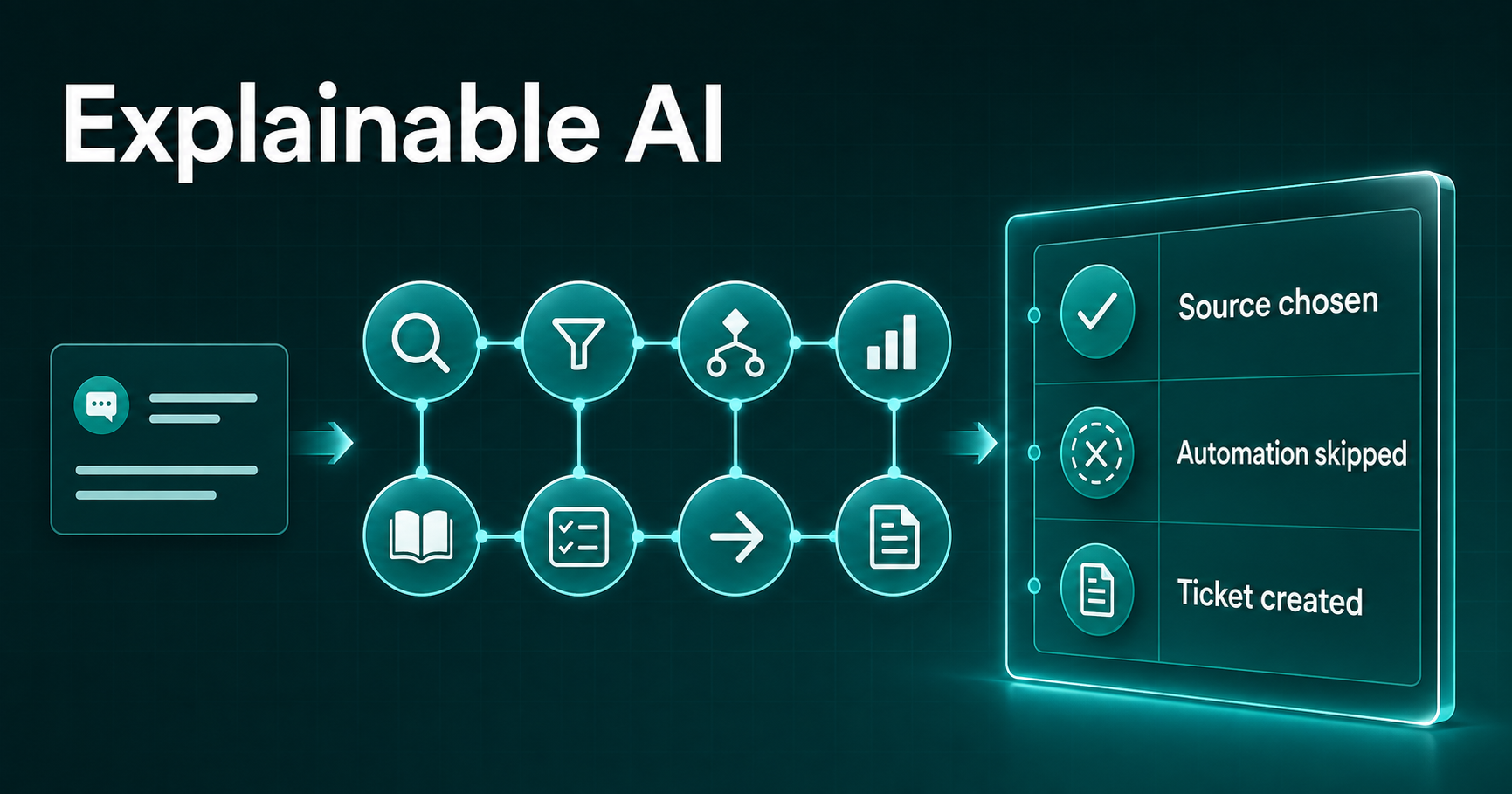
Follow one support request across the eight specialists that classify, ground, route, and record the response.
A useful explanation follows the decision, not just the answer
The final response is the smallest part of the record. A useful explainability view follows the request through the moments where judgment was applied.
| Moment | Question | Evidence a reviewer needs |
| 1. Understand | What did the system believe the person was asking? | Intent, urgency, language, sentiment, and relevant entities. |
| 2. Retrieve | What evidence was available? | Knowledge matches, catalog items, approved external sources, versions, and permissions. |
| 3. Choose | Why this route? | The selected answer, automation, follow-up, ticket, or escalation - and the alternatives not used. |
| 4. Act | What happened in connected systems? | Tool calls, approvals, inputs, outputs, errors, and the identity under which the action ran. |
| 5. Record | Can the outcome be reviewed later? | Time, actor, source, decision, action, result, and subsequent human changes. |
Progress is not the same as explainability
There are two useful views of what an AI system is doing, and they should not be confused.
The employee needs progress
At the front end, the assistant can say that it is checking approved knowledge, reviewing the request, validating a condition, or preparing a handoff. This makes the wait legible and reassures the person that the system has not stalled.
That status is valuable. It is not the full explanation.
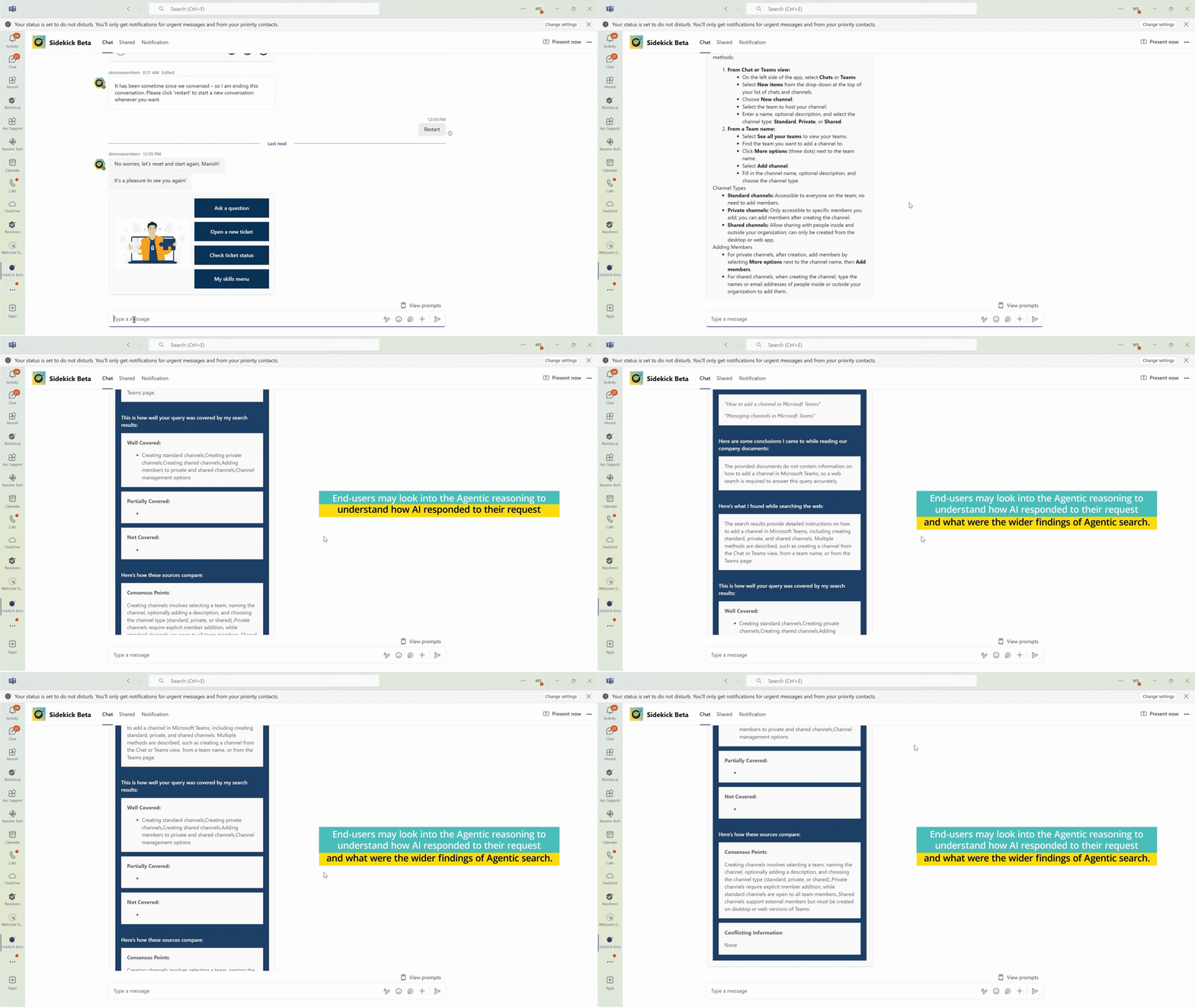 A Teams conversation followed by the explainability view showing why the AI chose its response.
The administrator needs evidence
The deeper view belongs behind the product: the sources retrieved, the route selected, the specialist agents involved, the action attempted, the conditions that blocked it, the handoff, and the result. Administrators and supervisors need enough detail to investigate one conversation without reconstructing it from separate logs.
The two views serve different people. One makes the experience understandable while work is happening. The other makes the decision reviewable after it happened.
Watch: The Power of Explainability
How eight specialist agents make the path easier to inspect
Rezolve.ai's public How Sidekick thinks experience describes eight specialists behind a conversation: Routing, Knowledge, Synthesis, Follow Up, Ticket, Catalog, Escalation, and Web Search.
The important idea is not that eight is a magic number. It is that responsibilities are separated. One specialist understands the request. Another chooses how to respond. Another composes a grounded answer. Others gather missing details, prepare a ticket, guide a catalog request, interpret a response to an offered step, or search the web only when the organization has allowed it.
That separation gives an explanation a structure. Instead of saying 'the AI decided,' the record can show where the decision changed direction: the request was classified as an incident, the internal article was selected, the automation was excluded because a required condition was missing, and the ticket route was used instead.
It also makes improvement more precise. If classification was wrong, fix the routing guidance. If the wrong source won, fix the knowledge and retrieval layer. If an automation could not handle a legitimate exception, fix the automation. If the handoff arrived without the needed context, fix the ticket preparation or escalation policy.
Explainability should not live in one screen
As an AI service desk grows, explainability becomes a product-wide requirement rather than a single administrator page.
| Surface | What explainability must make reviewable |
| Employee self-service | Show progress, evidence citations, actions taken, and when control moves to a person. |
| Agent Assist | Show why a summary, recommendation, related ticket, or drafted response was surfaced. |
| Automation | Show the trigger, conditions, approvals, tool calls, skipped branches, failures, and result. |
| Knowledge | Show which source and version supported the response, and expose conflicts or stale content. |
| System of record | Keep the request, decision, action, approval, and outcome attached to one reviewable history. |
A platform that explains only the chatbot answer but hides what happened in Agent Assist or automation has not solved the operational problem. The more places AI applies judgment, the more places the organization needs decision evidence.
The surprising value: explainability often exposes a system gap
Most teams approach explainability expecting to correct the AI. Sometimes that is exactly what the trace reveals: the request was misunderstood, the wrong route was selected, or the system needs new guidance.
But a different pattern appears just as often. The AI made a defensible decision with the material it had, and the explanation exposes a problem elsewhere.
- Two knowledge articles contradict each other.
- The current policy was never published to the approved source.
- An automation covers the happy path but not a common exception.
- The identity or entitlement data needed for a safe action is missing.
- A catalog item asks for a field nobody uses but omits the one the fulfiller needs.
- An escalation rule does not reflect the business impact of the request.
The explanation changes the review from 'Why didn't the AI do what we expected?' to 'What was missing from the environment that made this the safest available choice?'
That distinction matters. Explainability is not only a mechanism for training or restraining AI. It is a diagnostic for the knowledge, automations, policies, permissions, and service design the AI depends on.
What humans should be able to do next
A trace without a way to improve the system is an archive, not a control loop. Once a supervisor understands a decision, they should be able to choose the right correction.
- Change guidance when the AI interpreted the request incorrectly.
- Repair or retire knowledge when sources are stale, incomplete, or conflicting.
- Extend an automation when a safe, repeatable exception is missing.
- Tighten an approval or escalation rule when the action carries more risk than expected.
- Preserve the refusal when the AI correctly avoided an unsafe or unsupported action.
- Verify the change against later conversations rather than assuming the fix worked.
The goal is not to force the AI to take the path a human expected. The goal is to make the reason visible, decide whether that reason is sound, and improve the right layer.
Seven questions to ask any explainable AI vendor
| Question | A credible answer includes | Red flag |
| 1. Can I reconstruct one decision end to end? | Request, sources, route, action, approval, and outcome in one history. | A final answer plus a confidence score. |
| 2. Are sources exact and versioned? | The article, policy, catalog item, or external source used. | A generic 'knowledge base' label. |
| 3. Can I see why an automation did not run? | Eligibility, missing inputs, policy, permissions, and skipped branches. | Only successful executions are logged. |
| 4. Are explanations role-aware? | Different depth for employee, admin, security, and auditor. | One technical dump for everyone. |
| 5. Does it cover every AI surface? | Self-service, Agent Assist, knowledge, automation, and record. | Explainability exists only in the chatbot. |
| 6. Can a human correct the right layer? | Guidance, content, workflow, access, or escalation can be updated and tested. | The trace cannot lead to a controlled change. |
| 7. Is evidence governed? | Access control, retention, timestamps, identities, and audit export. | Sensitive traces are visible without role controls. |
Explainability is how autonomy stays governable
The case for explainability is not that people should watch every machine decision in real time. That would erase much of the value of automation. The case is that any important decision should be reviewable when a person needs to understand it. This is also the direction of established risk frameworks and emerging regulation: role-appropriate transparency, documentation, logging, AI governance and human oversight matter more as an AI system's impact rises. See NIST's Four Principles of Explainable AI and the EU AI Act's transparency provisions for high-risk systems.
That does not make every service-desk use case high-risk. It does make explainability a normal enterprise buying question. If an AI system can decide whether to answer, act, refuse, route, or escalate, the organization should not have to take that judgment on faith.
The best explainability gives people a useful window into the system, keeps humans and AI in sync, and turns one surprising decision into a better knowledge base, a safer automation, or a clearer policy.
The black box is not a feature of intelligent software. It is an operational debt. Agentic AI becomes easier to trust when the path is visible - including the moments when the right decision is not to act.
Last updated on September 16, 2026
Get summary with:
See the agentic service desk in action
Watch Rezolve.ai autonomously resolve real IT and HR tickets: governed, auditable, glass-box.
Frequently asked questions
What is explainable AI?
Explainable AI is the practice of making an AI system's outputs, actions, and decision path understandable to the people who use, supervise, and audit it. In an agentic service desk, that includes what the system understood, which evidence it used, why it selected a route, what it did, and when it handed control to a human.
What is the difference between explainable AI and AI transparency?
Transparency shows what happened in the system. Explainability shows how a decision was reached. Interpretability helps a person understand why the result matters in its real context. A trustworthy operational record usually needs all three.
Why is explainability especially important for agentic AI?
Agentic AI does more than generate text. It can choose an answer, run an automation, open a ticket, change a record, or escalate. Because those choices have operational effects, reviewers need evidence for both the decision and the action
What should an AI audit trail record?
At minimum: the request, time, identity, classification, sources and versions used, route selected, relevant alternatives or skipped conditions, tool calls, approvals, outputs, errors, handoff, and final outcome. Access and retention should be role-controlled.
Does explainable AI require exposing a model's private chain of thought?
No. A useful explanation can provide decision evidence - inputs, sources, routing, rules, tool calls, approvals, and outcomes - without exposing private model internals or raw chain-of-thought text.
Can explainability help improve the system?
Yes. A decision trace can reveal that the AI needs different guidance, but it can also expose stale knowledge, conflicting policies, missing identity data, incomplete automations, or weak escalation rules. The right response is to improve the layer that caused the decision.