AI copilot vs AI agent: which does your IT team need?
An AI copilot helps a person work faster; an AI agent completes the task itself. The four-rung autonomy ladder that makes the difference concrete, a six-point comparison, and three IT scenarios for deciding which your team needs.

Key takeaways
- An AI copilot helps a person work faster and acts only when asked; an AI agent is given an outcome and completes the task within limits you set.
- The autonomy ladder has four rungs: suggest, prepare, act with approval and act within limits. Copilots work on rungs 1 and 2, agents on rungs 3 and 4.
- Product names are unreliable in both directions, so judge any tool by which rung it actually reaches.
- Most IT teams need both: copilots for work a person is accountable for, agents for frequent, rule-bound requests like password resets and access.
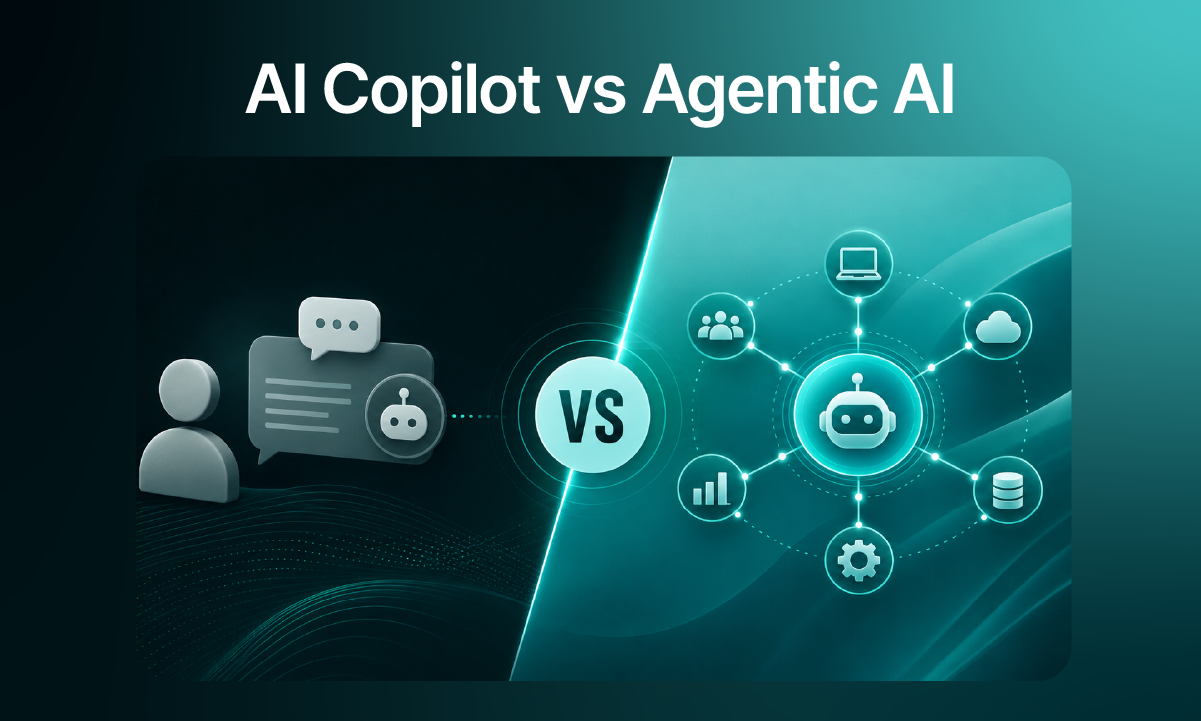
The difference between an AI copilot and an AI agent is not a matter of intelligence, and it has little to do with which model sits underneath. It comes down to one question: who decides what happens next.
An AI copilot helps a person do a task faster, and acts only when that person asks.
An AI agent is given an outcome, works out the steps, and completes the task within limits you set.
Everything else follows from that one difference: the architecture, the governance, and the way you measure value. This piece uses a simple framework to make the difference concrete, the autonomy ladder, and ends with three scenarios to help you decide which one your IT team needs.
The autonomy ladder
Autonomy is not on or off. It comes in steps, and naming the steps makes the copilot-or-agent decision far easier.
- Suggest. The system drafts, summarizes or recommends. A person decides and does everything else.
- Prepare. The system assembles the action: it fills in the request, drafts the change and gathers the context. A person reviews it and carries it out.
- Act with approval. The system carries out the action once a named person approves it.
- Act within limits. The system carries out the action on its own, inside policies you have defined, and records every step.
Copilots work on the first two rungs. Agents work on the third and fourth. So the useful question is rarely "copilot or agent?" It is "which rung does this task belong on?"
Figure 1. The autonomy ladder. Copilots work on the first two rungs and agents on the last two, so the useful question is which rung each task belongs on.
What is an AI copilot?
An AI copilot is an assistant embedded in an application that helps a person work faster: suggesting text, summarizing content, drafting code and surfacing relevant data. It operates inside the tool the person is already using, and it acts only when prompted. On the autonomy ladder, it sits on rung 1 or 2. The person remains the operator throughout, and the work still passes through them.
The product names have become unreliable, though. Several tools branded "Copilot" now include agent features as well: GitHub Copilot can take on coding tasks as an agent, and Microsoft 365 Copilot ships with agents of its own. Judge a product by where it sits on the ladder, not by what it is called.
What is an AI agent?
An AI agent pursues an outcome across multiple steps, deciding which actions to take and adapting when a step fails. Rather than suggesting a reply to a request, an agent can interpret the request, check the requester's entitlements, act on the relevant system and confirm the result. Agentic AI is the broader term for systems built to work this way.
The practical difference is where the work ends. A copilot hands a better draft back to a person. An agent completes the task and reports what it did.
The agent label is unreliable in the other direction too. Gartner calls the rebranding of assistants and chatbots as agents "agent washing," and in June 2025 estimated that only about 130 of the thousands of vendors claiming agentic AI were the real thing. The autonomy ladder is a quick test: ask a vendor which rung each task actually reaches.
AI copilot vs AI agent: the differences that matter
The six differences below are the ones that change how an IT team buys, runs and governs each.
The governance row is where most enterprises are surprised. A copilot that drafts a poor summary wastes a minute. An agent that acts on a stale policy has changed something in a production system, which is why grounding, permissions and auditability stop being features and become preconditions. Each rung you climb raises that bar.
Why the architectures differ
A copilot is usually a model added to an existing application. It has two essential parts: the application, and the model that makes it faster.
An agent needs more. It needs retrieval against approved enterprise content, so its decisions are grounded rather than merely plausible. It needs integrations with the systems that hold the records, since acting requires somewhere to act. It needs memory, so context survives between steps. And it needs orchestration to decide which agent handles what, and when a person should be asked.
That gap explains why copilot features appeared across the market so quickly, and why genuine agent capability did not.
Which should you choose? Three scenarios
Most IT teams need both. The common mistake is putting a task on the wrong rung. Three everyday situations show how the decision usually falls.
Scenario 1: your analysts write incident summaries and change plans
A person is accountable for every one of these, and the value lies in producing them faster and better. The work belongs to a copilot, on rung 1 or 2: draft the summary, pull in the related tickets, suggest a rollback plan, and leave the judgment with the analyst. Moving this work further up the ladder would remove accountability from decisions that need it.
Scenario 2: password resets and access requests fill the queue
These requests are frequent, rule-bound and identical in shape every time, and nobody wants a person involved. A copilot that drafts reset instructions for an analyst to send keeps someone in the loop for no reason. The work belongs to an agent, on rung 4: verify the requester's identity, check entitlements, reset the password or grant the access, and close the request, with every step recorded. Success is measured by how much of this volume never reaches a queue.
Scenario 3: onboarding a new hire across HR, IT and facilities
Onboarding mixes both. Creating accounts, ordering the laptop and assigning licenses are agent work, but some steps need sign-off, such as access to finance systems or an exception to the standard device build. Those approvals put most of the flow on rung 3, acting with approval, with each approval routed to the person who owns it. The manager's welcome note, meanwhile, is a good job for a copilot.
What this looks like in service operations
Routine employee requests are the clearest case for agents, because they are frequent, rule-bound and expensive in aggregate. When Black Angus Steakhouse moved common device and access issues to autonomous resolution, the share of support calls arriving after hours fell from 90 percent to 10 percent, because staff working evenings no longer had to wait for the desk to open.
Where Rezolve.ai fits
This is what we build, so read this section as our case rather than a neutral view.
Rezolve.ai works on both sides of the ladder, matched to the task. For routine requests, Agentic Sidekick takes the request in Microsoft Teams, Slack, email, the web or on the phone and resolves it, acting within limits on rung 4 or with approval on rung 3 where your policy requires sign-off, with every step grounded in your own knowledge and open to review. For the requests that should reach a person, Ask Sidekick works as a copilot inside the ticket, so the analyst starts with the context already gathered. New workflows and automations can be described in plain language and built in Rezolve Creator Studio by the team that owns the process.
More than 200 enterprises run on Rezolve.ai, and Gartner recognized it with the "Highest score of 10 products evaluated in two of three Use Cases — AI for End-User Self-Service and AI for IT Agents — 2026 Gartner® Critical Capabilities for AI Applications in IT Service Management."
So, back to the question at the top: who decides what happens next? For most IT teams the answer is both, task by task. Put each task on the right rung of the autonomy ladder, and the copilot-or-agent decision largely makes itself.
Last updated on October 23, 2026
Get summary with:
See the agentic service desk in action
Watch Rezolve.ai autonomously resolve real IT and HR tickets: governed, auditable, glass-box.
Frequently asked questions
Is Microsoft Copilot an AI agent?
Microsoft 365 Copilot is primarily an assistant that works when a person prompts it, which places it on the first two rungs of the autonomy ladder. Microsoft also ships agents inside Microsoft 365 Copilot and offers Copilot Studio for building custom agents, so whether a particular Copilot experience acts as an agent depends on which feature is in use and how it is configured.
Can an AI copilot be turned into an AI agent?
Not by adding features to the interface. Acting on someone's behalf requires grounded retrieval against approved content, integrations that can change records, memory across steps and orchestration that decides when to involve a person. That is an architectural difference, which is why vendors that started with a copilot usually build agents as a separate layer.
Are AI agents safe to use in IT service management?
They can be, provided the controls match the rung. Agents acting on their own need entitlement checks before every action, approval gates where policy requires sign-off, and a step-level audit trail that shows what was done and why. Many IT teams start agents on rung 3, acting with approval, and move proven tasks to rung 4 once the record shows they are reliable.
How do you measure whether an AI agent is working?
Track the share of requests resolved with no person involved, how often the same employee comes back about the same issue, time to resolution, and how often a person has to override or reverse what the agent did. A rising resolution rate alongside a low override rate is the clearest sign an agent is on the right rung.
Do AI agents replace IT service desk staff?
They remove routine volume rather than roles. Password resets, access requests and status checks stop reaching the desk, which leaves analysts with fewer but harder issues that need judgment. Copilots then help with that remaining work, by gathering context and drafting responses for the analyst to review.