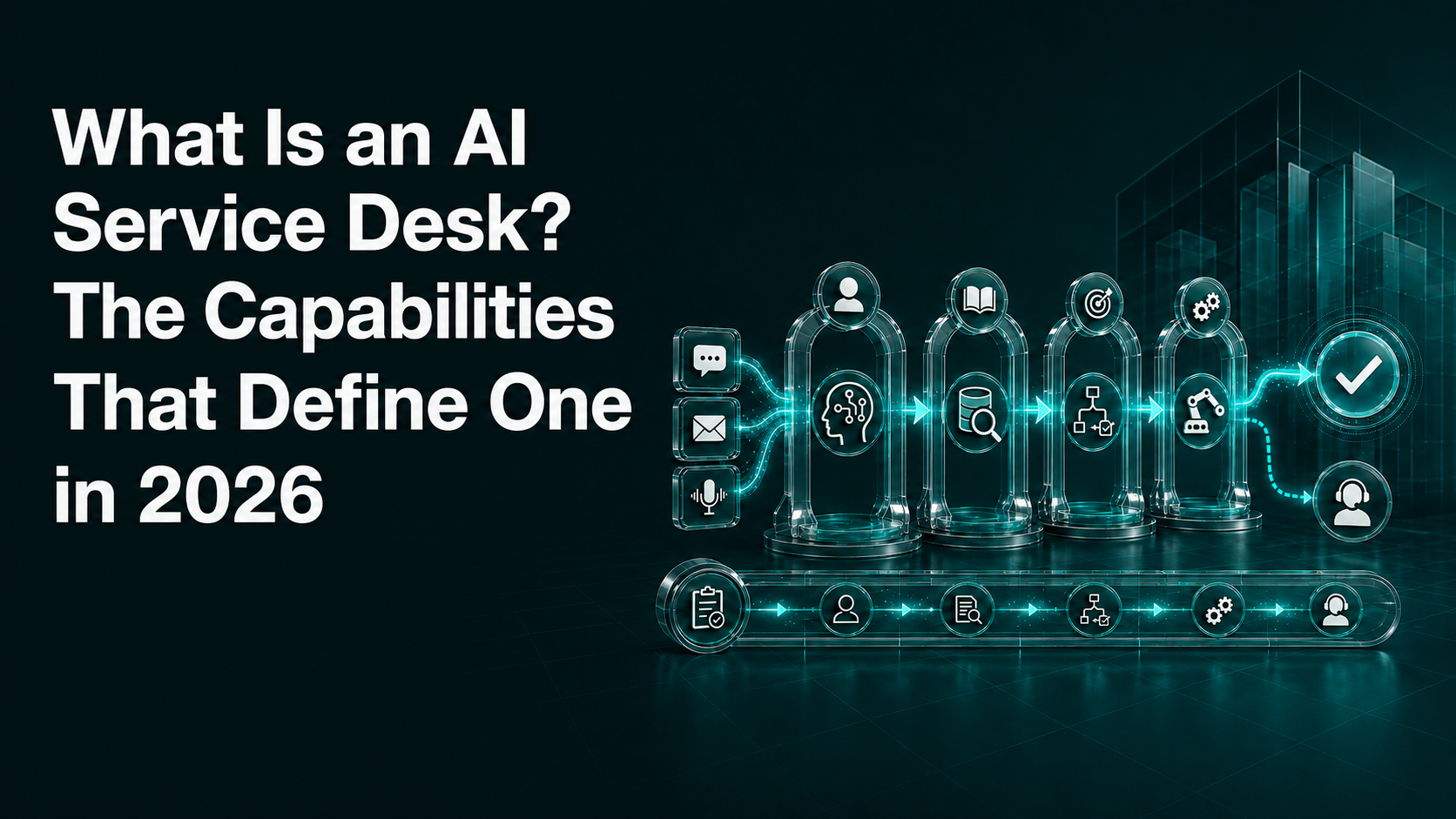
What Is an AI Service Desk? The Capabilities That Define One in 2026

Key takeaways
- An AI service desk resolves requests end to end; a conversational front end that still turns every interaction into a ticket does not.
- Four capabilities compound: agentic RAG-based knowledge, omnichannel triage that decides, automation created with AI, and agents built for organization-specific problems.
- A credible demo should prove each capability using a changed source document, non-ticket outcomes, a newly described automation, and a custom problem from the buyer's environment.
- Measure adoption and autonomous resolution. Deflection alone cannot show whether the employee's work was actually completed.
Almost every service desk product now calls itself AI-powered. Most of them mean a chat window has been added to a ticket form.
That gap matters commercially, because the products on either side of it are diverging fast. So rather than another definition, here is a working test: the capabilities an AI service desk actually needs, and why the most common shortcut in this market does not work.
The short answer
An AI service desk resolves an employee's request end to end. It finds the right answer in your knowledge, decides what the request actually needs, takes the action that resolves it in the systems holding the data, and leaves a record you can audit.
 Figure 1. The four capabilities compound — what you have if you stop at each stage.
Four capabilities make that possible. They are worth little individually — the first without the second is a search box, the second without the fourth has a ceiling you will hit in year one. They compound, which is why partial implementations disappoint the people who bought them.
1. Agentic RAG-based knowledge management
The model's training data does not know your VPN split-tunnel policy, which of your three expense tools the Denmark office uses, or that the Okta group governing Tableau access was renamed last quarter. Every answer has to trace to a document you own.
That much is table stakes — everything claims retrieval. The distinction is what happens around it. Basic retrieval returns the passage most similar to the question. Agentic retrieval decides what to look for, searches again when the first result is thin, reconciles two documents that disagree, and recognizes when the knowledge is not there rather than returning the nearest available paragraph.
Test it: change a source document and ask the question again. If the answer is unchanged, the retrieval is decorative. Then ask something your knowledge base genuinely does not cover, and see whether it says so or improvises.
2. An experience layer that triages and decides — on every channel
This is the capability most products skip, and it does the most work.
Something has to receive a request and decide and decide what it actually is — not classify it for a queue, but decide what to do. Answer it. Trigger an automation. Raise an incident. Open a service request. Ask a follow-up because the request as phrased is not actionable. Route it to a named human because software should not handle it at all.
Six outcomes, and choosing between them is the job. A product that turns everything into a ticket has not triaged anything. It has put a conversational front door on the same queue.
A product that turns everything into a ticket has not triaged anything. It has put a conversational front door on the same queue.
Channels are not a detail here. The employee who most needs help is often the one who cannot reach a chat window — locked out, working a depot or a factory floor without a laptop, calling after hours. Chat, email, Teams, the portal and the phone line all have to reach the same decision-making layer rather than five separate implementations of it.
 Figure 2. Every channel reaches the same layer. Six outcomes it can choose between
Test it: send in one request that should not become a ticket, one that needs a follow-up question first, and one that should be refused. Watch all three. Then ask what happens when that person calls instead of typing.
3. Automation you can create with AI
Automation is not new to service management. What is new is who can build it.
Traditionally an automation is a project: someone specifies it, a specialist builds it in the platform's workflow engine, it ships weeks later after a release cycle. That cost means only the highest-volume requests ever get automated, and the long tail of small repetitive tasks never clears the bar.
An AI service desk changes the economics by letting automation be described rather than engineered. Someone who understands the process explains what should happen, and the system drafts the flow.
Determinism still matters. Some work should be deterministic — same input, same steps, every time, auditable, no judgement. Provisioning against an approval policy belongs there. Other work benefits from reasoning across a messy situation. A serious product supports both and lets you choose per use case, rather than making everything probabilistic and calling it intelligence.
Test it: describe a moderately complex process out loud and ask them to build it in front of you. Not from their template library — a new one, from your description, in the session.
4. Agents you can build for specific problems
This determines whether the product keeps improving after deployment.
Every organization has problems nobody else has: a specific approval chain, a regulated process, a homegrown system three hundred people depend on. If solving each one requires a professional services engagement, the product has a ceiling.
What matters is range — foundational agents for universal work, a marketplace of proven agents to clone, and the ability to build genuinely custom ones. Most products offer one of the three and imply the others.
Test it: describe a problem specific to your organization and ask who builds the agent, how long it takes, and what it costs. If the answer routes through their professional services team, add that to the total cost, because you will be back.
Other capabilities worth checking
Four capabilities define the category. Several others separate a serious product from a starter one, and each deserves more room than this page can give it:
- A record that survives audit. Every retrieval, decision and write attributable, timestamped and reviewable — and an agent that decides not to proceed when confidence is low or the requester is not entitled to what they are asking for. More on governing an agent estate.
- Major incident detection and handling. Spotting that twenty unrelated-looking tickets are one outage, before someone senior notices first. More on major incident management.
- Change management. Risk assessment, approval routing and change records generated from what actually happened. More on how the four practices differ.
- Technician assist. The requests that reach a human should arrive pre-analyzed, with a drafted response and the context already gathered. More on what that looks like in practice.
What an AI service desk is not
The most common product in this market is a conversational interface bolted onto a traditional ITSM or ESM platform. The vendor calls it an AI service desk. It is not, and the reasons are structural rather than a matter of maturity — they do not resolve with the next release.
The bot can only do what the platform's API already exposes. It inherits the data model, the permission model and the release cycle. Any capability the platform lacks, the bot cannot add.
It sits in front of a system designed around the ticket. The architecture assumes a request becomes a record, enters a queue, and is worked by a person. A conversational layer can help people avoid the queue; it cannot resolve outside it. Which is why these products report deflection — it is the only metric that architecture can produce, and deflection counts everyone who gave up and asked a colleague instead.
Automation still lives in the platform's workflow engine. So the capability in point three is not available regardless of what the front end can do. You are still filing a request with a specialist and waiting for a release.
 Figure 3. One can help people avoid the queue. The other resolves outside it.
Triage collapses into classification. The bot can categorize and route, because that is what the platform supports. It cannot choose to trigger an automation instead of raising a ticket, because the automations are not its to trigger.
None of this makes those products useless. A good conversational front end on a mature ITSM tool beats a portal form. It is a different category from a product built agentically from the ground up, and buying one expecting the other is where disappointment comes from.
Not only IT
Nothing above is IT-specific, which is the point.
In HR, an employee asks how parental leave interacts with accrued vacation. The answer depends on location, tenure and employment class, sits across three policy documents, and is confidential — nobody wants to raise a ticket a colleague might see. In finance, a manager asks whether a purchase needs approval and from whom, where the answer depends on the amount, category, cost center, and the current approval matrix. In both cases, the right outcome is not a ticket to a shared services team. It is the answer, followed by the request being raised correctly, with a record of the policy applied.
Same four capabilities. Only the systems and policies change — and because these requests carry confidentiality and compliance weight, most IT requests do not, the audit trail matters more in those functions, not less.
A note on the vocabulary
AI service desk is the broadest term: any service desk where AI does substantive work rather than assisting a human who does it.
AITSM applies the same idea across IT service management as a discipline — incident, problem, change and request — not only the front door.
Agentic service desk is the narrower, more demanding claim. Agentic implies the system acts rather than responds, and decides when not to. Every agentic service desk is an AI service desk; the reverse is not true, and most products claiming the first are describing the second.
The gap is widening
The important thing is not that this distinction is currently true. It is the rate at which the two categories are separating.
A product built agentically from the foundation compounds. Better retrieval makes triage more accurate. Better triage sends more requests to automation. More automation surfaces more patterns worth building agents for. Each capability improves the next, and the system gets better as it runs.
A conversational layer over a ticket queue does not compound, because the queue underneath it does not change. It improves when the vendor ships an improvement, on the vendor's schedule.
Over a quarter that is not dramatic. Over two or three years it is the difference between a service desk that is measurably better every month and one that is roughly where it was with a nicer interface. The capabilities arriving over the next few years will land on the foundation, not the interface. Organizations running a real AI service desk will get them as they arrive. Organizations running a bot in front of a ticket queue will read about them.
That cost is not paid today. It is paid later, quietly, in innovations that arrive for other people.
Last updated on September 16, 2026
Get summary with:
See the agentic service desk in action
Watch Rezolve.ai autonomously resolve real IT and HR tickets: governed, auditable, glass-box.
Frequently asked questions
What is an AI service desk?
A service desk where AI resolves requests end to end rather than assisting a human who resolves them. It retrieves grounded answers from your knowledge, decides what each request needs, takes the resolving action in the systems that hold the data, and records what it did for audit.
What is the difference between an AI service desk and a chatbot?
A chatbot answers; an AI service desk acts. The test is whether anything changes in your systems of record when the conversation ends — an access grant, a status change, a field updated in the HRIS. If the only output is text, it is a chatbot regardless of how it is marketed.
What is AITSM?
AI applied across IT service management practices — incident, problem, change and request — rather than only at the point of contact. An AI service desk is the front door; AITSM is the discipline behind it.
Does an AI service desk replace ITSM?
No. It changes which layer does the work. You still need a system of record, service definitions, approval policy and audit. Execution moves from a human reading a runbook to software following a governed policy, so the record captures far more resolved requests that never became tickets.
How do you measure an AI service desk?
Adoption rate and autonomous resolution rate. Deflection is the weakest of the three because it counts everyone who gave up. Ask vendors for adoption at a comparable enterprise rather than deflection in aggregate.
Can an AI service desk handle HR and finance requests?
Yes, and the same four capabilities apply. The systems and policies differ; the pattern does not. Confidentiality requirements are usually higher in those functions, which makes the audit trail more important rather than less.