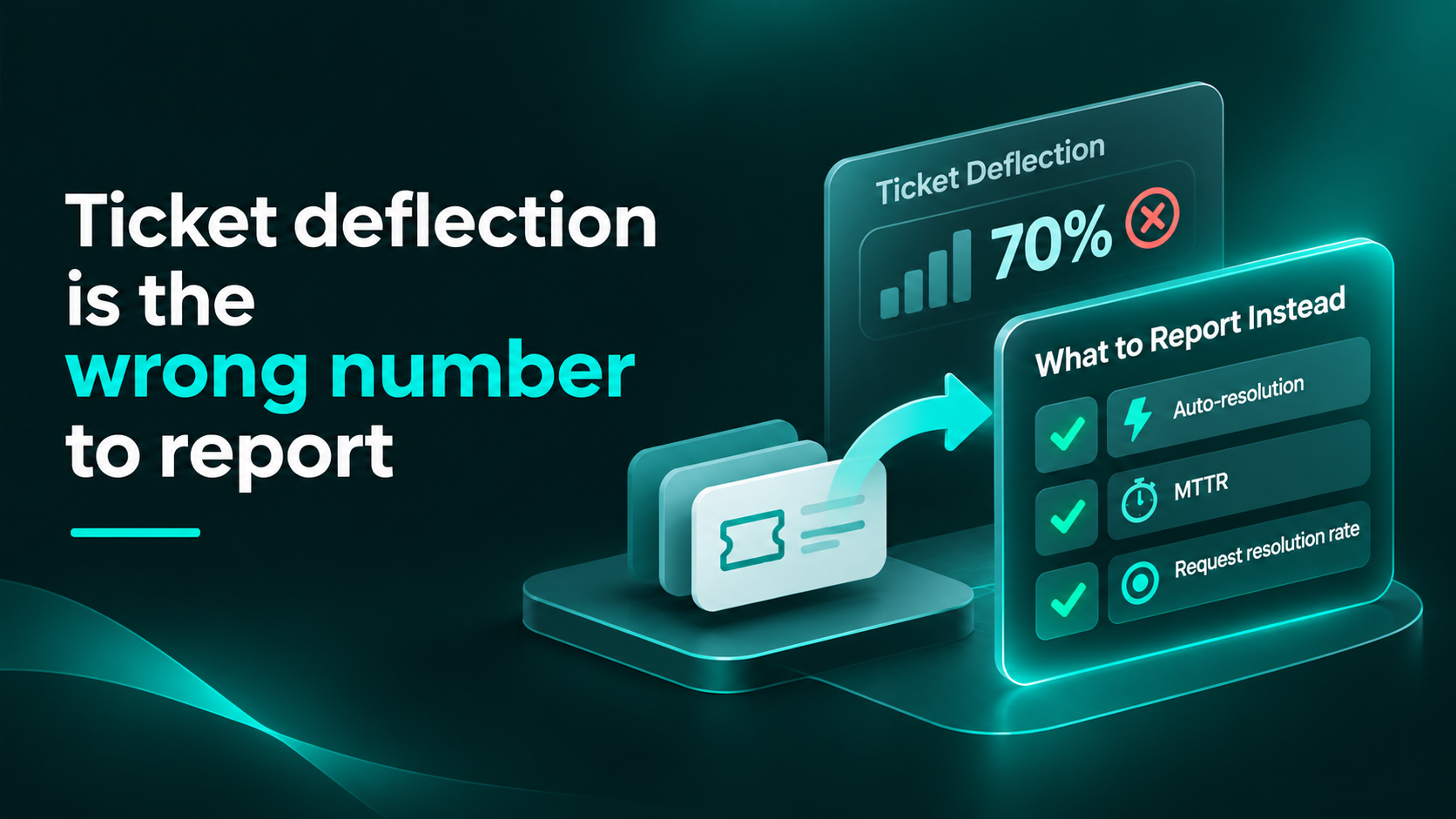
Ticket deflection is the wrong number to report
Ticket deflection goes up when employees resolve their own issue, and it also goes up when they give up. Why the metric became the default, what it cannot tell apart, and the resolution measures that should replace it on your dashboard.

Key takeaways
- Ticket deflection rises when employees resolve their own issue and also when they give up, and the number cannot tell the two apart.
- A session without a ticket can mean resolved, gave up, went elsewhere or came back later.
- Report verified resolution and repeat contact together, with abandonment as its own trend.
- When the system completes the request, success can be recorded directly instead of inferred from an absence.
Ticket deflection has one property that makes it popular with vendors and risky for service desk leaders: it goes up when people give up.
An employee who opens the self-service portal, reads an article, solves the problem and leaves counts as a deflected ticket. So does an employee who opens the portal, finds nothing useful, closes the tab and asks a colleague instead. The dashboard records two successes. One of them was a failure the service desk never saw.
That is not a flaw in how anyone calculates deflection. It is what the metric measures.
What is ticket deflection?
Ticket deflection is the share of support requests that never become tickets because the employee found an answer, or a fix, through self-service. It is usually calculated as the number of self-service sessions that did not end in a ticket, divided by all sessions that started with a support need.
The appeal is obvious. Every deflected ticket is work the desk did not have to do, and the number is easy to collect from any portal or chatbot.
What a deflection number cannot tell apart
A session that ends without a ticket can end in at least four different ways, and deflection counts all four the same.
Figure 1. A deflection rate counts every session that ends without a ticket. Only one of the four endings is a success.
Resolved. The employee got the answer or the fix and their problem is gone. This is the outcome everyone wants.
Gave up. The employee could not find what they needed and stopped trying. The problem is still there, and the employee now trusts self-service a little less.
Went elsewhere. The employee asked a colleague, messaged a technician directly, or walked over to the desk. The work still happened, off the record, often taking someone else's time.
Came back later. The employee tried again the next day, or raised a ticket after all. The first session counted as deflected; the second counted as a ticket. The same problem was recorded twice, once as a success.
Only the first of those is a reason to celebrate, and a deflection rate cannot tell you how much of it you have.
Why deflection became the default anyway
Deflection made sense as a measure when self-service meant a portal full of articles. The best the system could do was point someone at a document, and whether they read it, understood it or acted on it was out of view. Counting the tickets that did not arrive was the only signal available.
That is no longer true. When the system can carry out the request (reset the password, grant the access, install the software) it knows whether the work was done. There is no reason to infer success from an absence when you can record it directly.
What to report instead
| Measure | What it tells you | How to calculate it |
|---|---|---|
| Verified resolution rate | How much work was actually completed without a person | Requests closed with a confirmed fix or completed action, divided by all requests |
| Repeat contact | Whether "resolved" really meant resolved | The share of employees who contact the desk again about the same issue within seven days |
| Abandonment | How often people give up | Sessions that end with no answer, no action and no ticket |
| Time to resolution | How long the employee actually waited | From first contact to confirmed fix, whatever the channel |
| Escalation with context | Whether handoffs help the technician | Escalated requests that arrive with the conversation, steps tried and relevant details attached |
Verified resolution and repeat contact are the pair that matter most. Resolution says how much work was done; repeat contact checks that it stayed done. A desk where resolution is rising and repeat contact is flat is genuinely getting better. A desk where the deflection rate is rising and repeat contact is rising with it is getting quieter, not better.
Abandonment deserves its own line rather than being folded into anything else. It is the number deflection hides, and it is the earliest warning that self-service is failing.
How to move a dashboard from deflection to resolution
Most teams cannot switch overnight, because last year's targets and this year's vendor contract are written in deflection. A gradual change works better.
- Report both for a quarter. Put verified resolution next to deflection and let the gap speak for itself.
- Add repeat contact to every resolution figure. A resolution rate without it is a claim, not a measurement.
- Break out abandonment. Show it as its own trend, so a rising deflection rate driven by people giving up is visible immediately.
- Rewrite the target. Once the new numbers are trusted, move goals and vendor commitments to resolution and repeat contact, and retire deflection as a headline metric.
It is worth being clear with leadership about what will happen to the numbers. Resolution rates usually look lower than the deflection rates they replace, because they no longer count abandoned sessions as wins. That drop is the old number's error becoming visible, not the service getting worse.
What Rezolve.ai reports in place of deflection
Declared interest: this is our own product area.
Rezolve.ai records what happened to each request rather than inferring it. Because Agentic Sidekick carries out the work (the reset, the access grant, the software install), a resolved request is a completed action with a record, not a ticket that never arrived. Support Effectiveness reporting then follows each request from first contact to outcome across Microsoft Teams, Slack, email and the phone, which is what makes repeat contact and abandonment measurable rather than invisible. The same record shows which request types keep failing, so you know where to automate next.
Deflection asks how many tickets did not happen. Resolution asks how many problems went away. Only the second is the job.
Last updated on November 3, 2026
Get summary with:
See the agentic service desk in action
Watch Rezolve.ai autonomously resolve real IT and HR tickets: governed, auditable, glass-box.
Frequently asked questions
How is ticket deflection calculated?
Ticket deflection is usually calculated as the number of self-service sessions that ended without a ticket, divided by the total number of sessions that started with a support need. Some teams calculate it from knowledge article views or chatbot conversations instead, which makes deflection rates hard to compare between organizations.
What is a good ticket deflection rate?
There is no reliable benchmark, because deflection counts abandoned sessions as successes and every organization measures it differently. A more useful target is a rising verified resolution rate with flat or falling repeat contact, which shows that problems are actually being solved rather than going unreported.
What is the difference between ticket deflection and self-service resolution?
Deflection counts requests that did not become tickets, whatever the reason. Self-service resolution counts requests that were confirmed as solved, either because the employee confirmed it or because the system completed the action. Resolution is the narrower and more honest measure.
Why do deflection rates sometimes rise while satisfaction falls?
Because employees who give up on self-service are counted as deflected. If the portal or chatbot gets harder to use, more people abandon it, the deflection rate rises, and the problems move to colleagues, direct messages and repeat contact that the deflection number never sees.
Should vendor contracts use deflection as a success metric?
It is better to tie commitments to verified resolution and repeat contact. A deflection commitment rewards a vendor for sessions that end without a ticket, including the ones where the employee gave up, which is not the outcome you are paying for.