AI-native DEX: why digital employee experience needs agentic AI, not more dashboards
Most digital employee experience tools tell IT what is wrong. AI-native DEX fixes it. What agentic AI in DEX looks like in practice, where legacy DEX tools hit their ceiling, and how to evaluate a digital employee experience platform.

Key takeaways
- Most DEX tools digitized the service desk without removing the work. A ticket submitted through a polished portal is still a ticket someone has to triage and close.
- Seeing a problem is not the same as solving it. Endpoint analytics tools typically surface issues to an administrator, and a person still has to act.
- AI-native DEX means AI does the work. It resets the password, grants the access or fixes the device instead of pointing to a help article.
- The best ticket is the one that never gets created. Agentic AI watches device health, app performance and access patterns, and fixes problems before employees notice.
- Connected beats collected. When endpoint, identity and service desk work as one system, fixes take minutes instead of days.
Most digital employee experience (DEX) tools are very good at telling IT what is wrong. Very few of them fix it. AI-native DEX changes that: instead of surfacing a slow laptop, a failed login or a missing license to a human who then opens a ticket, agentic AI diagnoses the issue, takes the action and confirms the result. This post explains what AI-native DEX means, where legacy DEX tools hit their ceiling, and what agentic AI in DEX looks like in day-to-day IT support.
What is AI-native DEX?
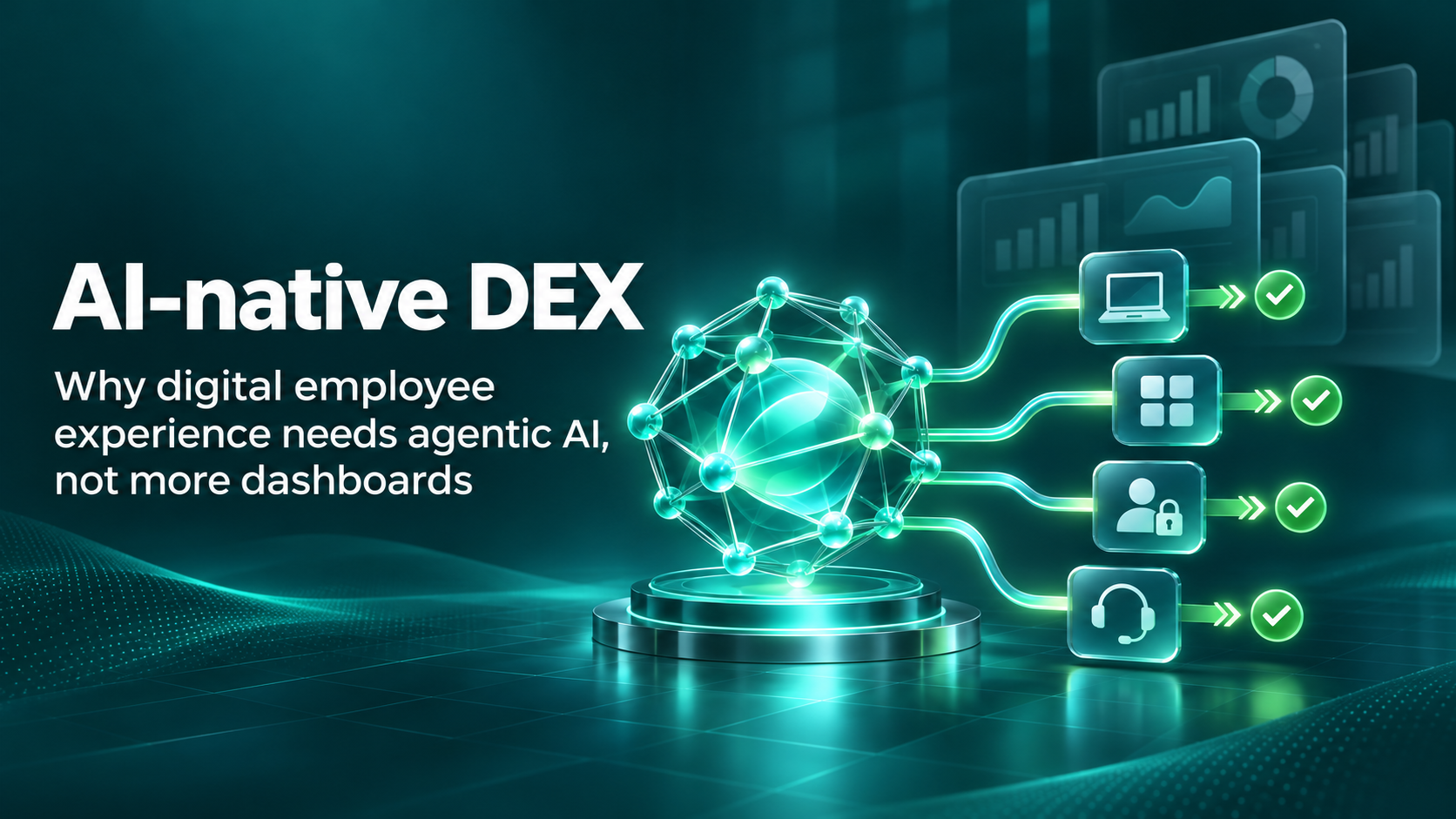
AI-native DEX is a digital employee experience approach in which AI agents are the operating model rather than an add-on. Instead of reporting experience problems to IT, an AI-native DEX solution detects issues across devices, apps, identity and service requests, then resolves them autonomously, with every action logged and reviewable.
The difference from "DEX with AI features" is architectural. Bolt-on AI suggests. AI-native AI acts.
The digital employee experience market has a problem
Organizations have invested heavily in digital employee experience: service portals, ITSM tools, knowledge bases, chatbots and endpoint analytics. The intent was right. The results have fallen short.
Employees still wait hours for password resets. Queues still fill with requests that should never have become tickets. IT teams still spend most of their capacity on repetitive, low-complexity work. And despite dashboards full of experience scores, the friction that drags on productivity every day is largely unresolved.
The tools that were supposed to fix this mostly automated the wrapper around manual processes, not the processes themselves. That is the gap AI-native DEX was built to close.
Looking for an AI service desk with DEX product?
Rezolve.ai does all of it, Rapport by Rezolve.ai does even more
What digital employee experience covers, and why depth matters
DEX is not a single capability. It spans every point where employees meet technology at work:
- Endpoint experience: device performance, stability, patch status and compliance.
- Application experience: whether SaaS and enterprise apps are accessible, responsive and correctly provisioned.
- Service experience: how quickly and completely issues are resolved, and whether employees can self-serve.
- Onboarding and offboarding: day-one readiness for new hires and clean access removal for leavers.
- Identity and access: the right access at the right time, without friction or security risk.
- Sentiment: what employees actually feel about their digital environment, not just what the ticketing system records.
Legacy DEX tools tend to cover one or two of these dimensions well. Endpoint analytics tools, for example, are typically strong at capturing telemetry and sentiment. That visibility is valuable. But knowing that 340 employees are seeing VPN latency above threshold is useful. Diagnosing the root cause, pushing a fix to the affected devices and closing the loop without a single ticket is transformative.
The space between observing a problem and resolving it is where standalone DEX tools hit their ceiling.
Why legacy DEX tools are hitting a ceiling
Traditional DEX was designed to digitize the service desk: move requests from phone calls to forms, and from email to tickets. That was real progress at the time. But digitizing a manual process is not the same as eliminating it.
Four structural limits hold legacy DEX back:
Bolt-on AI. Many incumbent tools have layered AI on top of workflow engines built for human routing. The AI can suggest an answer, but the system underneath was never built to act on its own. Suggestions are not resolutions.
Reactive by design. Conventional ITSM and DEX tools respond to requests. If an employee's VPN client is about to fail, they will handle the resulting ticket efficiently. They will not stop the ticket from being created.
Visibility without action. Experience monitoring generates rich telemetry, but it is typically built to inform administrators, not to act. The path from signal to fix still runs through a person, and at scale that bottleneck grows.
Integration as an afterthought. Enterprises run on dozens of systems: identity providers, endpoint management, HR systems, productivity suites. When every connection is a professional services project, the DEX tool can only act on a small slice of the employee's world.
These are not feature gaps. They are architectural constraints, and incremental updates will not remove them.
Legacy DEX vs. AI-native DEX
| Capability | Legacy DEX | AI-native DEX |
|---|---|---|
| Role of AI | ✗ Bolt-on: AI suggests answers or articles, a person does the work | ✓ Operating model: AI agents take the action and confirm the result |
| Timing | ✗ Reactive: responds after a ticket is raised | ✓ Proactive: acts on device, app and access signals before a ticket exists |
| Telemetry | ✗ Insight for administrators to review | ✓ Insight that triggers a governed fix |
| Integrations | ✗ Configured per project, often with custom scripting | ✓ Core architecture, so agents can act across identity, endpoint and HR systems |
| Learning | ✗ Improves when an admin updates rules | ✓ Improves from every resolution and escalation |
| Success metric | ✗ Tickets deflected | ✓ Issues resolved, and tickets that never needed to exist |
What AI-native DEX actually means
AI-native does not mean a DEX tool with a chatbot attached. It means AI is how the work gets done. That shows up in four ways:
Resolution, not deflection. The goal is not to show an employee a knowledge article and hope. It is to reset the credential, provision the access, restart the service or update the record, so the problem is gone rather than redirected.
Proactive, not reactive. AI-native DEX watches endpoint health, access patterns and application performance, and intervenes before an issue turns into a request.
Built for orchestration. Because the agents are designed to act across systems, connecting to an identity provider, endpoint manager or HRIS is a prerequisite, not a project. That is why the breadth of integrations matters as much as the intelligence on top of them.
Continuously learning. Every interaction, resolution and escalation improves the next one, without anyone rewriting a decision tree.
Agentic AI in DEX: what it looks like in practice
Agentic AI in DEX is not theoretical. These are the patterns IT teams are putting to work now:
Autonomous endpoint remediation. An agent spots a pattern in endpoint telemetry, such as rising memory use, a failing disk or an app that keeps crashing. It identifies the likely cause, runs the right fix (driver update, process restart, policy correction), validates it and logs the outcome. The employee sees a brief background process. No ticket is created.
Intelligent access provisioning. A new hire is added to the HRIS. The agent maps the role to the right entitlements, provisions accounts across the identity provider, productivity suite and line-of-business apps, and sends the employee one confirmation. A multi-team checklist becomes a few minutes of automated work.
Proactive application experience. The agent notices a group of employees in one region seeing degraded performance in a critical SaaS app. Cross-checking network telemetry, it traces the problem to a recent configuration change, rolls it back, confirms performance has recovered and tells IT what happened and why.
Conversational self-service that actually resolves. An employee asks in Microsoft Teams for access to the Q3 financial reporting dashboard. A legacy chatbot links to a request form. An AI-native agent verifies identity, checks the approval policy, routes to the approver, provisions access once approved and confirms, all in the same conversation.
Offboarding and access hygiene. When a departure is recorded, the agent suspends accounts, revokes tokens, archives data per policy and produces a compliance audit trail. No orphaned accounts surface weeks later.
Predictive hardware lifecycle. By reading performance degradation across the fleet rather than asset age alone, the agent builds a prioritized refresh list by role and location and starts the procurement workflow before devices fail.
All of these depend on one thing: a system built to act, not just to observe or suggest. That is also why the same agentic approach is reshaping adjacent work such as vulnerability management in SecOps.
The full-stack advantage: why standalone tools cannot keep up
Take a common scenario: an employee cannot open a critical application because their device has been flagged for a compliance issue.
In a fragmented setup, the endpoint analytics tool flags the device to an administrator. A ticket is raised, by the employee or by IT. Someone checks access status in the identity system separately. A technician coordinates the fix, restores access and closes the ticket. Elapsed time: hours to days, depending on queue depth and shift coverage.
With AI-native DEX, the compliance flag arrives through integrated endpoint telemetry. The agent cross-references the employee's access profile, finds the block, pushes the policy fix, restores access and validates the result. The employee gets a note that the issue was found and fixed. Elapsed time: minutes, with no ticket and a complete audit trail.
Standalone tools, even excellent ones, are limited by the edges of their domain. An endpoint analytics tool cannot provision access. An ITSM tool cannot push a remediation script. A chatbot cannot update an HR record. That is the same line that separates a real AI service desk from a chat window placed in front of a ticket queue.
How AI in digital employee experience changes the employee journey
The payoff of AI in digital employee experience is not only operational efficiency for IT. It is a different working life for employees.
Day one: devices are configured, accounts provisioned and access confirmed before the new hire first logs in.
Day to day: slow apps, failed sign-ins and missing licenses are fixed before employees notice, or within minutes of a short conversation.
Access requests: employees ask in plain language and get access in real time, instead of waiting days on a form.
Device reliability: crashes, slowdowns and compliance warnings are handled in the background.
Departure: access is removed cleanly and completely, with nothing left for an auditor to find.
The result is more time spent on the work people were hired to do, and less time spent working around enterprise IT.
How to evaluate an AI-native DEX solution
If you are comparing digital employee experience platforms, these questions separate AI-native from AI-added:
- Does it resolve or recommend? Ask for a live demo of an end-to-end fix, not a dashboard of insights.
- What can it act on? List the systems the agents can take action in (identity, endpoint, HRIS, productivity suite), not just read from.
- Is every action explainable? Autonomous fixes need a reviewable record of what the agent did, why and with what approval. This is what explainable AI should give you.
- Where do employees ask for help? Resolution should happen where people already work, such as Microsoft Teams and Slack, not in yet another portal.
- How is success measured? Look for resolved issues and prevented tickets, not just deflection rates or experience scores.
- How fast is time to value? If every integration needs a services engagement, the agents will only ever act on a fraction of your environment.
The minimum standard has moved
For years, L0 and L1 automation (self-service password resets, FAQ deflection, basic ticket routing) was the leading edge of DEX ambition. Organizations that achieved meaningful deflection were considered mature.
That benchmark is now the floor, not the ceiling. Leading service organizations are judged by what they resolve autonomously, not by what they deflect. The question is no longer whether AI can answer a request. It is whether AI can make the request unnecessary.
That is the standard AI-native DEX was built to meet. Rezolve.ai automates up to 85 percent of IT support with agentic AI that works inside Microsoft Teams and Slack, and it scored highest of 10 products evaluated in two of three Use Cases (AI for End-User Self-Service and AI for IT Agents) in the 2026 Gartner® Critical Capabilities for AI Applications in IT Service Management.
For a dedicated digital employee experience product, explore Rapport by Rezolve.ai.
Last updated on November 2, 2026
Get summary with:
See the agentic service desk in action
Watch Rezolve.ai autonomously resolve real IT and HR tickets: governed, auditable, glass-box.
Frequently asked questions
What is AI-native DEX?
AI-native DEX is a digital employee experience approach where AI agents detect and resolve issues across devices, applications, identity and service requests on their own, instead of reporting them to IT. AI is the operating model, not a feature added to a legacy tool.
How is AI-native DEX different from traditional DEX tools?
Traditional DEX tools typically focus on visibility: telemetry, experience scores and alerts for administrators. AI-native DEX closes the loop by taking action, such as remediating a device, provisioning access or rolling back a bad configuration, and logging what it did.
What is agentic AI in DEX?
Agentic AI in DEX refers to AI agents that can plan and carry out multi-step tasks across systems. Examples include fixing a failing endpoint, provisioning a new hire's accounts or offboarding a leaver, with approvals and an audit trail built in.
How does AI improve digital employee experience?
AI in digital employee experience reduces wait time and friction. It resolves common issues instantly in channels like Microsoft Teams and Slack, prevents problems by acting on device and app signals early, and frees IT teams from repetitive work so they can focus on higher-value projects.
Does AI-native DEX replace endpoint analytics?
Not necessarily. Endpoint telemetry remains an important signal. The difference is what happens next: in AI-native DEX, that signal feeds agents that can act on it, rather than stopping at a dashboard.
What should I look for in a digital employee experience platform?
Look for autonomous resolution rather than recommendations, the ability to act across identity, endpoint and HR systems, explainable and auditable actions, support inside the tools employees already use, and success measured by issues resolved and tickets prevented.