Reinventing Shared Services with Agentic AI
The shared services organization has already done much of the hard work AI needs: defined processes, clear ownership, measurable workloads and centralized systems. Now the question is no longer how to consolidate the work, but how much of it a digital worker can actually do.

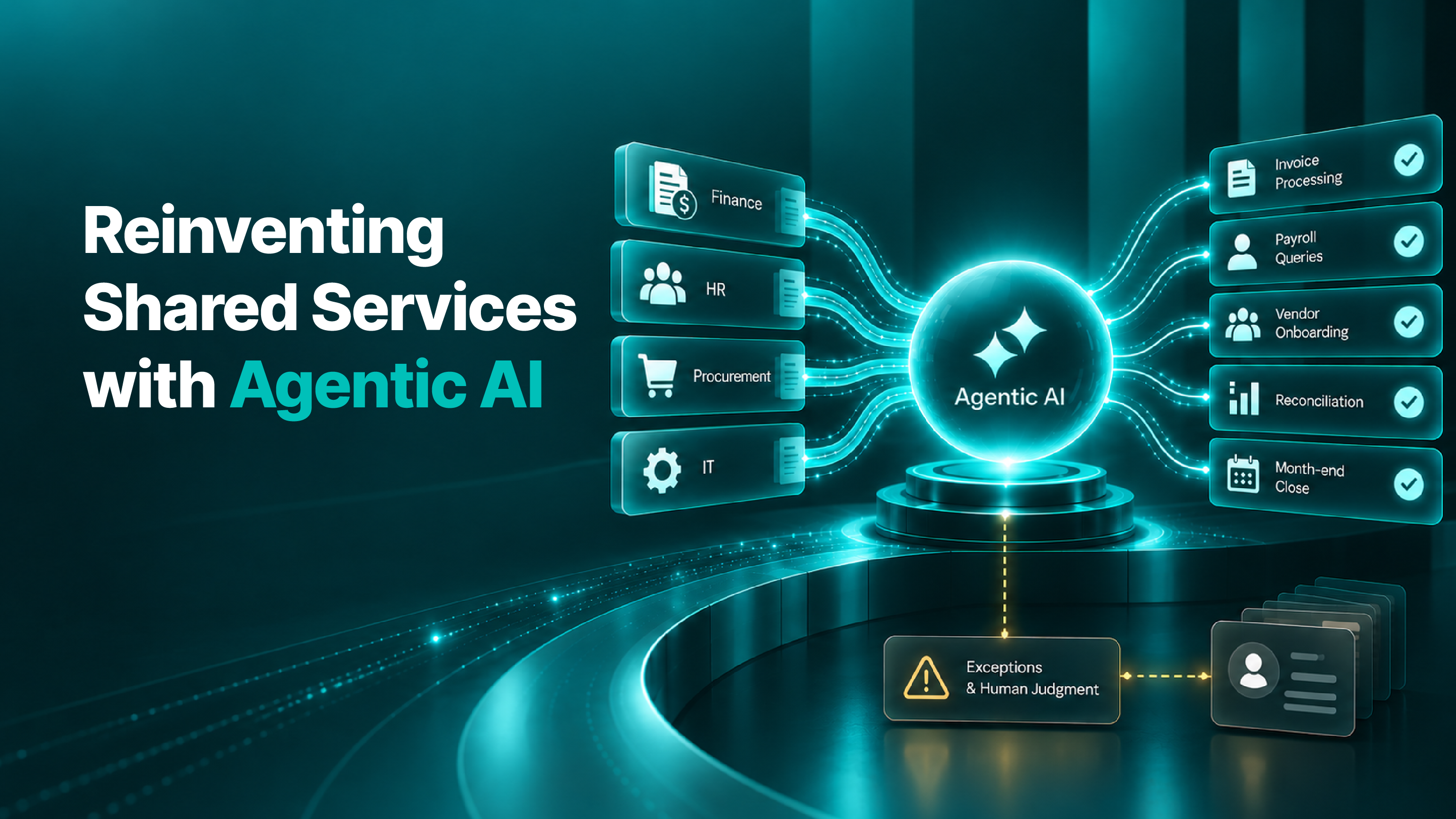
The shared services model has one of the better track records in enterprise operations. Take the work every business unit used to do separately (invoice processing, payroll administration, vendor onboarding, month-end close), put it in one place, define it as a service and measure it, and you generally get what was promised: lower cost, a single standardized process, and visibility into work that nobody could previously see.
What interests me is what happens next, because most shared services organizations eventually reach the point where consolidation has given everything it has to give. The work is centralized, standardized and still largely manual, which means the same manual process now happens in one building rather than nine.
Agentic AI changes the arithmetic at precisely that point, and it does so in a way the original model could never have reached on its own. I would put it more strongly than most in this market do: the organizations that built shared services centers a decade ago did the preparatory work for automation without knowing it.
What is a shared services model?
A shared services model consolidates work that individual business units used to perform for themselves into a single internal organization serving all of them. Instead of every division running its own accounts payable, payroll administration and HR support, one shared services center handles the work for the whole enterprise, usually operating as an internal service provider with defined services, service levels and often an internal charging arrangement.
The functions that move first are the ones with high volume and repeatable process: in finance, the end-to-end cycles of record to report, procure to pay and order to cash; in HR, payroll, benefits administration and employee support; in procurement, vendor onboarding and purchase order processing. IT frequently sits alongside as another shared function.
Organizations do it for three reasons: cost, because one team of thirty is cheaper to run than nine teams of five; standardization, because a single process is easier to control and audit than nine variations of it; and visibility, because work scattered across business units cannot be measured while work inside a center can. A shared services center is the organizational expression of that model: a defined team, often in a specific location, with its own leadership and its own performance measures.
What does consolidation deliver, and where does it stop?
Consolidation is genuinely powerful, and it has a ceiling that most organizations reach sooner than they expect. Once the work is in one place and running one way, the remaining inefficiency sits inside the work itself. An invoice still has to be read by somebody, matched against a purchase order, checked for exceptions and coded. A payroll question still has to be read, understood, researched against policy that varies by state and employment class, and answered. A new vendor still has to be chased for documents, checked and set up across several systems. Centralizing all of that made it consistent without making any of it faster to do.
Most shared services organizations respond by pushing the two levers available to them: process improvement, which yields diminishing returns once the obvious waste has gone, and labor arbitrage, which is why so many centers sit where they do. Both levers work, and neither one changes what the work actually is. The interesting question for anybody running one of these organizations today is whether a third lever exists, and I would argue that one now does.
What does agentic AI add on top?
The shared services center already did the hard organizational work by bringing the processes together, defining them, and putting them in one place with one owner. Those conditions happen to be the exact ones under which AI is most useful: a defined process, in a known system, with a single team accountable for the outcome. Connect agents to the systems of record underneath, and how much you automate becomes a question of what you choose to build.
Invoice processing is the obvious place to start. An agent reads the invoice, extracts what matters, matches it against the purchase order and the receipt, applies the coding rules, flags the exceptions that genuinely need a person, and passes the rest through. The exceptions were always the job, and the routine matching was never a good use of anybody's day.
Payroll questions are the second candidate. They arrive in enormous volume and repeat endlessly (when am I paid, why is this deduction different this month, how does overtime work for my shift pattern, what happened to my expense claim), and each one is answerable from policy and records the shared services team already holds. Each one also costs somebody several minutes and costs the employee a wait.
Vendor onboarding follows the same pattern. Chase the documentation, validate what comes back, check it against the compliance requirements, set the vendor up across the systems that need to know, and tell the requester where things stand. A process made almost entirely of waiting and following up is precisely the shape of work that automates well. Month-end and reconciliation behave similarly: compare what should match, flag what does not, and hand a person the differences rather than the whole reconciliation.
None of this requires reinventing the process your center already designed. The process stays as it is, and what changes is how much of it a person has to perform.
There is a second effect worth naming, and it compounds over time. Because a shared services center sits across several functions, an improvement built once becomes available everywhere, so better document extraction built for invoices helps with expense receipts and vendor contracts, and better retrieval built for payroll policy helps with procurement policy. In a decentralized model each business unit would have solved those problems separately, or more likely would not have solved them at all.
Why this connects to enterprise service management?
A shared services model and enterprise service management are the same idea approached from opposite directions. Shared services starts organizationally, by bringing the teams together, defining the services and measuring the work. ESM starts from the employee, with one way in and one experience, regardless of which function owns the answer.
Each approach needs the other to work properly. A shared services center without a coherent front door has consolidated the back office and left the employee where she was, still guessing which mailbox to use and still getting a different experience depending on the function she needs. A single front door with fragmented services behind it is a more pleasant route to the same fragmentation.
The organizations getting the most out of either have done both: the center gives them defined services with clear ownership, and the service layer gives employees one place to ask, with AI underneath resolving what it can and routing the rest. That combination is also what makes the location question worth revisiting. If service can be delivered in twenty languages from anywhere, and if a large share of routine volume never needs a person at all, the geography of a shared services center becomes a choice rather than a constraint. Centers established because you needed people in a particular place, at a particular cost, answering in a particular language, are worth looking at again.
How to approach it?
Start where volume and repetition are highest rather than where the process is most interesting. Invoice processing and payroll queries are unglamorous, and they are where the hours actually go.
Do not automate a process you have not fixed. A center that consolidated nine bad processes into one bad process will end up with a faster bad process. Consolidation was the opportunity to redesign, and if that never happened, do it before adding AI.
Check the knowledge before anything else, because answering payroll questions well requires policy documents that are current and do not contradict each other. Most organizations discover the gaps only when something tries to answer from them.
Decide what stays with people, and write the list down: exceptions, judgment calls, anything carrying a compliance consequence. That list is a design input rather than a limitation on the program.
Measure what the work costs you today, before you change anything. Shared services organizations are unusually good at this compared with the rest of the enterprise, which makes them one of the few places where the value of automation can be demonstrated rather than asserted.
Actionable insights for you
The shared services model was a good idea that delivered roughly what it promised, and for a lot of organizations it has now delivered most of what it can. The teams are consolidated, the processes are standardized, and the curve has flattened.
What is available now is a second layer of improvement sitting on top of the first, and that layer does not require a reorganization or another consolidation program. It is automation applied to work that is already defined, already measured and already owned by a single team.
So if you run one of these organizations, I would not start with a strategy document. Take the two highest-volume processes you own, work out what a single transaction costs you today, and test how much of that volume an agent can complete end to end rather than partially. You did the difficult organizational work years ago, and this second round is smaller, faster and easier to measure than the program that built the center.
Last updated on September 16, 2026
Get summary with:
See the agentic service desk in action
Watch Rezolve.ai autonomously resolve real IT and HR tickets: governed, auditable, glass-box.
Frequently asked questions
1. What is agentic AI in shared services?
Agentic AI uses AI agents to complete multi-step business processes with limited human intervention. In shared services, agents can handle tasks such as invoice processing, payroll queries, vendor onboarding and reconciliations. People remain involved where judgment, exceptions or compliance decisions are required.
2. Which shared services processes are best suited for agentic AI?
Start with processes that have high volumes, clear rules and repetitive steps. Invoice processing, payroll queries, vendor onboarding, reconciliations and routine employee requests are strong candidates. These processes offer measurable workloads where automation can deliver value quickly.
3. Does agentic AI replace shared services teams?
Not necessarily. The bigger opportunity is to change what people spend their time doing. AI can handle routine transactions and queries, while employees focus on exceptions, complex cases, judgment and work that requires human accountability.
4. Do organizations need to redesign their shared services model before using AI?
They do not need to rebuild the entire model, but they should fix inefficient processes before automating them. AI applied to a poorly designed process can simply make bad work happen faster. Clear processes, reliable knowledge and defined ownership provide a much stronger foundation.
5. How should a shared services organization get started with agentic AI?
Pick one or two high-volume processes and establish the current cost, volume and handling time. Then identify which steps an AI agent can complete end to end and which should remain with people. A focused pilot makes the benefits, risks and potential for scaling much easier to measure.