Enterprise Service Management: Why Employees Need One Front Door
Service delayed is sometimes service denied, and the failure is a quiet one: some people give up, some ask a colleague and get an answer that was right for that colleague and wrong for them, and some decide the problem is not worth the effort.


Consider this scenario. An employee three years into her time with your organization needs three things this week: her laptop keeps dropping off the VPN, she wants to know how parental leave interacts with vacation she has already booked, and she is chasing a travel expense from last month that has not been paid.
For the IT problem she thinks there is a portal, though she will have to look up where it lives, and possibly a phone number (the last time she called, she waited). For the HR question a colleague told her to use the shared mailbox. For the expense, Gary in finance sorted it out last time over Microsoft Teams, and she is fairly sure Gary retired in the spring.
She will get help with all three eventually, along with three different experiences, and I would argue that matters more than it appears to. Service delayed is sometimes service denied, and the failure is a quiet one: some people give up, some ask a colleague and get an answer that was right for that colleague and wrong for them, and some decide the problem is not worth the effort. Most organizations that come looking for enterprise service management (ESM) want their employees to have one consistent experience of being helped, whatever they need help with.
What is enterprise service management, and how is it different from ITSM?
ITSM is the practice of running IT as a service: a catalog of what IT provides, structured intake, defined ownership, approvals, tracking, and a record of what happened. ESM applies the same discipline to every function serving employees, so HR, finance, facilities, legal and procurement work the way a well-run IT function already does, with IT inside the model rather than beside it.
The obvious objection is that these functions have systems already. HR has an HRIS and finance has an ERP, but both were built for the people inside those functions rather than for the employee at the other end of the transaction. When your employee changes an address or queries an invoice, she is dealing with the service delivery team sitting in front of the system, and that team is where her experience is made or ruined. ESM is the discipline of making that layer consistently good everywhere at once, and most programs begin with a single front door.
What a single front door actually means
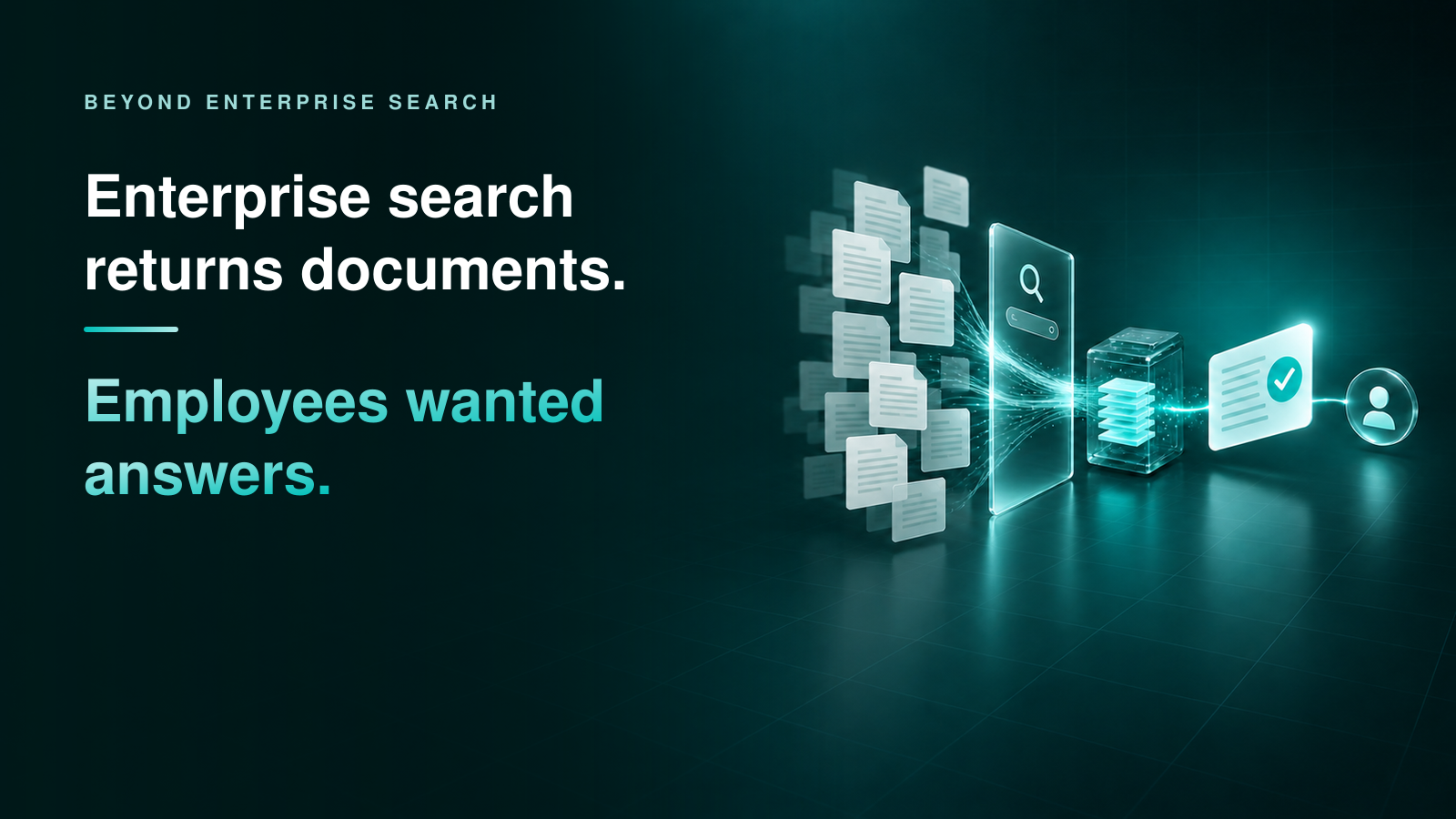
Everybody in this market agrees that no employee should have to remember which mailbox reaches facilities or which Teams channel reaches HR, and agreement breaks down over what the front door actually is.
The common answer is one URL, a single portal every employee visits and gets routed from, and five years ago I would have said the same. Two things have changed since: employees now arrive from wherever they already are (email, a phone call, Microsoft Teams or Slack, the portal), and AI has changed what happens after they arrive, so the front door no longer has to be a place at all.
The better answer is one AI persona running across every mode. The same assistant answers in Microsoft Teams whether the question is about payroll, a laptop or the air conditioning; one phone number is answered by voice AI that works out which function the request belongs to; a monitored mailbox reads what arrives and knows what to do with it; and the portal remains for the people who prefer one, on the same intelligence underneath. The answer is the same whichever way she came, and she never has to work out who owns her problem before she can describe it. Many doors into one building is a sound design; many buildings, each with its own reception desk, is what employees cannot navigate.
What do you get beyond the front door?
Organizations start these programs because employees do not know where to go, then find capabilities that were impossible while service delivery sat in four systems.
You end up with one privacy and data-loss policy instead of four. Every function handling employee requests handles sensitive material: HR most obviously, but finance sees compensation and facilities knows who was in the building. Split across four systems, each decides separately what is retained, logged and readable by an AI; unified, you write that policy once and defend it once when the auditor asks.
AI and automation land everywhere rather than only where somebody bought them. Improvements built for IT (better routing, better retrieval, automations that complete a request instead of filing it) arrive everywhere at once, rather than IT getting AI in year one while finance waits for its own project. The same logic applies to work that crosses functions, such as onboarding or a relocation touching HR, IT, facilities and payroll. Multilingual delivery becomes an organizational design question too, since a regional center built around answering the phone in Polish is worth revisiting.
You start to see patterns that cross departments. Take a surge of IT tickets from the Ohio office on a Tuesday morning, which on its own reads as a connectivity problem. Ohio is also having extreme weather that week, and the same data read whole says something different: people are working from home in difficult conditions and some have no power, so HR might reasonably ask whether anybody needs support. Reporting improves for the same reason: what onboarding costs end to end, where requests sit and wait, which sites generate disproportionate volume.
You have one estate to govern instead of four sets of integrations, four security reviews and four renewals. Four functions each buying their own AI leaves you with four governance models, four audit trails and nobody holding a complete list of what has been built. And when change is hard people stop making it, so the catalog drifts from how work happens and employees route around it.
Why the future looks more like ESM than ITSM
From where your employee sits, departmental boundaries are an artifact of how you are organized, and she should not need to understand your org chart to get the VPN fixed or the expense paid. Once resolution stops respecting those boundaries, which is what agentic AI does once pointed at more than one function, organizing service delivery around them stops making sense. From where the enterprise sits, efficiency beats almost everything else, and ESM lets you pull several of those levers at once rather than one per budget cycle.
Service delivery was designed around scarcity: expertise was concentrated into functions and knowledge lived with whoever had done the job longest. Agentic AI removes a good deal of that scarcity, and the architecture built to manage it becomes overhead, which is why I would expect the distinction between ESM and ITSM to look quaint inside five years.
What to ask before you buy
Count your front doors first: the portal, each shared mailbox, every form, every phone number, and every named person who has become a route. Most organizations are surprised by the length of that list, and by how many entries are a person rather than a system.
Then ask what happens when the employee is wrong about who owns the problem, because she often will be. Submit a facilities request through an IT route in the demo, and if it gets reassigned, ask how long that takes and whether she is told. Ask who can change HR's intake form, because if the answer is IT, ownership never transferred.
Ask to see a report that crosses two departments, with nobody exporting to a spreadsheet on the way. Then ask the same question in Teams and on the phone, and if the answers differ, you are looking at several products with one logo on them.
So what does this mean for your enterprise?
Go back to the employee at the start and hand her the same three problems inside an organization that has done this work. She asks about the VPN in the MS Teams window she already had open, and the laptop is remediated while she carries on with her morning. She asks about parental leave an hour later and gets an answer instantly. She asks about the expense reimbursement from her phone on the way home and is told where the claim sits and what happens next.
Nothing in that version of her week asks her to learn anything new, and that is the part I would hold on to. Almost every other route to better employee experience puts the burden on employees: use the new portal, log the ticket properly, pick the right category (Or, stop emailing Gary!).
So start with the list of front doors, mark the ones that are really a person, and work out what it would take for her to get the same quality of help through any entry on it. Get that far and she stops planning her week around three different ways of asking for help, and nobody has to wonder whether Gary still works here before an expense gets paid.
Last updated on September 16, 2026
Get summary with:
See the agentic service desk in action
Watch Rezolve.ai autonomously resolve real IT and HR tickets: governed, auditable, glass-box.
Frequently asked questions
What is enterprise service management?
ESM is the practice of running every employee-facing function the way a well-run IT function already runs, with a defined catalog of services, structured intake, clear ownership and a record of what happened. HR, finance, facilities, legal and procurement all work to the same standard, and IT sits inside that model rather than beside it.
What is the difference between ESM and ITSM?
ITSM applies service management discipline to IT alone, while ESM applies the same discipline to every function that serves employees. The mechanics are largely shared, which is why most organizations reach ESM by extending what IT already does well rather than by buying something unrelated to it.
Do we still need ESM if HR and finance already have an HRIS and an ERP?
An HRIS and an ERP are systems of record, built for the people working inside HR and finance rather than for the employee at the other end of a request. ESM governs the service delivery layer sitting in front of those systems, which is where an employee's experience of asking for help is made or ruined.
Does a single front door mean forcing everybody onto a portal?
A single front door does not have to be a portal, and I would argue the portal-only version of the idea is now the weaker one. The front door is better understood as one AI persona answering consistently in Microsoft Teams, on a phone line, in a monitored mailbox and in the portal, so the answer and the commitment stay the same whichever route an employee takes.
Where should an ESM program start?
Start by counting your front doors, meaning every route an employee could take, including the named people who have quietly become routes. Then pick the reporting question you would most like answered by this time next year, and work out what it would take for an employee to get the same quality of help through any entry on the list.