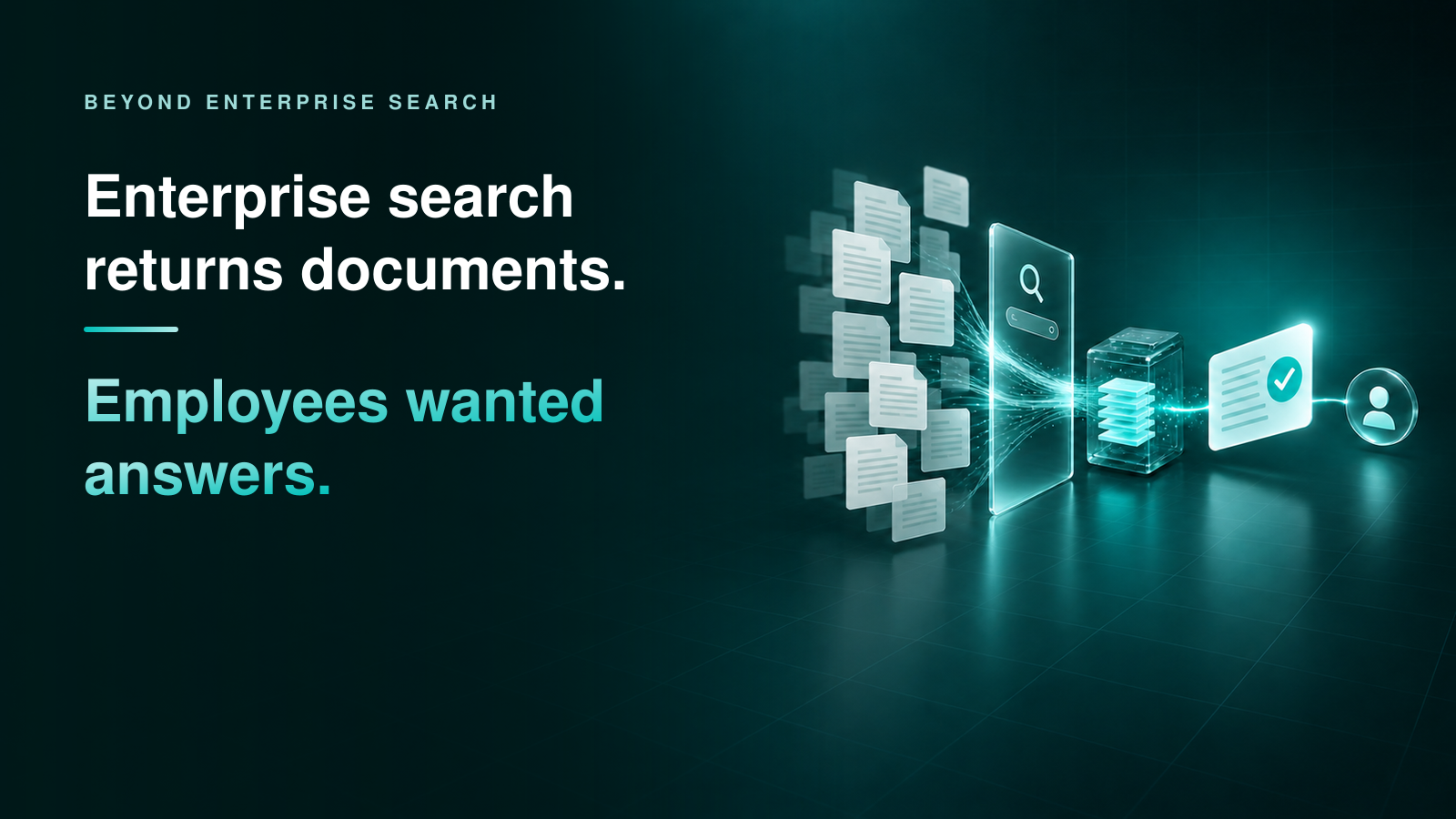
Enterprise search returns documents. Employees wanted answers.
Enterprise search has been reinvented three times and still ends at something to read. What enterprise search does well, where retrieval stops being useful, and why for most employee questions the last step is an action rather than a result.

Enterprise search has been reinvented three times in twenty years, and each version was a real improvement on the last. Keyword search found documents that contained your words. Semantic search found documents that meant what you meant. Generative search reads those documents and writes you a summary with citations.
All three still end in the same place. The employee gets something to read. A ranked list, a paragraph, a citation to the policy. Then they have to work out which part applies to them, and then they still have to go and do the thing they were trying to do in the first place.
That last step is where most of the value sits, and it is the step enterprise search was never designed to take. The practical question for anybody buying or running search inside an organization is not which retrieval approach is best. It is what happens after the answer.
What is enterprise search?
Enterprise search is software that indexes content across an organization's systems and lets employees find information in it from one place. The content is usually spread across document stores such as SharePoint and Google Drive, wikis such as Confluence and Notion, ticketing and service systems, chat, email and a long tail of line-of-business applications. A search product connects to those sources, keeps an index of what they contain, and returns results that respect who is allowed to see what.
That last requirement is what makes enterprise search harder than web search. On the web, everybody can see everything that is indexed. Inside a company, the same query from two people should return different results, because a compensation policy, an unannounced reorganization or a legal file should only appear for the people entitled to see it.
Three generations, one ending
The history is worth a moment, because each generation fixed a real problem and left the same one standing.
Keyword search matched terms. It was fast and predictable and it failed whenever the employee used different words from the author. Search for "time off" and miss the article titled "annual leave entitlement."
Semantic search matched meaning. Vector embeddings let a query find documents about the same thing even when the words differed. Findability improved substantially, and the result was still a list.
Generative search reads the retrieved documents and composes an answer, usually with citations. It is the first generation where the employee does not have to open the document, and it is a genuine step forward.
Each generation changed how well the system found things. None changed what the employee received at the end, which is information. And information is rarely what an employee is actually after. They were not searching for the laptop refresh policy because they wanted to read it. They wanted a new laptop.
What search is genuinely good at
The point is worth being clear about, because the argument here is not that search is the wrong tool.
Search is the right answer when the goal really is information. Research across a large body of documents, finding the precedent in past contracts, locating the slide deck somebody presented last quarter, working out who in the organization knows about a subject. For those tasks, returning the right document to the right person with permissions respected is the whole job, and the better products do it very well. We have set out how to evaluate AI-powered enterprise search on exactly those terms: permissions, freshness, citation and refusal.
Search is also becoming more capable at synthesis. Benchmarks such as DRBench now test whether agents can combine public and private sources into cited research, which we covered in what DRBench means for enterprise AI. That work matters for knowledge workers whose output is analysis.
Where retrieval stops being useful
Most of what employees ask for is not analysis. What they want is a service. And for service questions, a correct retrieval result is often not enough.
The answer depends on who is asking. "How much parental leave do I get?" has a different answer depending on the employee's country, tenure and employment class. A search result that returns the policy is correct and still leaves the employee to work out which clause applies to them, which is the part they were least equipped to do.
Two sources disagree. The handbook says one thing and a policy update from March says another. Search returns both, ranked. The employee picks one, or asks a colleague, and the disagreement stays hidden until somebody acts on the wrong version. Strong models do not solve this on their own, which is part of why AI agents fail on enterprise data even when the model is capable.
The answer is an action. "I need access to the finance dashboard" has a correct answer that is a document explaining how to request access. The employee reads it, finds the form, fills it in, and waits. Search found the right thing and the employee is no further forward.
Nothing answers it. Sometimes the content genuinely does not exist. A good search product says so rather than guessing. What it rarely does is record that the question was asked and could not be answered, which is the signal a knowledge team most needs.
What changes when the last step is an action
| The employee asks | Search returns | What they actually needed |
|---|---|---|
| "I need access to the finance dashboard" | The access request policy | The access requested, routed to the right approver |
| "How much parental leave do I get?" | The parental leave policy | Their entitlement, for their country and contract |
| "My laptop is due for a refresh" | The hardware refresh policy | The refresh order placed, if they are eligible |
| "How do I get reimbursed for a client dinner?" | The travel and expense policy | The expense submitted, with the policy limit applied |
| "Why does Excel keep freezing?" | Three troubleshooting articles | The one fix that applies, walked through step by step |
Read the right-hand column and a different product category comes into view. Every one of those needs retrieval first, because the answer has to come from the organization's own content. But each then needs something search does not do: apply the answer to the specific person, and carry out the task.
That is the boundary between enterprise search and an employee service product. It is not a question of which retrieves better. It is whether retrieval is the deliverable or the first step.
What you do not have to fix first
The usual assumption is that better answers require better content: rewrite the knowledge base, standardize the format, break long documents into short ones, clean up the PDFs. Current models read content in the shape it already exists, long documents and inconsistent formatting included, and the effort that goes into reformatting is usually effort spent on the part of the problem that no longer matters much.
What does matter is the relationship between sources. The contradictions, the stale articles and the questions nothing answers are what produce wrong results, and those are found by watching what fails rather than by rewriting in advance.
Where Rezolve.ai sits on that boundary
We are on the employee service side of it, so weigh the next two paragraphs accordingly.
Rezolve.ai reads the knowledge your teams already maintain and keeps it synchronized, so nothing has to be rewritten or moved before it can be used. Sidekick answers from it wherever employees already ask for help, grounded only in sources you approve and citing each one, and applies the answer to the person asking: their country, their contract, their entitlement. Where the right answer is a task, the task gets done in the same conversation, so the laptop refresh is ordered rather than explained. Everest Group named Rezolve.ai a Major Contender in its Enterprise Search Products PEAK Matrix® Assessment 2026.
That does not make us the right answer to every search problem. Research across years of documents, or finding precedent in contracts, is dedicated search territory. Where the typical question is about getting something done, though, search on its own will keep stopping one step before the finish.
Last updated on September 25, 2026
Get summary with:
See the agentic service desk in action
Watch Rezolve.ai autonomously resolve real IT and HR tickets: governed, auditable, glass-box.
Frequently asked questions
What is the difference between enterprise search and web search?
Web search indexes public content that everybody can see. Enterprise search indexes an organization's private content across many systems and has to enforce permissions, so the same query from two employees can correctly return different results. It also has to handle content that changes constantly and sources that were never designed to be searched together.
What is the difference between enterprise search and knowledge management?
Knowledge management is the practice of capturing, maintaining and governing what an organization knows: who owns content, how it is reviewed and when it is retired. Enterprise search is a way of retrieving that content. Search can make well-managed knowledge easy to find, but it cannot tell you whether the content is accurate or current.
How does enterprise search handle permissions?
Well-built products mirror the access controls of each connected source and enforce them when results are retrieved, so a user only sees content they are entitled to see. The weaker approach filters results after retrieval, which can let restricted content shape a generated answer even if the source is never shown.
Is generative AI search the same as a chatbot?
Not quite. Generative search retrieves documents and composes an answer from them, usually with citations. A chatbot is an interface that may or may not be grounded in your content. The more useful distinction is whether the system only answers or can also carry out the task the employee was asking about.