
Finding information inside a large organization can feel like searching for a needle in a haystack. Employees spend countless hours navigating shared drives, email threads, wikis and ticketing systems to locate the right document or expert. One McKinsey report notes that employees spend 19% of their workday searching for information. In a world of remote work and ever-growing data volumes, traditional keyword search is no longer sufficient.
AI-powered enterprise search engines have emerged to solve this problem. They use natural-language understanding, semantic search and retrieval-augmented generation to deliver precise answers, not just links, from across your organization's knowledge sources. They also respect permission models, so users only see what they are allowed to see.
This blog compares seven of the leading AI-powered search solutions for enterprises in 2025. For each platform we outline what it does, highlight key features, discuss benefits, list pros and cons, describe pricing (where available) and suggest ideal use cases.
How the Top 7 Enterprise Search Platforms Stack Up Against Each Other?
1. Rezolve SearchIQ

What it is
Rezolve.ai is an agentic AI platform designed for employee support. While it started as a modern IT service desk solution, it now includes a full-featured enterprise search component. The platform indexes information across collaboration tools, cloud storage, HR systems and ticketing databases. Users of Rezolve SearchIQ query in natural language, and Rezolve.ai retrieves, summarizes and acts on information from multiple systems.
Main features
- Natural-language queries
- Semantic search with embeddings and LLMs
- Multi-source integration (SharePoint, Google Drive, OneDrive, Confluence, Notion, ITSM tools)
- Answer summarization with citations
- Role-based personalization
- Advanced filters (file type, date, department, language, location)
- Search analytics dashboards
- Secure permission models
Benefits
- Reduces wasted time
- Breaks down silos with a unified source of truth
- Boosts service-desk productivity
- Provides traceability with citations
- Multilingual support
- Continuous improvement through analytics
Pros and Cons of Rezolve SearchIQ
✅ Pros
- Deep integration with service-desk and HR workflows
- Conversation-based search
- Answer summarization with citations
- Role-based personalization
⚠️ Cons
- Pricing not publicly disclosed
- Bundled with platform
- May be overkill for simple use cases
Pricing
Custom, bundled with Rezolve.ai’s broader platform.
Best for
Companies seeking an integrated support platform with conversational enterprise search.
2. Glean
What it is
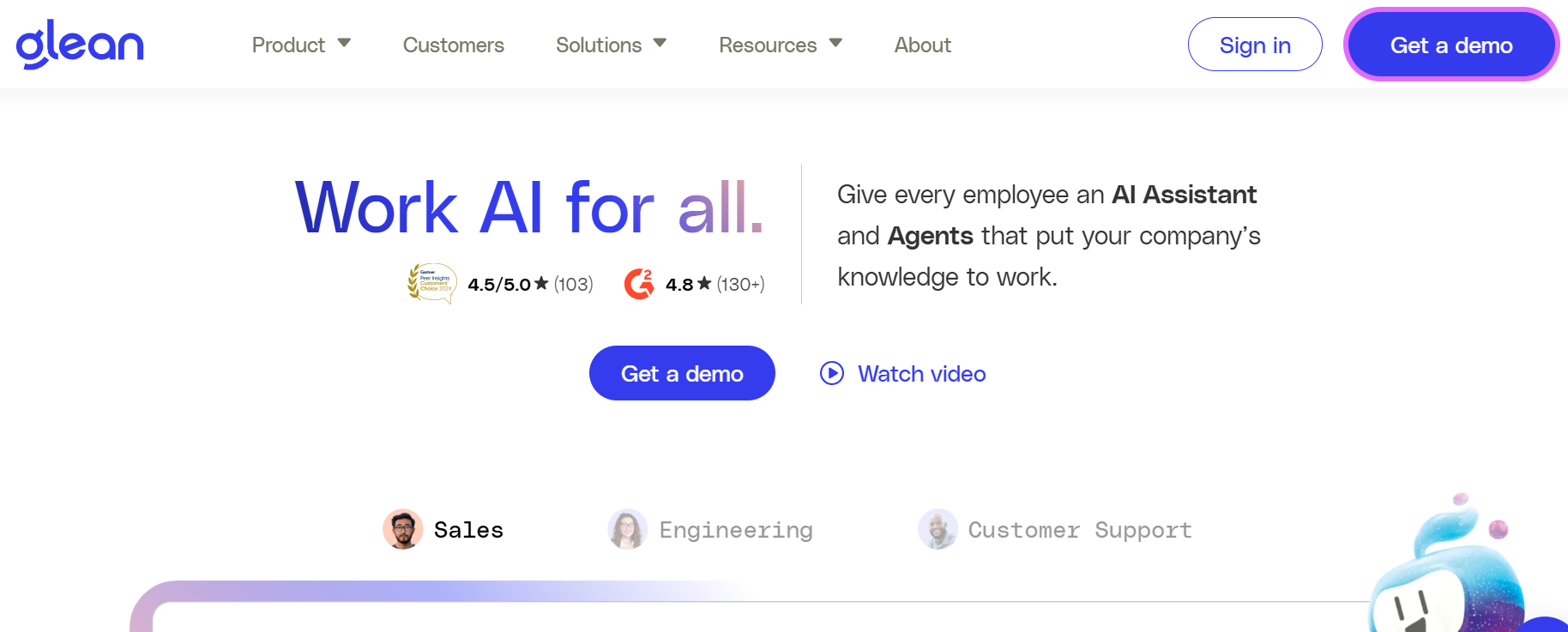
Glean is an AI-powered search tool designed to unify information across files, messages, tickets and documents. It emphasizes security and context-aware results.
Main features
- Automated content tagging
- Personalized results based on role and history
- Collaborative knowledge sharing
- Contextual awareness of user activity
- Semantic understanding of queries
- Verification of information freshness
- Integration with 100+ apps (Jira, Confluence, Gmail, Slack, Salesforce, etc.)
Benefits
- Provides a central knowledge hub
- Improves relevance of results
- Encourages collaboration
- Ensures data freshness
Pros and Cons
✅ Pros
- Highly personalized results
- Strong app integrations
- Semantic/contextual understanding
⚠️ Cons
- Pricing can be high
- Requires adoption efforts
- Limited custom workflow execution
Pricing
Custom, contact sales.
Best for
Mid-to-large enterprises seeking personalized, context-aware enterprise search.
3. Guru
What it is
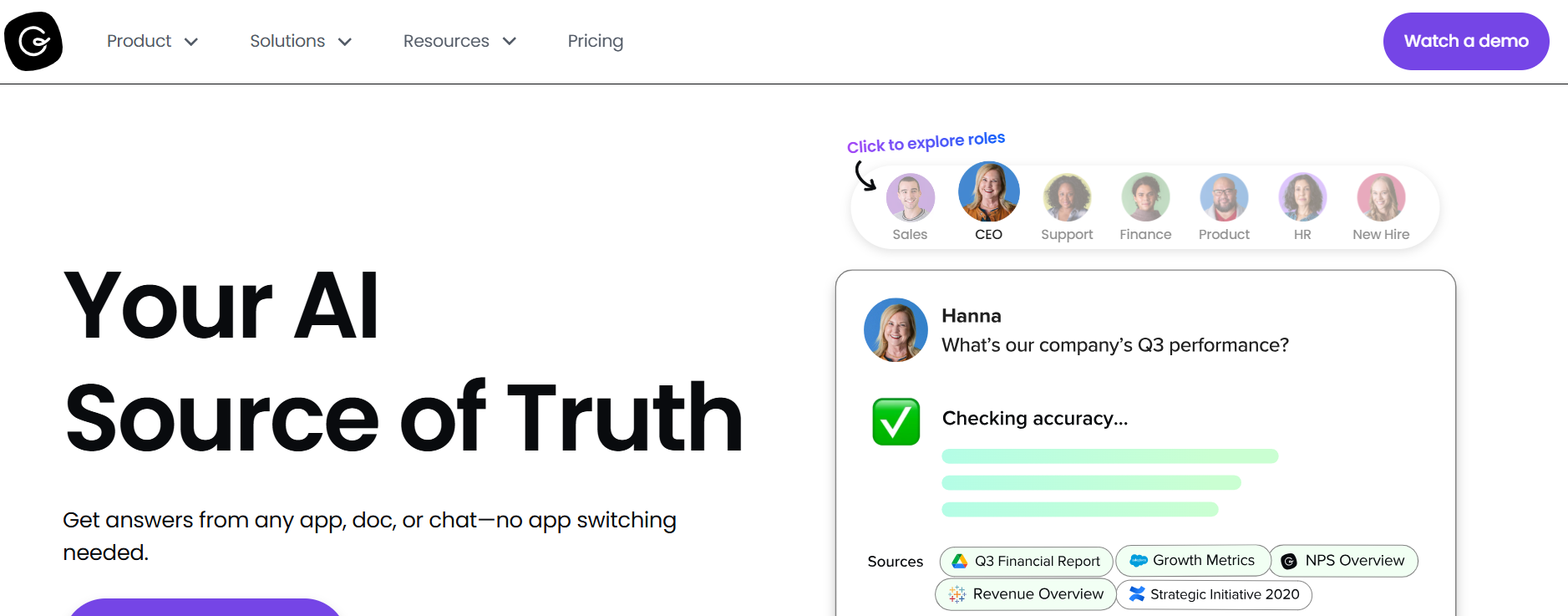
Guru began as a sales enablement tool and evolved into a company-wide knowledge management and search platform.
Main features
- Natural-language answers
- Centralized knowledge base
- AI dashboard for knowledge gaps
- Personalized search results
- Semantic search with continuous learning
- Integrations with Salesforce, Zendesk, Slack, Teams, Google Drive, Box, SharePoint
Benefits
- Provides direct answers instead of just links
- Keeps knowledge centralized and verified
- Highlights knowledge gaps with analytics
- Seamless integrations
Pros and Cons
✅ Pros
- Easy contribution and verification
- Personalized answers
- Semantic search
⚠️ Cons
- Limited analytics
- May not handle complex workflows
- Pricing may scale quickly
Pricing
Tiered (self-service for small teams, custom for enterprise).
Best for
Organizations needing a trusted, user-friendly knowledge base with direct answers.
4. Algolia
What it is
Algolia is a developer-friendly hosted search and discovery engine, popular for fast, customizable search.
Main features
- Searchable content with filtering/faceting
- Developer-friendly APIs and SDKs
- UI for analytics, A/B testing, reporting
- Natural-language understanding
- Integrations with Adobe, Zendesk, Salesforce Commerce Cloud
Benefits
- Lightning-fast search
- Highly customizable interfaces
- Strong analytics and testing support
Pros and Cons
✅ Pros
- Very fast search
- Flexible APIs
- Analytics
⚠️ Cons
- Requires technical resources
- Advanced features cost extra
- Not specialized for unified enterprise search
Pricing
Usage-based with free tier.
Best for
Developers/product teams needing fast, flexible search in apps or e-commerce.
5. Lucidworks Fusion
What it is
Lucidworks Fusion is a cloud-native, AI-powered search platform that helps organizations build and deploy intelligent search applications. It's built on top of Apache Solr and Apache Spark, offering a development platform for creating search and data applications with enterprise-grade features.
Main features
- AI-powered relevance and recommendations
- Deep connectors for SaaS and databases
- Customizable indexing/query pipelines
- Smart answers with NLP
- A/B testing for ranking
- Cloud or on-premises deployment
- Enterprise-grade security
Benefits
- Handles very large/complex datasets
- Advanced AI features
- Granular pipeline control
- Ideal for regulated industries
Pros and Cons
✅ Pros
- Top-tier AI performance
- Extensible
- Strong security
⚠️ Cons
- Steep learning curve
- Expensive
- Complex to set up
Pricing
Custom, contact sales.
Best for
Enterprises with massive datasets, needing custom ML pipelines.
6. Coveo Relevance Cloud
What it is
Coveo is a cloud-based platform focusing on personalized and predictive enterprise search.
Main features
- Unified central index
- Role-based personalization
- Predictive analytics
- Semantic search
- AI-driven recommendations
- Integrations with Salesforce, Adobe, SAP, Slack, SharePoint
Benefits
- Single source of truth
- Personalized, predictive experiences
- Flexible for customer-facing and internal use cases
Pros and Cons
✅ Pros
- Strong recommendations
- Unified index
- Analytics
⚠️ Cons
- Enterprise pricing
- Setup required for complex permissions
Pricing
Customized by use case.
Best for
Organizations wanting predictive, cloud-native enterprise search with recommendations.
7. Elastic Enterprise Search

What it is
Built on Elasticsearch, Elastic offers a flexible open-source search platform with NLP and ML-driven features.
Main features
- Data ingestion from multiple sources
- Federated search
- Search analytics
- NLP-based relevance
- Vector and hybrid search with ML
- Extensive integrations (Salesforce, Microsoft 365, Slack, Jira, etc.)
Benefits
- Open-source flexibility
- Strong developer community
- Advanced ML search capabilities
- Cost-effective entry tier
Pros and Cons
✅ Pros
- Free/basic tier
- Extensive integrations
- ML capabilities
⚠️ Cons
- Requires technical expertise
- Fewer built-in features for conversational use
Pricing
Free and paid tiers; paid scales with infrastructure.
Best for
Development teams seeking flexible, open-source enterprise search.
How to Choose the Right Enterprise Search Platform for Your Use Case?
Selecting the right enterprise search platform depends on aligning features with your organization's goals, scale, and technical environment. Here are the main factors to consider:
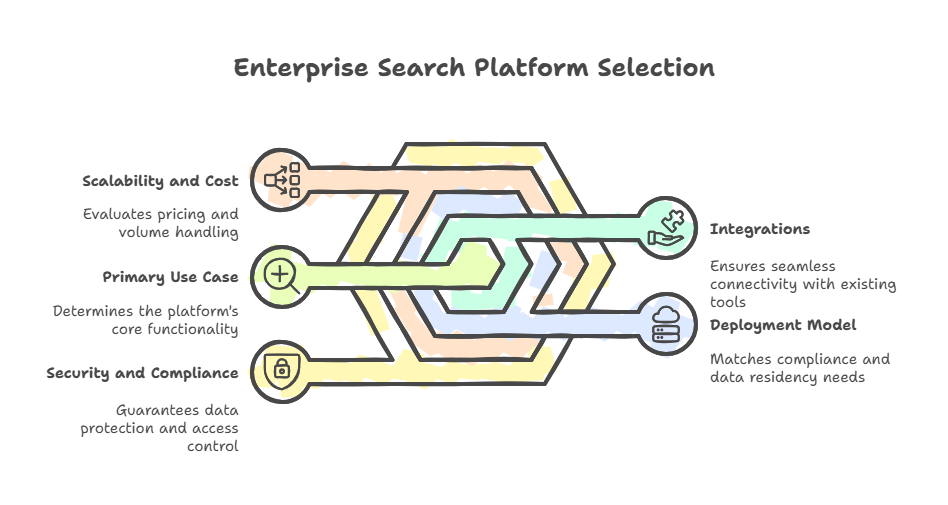
- Primary Use Case
- If your focus is employee productivity and IT/HR support, choose platforms like Rezolve.ai.
- For general knowledge management across SaaS tools, Glean and Guru shine.
- For developer-driven customization and product search, Algolia or Elastic may be best.
- For large-scale, data-heavy enterprises, Lucidworks Fusion or Coveo may offer the depth needed.
- Integrations
- Ensure the platform connects seamlessly with your existing collaboration tools (e.g., Teams, Slack), content sources (SharePoint, Google Drive, Confluence), and systems of record (HRIS, CRM, ITSM).
- Deployment Model
- Cloud-native (Rezolve.ai, Coveo) for quick deployment.
- Hybrid or on-premises (Lucidworks, Elastic) if compliance and data residency are critical.
- Scalability and Cost
- Consider whether pricing is per user, per query, or enterprise license. Test whether the model scales cost-effectively with your expected search volume.
- Security and Compliance
- Role-based access and permission respect should be non-negotiable, especially if sensitive data is indexed.
- User Adoption
- A technically powerful tool is only effective if employees actually use it. Prioritize platforms that integrate into daily workflows with minimal friction.
Ultimately, the right choice depends on whether you want search as a standalone knowledge tool or search as an integrated enabler of action and automation. Pilot testing with real users is often the best way to validate which platform fits your culture and needs.
Why Choose Rezolve.ai?
While each of the seven platforms has its strengths, Rezolve.ai stands out if your organization is seeking enterprise search designed specifically for employee support scenarios. Unlike tools that simply surface documents, Rezolve.ai focuses on delivering precise, summarized answers from across multiple knowledge repositories, enabling employees to quickly find the information they need without wading through long lists of files.
Key reasons to pick Rezolve.ai include:
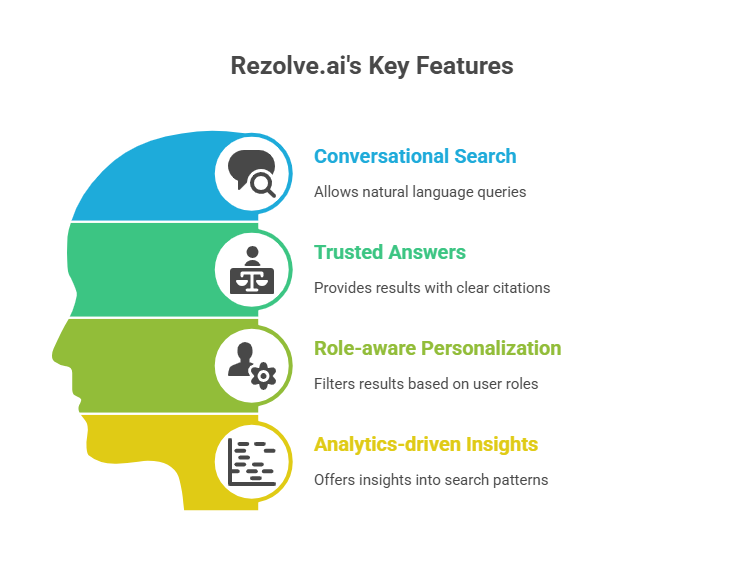
- Conversational, context-aware search – Employees can phrase queries in natural language, and the platform interprets meaning rather than relying only on keywords.
- Trusted answers with citations – Results are summarized with clear references back to the original source, ensuring accuracy and traceability.
- Role-aware personalization – Search results are filtered by the employee’s role and permissions, so users only see what is relevant and accessible to them.
- Analytics-driven insights – Admins gain visibility into top queries, gaps, and usage patterns, allowing continuous improvement of organizational knowledge.
If your priority is to streamline employee support, eliminate knowledge silos, and boost productivity, Rezolve.ai offers a purpose-built enterprise search solution that is tightly aligned to workplace needs—without the complexity of developer-heavy or e-commerce-focused tools.
Key Takeaways
- Search is mission-critical: Employees waste significant time searching; AI engines solve this.
- Different tools for different needs: Rezolve.ai excels at conversational search; Glean at context; Guru at knowledge centralization; Algolia at speed and customization; Lucidworks at advanced ML; Coveo at predictive recommendations; Elastic at open-source flexibility.
- Integration and deployment matter: Choose based on your existing stack and hosting model.
- Adoption requires change management: Training and continuous improvement are essential.
- Security is non-negotiable: Ensure permission models and compliance are enforced.
Conclusion
AI-powered enterprise search has matured rapidly. From all-in-one employee support platforms like Rezolve.ai to open-source engines like Elastic, organizations today have multiple strong options. Regardless of the platform chosen, natural-language understanding, semantic search, unified indexing, role-based personalization and analytics should be prioritized. With employees spending nearly a fifth of their day searching for information, intelligent search is no longer optional—it’s a strategic requirement.

FAQs
Q1. What is semantic search and why does it matter?
Semantic search uses vector representations and machine learning to understand the meaning behind a query rather than matching exact keywords. This allows more relevant results when users phrase queries in natural language.
Q2. How do AI search engines like Rezolve SearchIQ handle security and permissions?
Enterprise platforms enforce permission models from connected systems. Users only see results they’re authorized to access. Some also personalize results by role.
Q3. Do these platforms replace existing knowledge bases?
Most index existing sources rather than replace them.
Q4. What should I consider when choosing an enterprise search engine?
Evaluate your use case (internal vs external), data sources, needed features (summarization, conversational support), hosting preferences, and budget. Running a pilot can validate adoption before full rollout.


.webp)

.png)













.webp)