
The rise of agentic AI has fundamentally changed how enterprises search for and use knowledge. Traditional enterprise search tools could only match exact keywords, leaving employees to sift through long lists of results. Modern agentic AI platforms do much more: they understand natural language queries, reason about intent and context, and autonomously perform multi-step tasks. These agents don’t just respond to queries—they proactively retrieve, summarize, and act on information.
In this blog, we unpack how agentic AI elevates enterprise search and introduce Rezolve SearchIQ, our AI-powered platform that delivers instant, contextual answers across the enterprise. We’ll cover the evolution from keyword to semantic retrieval, core capabilities (NLQ, vector search, RAG), multi-source integration and security, real service-desk impacts, how Rezolve.ai implements it end-to-end, and practical criteria for choosing the right solution.
Agentic AI transforms enterprise search from basic keyword matching into intelligent, context-aware knowledge retrieval by integrating multiple data sources and understanding natural language. Rezolve.ai enhances this with AI-powered semantic search, unified search integration, and conversational follow-ups, delivering instant, personalized answers to employees.
Why Agentic AI Matters for Enterprise Search
Agentic AI refers to systems that autonomously reason, plan and execute tasks. In 2025 these systems are no longer experimental; 45% of Fortune 500 companies are piloting agentic AI. In IT service desks, agentic AI agents have reduced Tier-1 and Tier-2 ticket resolution times by up to 72%. For knowledge management, they can handle over 60% of internal knowledge requests and cut response times from hours to minutes. These efficiencies stem from agents’ ability to interpret intent, search across diverse systems, learn from interactions and summarize answers.
The Evolution of Enterprise Search
AI enterprise search uses natural language processing (NLP), machine learning (ML) and retrieval-augmented generation (RAG) to understand what users are looking for and to deliver precise answers. Unlike keyword-based search, it can infer meaning, recognize synonyms and draw information from multiple sources simultaneously. AI enterprise search systems understand plain-language questions and use vector search to find content with similar meaning. They also respect existing data governance by enforcing permission models and keep results current by accessing real-time data.
Key capabilities of effective AI enterprise search include:
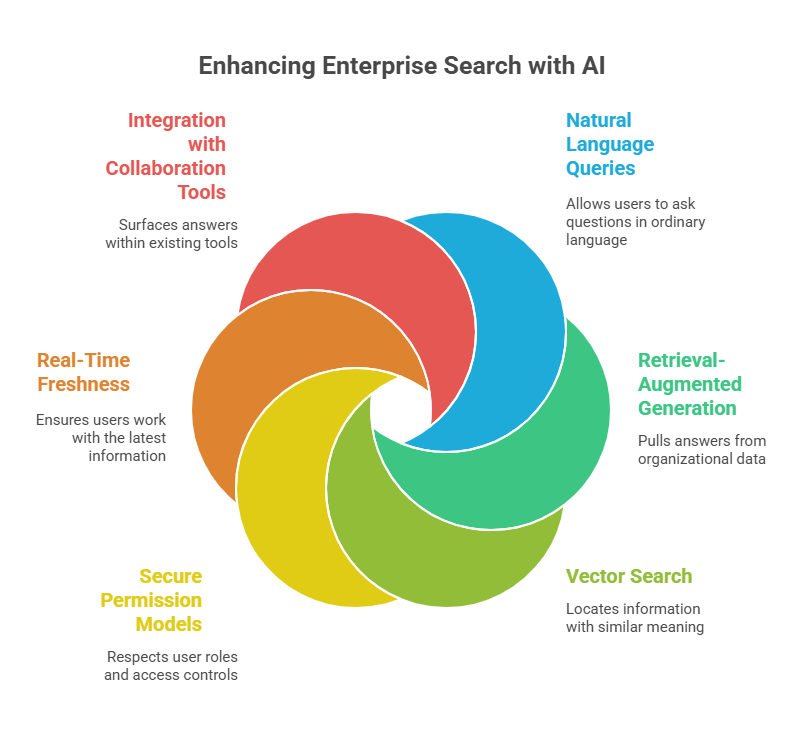
- Natural language queries: Employees should be able to ask questions in ordinary language instead of using specific keywords.
- Retrieval-Augmented Generation (RAG): The search engine pulls answers from your organization's data rather than generic public sources.
- Vector search: Locates information with similar meaning even if the exact terms do not match.
- Secure permission models: Search results respect user roles and access controls.
- Real-time freshness: Connected systems ensure you always work with the latest information.
- Integration with collaboration tools: The best solutions surface answers within the tools teams already use, reducing app-switching.
In 2023, over 90% of knowledge workers who use AI reported higher productivity. That boost largely comes from eliminating time-consuming searches and presenting the right information at the right time. AI search also breaks down information silos, pulling data from chat conversations, documents and other apps, and enhances support by letting agents access relevant details instantly.
The Agentic AI Platform: Turning Search into Action
From Search to Conversation
In agentic AI platforms, search is no longer a one-and-done query. Agents remember context and support conversational follow-up. Employees can ask clarifying questions or request deeper details, and the agent refines its answers. This interactive loop feels like chatting with a colleague rather than issuing disconnected queries.
Multi-Source Integration
Enterprise knowledge lives in many places: SharePoint, Google Drive, Confluence, wikis and ticketing systems. AI search platforms unify these sources, indexing structured and unstructured data. Unified search prevents users from hunting across multiple repositories and ensures a single source of truth.
Semantic Understanding and Summarization
Using vector embeddings and large language models, semantic search finds information with similar meaning and synthesizes a concise answer. Rezolve SearchIQ summarizes answers with citations, highlighting document excerpts and linking back to source files. This reduces cognitive load and provides traceability.
Personalization and Insights
Role-based personalization tailors results to the user’s department, role or access rights. For example, an HR employee searching for “leave policy” should see the HR handbook first, while a manager might see approval workflows. Behind the scenes, an admin dashboard provides search insights such as top queries, unanswered questions and team-level usage trends. These analytics reveal knowledge gaps and training needs.
Rezolve SearchIQ AI Enterprise Search Key Features
Rezolve SearchIQ combines the best of agentic AI with enterprise-grade security and service-desk integrations:
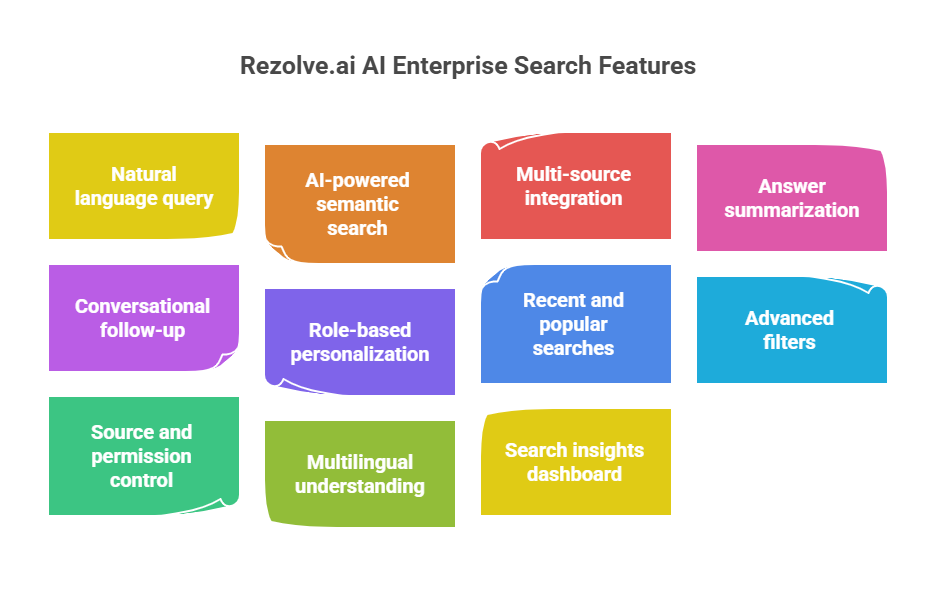
Natural language query support
Employees can ask questions the way they speak—no keyword gymnastics. The system parses intent to surface the most relevant answer fast.
AI-powered semantic search
Uses embeddings and LLMs to understand meaning, not just words. Finds conceptually related content even when phrasing doesn’t match.
Multi-source integration
Unified index across SharePoint, Google Drive, OneDrive, Confluence, Notion, internal wikis, and ITSM tools. One search bar, all your knowledge.
Answer summarization with citations
Generates concise, trustworthy answers with highlighted excerpts and links back to the original source so users can verify details instantly.
Conversational follow-up
Keeps context across turns so users can refine, drill down, or pivot without starting over—like chatting with a knowledgeable teammate.
Role-based personalization
Prioritizes results based on department, role, and permissions so each user sees what’s most relevant to their work.
Recent and popular searches
Surfaces trending queries and frequently accessed items to speed up discovery and inform content curation.
Advanced filters (file type, date range, department, language, location)
Let power users narrow results in seconds, cutting through noise to the exact doc or snippet needed.
Source and permission control
Admins can potentially include/exclude sources, enforce least-privilege access, and mirror system-of-record permissions for secure retrieval.
Multilingual understanding
Understands and retrieves across major languages, helping globally distributed teams find answers in their preferred language.
Search insights dashboard
Real-time analytics on top queries, zero-result searches, and adoption trends—so you can fix knowledge gaps and measure impact.
How Rezolve SearchIQ Compares to Existing Solutions?
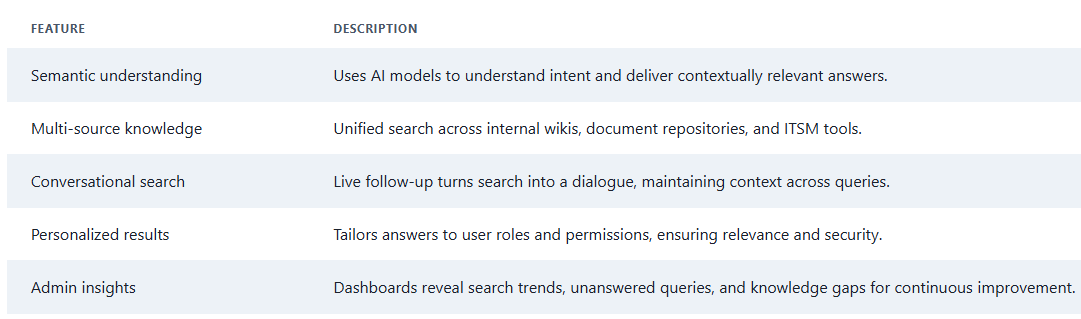
Benefits for IT Service Desks and the Broader Enterprise
With agentic search embedded in your service desk, the impact shows up fast in day-to-day operations. Below are the concrete benefits—from faster resolutions and fewer escalations to analytics-led improvements, and airtight governance.
- Faster issue resolution: AI search dramatically reduces the time agents spend looking for answers.
- Reduced escalations: Tier-1 agents have immediate access to documentation, reducing expert intervention.
- Better employee experience: Clear, concise answers with citations empower employees to resolve issues themselves.
- Data-driven improvements: Analytics highlight where users struggle, guiding content curation and training.
- Security and compliance: Potential to enforce source-level permissions to protect sensitive data.
Choosing an AI Enterprise Search Solution
Organizations should:
- Map existing systems to identify critical knowledge sources.
- Prioritize security and compliance.
- Evaluate user experience for intuitive interfaces and fast results.
- Check integration capabilities with collaboration and business tools.
- Assess AI capabilities for natural language understanding.
In Closing
Enterprise search is no longer about keyword strings and endless scrolls. Agentic AI platforms transform search into a dynamic, conversational experience that understands intent, summarizes knowledge and initiates actions. Organizations that invest in intelligent search will see dramatic productivity gains. Rezolve.ai’s enterprise search stands out with its natural language queries, multi-source integration, personalized results and robust admin controls. By turning every employee into a decision-maker with instant access to knowledge, it helps service desks resolve issues faster and empowers teams across the enterprise.
Key Takeaways
- Agentic AI is the future of enterprise search.
- Semantic search understands intent and context.
- Multi-source integration eliminates silos.
- Personalization and security enhance relevance and protect data.
- Data-driven analytics reveal content gaps and training needs.
Frequently Asked Questions
Q1. How is AI enterprise search different from traditional search?
Traditional search matches keywords and requires users to know exactly what they’re looking for. AI enterprise search understands the intent behind questions, recognizes relationships between concepts, and combines information from multiple sources to provide direct answers and summaries.
Q2. Does AI enterprise search with Rezolve.ai improve data security?
Yes. AI search platforms like Rezolve.ai enforce existing permission models and only return results users are authorized to see. Real-time federated search ensures up-to-date permissions.
Q3. Can I customize AI enterprise search?
Modern platforms allow administrators to configure which data sources to index, adjust relevance algorithms and define custom metadata. Rezolve.ai also provides advanced filters for file type, date range, department and more, letting organizations tailor the experience to their needs.


.webp)

.png)










.webp)