ServiceNow AI Licensing in 2026: What "AI Included" Actually Means
ServiceNow replaced Standard, Professional, and Enterprise with AI-native Foundation, Advanced, and Prime tiers, and legacy SKUs are now end-of-sale. Here is what changed, what is still unclear, and how to evaluate your options.

Key takeaways
- ServiceNow's April 2026 commercial model replaces legacy ITSM tiers with Foundation, Advanced, and Prime; legacy SKUs reached end-of-sale on July 1, 2026
- Every tier now bundles Now Assist with a metered "Assist" allowance, while Virtual Agent conversations are described as unlimited
- "AI included" does not mean unlimited AI: usage is consumption-based, and the exact allowance values are not publicly listed
- Buyers comparing options should price the AI they will actually use, not the tier label, and evaluate AI-native alternatives on resolution outcomes
If your ServiceNow renewal notes still say Standard, Professional, or Enterprise, they are out of date. In April 2026, ServiceNow replaced its legacy ITSM packaging with three new tiers (Foundation, Advanced, and Prime), under what it calls an AI-native commercial model. Community guidance indicates the legacy SKUs reached end-of-sale on July 1, 2026, which means every customer will eventually cross this bridge at renewal or migration.
The headline is simple: AI is no longer an add-on. Now Assist generative AI is bundled into every tier with an "Assist" allowance, and Virtual Agent conversations are described as unlimited. The details are less simple, and they are where budgets get decided. This post walks through what changed, what "AI included" actually means in practice, and the questions to ask before you sign.
What changed: from module tiers to capability tiers
The old ITSM structure was organized around process coverage, the higher the tier, the more ITIL modules you unlocked. The new structure is organized around how much AI autonomy you license:
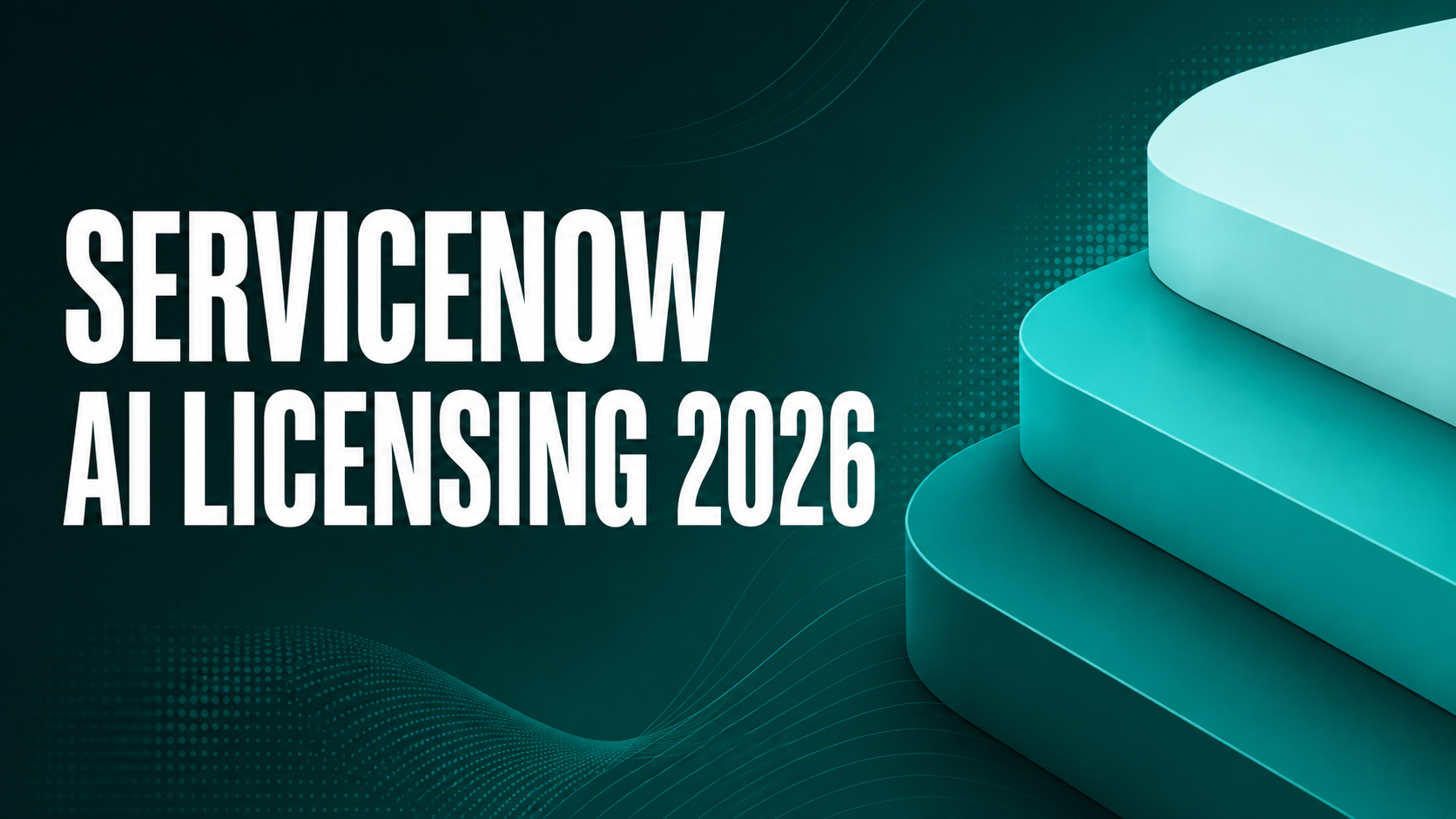
- Foundation is the entry tier: incident (basic), request, asset and cost management, CMDB, Virtual Agent, Predictive Intelligence, and Now Assist for ITSM at a configured, out-of-the-box level.
- Advanced adds the fuller ITIL suite (problem, change, major incident, on-call, and walk-up), plus deeper analytics, process mining, AI voice agents, and higher Assist allocations.
- Prime includes everything in Advanced and is the only tier that allows you to build net-new custom AI skills and AI agents, alongside autonomous AI agents, an L1 service desk AI specialist, and the highest Assist allocations.
In other words, the tiers no longer differ by whether AI is present. They differ by whether that AI assists, acts, or operates autonomously, and by how much of it you are allowed to consume.
What "AI included" actually means
This is the part most renewal conversations gloss over. Bundled AI in the new model is consumption-metered. Now Assist usage is counted in units called assists, consumed each time a skill runs. A lightweight action such as a ticket summary consumes far less than a multi-step agentic workflow. Each tier ships with an Assist allowance, and heavier usage draws against that pool.
Three practical implications follow:
- "Included" is not "unlimited." Virtual Agent conversations are described as unlimited, but Now Assist skills run against a metered allowance. If your AI adoption succeeds (more summaries, more agentic resolutions, more automated workflows), your consumption climbs with it.
- The allowance values are not publicly listed. ServiceNow has not published exact per-action assist costs or bundled pool sizes per tier, so any specific numbers circulating in partner material should be treated as estimates until they appear in your order form.
- Success has a variable cost. In a per-seat world, adoption was free once you bought the seat. In a consumption world, the better your AI performs, the more carefully you need to forecast and govern usage.
None of this makes the model bad. Bundling AI into every tier is genuinely simpler than the previous maze of Pro Plus and Enterprise Plus add-ons. But "simpler packaging" and "predictable cost" are not the same thing.
What does "AI included" actually cost?
Compare ServiceNow's AI licensing tiers with Rezolve.ai side by side.
Questions to ask before your migration or renewal
Whether you stay on ServiceNow or evaluate alternatives, get written answers to these before signing:
- What is our Assist allowance, in numbers, per tier, and what happens when we exceed it? Ask for overage rates and whether unused allowance rolls over.
- How do our current workflows map to assist consumption? A summary, a drafted reply, and an end-to-end agentic resolution consume very differently. Model your last twelve months of activity against the meter.
- Which of our legacy entitlements do not carry over cleanly? Migrations from Standard, Professional, or Enterprise will not always land on an obvious equivalent, and the tier that matches your process footprint may differ from the tier that matches your AI ambitions.
- Are we paying for autonomy we will not deploy? Custom AI agent creation lives only in Prime. If you do not have a funded program to build agents, you may be buying capability that sits idle.
- What governance exists over consumption? Someone in your organization now needs to watch an AI meter the way FinOps teams watch cloud spend.
The bigger question: is the platform the point, or is resolution the point?
The new tiers are a bet that customers want to license AI maturity levels on a platform. But most service desk leaders are not buying maturity levels. They are buying outcomes: fewer tickets, faster resolutions, employees who get answers where they already work.
That is worth keeping in view when comparing AI-native options. At Rezolve.ai, the model is built around resolution rather than consumption tiers: Sidekick meets employees in Teams, Slack, email, and voice, answers with grounded, cited responses, and executes fixes, resolving roughly 70% of requests before they ever become tickets. Agent Assist supports the agents behind the queue with triage, summaries, and drafted replies, while Agent Studio lets teams build governed, approval-gated agents in plain language, without a top-tier licensing gate on who is allowed to create automation. DeskIQ then mines your ticket history to show what to automate next. And because Rezolve.ai runs on a true ITSM system of record, standalone or alongside ServiceNow, you are not forced into a rip-and-replace decision to get AI-first service delivery.
Organizations like JLL (roughly 100,000 employees across 80+ countries) and TotalEnergies Denmark run employee-facing AI on Rezolve.ai today, and Black Angus Steakhouse cut after-hours IT dependency from 90% to 10%. The platform is rated 4.8/5 on G2 and carries SOC 2 Type II, ISO 27001, GDPR, and HIPAA-ready credentials.
Bottom line
ServiceNow's Foundation, Advanced, and Prime tiers are a real simplification of a genuinely complicated legacy catalog, and bundled AI in every tier is a meaningful upgrade over the old add-on model. But "AI included" comes with a meter attached, the allowance math is not yet public, and the July 1 end-of-sale date means the migration decision is no longer optional.
Before you renew, price the AI you will actually use, not the tier label. And if the outcome you want is resolution rather than platform tiers, it is worth seeing what an agentic, governed, glass-box service desk looks like side by side. Book a demo or compare pricing.
Last updated on August 27, 2026
Get summary with:
See the agentic service desk in action
Watch Rezolve.ai autonomously resolve real IT and HR tickets: governed, auditable, glass-box.