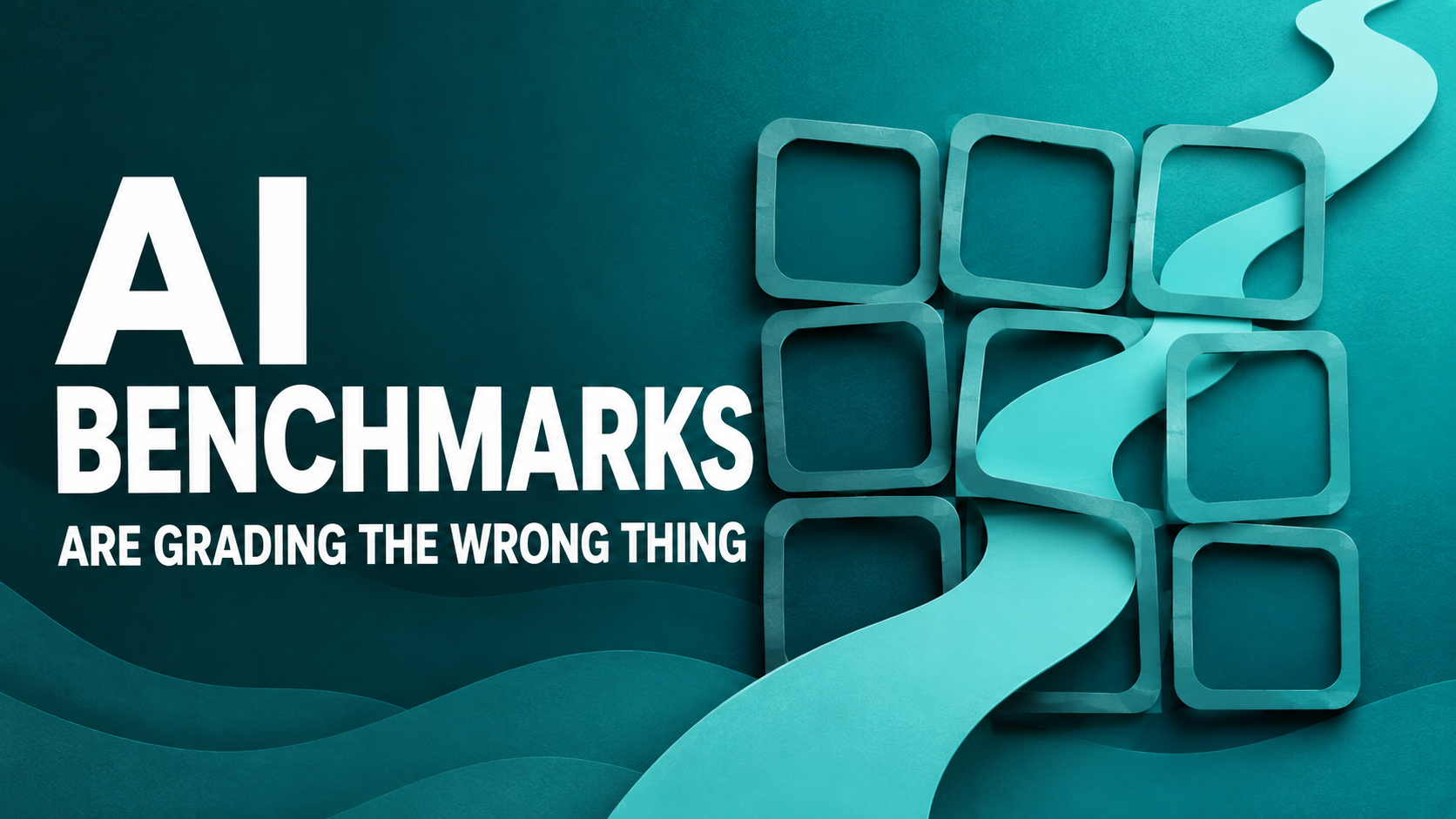
AI Benchmarks Are Grading the Wrong Thing
We keep testing whether models can juggle. The better question is whether the tools they hold are sharp. Smart tools let models be dumb, and systems be reliable.

Key takeaways
- Benchmarks reward models for orchestrating multi-step processes, the exact work that should live in deterministic tools
- A model chaining ten AI calls is improvised orchestration code; real orchestration belongs in the tool layer
- Smart tools shrink the model's job to judgment and language, which is where models are actually good
- Reliability, governance, and auditability come from the system design, not from a higher benchmark score
There is a pattern in how we evaluate AI right now, and it is quietly steering the industry in the wrong direction. Benchmarks increasingly grade models on their ability to orchestrate: plan a dozen steps, call a series of tools in the right order, hold intermediate state in their heads, recover when step seven fails. The leaderboards celebrate the model that can juggle the most balls at once.
I think that is grading the wrong thing. Tools should be smart. Models can be dumb.
The juggling test
When a benchmark asks a model to string together a long sequence of actions (search, extract, transform, call another model, merge, decide, retry), it is really asking the model to behave like orchestration code. And the model obliges, badly. It improvises a workflow in natural language, token by token, with no transaction boundaries, no retry semantics, no state it can't accidentally forget.
We would never accept this from software. If an engineer proposed replacing a workflow engine with an intern who keeps the whole process in their short-term memory and narrates it aloud, we would decline. Yet that is functionally what a lot of "agentic" benchmarks measure, and what a lot of agentic products ship.
The failure math is unforgiving. A model that executes each step correctly 95% of the time completes a ten-step improvised chain far less often than anyone would tolerate in production. Nobody's change-management process should hinge on a probabilistic juggler having a good day.
Orchestration belongs in the tool
The alternative is old-fashioned and unglamorous: put the process in the tool. Sequencing, branching, retries, state, permissions, rollbacks. These are deterministic concerns, and deterministic code handles them perfectly every time. A password reset, an access grant, an onboarding flow: each is a known process with known steps. Encode it once, correctly, and it never forgets step seven.
When the tool carries the process, the model's job collapses to the parts models are genuinely good at: understanding what a person is asking for, choosing the right tool, filling in its parameters, and explaining the outcome in plain language. That is a small job. A modest model does it well. And a small job is a testable job. You can measure whether the model picked the right tool with the right inputs, instead of grading a fifty-step transcript for vibes.
"Smart tools, dumb models" is not a downgrade
This framing sounds like it diminishes the model. It doesn't. It puts intelligence where each kind of intelligence works. Models are superb at language, intent, and judgment at the boundaries. They are unreliable as process engines. Tools are the opposite. A system that pairs a competent model with rich, well-designed tools will beat a frontier model improvising over thin tools, and it will do so at lower cost, with lower latency, and with failure modes you can actually reason about.
It also changes what "better" means. If your architecture leans on the model to orchestrate, every reliability improvement requires a smarter model. You are renting your roadmap from a lab's next release. If your tools are smart, you improve the system by improving the tools, which is engineering you control.
What this means for enterprise AI
This is not an academic distinction for us. In an IT or HR service desk, autonomy without governance is a liability. The reason to keep orchestration in the tool layer is not just reliability. It is that a defined process can be approval-gated, audited, and explained. You can show exactly what ran, in what order, under whose authorization. Try reconstructing that from a model's freeform chain of thought.
It is why we build the way we do at Rezolve.ai: specialized agents reasoning over a shared conversation, calling governed tools that carry the process, rather than one giant model improvising the whole workflow. The model decides what the employee needs. The tool guarantees how it happens.
Grade the system, not the juggler
So here is the benchmark I would rather see: hold the model constant and vary the tools. Measure task completion, cost, latency, and auditability of the whole system. Reward architectures that fail safely. Stop awarding points for a model white-knuckling its way through a process that a hundred lines of orchestration code would execute flawlessly.
Until then, read the leaderboards with some skepticism. The model that juggles best in the lab is not the system that resolves issues reliably at work. Smart tools, dumb models. It is less exciting, and it is how this actually gets done.
Last updated on August 27, 2026
Get summary with:
See the agentic service desk in action
Watch Rezolve.ai autonomously resolve real IT and HR tickets: governed, auditable, glass-box.
Writes about agentic AI for IT and HR service delivery.
LinkedIn ↗