The affordability crisis in enterprise service management
Nobody ever approved a doubling of the ITSM bill; everybody approved six reasonable increases. Why that pattern has become an affordability problem, and what to do at renewal.

Key takeaways
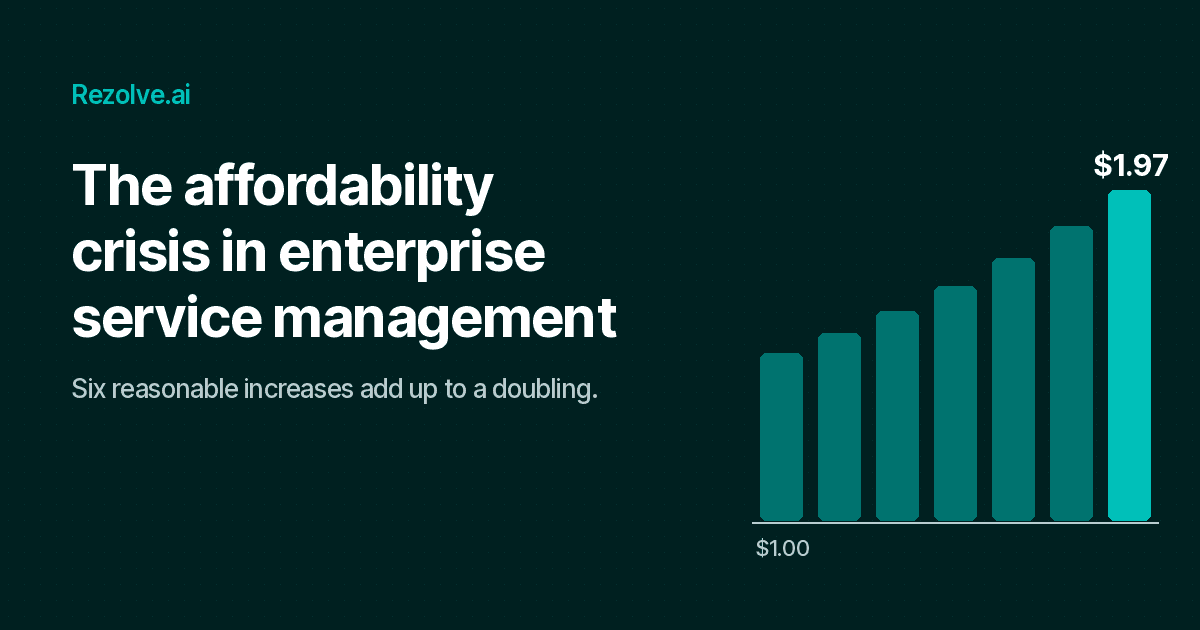
- At 10 to 12% a year, a dollar of ITSM spend becomes $1.77 to $1.97 in six years, without anyone ever approving a doubling.
- SaaS inflation hit a record 16.4% in June 2026 (Vertice), and 61% of IT leaders cut projects over unplanned software cost increases (Zylo).
- Three mechanisms compound: the contracted uplift, costs that are not metered until they are, and the complexity tax.
- Ticket volume is flat or falling while the invoice rises, so cost per ticket climbs faster than the invoice.
- Expect erosion at renewal (tier downgrades, shorter terms, seat true-downs) long before outright migration.
There is an affordability crisis in enterprise service management, and it has arrived slowly enough that most of the organizations living through it have never named it as one.
It is sharpest for the people who have been loyal the longest. If you signed your first serious service management contract seven or eight years ago and have renewed with the same vendor ever since, you have absorbed an increase at every one of those renewals. Each was individually arguable, and none was worth a fight on its own. That is what makes the pattern hard to see from inside it. At 10 percent a year a dollar of spend becomes $1.77 after six years, and at 12 percent it becomes $1.97. Nobody ever approved a doubling; everybody approved six reasonable increases, one at a time.
The explanation on offer at the moment is AI, and the premium vendors will tell you the pricing reflects what they are investing in it. Some of that is fair, and I am not going to pretend otherwise. We build AI products ourselves, so I know what the investment costs, and nobody in this industry is giving that work away. But the explanation is not really the point, because the explanation keeps changing and the direction never does. Before AI it was the platform, before the platform it was module expansion, and before that it was simply the uplift written into the paper. For roughly ten years the number on the renewal has gone up every single year, through whatever happened to be the announcement of that era. The justification changes every few years; the direction of the invoice never does.
What the crisis actually looks like
Software pricing has come loose from every other price in the business. Vertice, which bases its index on more than $75 billion of software spend it processed this year, recorded a record SaaS inflation rate of 16.4 percent in June 2026. The rate cooled over the summer without ever dropping below 12 percent, and preliminary September data has it back up at 14.3 percent. General inflation across most economies, meanwhile, has settled down.
Inside an organization that shows up in three numbers from Zylo's 2026 SaaS Management Index. Seventy-nine percent of IT leaders saw a price increase at renewal in the previous twelve months, and 77 percent had costs surface after a contract was already signed. The one that matters is the third: 61 percent had to cut projects because of unplanned increases in software cost. That is where a pricing complaint becomes an affordability problem, because work the business asked for did not happen. For most of the last decade an organization could absorb an increase by trimming elsewhere. The slack is gone.
Why it compounds rather than simply rising
Three mechanisms stack, which is why this crept up on people.
The contracted uplift is the one everybody knows about, commonly 7 to 12 percent at the premium end, as our ServiceNow pricing guide breaks down. The detail that matters is not the rate but the base. The base grows with headcount and with every module added mid-term, so an uplift negotiated against one number compounds against a larger one every year after.
The part that is not metered until it is arrives as true-ups priced above your renewal rate, as modules that turn out to be prerequisites for modules you wanted, and lately as AI consumption quoted going in as a rounding error. AI being "included" does not make it free. Three-quarters of IT leaders reporting costs that surfaced after signing is not an accident of procurement.
The complexity tax is the largest of the three and almost never counted. These products became materially more capable over the last decade, and capability in enterprise software is paid for in configuration, which is paid for in specialists. A certification market exists around the premium platforms because the product cannot be run without one. The license is joined by a platform team, an integrator retainer, non-production instances and an annual upgrade cycle, all of it keeping the lights on rather than moving anything forward. As we have written separately, the license is the small number.
The work is shrinking while the price climbs
All of that would still be a negotiation if the work were growing. A rising price for a falling volume of work is something else.
There is a transition underway toward what I have called the ticketless enterprise, and the striking thing is how many organizations are on that path without having named it. Fixify's 2026 benchmark of more than 50,000 tickets puts identity and access at about 16 percent of service desk volume, and it is already among the most automated categories in enterprise IT. Joiners, movers and leavers take another 17 percent, and they were always coordination work wearing a ticket's clothing. Applications, the largest bucket at 38 percent, get quieter on their own as SaaS removes the break-fix failures that generated them. And device faults are increasingly resolved where the fault actually is. That is what our agentic endpoint product, Rapport, does on the machine itself, rather than inferring the problem from five minutes of somebody else's screen.
Put the halves together and the squeeze shows up in one figure almost nobody calculates. The price rises at double digits while the volume of work processed is flat or falling. That means cost per ticket is climbing considerably faster than the invoice, and it is the only number in this discussion a CFO understands instantly. It is also why ticket deflection is the wrong number to report on its own.
The cost of building software is falling, which changes the floor
Here is the part that makes continued double-digit increases a strategic mistake rather than simply an expensive one.
The cost of building enterprise software has dropped sharply, and it is still dropping. That does not make incumbents obsolete, and the honest caveat belongs here rather than in a footnote. As Maya Mikhailov of SAVVI AI puts it, "AI makes it dramatically easier to write software. It does not make it easier to run enterprise software." Running it at enterprise scale is still hard: security, data residency, the thousandth edge case, a migration that does not break the business. It is still where most young products fall over.
But a lower cost of building is a lower floor under price, and competitors who started recently do not carry a decade of accumulated price increases they have to defend. Plenty of them lack the deployment experience to be a serious candidate for a large estate. Some combine a modern cost base with real enterprise scar tissue, and those are the ones that make the floor meaningful. Rezolve.ai is one of them. We have spent 9+ years in the AI service desk industry and serve more than 200 enterprise customers. We also received the highest score of 10 products evaluated in two of three Use Cases, AI for End-User Self-Service and AI for IT Agents, in the 2026 Gartner® Critical Capabilities for AI Applications in IT Service Management. Collin Hogue-Spears of Black Duck describes the result as the most credible pricing pressure SaaS vendors have faced since cloud computing displaced on-premises licensing.
The market has already started repricing this. ServiceNow, the clearest public proxy for the premium end of the category, closed at $102.76 on 9 November 2026. At the time of writing that is down roughly 40 percent across the preceding twelve months and about 56 percent below its January 2025 closing high of $234.08.
What makes that worth citing is the reason rather than the number. The most recent quarter was a beat, with subscription revenue up 21 percent and operating margin ahead of guidance. But management guided fourth-quarter cRPO, the contracted backlog due to become revenue over the next year, to grow 18.5 percent. That is three points slower than the subscription revenue it guided for the same quarter. The company attributes the gap to timing, including renewals pulled forward into the third quarter; skeptics read it as the first visible sign of seat-based renewals eroding. The CFO called the AI-disruption narrative "false," and the stock posted its largest one-day fall in over a year anyway. UBS had already cut it to neutral in April, citing budget pressure as enterprise spending shifted toward AI.
Reasonable people disagree on whether the market is right. What is not in dispute is the direction of the forces: build costs down, credible alternatives multiplying, and the volume of work being licensed heading the other way. Raising price into that is a decision with a shelf life.
How I think this resolves
When senior management says to take cost out, the reflex is headcount. Gartner's survey of finance leaders suggests that reflex has already fired: three-quarters of CFOs expect technology budgets to rise while expected headcount growth collapses from 6 percent to 2 percent. But headcount reduction is slow, visible, politically expensive and essentially a one-time move. A software line is none of those. It is one decision, invisible outside the budget, and the saving recurs every year once taken. It is also the line a CFO will ask IT to defend.
So, two predictions.
The first movers will not be the smallest organizations. They will be the segment between upper mid-market and true enterprise, somewhere between two and fifteen thousand employees. Those organizations carry premium pricing without the breadth of use that justifies it: they bought a product capable of running IT operations, security operations and governance, and they use it for service management. Genuinely large enterprises follow more slowly, and for a different reason. At their scale the absolute number is big enough that the CFO raises it without anybody in IT starting the conversation.
And it will not look like migration, at least not at first. It will look like a tier downgrade, a one-year term instead of three, a true-down of seats nobody uses, a module quietly not renewed. The erosion happens at renewal, in increments, long before anyone announces they are replacing anything. That is harder to see coming than a competitive loss, and considerably harder to reverse.
If you are the person holding that line item
- Calculate fully loaded cost per fulfiller and per ticket, and plot both over three years. The per-ticket line is what changes the internal conversation, and most organizations have never drawn it.
- Separate the system of record from the intelligence layer in your budget as well as your architecture, because bundling them conceals which one is actually growing.
- Buy shorter. One or two years costs some discount and buys back the ability to act on a forecast you believe. If your renewal is within the next year, start that negotiation now.
- Put a number on the complexity tax. If the platform team, integrator and upgrade cycle cost more than the license, and they frequently do, that belongs in any comparison.
Back to the six reasonable increases
Nobody in this story made an obviously bad decision. Each renewal was negotiated by somebody competent, against a justification that sounded fine at the time, for an increase small enough that escalating it would have looked like a waste of everyone's attention. That is how a line item doubles without a single person deciding to double it.
What has changed is that the slack which used to absorb those increases is gone. The volume of work on the other side of the invoice has started falling, and the cost of building the alternative has dropped far enough that the price can be tested rather than merely resented. The organizations that come out of this well will be the ones that ran those numbers themselves, early, and treated the renewal as the decision it always was. The ones that come out of it badly will be the ones whose CFO ran the numbers first.
If you want help putting your own figures against that comparison, learn more. And if it is the objections to moving rather than the economics that are stopping you, we went through those one at a time in there is zero reason, anymore, to buy an overpriced ITSM or ESM.
Last updated on November 11, 2026
Get summary with:
See the agentic service desk in action
Watch Rezolve.ai autonomously resolve real IT and HR tickets: governed, auditable, glass-box.
Frequently asked questions
Why do ITSM renewal prices keep rising?
Most premium ITSM contracts carry a contracted annual uplift, commonly 7 to 12 percent, applied to a base that grows with headcount and mid-term modules. True-ups, prerequisite modules and AI consumption add further increases, so costs compound even when each individual renewal looks reasonable.
How high is SaaS inflation in 2026?
Vertice recorded a record 16.4 percent in June 2026, based on more than $75 billion of processed software spend. The rate cooled to 12.7 percent in August, and preliminary September data shows 14.3 percent. It has stayed in double digits all year while general inflation has settled.
What is the complexity tax in ITSM?
It is the cost of running a highly configurable product: a dedicated platform team, integrator retainers, non-production instances and an annual upgrade cycle. For many organizations it costs more than the license itself, yet it rarely appears in renewal comparisons.
How do you calculate cost per ticket for ITSM?
Divide the fully loaded annual cost (license, platform team, integrator, infrastructure and upgrades) by the number of tickets processed. Plot it over three years. If the invoice rises while volume is flat or falling, cost per ticket climbs faster than the invoice.
How can organizations reduce ITSM costs at renewal?
Start negotiating early, buy shorter terms, true down unused seats and question modules nobody uses. Separate the system of record from the intelligence layer in the budget, and put a number on the complexity tax so any alternative is compared on fully loaded cost.