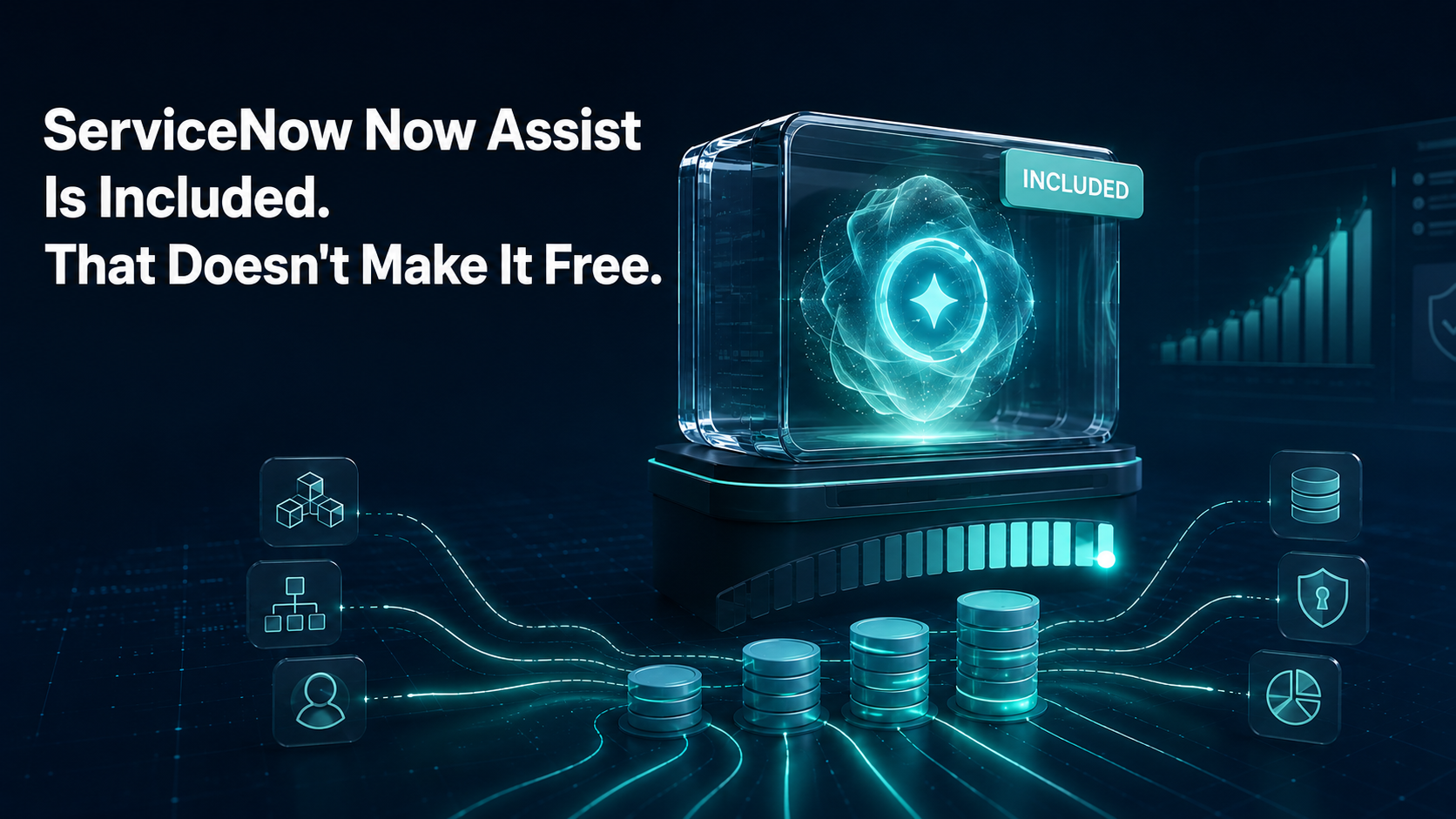
ServiceNow Now Assist Is Included. That Doesn't Make It Free.
Now Assist is bundled into ServiceNow but metered by consumption. Understand what that means for cost, readiness and adoption—and when staying native or adding an independent AI layer makes sense.
.png)
Anyone who accepts that agentic AI belongs in their service desk asks the obvious follow-up question: why not just use the AI ServiceNow already gave us?
It is bundled. It is native. Nobody has to sign anything, sit through another security review, or explain a second vendor to procurement. That is a serious question and it deserves a straight answer rather than a vendor brush-off.
The answer is that Now Assist is a capable product with an unusual pricing model, and the second part matters more than most buyers realise at signature.
What Now Assist actually is
Since April 2026, ServiceNow ships three AI-native tiers — Foundation, Advanced and Prime — with Now Assist, the Moveworks-derived agent capability, Workflow Data Fabric and AI Control Tower bundled into all of them. Legacy SKUs reached end of sale on 1 July 2026, so this is now the only way to buy.
What you get is genuine. Summarisation that saves agents real minutes on long incident threads. Generative search across your knowledge base. Drafted responses. A virtual agent that surfaces in Teams and Slack through connectors. AI agents that can execute multi-step work. And AI Control Tower, which is a serious answer to agent governance across an estate — the discovery, inventory and policy layer that most organisations running agents do not have at all.
It also has an architectural advantage nobody else can match: native access to your data model. It reads your CMDB, your workflows and your catalogue without an integration in between. If your ServiceNow implementation is mature and clean, that closeness is worth something real.
The packaging also keeps moving. Partner material describing the 2026 stack puts Now Assist, the acquired Moveworks capability and AI Experience behind a single conversational front door called Otto, with Now Assist as the capability layer beneath it, the Now Platform executing, and AI Control Tower governing. Check which of those names your account team is actually quoting, because they are not interchangeable and the commercial terms differ.
Any comparison that starts by belittling this loses the reader who already uses it. So start somewhere more useful: what it costs when it works.
Bundled is not the same as free
Now Assist is included in every tier, and it runs on consumption. Usage draws from committed Assist pools, and exceeding those pools generates overage charges. ServiceNow's own documentation puts it plainly, warning that usage growth on metered products can outrun the committed unit pool.
The shift is visible in ServiceNow's own reporting rather than in anyone's criticism. Now Assist net new ACV passed $600 million, more than doubling year over year and tracking toward $1 billion, with $1 million-plus Now Assist deals nearly tripling quarter over quarter. In April 2026 the CFO noted that around half of new ACV now comes from non-seat models.
None of that is evidence of a problem. It is evidence that the meter runs, and that it runs faster the more the product succeeds.
Three consumption details worth knowing before you sign
These come from ServiceNow practitioners rather than from competitors, which is what makes them worth reading twice.
Custom skills draw from the same pool. The agents your own team builds consume assists from the same allocation as the out-of-the-box capabilities. Building more of your own does not move you off the meter.
Non-production consumes production's budget. The pool is tenant-level, so cloned instances, testing and scheduled jobs draw from the same allocation. A thorough test cycle is a cost event.
Imperfect data is expensive. An agent acting on a fractured CMDB does not fail quietly. It retries, loops and escalates — and every one of those steps spends assists.
That third point deserves a moment if you have ever looked closely at your own configuration data. Under consumption pricing, CMDB quality stops being a reporting concern and becomes a direct cost input. The organisations most likely to overrun their pool are the ones whose data was already the problem.
The cost that isn't in either number
Licence and consumption are the two figures people compare. There is a third, and in many enterprises it is the largest.
Now Assist expects a ready instance. Clean configuration data, documented workflows, governance for what agents may do, and usually a Center of Excellence to hold it together. Crossfuze — a ServiceNow Elite Partner, writing for procurement and finance leaders rather than for critics — puts that foundation work at typically 12 to 18 months. Their explanation of why is the sharpest summary of this whole subject: because consumption is metered, readiness is directly cost control.
An entire services market has grown around this. ISG's 2026 ServiceNow Ecosystem Partner research evaluates providers specifically on readiness assessments and the use of Now Assist to align business cases and adoption plans. There is a Now Assist Readiness Evaluation application that scores your instance across AI Search, Virtual Agent, ITSM, CSM and HR Service Delivery and hands back findings with remediation effort attached. The tool is useful. The fact that it needs to exist is the point.
In practice this means the big integrators bid on Now Assist implementations the same way they bid on ServiceNow implementations, because it is the same kind of programme.
Which raises the question underneath the pricing debate.
What you are really choosing
Adopting Now Assist is not only a decision about AI capability or consumption pricing. It is a decision to get AI the same way you got everything else on the platform: through a readiness assessment, a certified partner, a configuration programme, and a queue of change requests.
For a lot of enterprises that is genuinely fine. The muscle exists, the partner is already engaged, and the governance is real rather than theoretical.
But it is worth noticing what is being perpetuated. If the reason you started looking at AI was that nothing changes without a specialist and workflow changes take a quarter, then acquiring AI through a twelve-month readiness programme run by consultants does not solve that problem. It applies it to a new category of work.
An independent layer makes the opposite trade. Less native access to the data model, a second vendor to manage — and a shorter path between someone wanting an automation and that automation existing.
The incentive this creates
Here is the consequence, and it is structural rather than anyone's fault.
When AI is metered, successful adoption raises the bill. So teams start rationing. They restrict which queues get the agent. They discourage the heavy users. They hold back precisely the automations most likely to be used often, because those are the ones that consume most.
Nobody decides this. It emerges, meeting by meeting, and the platform gets quietly optimised for lower consumption rather than better outcomes. One ServiceNow customer, modelling the numbers, worried aloud that the cost implications could nose-dive adoption.
That is the opposite of what you bought AI to do.
What an independent layer changes, and what it doesn't
Worth being precise, because the honest list is shorter than most vendors imply.
What does not change. Your CMDB. Your workflows. Your integrations. Your audit history. Your compliance posture. Your ServiceNow contract, until you decide otherwise.
What changes. Where employees ask — chat becomes the primary channel rather than a connector into the portal. What share of requests reach a human at all. Who can build an automation, since business users can create and adapt agents without a certified specialist in the loop. And how cost behaves as adoption grows: per-user pricing means resolving more requests does not cost more, so nobody has a reason to ration.
There is also a capability distinction that independent comparisons draw more sharply than vendors do. Now Assist surfaces its conversational AI in Teams and Slack through Virtual Agent connectors. An independent 2026 comparison of AI service desk integrations notes that connectors are table stakes across every major vendor, and that the real difference is depth: whether chat is a surface where a bot appears, or a primary action channel where the AI receives the request, executes across integrated systems and confirms the outcome without anyone leaving the conversation. On that measure it rates the chat-native products highest, and ServiceNow's connector-based approach behind them.
And the honest cost of the alternative. A second vendor relationship. A second security review. Integration work that is real even when it is straightforward. Two governance surfaces to reconcile rather than one. None of that is fatal, and all of it belongs in the business case.
Side by side
When staying native is the right call, and what you accept
This is a genuine choice for a lot of organisations, and there are four situations where it is clearly correct.
If your ServiceNow implementation is mature and your CMDB is clean, native access to the data model is an advantage nobody else can replicate. If your usage is predictable and bounded — a defined set of use cases, a stable volume — the meter is not a threat and the pool is simply a budget line. If AI Control Tower is already how you govern agents across the whole estate, splitting that governance across two surfaces has a real cost. And if you have no appetite for a second vendor this year, that is a legitimate position rather than an excuse.
But be clear about what comes with it, because these are trade-offs rather than a free ride.
You accept that your AI cost scales with your success, and that someone will eventually be asked to explain why the bill grew. You accept that chat is a connector rather than the primary place work happens, which caps how much volume can be resolved before it becomes a ticket. You accept a longer path to value, because native AI features require configuration, training data and ongoing tuning rather than working on day one. And you accept that building an automation stays inside the platform team, which is the constraint most service desks complain about in the first place.
If those trade-offs are acceptable in your environment, staying native is a defensible decision. Making it deliberately is the point.
Take these questions to your account team
Whatever you decide, this is due diligence any buyer should do before a renewal.
What is our committed Assist pool, and what happens commercially at 120% of it? Do sub-production and cloned instances draw from the same allocation? How many assists does a typical agentic action consume in our configuration, not in a reference architecture? What did we actually consume last quarter, broken down by use case? And what is the renewal price once usage is established rather than projected?
The answers are more useful than any comparison article, including this one, because they are about your estate rather than a generic one.
The question underneath
The choice is not really native versus third party. Both can work, and plenty of enterprises will end up running both.
The question is whether your AI cost scales with your success or with your headcount. One of those rewards adoption. The other quietly teaches your organisation to use less of the thing you just bought.
Answer it before the renewal, not after.
Last updated on September 16, 2026
Get summary with:
See the agentic service desk in action
Watch Rezolve.ai autonomously resolve real IT and HR tickets: governed, auditable, glass-box.
Frequently asked questions
Is Now Assist included in all ServiceNow tiers?
Yes. Since April 2026, Now Assist is bundled into all three AI-native tiers — Foundation, Advanced and Prime — along with the Moveworks-derived agent capability, Workflow Data Fabric and AI Control Tower. Legacy SKUs reached end of sale on 1 July 2026. Bundled means it is included in the tier, not that usage is unlimited.
What is an assist in ServiceNow pricing?
An assist is the unit ServiceNow meters AI usage in. Each tier includes a committed pool of assists, and different actions consume different amounts — a short generative task costs a fraction of what a multi-step agentic action costs. Usage beyond the committed pool generates overage charges.
Does Now Assist cost extra?
Not as a separate licence, but usage is metered. The commercial risk is not the line item, it is the consumption curve: because assists are spent per action, cost rises as adoption rises. ServiceNow's own documentation warns that usage growth on metered products can outrun the committed unit pool.
Do test and cloned instances use the same assist pool?
Yes. The pool is tenant-level, so sub-production instances, scheduled jobs and test cycles draw from the same allocation as production. This is worth confirming with your account team before planning a large testing programme.
Can you use a third-party AI agent with ServiceNow?
Yes. An independent AI layer sits in front of ServiceNow and passes what it cannot resolve into the platform as a ticket. Nothing is migrated — the CMDB, workflows, integrations and audit history stay where they are — and the ServiceNow contract continues until you decide otherwise.
How long does Now Assist take to implement?
The AI features can be enabled quickly, but readiness is the longer path. Clean configuration data, documented workflows, agent governance and a Center of Excellence are the prerequisites for meaningful results, and a ServiceNow Elite Partner puts that foundation work at typically 12 to 18 months.