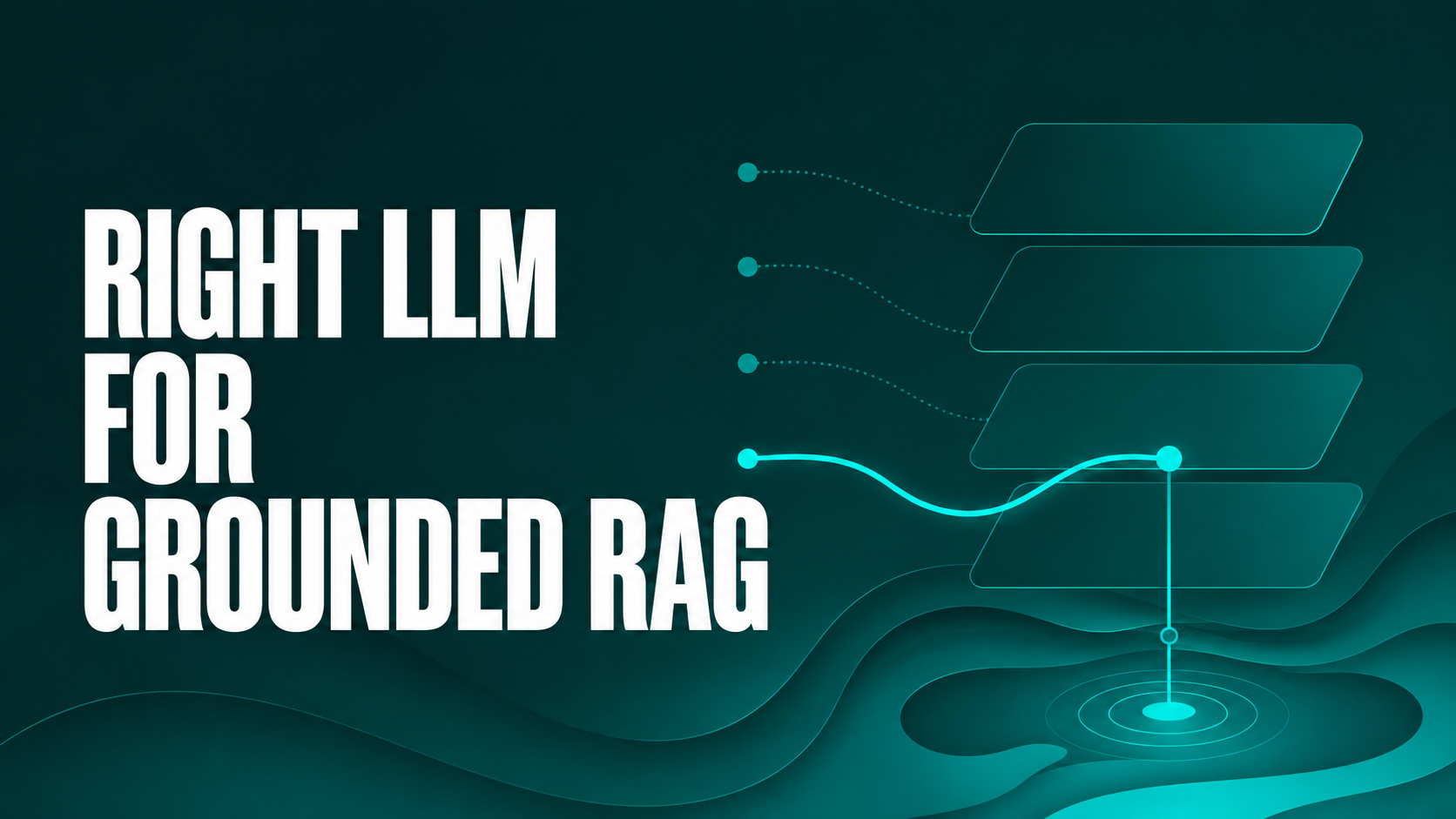
Choosing the Right LLM for Grounded RAG (Without Overpaying for Reasoning)
GPT-4.1 vs GPT-5.5 for retrieval-augmented answering: what actually changes at 80K tokens, and when prompt-engineered reasoning is enough.

Key takeaways
- At ~80K tokens of context, older non-reasoning models remain viable for single-fact grounded answering
- Native reasoning models pull ahead on multi-hop synthesis, and the gap widens with context length
- Prompted chain-of-thought plus structured outputs narrows the gap but erodes the cost and latency advantage
- Route by query type and validate on your own traffic, not public benchmarks
Retrieval-augmented generation looks like a solved problem until you have to pick the model. The choice most teams face today is between a fast, inexpensive non-reasoning model like GPT-4.1 and a frontier reasoning model like GPT-5.5, and the right answer depends less on leaderboards than on the shape of your context and your queries.
The two models are built for different jobs
GPT-4.1 is a non-reasoning model tuned for low latency and strong instruction-following. For grounded question answering, where every fact the model needs is already in the prompt that profile is a good fit. It follows "answer only from the provided context" instructions reliably, responds quickly, and costs a fraction of a frontier model.
GPT-5.5 is a reasoning model, and its headline improvement is long-context retrieval. On OpenAI's MRCR v2 benchmark at 512K–1M tokens it roughly doubled its predecessor's score. That is a genuine architectural leap, but note where it was measured: at context lengths most RAG pipelines never reach.
What actually happens at 80K tokens
Most production RAG prompts land in the tens of thousands of tokens, not the hundreds. At around 80K, the picture is more balanced than the benchmark deltas suggest.
GPT-4.1 was designed to perform well up to 128K and holds up for single-fact retrieval: find the relevant passage, answer from it. Where it weakens is multi-needle disambiguation and multi-hop synthesis, combining a fact from page 12 with a fact from page 200. All transformer models also show some "lost in the middle" attention decay, and older generations show more of it.
GPT-5.5 at 80K is operating near its ceiling, so its advantage is real but concentrated in the hard tail: scattered evidence, cross-document reasoning, and questions where a confidently wrong answer is expensive.
Can prompt engineering close the gap?
Partially. Because GPT-4.1 follows instructions well, you can scaffold deliberation into it:
- Evidence extraction first. Have the model quote the relevant passages before answering, converting one hard attention problem into two easier steps.
- Grounding verification. Add a pass that checks every claim in the draft answer against the extracted evidence, and removes anything unsupported.
- Structured outputs, ordered correctly. Put evidence and reasoning fields before the answer field in your schema. Generation is autoregressive; if the answer comes first, the reasoning is post-hoc rationalization.
This meaningfully improves grounded accuracy. But it cannot fix retrieval-over-context failures: if the model never surfaces the second fact into its scratchpad, no amount of reasoning over the scratchpad recovers it. And the scaffolding generates several times more output tokens, eroding the very cost and latency advantage that made the smaller model attractive.
The routing answer
In practice the strongest architecture is not one model but a routed system: an inexpensive, fast model for lookup-style questions, and a reasoning model for synthesis-heavy or high-stakes ones. The decision of where to draw that line should come from your own evaluation set (50–100 real queries against your real prompts, graded for groundedness), because at moderate context lengths the gap is workload-dependent.
This is how we think about model selection inside Rezolve.ai. Sidekick answers employees from their organization's own knowledge, grounded and cited, with specialized agents reasoning over one shared conversation rather than a single monolithic prompt. Matching the model, and the amount of deliberation, to the question is how you get answers that are fast when they can be and careful when they must be.
If you want to see governed, grounded AI answering in action on your own knowledge base, book a demo.
Last updated on August 27, 2026
Get summary with:
See the agentic service desk in action
Watch Rezolve.ai autonomously resolve real IT and HR tickets: governed, auditable, glass-box.