
HR Automation Software: The Two Kinds, and Why the Second One Changes What You Can Automate
Explore how HR automation moves beyond fixed workflows to handle variable work—applying policies, coordinating systems and escalating uncertainty without sacrificing control, consistency or an auditable record.

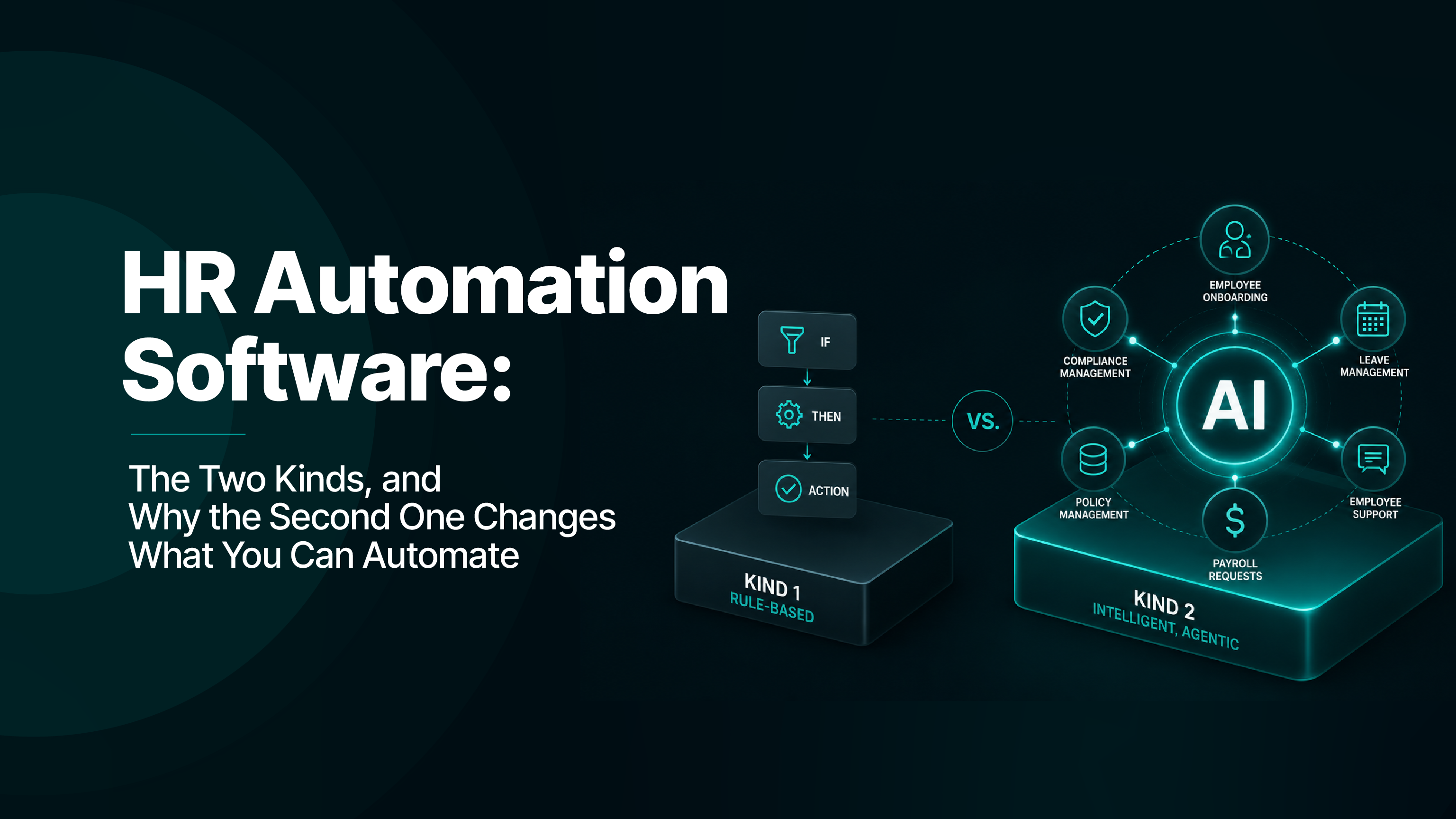
Ask an HR operations team what they have automated and you will get a good list. Leave applications route to the right approver. New joiners trigger a sequence across HR, IT and facilities. Address changes update the record and notify payroll. Timesheet reminders go out before the cut-off.
These are real automations doing real work, and they share a shape: somebody mapped the path in advance. If this, then that. If the request exceeds ten days, add a second approver. If the joiner is in Germany, use the German template. The flow was designed once, and it runs the same way every time.
Deterministic automation of this kind is the backbone of HR operations, and it is not going anywhere. What has changed is that a second kind now exists alongside it, and it reaches work the first kind never could.
The work that was never automated
Take a wage garnishment order. When one of these arrives from a court, somebody in payroll has to read it and work out which jurisdiction's rules apply, what type of order it is, how it interacts with any order already running against that employee, what the protected minimum earnings are, and what the priority is if the total exceeds what can lawfully be withheld. Only then can the deduction be set up, the employee notified, the issuing authority answered, and the whole sequence documented in case it is challenged later.
Nobody could build a standard process for this, because what needs to happen depends on facts you only discover by reading the order in front of you.
A much smaller example works the same way. An employee says their overtime is wrong. They expected a certain amount and something different arrived. Answering that means pulling their time records, applying the overtime rules that apply to their location, employment class and shift pattern, checking whether a union agreement changes the calculation, reconciling against the pay period, and then — the hard part — explaining the gap between what they expected and what they received.
This one cannot be standardised either. Every case is different, and what the employee needs at the end is an explanation rather than a transaction.
Both are ordinary HR work. Neither is exotic. And in most organisations both are done by a person, every time, because the tooling could not reach them.
What makes an automation intelligent
The difference is not that one is smarter than the other. Deterministic automation executes a known path reliably. What has been added is the ability to work out which path this particular situation needs, before executing it.
An intelligent automation reads a situation, applies the rules that actually govern it, decides what should happen, and then acts — with the execution itself remaining as predictable and auditable as any deterministic flow. The judgement sits in the deciding. The doing stays boring, which is exactly what you want when the outcome is a payroll deduction.
That is where agents come in, and it is why the question "what can we automate in HR" has a different answer this year than it did two years ago. The old boundary was drawn around processes with a known path. The new boundary is drawn around processes with knowable rules — which is a much larger set.
What has to be underneath
An agent that decides is only as good as what it can see and remember.
Knowledge is the first half. The rules governing overtime, garnishment priority, leave entitlement and eligibility live in policy documents, handbooks and jurisdiction-specific addenda. An agent applying those rules has to retrieve the current version and be able to cite which clause it applied — both because the employee will ask and because someone may later need to prove it. Knowledge that goes stale silently is worse than no automation at all.
Case management is the second. Some of this work is not a transaction that closes in a minute. A garnishment order has a lifecycle, correspondence, evidence and a retention requirement that outlives the software. A disputed overtime calculation may run for weeks and involve a manager, payroll and an employee relations partner. Automation that can only handle tickets will drop these on the floor, so the case has to exist as a first-class object, with the agent working inside it rather than around it.
Orchestration is the third. Very little HR work finishes inside HR. A garnishment order touches payroll and finance. Onboarding touches IT and facilities. A disputed payment may need a manager, a payroll analyst and an employee relations partner, in that order, with each step waiting on the last. Something has to hold the sequence together across those systems and those people — knowing what has been done, what is waiting, what to chase and when to hand over. Without it you have a set of individually clever steps and nobody holding the thread.
Get those three right and the intelligent automation has ground to stand on. Without them it becomes a very confident guess.
Where these get built
Whatever product you look at, three things have to exist for any of this to be buildable.
Somewhere to turn a process into an automation without commissioning an engineering project. Somewhere to build and orchestrate the agents that handle the situations needing judgement. And a connection layer that reaches the systems where the work actually happens — the HRIS, payroll, time and attendance, identity. A product missing any of the three will do part of the job and hand you the rest.
In Rezolve.ai those are three separate things, deliberately.
Creator Studio is where a process gets turned into an automation by describing it. Someone who understands garnishment intake explains what should happen, and the AI Flow Builder drafts the flow. That matters because of who it lets build: the economics of automation have always been set by the cost of specialist time, which is why only the highest-volume processes ever cleared the bar. Describing a process rather than engineering it changes which processes are worth automating at all.
Agent Studio is where agents get built and orchestrated for the work that needs judgement. Eight foundational agents handle the universal decisions in any conversation — routing, knowledge selection, composing a cited answer, gathering missing detail, forming a clean ticket, guiding a catalogue request, reading replies to escalations, and falling back to live search when permitted. On top of those sits a marketplace of 55+ agents that can be cloned and adapted, and beneath both is the ability to build genuinely custom ones for the situations only your organisation has. An overtime dispute agent is the kind of thing nobody ships as a feature and every organisation with shift workers needs.
Underneath both, the Integration Hub provides the reach — the connections into the HRIS, payroll, time and attendance, identity and whatever else the decision depends on. An agent that can reason but cannot act is a well-informed bystander.
Beyond information at your fingertips
Much of the current conversation about AI in the enterprise is about access to data — the idea that information scattered across a dozen applications can be brought to an employee without them going to find it. It is a genuine improvement over searching six systems, and the products doing it well are useful.
The ambition worth having is larger than retrieval.
Telling an employee what the overtime policy says is retrieval. Working out why their specific payment differs from their expectation, explaining the gap in terms they can act on, and correcting it if it is wrong — that is a different capability, and it is the one that removes the work rather than relocating it.
The test is simple enough to apply in any demo. Ask what happens after the answer. If the conversation ends with the employee better informed and still waiting, the product surfaces information. If it ends with the discrepancy explained and the correction submitted, the product does the work.
The two kinds work together
None of this displaces deterministic automation, and any vendor suggesting otherwise is selling you something.
The strongest HR operations run both, with a clear division between them. Deterministic flows carry the high-volume, well-understood processes where the path is known and consistency matters — leave, address changes, standard onboarding. Intelligent automation handles the situations where the path depends on facts discovered along the way.
They also compose. A garnishment agent reads the order and decides what applies; the deduction it sets up should then run through a deterministic, auditable flow every single time. Judgement at the front, predictability at the back. Anyone who has explained a payroll error to a regulator will recognise why that arrangement matters.
The practical consequence for anyone building an automation roadmap: stop sorting candidate processes by volume alone. Sort them by whether the path is known. The known ones are a deterministic flow and probably always were. The unknown ones are the work you have been doing by hand because nothing could reach it, and they are usually where the expensive time goes.
What to ask when you evaluate
Automate something with an exception in it. Every product handles the happy path. Bring a process with a genuine branch — a jurisdiction that behaves differently, an employment class with its own rule — and watch what happens.
Ask who builds it. If every new automation is a request into a specialist queue, the long tail will never be automated, whatever the product can theoretically do.
Ask what it does when it is unsure. An automation that always proceeds is not intelligent, it is unsupervised. The correct behaviour is to stop and route to a person, and you should see that path before you buy.
Ask where the rules come from. If the answer is a model rather than your policy documents, the automation is guessing about your organisation with great fluency.
Ask what the record looks like afterwards. For anything touching pay, the question that eventually gets asked is what happened and why. The answer needs to exist without anyone reconstructing it.
Where this leaves the roadmap
HR automation software is no longer one category, and the two halves of it answer different questions. Deterministic tooling asks how reliably you can run a process you have already mapped. Intelligent automation asks how much of the work you never mapped can now be reached.
Most HR functions have spent a decade optimising the first question. The larger opportunity now sits in the second, and it is sitting in the queue that never seems to get shorter.
Last updated on September 16, 2026
Get summary with:
See the agentic service desk in action
Watch Rezolve.ai autonomously resolve real IT and HR tickets: governed, auditable, glass-box.
Frequently asked questions
What is HR automation?
HR automation uses software to complete repetitive HR tasks, route work and manage processes with less manual intervention. Traditional automation follows predefined workflows, while AI-powered HR automation can interpret a request, select the appropriate path and escalate when human judgement is required.
Which HR workflows benefit most from automation?
The strongest candidates are high-volume processes with clear rules, such as onboarding, leave requests, employee-data updates and approval routing. AI-powered automation can also support more variable work, including payroll enquiries and policy exceptions, when it has reliable data, defined controls and a human-escalation path.
Can HR automation handle complex workflows?
Yes, provided the governing rules are knowable and the required systems and data are accessible. The automation should gather the relevant facts, apply the correct policy, record its actions and stop for human review whenever the evidence, permissions or outcome remain uncertain.
How should an organisation implement HR automation?
Begin with a measurable process that has sufficient volume, clear ownership and recoverable mistakes. Document the rules, integrations, approvals and exception paths; establish a baseline; run a controlled pilot; and expand only after accuracy, completion rate and employee adoption meet agreed targets.
How should HR teams measure automation ROI?
Measure completed work rather than chatbot interactions alone. Useful metrics include handling time, cost per request, cycle time, error rate, escalation rate, employee effort, adoption and the percentage of requests resolved without manual processing. Compare each metric with a pre-automation baseline.


