
HR Case Management Grows Up
See how agentic AI helps HR teams prioritise risk, surface stalled cases, support associates and build audit-ready records—while keeping investigations, determinations and sensitive communications firmly under human control.

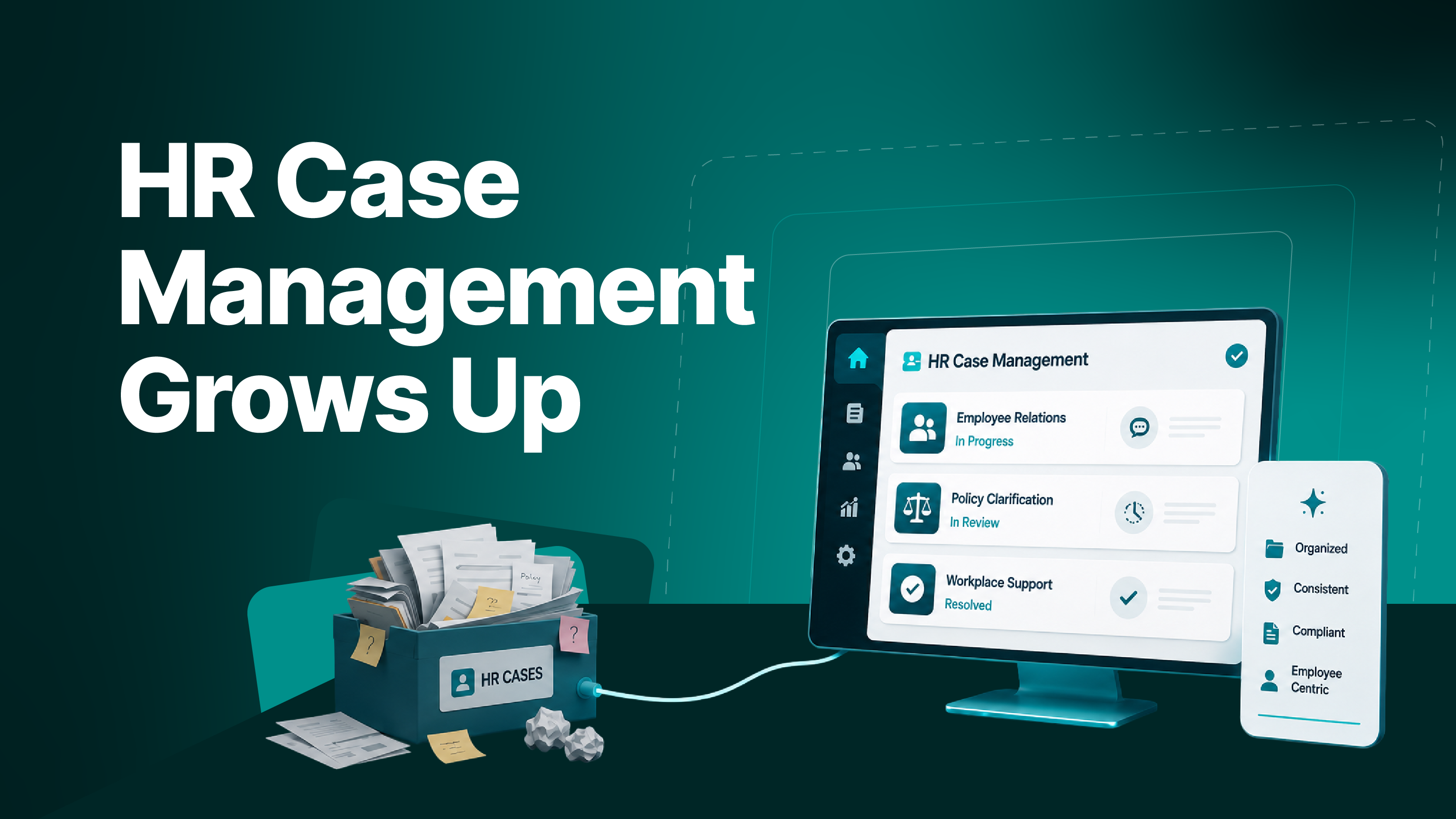
A harassment complaint and a question about a payslip arrive in the same queue, eleven minutes apart, both by email. Cases are created automatically for both and they sit there. But because of the backlog, it takes a day before either is assigned to an HR associate. The associate who reads the harassment charge understands its significance immediately and reassigns it to a senior manager. By the time the senior manager is ready to act, the situation on the ground has moved, and in this case it has moved for the worse.
Nobody did anything wrong there. Everyone followed the process. And yet, depending on what the complaint says and how long it sits in the queue, it may turn into a legal matter that took eleven minutes to create and eighteen months to resolve.
Legacy HR case management solutions had real limitations, and they do not run at the speed enterprises need today. That software was built to make sure nothing gets lost, and it is genuinely good at that. What it was never built to be is an intelligent assistant to the HR associates and managers doing the work.
Newer HR case management solutions, ours included, use agentic AI to close that gap. The system reads what has actually arrived rather than waiting for a person to open it, so a matter carrying real exposure is flagged and escalated within minutes instead of days. It watches for cases that have gone quiet and says so. It gives the associate handling a case the precedent, the policy, and the guidance in place, rather than sending them off to find a colleague who has done this before. It drafts the record as the work happens instead of at the end of the week.
None of it removes the human judgement from the entire process, and it should not. What it removes is the delay between something arriving and somebody understanding what it is.
What is an HR case, and how is it different from a ticket?
Before we get into any of that, it is worth defining terms, because case and ticket get used interchangeably and they are not the same thing.
A ticket is a request that gets answered and closed, usually within hours or days by one person, and once it is closed nobody looks at it again.
An HR case is different in kind rather than in length. A grievance, a workplace investigation, an accommodation request, an allegation about a manager - these run for weeks, involve several people (some of whom must not see what the others said), accumulate evidence as they go, and carry retention requirements that will outlive whatever software you are using today. And a proportion of them end up in front of a tribunal, a regulator, or opposing counsel.
Which is why I would argue that most writing about HR case management has the frame slightly wrong. Nearly everything published on the subject presents it as an efficiency tool for faster resolution, better consistency, and fewer things falling through the cracks. All of that is true, but all of it is secondary. The reason you restrict access, keep a chain of custody, and document as you go is that somebody may one day ask what you knew, when you knew it, and what you did about it. An HR case record is evidence that happens to be organized as a workflow.
Both of those things matter for what follows, because AI touches each of them very differently.
Where do HR cases get stuck today?
Cases are worked in the order they arrive. Or by an SLA clock set by category rather than by content. Nothing in the system reads the substance, so a complaint describing retaliation and a request to correct a name spelling carry the same urgency until a human opens them both.
A case that has gone quiet looks exactly like one updated this morning. Eleven days of silence is invisible in a list. Nobody decided to leave it and the queue simply has no opinion about elapsed time on an open matter.
The expert is in a meeting. An HR associate who has not handled a garnishment order before, or a fixed-term contract question under Dutch law, or an accommodation involving a condition they have never encountered, has to go and find someone who has. That person is busy, and the case waits another day.
Notes get written from memory at the end of the day. Sometimes the end of the week. The closure summary gets assembled at the point when everyone has already moved on to something else, which is a poor way to produce a document that may later be read out in a hearing.
Three complaints about the same manager, three sites, three handlers. Over five months, those are three separate cases, and they become a pattern only when somebody happens to notice. By the time somebody does, it is usually not three any more.
None of these are failures of diligence, and I want to be clear about that, because HR teams get blamed for them regularly. They are what happens when the system holding the work has no view on what the work contains.
What changes with AI
The queue tells you what to open first. The system reads what actually arrived including the substance, not just the category someone picked from a dropdown. It immediately surfaces what carries risk. In our product this appears above the inbox rather than on any individual case, as a high-risk section and a next-best-case recommendation, because the decision that matters is which case to open, and that is a decision about the queue.
 Which request weighs more and should be prioritized?
In the example we started with, the harassment complaint moves above the payslip question within minutes rather than at whatever point somebody gets to it.
Silence becomes visible. Cases that have gone quiet surface on their own, and a nudge fires when something has sat too long without an update. Eleven days stops being something you discover later.
Help comes to the associate rather than the other way round. Instead of going to find the colleague who has done this before, they get similar past cases, suggested knowledge, a guided troubleshooting path, and the ability to ask a question about the case in place and get an answer drawn from your own knowledge and your own history. Where something genuinely needs several people at once, a huddle opens a channel and brings them to it.
The record gets written as the work happens. Responses are drafted for review rather than sent, which is the right posture for anything sensitive, and a structured resolution note is composed at closure out of what actually occurred rather than out of somebody's recollection. Sentiment is read from the case itself, so a situation that is deteriorating shows up as a signal well before it shows up as a complaint about the complaint.
Patterns surface while they are still small. The same clustering that spots an IT outage inside a scatter of unrelated-looking tickets can spot three complaints naming the same manager across three sites. Nobody has to be the person who notices.
The case can start anywhere, including on the phone. A lot of the people most likely to have something serious to raise are the least likely to be sitting at a desk with a browser open. It can be the factory floor, the depot, the ward, or the store. Voice matters here more than it does almost anywhere else, because an employee who has to log into a portal to report something about their manager will frequently decide not to bother. An AI agent that answers a phone line, takes the matter properly, recognizes what it is, and opens the case with the detail already captured is not a convenience feature in this context. It is the difference between hearing about something and not hearing about it.
Knowledge sits inside the case rather than in another tab. The policy that governs the situation, the precedent from how something similar was handled, the jurisdiction-specific rule that applies to this employee and not to the last one - all of it available where the work is happening, and cited, so the associate can see what they are relying on.
The case connects to the workflows that actually resolve it. Very little of this finishes inside HR. An accommodation needs equipment ordered and a manager briefed. A substantiated finding may need access changed, a role adjusted, payroll corrected. If the case system cannot reach into those systems, somebody is retyping the outcome into three other places and hoping they remember all three.
Reporting stops being a monthly export. Most HR case reporting today is a count, usually about how many cases, of what type, closed in what time. What you actually want to know is harder and more useful: where cases are getting stuck and why, which categories are growing, which sites or managers or policies keep generating them, how long sensitive matters wait before someone opens them, and whether that number is improving. AI-driven reporting can answer those without somebody building a spreadsheet, and it can raise the question before you thought to ask it.
What should AI never do in an HR case?
A case system that exercises its own judgement inside an investigation is not a productivity gain, and I would not deploy one. The line is not hard to draw, but it does need drawing in writing before anything gets switched on.
Determinations stay with people. Whether a complaint is substantiated, whether conduct breached policy, whether an accommodation is reasonable — those are judgements with legal consequences, and they belong to somebody who is accountable for making them.
In sensitive matters, communication is drafted but not auto sent. A reply to someone who has raised a grievance goes out when a human has read it and chosen to send it. The draft saves you twenty minutes. The decision does not move until a human decides to.
Access stays governed, and the governance is visible. Who can see a case, and who has already seen it, is part of the record and that includes the AI. Which sources it is allowed to read should be something an administrator sets deliberately, and if knowledge is switched off, every capability that depends on it should visibly stop working rather than quietly degrade.
The reasoning has to be inspectable. If the system flags a case as high-risk, somebody needs to be able to see why it did. Unexplained scoring in a matter that may end up being litigated is worse than no scoring at all.
Deciding what will never be automated is part of designing the deployment, and any vendor who cannot answer that question quickly has not thought about it.
What belongs in an ER system, and what belongs in the service desk?
Some of this sits with a specialist employee relations platform (ER systems) and some of it sits with the service layer, and it is worth being clear about which, because organizations waste money getting this boundary wrong in both directions.
Formal investigation workflow including structured interview management, findings recorded allegation by allegation, the reporting a general counsel expects to see is what dedicated ER products are built for. If that is your primary requirement, evaluate those specifically rather than assuming an employee service platform covers it well. Ours does not, and I would rather say so.
What the service layer should own is everything around that. Intake from wherever the employee happens to be (Microsoft Teams, Slack, the portal, email, a phone call from a factory floor at six in the morning). Recognizing within seconds that a matter is sensitive and routing it out of the ordinary queue. Keeping every other case moving, so that the sensitive ones actually get attention rather than competing with two hundred password questions. Assisting the associate who is handling them. And producing a record that was written while the work was happening.
Most organizations do not have to choose between the two. They do have to draw the boundary on purpose rather than by accident.
What to ask before you buy?
Submit something that should never sit in a queue — a retaliation concern or a safety issue and watch what the system does with it in the next sixty seconds. If it assigns a category and an SLA, it has classified your case and understood nothing about it.
Ask to see a case that has gone quiet, and then ask how you would have found that case without asking.
Ask what a closure note looks like, and how much of it the associate wrote versus how much was drafted from the record.
Ask who can see this case and how you would prove it afterwards — and put the AI inside that question, not outside it.
Ask what happens when the system is not sure. You are looking for an answer that involves stopping.
Where this leaves you
The claim people reach for is that AI will handle HR cases. It will not, and in my view it should not. The determinations in this work belong to people who are accountable for making them, and no amount of capability changes that.
What it can do is make sure the case that matters is the one that gets opened, that nothing sits waiting in silence, that whoever is handling it has help without having to go and find it, that the record produced at the end is one you would be content to hand over, and that the pattern forming across three sites gets noticed while it is still three.
If you are running HR cases today on a system that files them well but does not read them at all, the gap between those two things is where your risk is sitting, and it is worth an hour of somebody's time to work out how wide it has become.
Last updated on September 16, 2026
Get summary with:
See the agentic service desk in action
Watch Rezolve.ai autonomously resolve real IT and HR tickets: governed, auditable, glass-box.
Frequently asked questions
1. What is the difference between an HR case and a ticket?
A ticket is a request that one person answers and closes, usually in hours or days, and nobody looks at it again. An HR case is a different kind of thing entirely. A grievance, an investigation, an accommodation request or an allegation about a manager can run for weeks, involve several people who must not all see the same information, gather evidence along the way, and carry retention requirements that outlast your current software. Some of them end up in front of a tribunal or opposing counsel. That is why an HR case record is best thought of as evidence that happens to be organized as a workflow.
2. What does AI actually change day to day?
Mostly it removes the delay between something arriving and somebody understanding what it is. The system reads the substance of what came in, so a retaliation complaint rises above a payslip question within minutes rather than after a day in the queue. Cases that have gone quiet surface on their own instead of looking identical to ones updated this morning. The associate handling a case gets precedent, policy and guidance in place rather than hunting for a colleague who has done it before. The record gets drafted as the work happens. And clustering can spot three complaints naming the same manager across three sites while it is still three.
3. Will AI decide whether a complaint is substantiated?
No, and it should not. Determinations belong to people who are accountable for making them: whether conduct breached policy, whether a complaint holds up, whether an accommodation is reasonable. In sensitive matters, replies are drafted for review and not auto sent, so the twenty minutes of typing is saved but the decision does not move until a human sends it. Access stays governed and visible, including what the AI itself can see. And if the system flags a case as high risk, you need to be able to see why. Unexplained scoring on a matter that may be litigated is worse than no scoring at all.
4. Do we need a dedicated employee relations platform, or will a service desk cover it?
They do different jobs. Formal investigation workflow, structured interview management, findings recorded allegation by allegation, the reporting a general counsel expects: that is what dedicated ER products are built for, and you should evaluate them specifically if that is your main requirement. The service layer should own everything around it. Intake from wherever the employee happens to be (Teams, Slack, portal, email, or a phone call from a factory floor at six in the morning), recognizing within seconds that a matter is sensitive and routing it out of the ordinary queue, keeping every other case moving so the sensitive ones are not competing with two hundred password resets, and producing a record written while the work was happening. Most organizations need both. The point is to draw the boundary on purpose.
5. How do we test a system before we buy it?
Submit something that should never sit in a queue, like a retaliation concern or a safety issue, and watch what happens in the next sixty seconds. If all it does is assign a category and an SLA, it has classified your case and understood nothing about it. Then ask to see a case that has gone quiet, and ask how you would have found it without asking. Ask what a closure note looks like and how much of it the associate wrote from memory. Ask who can see a case and how you would prove it later, with the AI inside that question rather than outside it. Finally, ask what happens when the system is not sure. The answer you want involves stopping.


