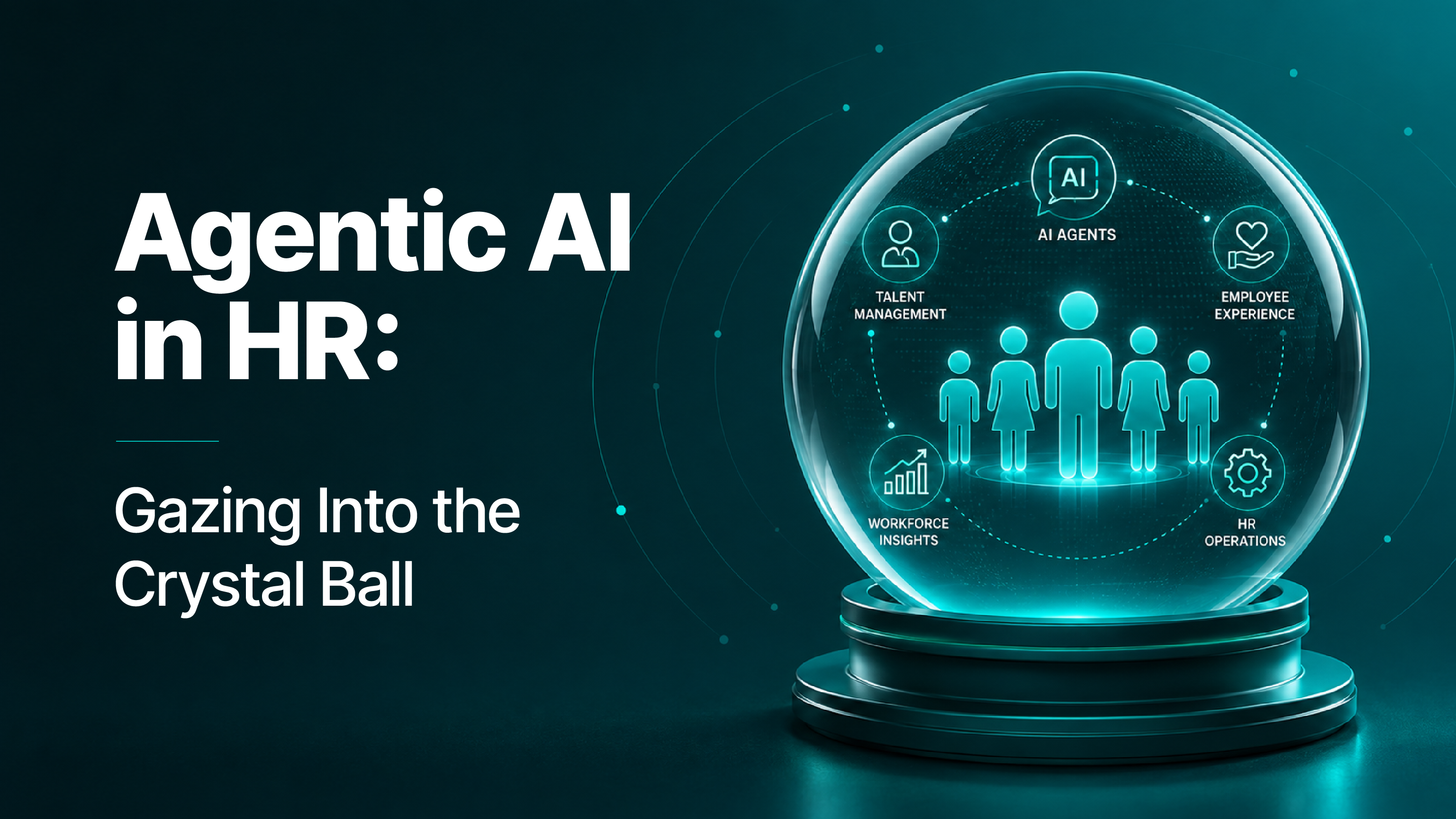
Agentic AI in HR: Gazing Into the Crystal Ball
Explore how agentic AI is changing HR, why early projects may disappoint, and what teams must do now to move from inflated expectations to measurable, repeatable business value.

The Gartner Hype Cycle is a framework that has stood the test of time. It explains how new technology gets adopted, and how sentiment around it swings, better than almost anything else we have.
Gartner published its first standalone Hype Cycle for Agentic AI in April 2026, mapping more than thirty innovations across the agent landscape. Agentic AI sits right at the Peak of Inflated Expectations.
I think we may be heading from that peak to the Trough of Disillusionment quite quickly, and faster in HR than in most functions. I also believe that trough will be shallower than most people expect.
Let us gaze into the crystal ball together, and look at how your enterprise can get through it.
The obligatory question: what is agentic AI?
Agentic AI is software that pursues a goal rather than completing a prompt. Given an objective, it decides the steps, uses tools and systems to carry them out, checks the result, and adapts when something does not work — without a person directing each move.
Agentic AI possesses reasoning, and it can decline a request when it believes declining is the right decision.
Today it can be experienced through a variety of channels: virtual agents inside Teams or Slack, voice AI over the phone, email, and the service portal.
Where agentic AI fits in HR
Agentic AI is being used, and will be used, across a wide range of HR work. Three functions are the natural starting points.
HR operations
The most obvious place to begin, and the hub of the whole HR function.
Employee support. Acting as the front door — answering policy and benefits questions, creating and assigning tickets when further help is needed, and giving HR associates better tools to resolve what reaches them.
Process support. Helping employees who are afflicted with process blindness navigate everyday workflows: applying for leave, changing an address, responding to an approval deadline, working through onboarding.
Application avoidance. Reducing the frustration of complex applications by letting employees avoid them altogether. Ask in plain language, get the outcome, never open the system.
Automation. Automating processes that cross applications, departments and teams, including the ones with complex calculations, decision trees and business rules. Garnishment order processing is a good example: paperwork scanned, data extracted, records updated, notifications triggered. So is timesheet validation before it reaches the payroll system.
Compliance. Running reconciliations, triggering approvals and building the audit trail. A payroll reconciliation agent that compares the current run against the prior period, flags discrepancies and generates the report is doing work that is both high volume and high consequence.
Talent acquisition
The function with the most waiting in it, and waiting is what agents remove.
Interview coordination. Finding time across three interviewers, two time zones and a candidate who works elsewhere, then rescheduling when one of them drops out.
Candidate communication. Answering "where am I in the process" without a recruiter writing the same email for the fortieth time — and doing it consistently, which matters for candidate experience and for fairness.
Requisition intake. Helping a hiring manager write a requisition that matches the job architecture and the approved comp band, rather than sending it back twice.
Offer and pre-boarding. Generating the offer against the right template and approval chain, then chasing background checks, references and document returns until the file is complete.
Learning and development
Enrolment and navigation. Finding the right course for a role and a skills gap, then enrolling the person, rather than pointing them at a catalogue.
Compliance training. Monitoring who has completed what, chasing the ones who have not, and escalating before the deadline rather than after it.
Certification tracking. Watching expiry dates across a workforce and starting the renewal early — the kind of task that is trivial for one person and unmanageable for ten thousand.
Will HR teams welcome any of this?
HR teams have been cut dramatically over the last two decades. As a cost centre, HR was always the obvious place to trim, and the trimming has been so deep and so pervasive that it has reduced the scope of what HR does. Teams firefight. They are heavily overworked. They do not get time for the strategic work they were hired to do.
That history is going to make HR teams suspicious of AI, and they have earned the right to be. Every previous efficiency programme arrived with the same promise and ended with fewer people doing the same work.
There is a happier ending available here, though. AI takes the mundane and repetitive, which is precisely the work that has been crowding out everything else. What is left is the strategic work — workforce planning, organisational design, the difficult conversations, the cases that need judgement. That raises the value HR brings to the enterprise rather than reducing the headcount that delivers it.
Whether that is how it plays out in any given organisation depends less on the technology than on what leadership decides to do with the capacity it frees.
Who is going to deliver agentic AI in HR?
Four kinds of provider are competing for this, and they are not equivalent.
The HRIS vendors are bringing their own AI. Workday has been expanding its Illuminate agents across HR and finance, covering case management, business process configuration and recruiting. UKG has launched Bryte AI agents inside the UKG Pro suite, aimed first at compliance and talent management, with built-in checkpoints where a person reviews and accepts. Both are serious efforts.
Both are also centred on their own application. The agent knows what the HRIS knows and acts where the HRIS acts. For a request that begins in HR and finishes in IT — which describes most of onboarding — that boundary is where the work stops.
Specialist point tools. There are strong products doing one thing extremely well: interview scheduling, candidate screening, compliance training. Depth in a narrow lane, and usually the best experience within it.
The cost is arithmetic. Each one is another system, another integration, another login, another renewal. Employees do not know which tool owns their question, and they should not have to.
Internal teams building it themselves. A CTO with a Copilot Studio licence and a capable team can build an HR agent. Some do, and some of them work.
What tends to surface a year later is not the agent but the estate around it. Who owns each one, which are still in use, what happens when the person who built it moves on, and who reviews what they are permitted to do. Building is the easy part; governing what you built is the part nobody budgets for.
Enterprise service management products. This is where Rezolve.ai sits, so read this knowing our interest in it.
An ESM product is built around the employee request rather than around a system of record. It spans IT, HR and finance because employees do not distinguish between them — "I am joining" is one event that touches all three. It sits above the systems of record rather than inside one, so it can complete a request that starts in the HRIS and finishes in the identity provider. And because service management already carries approvals, audit and governance, the controls are in place before the agents arrive rather than bolted on afterwards.
We built Rezolve.ai on that premise from the beginning. Employees ask in Teams, Slack, email or by phone. Answers are grounded in your own policy documents and cite the section they came from, so a leave question returns the policy that applies to that employee rather than a general article. Requests that can be completed are completed — the access granted, the request submitted, the record updated — and every retrieval, decision and action is recorded. Automations are created by describing the process rather than engineering it, and agents can be built for the situations specific to one organisation, which is what keeps the product improving after go-live rather than stopping at the feature list you bought. Across deployments, roughly 70% of requests resolve before they become tickets.
That focus is deliberate. We chose depth in service delivery across IT, HR and finance rather than being everything for everyone.
ServiceNow has moved in the same direction with its employee-facing agentic products, arriving from the platform side rather than from the request.
The question to hold onto while evaluating any of the four: when a request crosses a boundary, what happens? That single question separates them more cleanly than any feature comparison.
Why we may be heading for the trough
There is a gap between what is being promised and what is being delivered.
Gartner's own numbers frame it well. Only 17% of organisations have deployed AI agents, while more than 60% expect to within two years — the most aggressive adoption intent Gartner has recorded for any emerging technology. Ambition is running far ahead of execution.
Their prediction for what happens next is blunt: more than 40% of agentic AI projects will be cancelled by the end of 2027, on escalating costs, unclear business value and inadequate risk controls.
Three things are driving that.
Vendors are promising more than their products do. Gartner named the practice in the same Hype Cycle — agent washing, the rebranding of assistants, chatbots and RPA as agentic without the substance behind it.
Deployments are landing late and expensive. A capability demonstrated in a sales cycle turns out to need integration work, knowledge cleanup and process redesign nobody scoped.
And the cost-benefit analysis eventually gets run. In a lot of cases it will not survive contact with a CFO who wants to know what the spend returned.
Why the trough will be shallow
For every project that stalls, there will be one that works conspicuously well, and the successes in this category are unusually easy to replicate.
TotalEnergies Denmark is a good example. They launched an anonymous, confidential HR assistant called Robin for around 1,000 employees. It answers in roughly 30 seconds, and it became the default HR channel within a month. Not a pilot that ran alongside the old process — the channel people actually use.
Another global Rezolve.ai customer runs an anonymous ethics line on the same platform across roughly 100,000 employees, which is the harder version of the same problem, because people will not put their name on an ethics question.
Neither of those required a two-year programme. That is why the trough should be shallower here than in most categories: when the successful pattern is visible, cheap to copy and produces a number, the recovery is fast. What ends the trough is not better technology. It is enough people having seen it work.
What you need to do to come out the other side
Audit your policy knowledge before you buy anything. This is the step that decides more outcomes than any product choice, and no vendor will tell you to do it first. Pull your twenty highest-volume policy questions and find the document that answers each one. If two documents disagree, or the real answer lives in an HR partner's head, that is what you fix before a single agent is configured. An agentic layer surfaces those gaps quickly and unsentimentally, but it will not fill them — and a deployment on a contradictory knowledge base fails in a way that gets blamed on the technology.
Choose the right function to start with. High volume, low complexity, bounded actions, recoverable mistakes. Employee support and the repeating question load are the obvious first move. Do not start with the hardest thing you have in order to prove a point.
Set measurable goals before you start. Resolution rate, adoption rate, time saved — agreed with the people who will be asked to justify the spend, and baselined before deployment. Without a baseline, you will be arguing about impressions in six months.
Invest in adoption and commit to it. This is where most efforts die. A capable product deployed half-heartedly performs worse than a modest product deployed properly. Adoption needs communication, executive sponsorship and someone whose job it is to drive it.
Expand and replicate. Do not stop at the first win. The value compounds — better knowledge improves resolution, more resolution reveals more to automate, more automation shows you what to build next. The organisations that treat the first deployment as the finish line get one improvement. The ones that treat it as the first of many get a different function.
The trough is coming. It will separate the organisations that treated this as a technology purchase from the ones that treated it as a change in how the work gets done.
Last updated on September 16, 2026
Get summary with:
See the agentic service desk in action
Watch Rezolve.ai autonomously resolve real IT and HR tickets: governed, auditable, glass-box.
Frequently asked questions
What is agentic AI in HR, and how does it work?
Agentic AI in HR is software that can interpret an employee or HR objective, determine the required steps, use connected systems and check the outcome. Unlike a conventional chatbot, it can complete approved actions, monitor progress and hand the work to a person when judgement is required.
How can AI agents help HR teams?
AI agents can answer policy questions, coordinate interviews, support onboarding, monitor compliance deadlines, route sensitive cases and complete approved requests across HR systems. Their greatest value comes from reducing the waiting, follow-up and system switching that surround routine HR work.
Which HR use case should an organisation automate first?
Start with a high-volume, low-risk process that has clear rules and a measurable outcome. Employee policy support, onboarding coordination and routine request fulfilment are strong starting points because mistakes are recoverable and improvements in resolution time, adoption and workload can be measured quickly.
How do AI agents integrate with existing HR software?
AI agents connect to HRIS, payroll, identity, ticketing, collaboration and communication systems through governed integrations. They should work above existing systems of record rather than requiring organisations to replace them, with permissions controlling what each agent can read, change or approve.
What controls does agentic AI in HR require?
It requires approved knowledge sources, role-based access, explicit action permissions, human approval for consequential decisions, inspectable reasoning and a complete audit trail. The system must also recognise uncertainty and route sensitive, ambiguous or unsupported requests to an accountable person.