Where Should Your Agents Live- Copilot, Claude or Rezolve.ai?
The biggest AI agent failure isn't technology, it's placement. Enterprises that define agent ownership, governance, and platform residency upfront are far more likely to realize value than those simply focused on building more agents.

Most enterprises are now past the question of whether to deploy agents. What separates the programs that produce value from the ones that produce inventory is a decision almost nobody makes deliberately: where the agents live.
Two patterns show what happens when it isn't made.
The first is volume without use. An IT leader at a large enterprise described building around 850 agents — and then admitted hardly any were being used. Not because they didn't work. Because nobody owned them, nobody knew which ones existed, and the ones that survived were doing single-step tasks that never changed a process. Pilots of this kind rarely fail on capability. They stall on ownership, permissions and the quality of the content underneath them.
The second is quieter and more expensive. Someone builds a useful agent, connects it to a few systems, and moves to another role. The agent keeps running, acting under permissions inherited from a job that person no longer holds. Nobody reviews it because nobody knows it is there. A recent Cloud Security Alliance research note shows the scale of the problem: among 235 large-enterprise security leaders, 92% lack full visibility into their AI identities, and while 71% say AI systems can reach core platforms like ERP, CRM and finance, only 16% govern that access effectively.
Gartner's read on the market points the same way. Having warned about agent washing — vendors relabeling assistants and RPA as agents — it predicted that more than 40% of agentic AI projects will be canceled by the end of 2027.
Capability is not what's failing. Placement is.
Two decisions that get treated as one
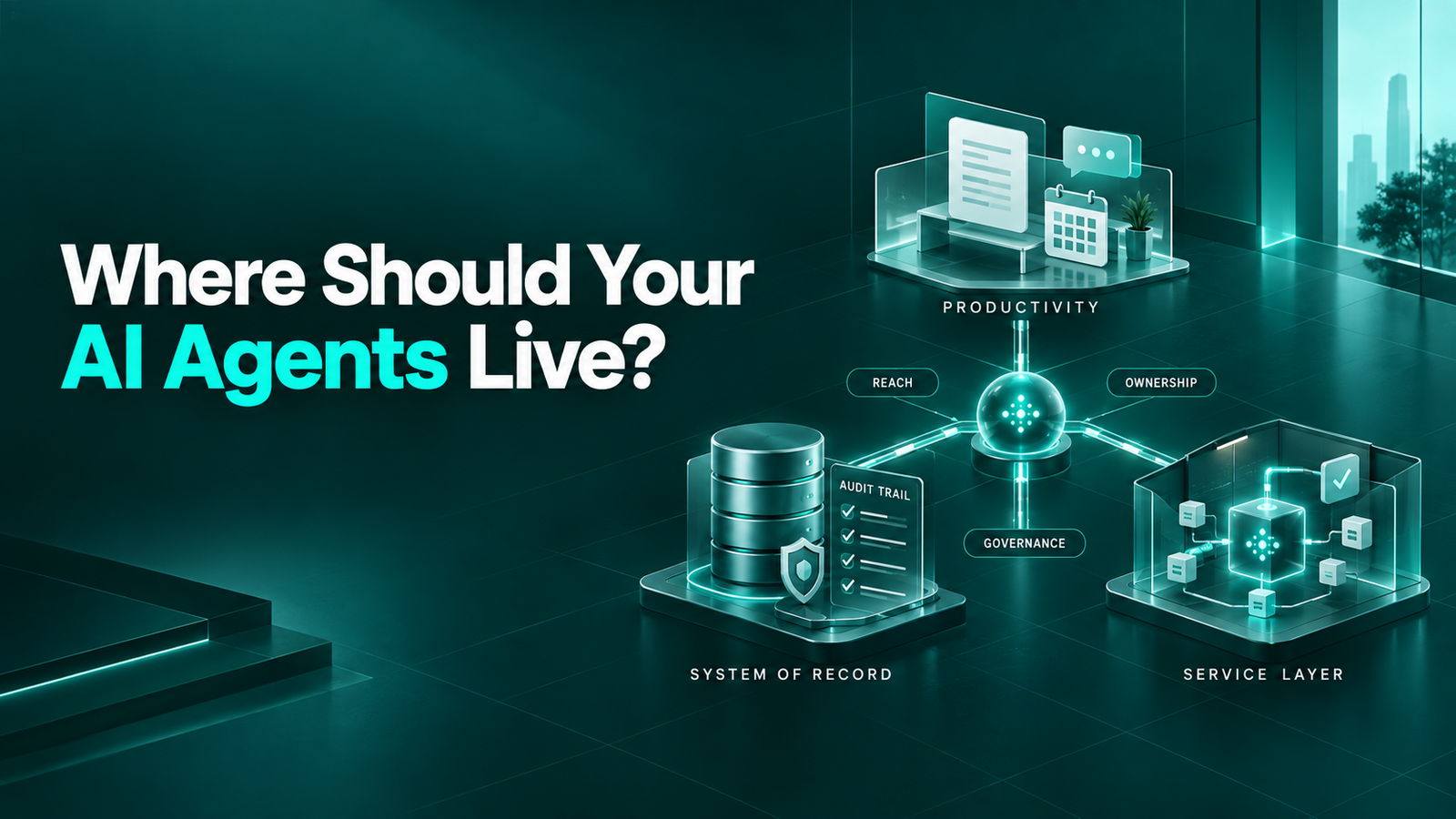
Where an agent is invoked and where an agent lives are different choices, and treating them as one produces most of the confusion in this market.
An employee should be able to ask for help in Microsoft Teams, because that is where their working day already happens. That's an interface decision, and it isn't contentious.
Where the agent is built, what it may touch, who owns it, and how its actions are recorded — that's a residence decision. It has almost nothing to do with the interface. An agent can be reached in Teams and governed somewhere else entirely.
Once those come apart, the choice stops being Copilot versus everything else, and becomes a question of which agents belong where.
The criteria you've already thought about
Platform capability is where most evaluations start, and it's necessary. Can the agent act on the systems that matter, or only draft text a person then executes? Does it complete a task end to end without someone doing the final click? Does it handle multi-step work spanning three systems, including the exceptions? A platform that excels at single-step helpers and struggles beyond them is how you end up with 850 of them.
Cost is the other familiar one, though it's usually scoped too narrowly. Licenses are the visible part. Consumption is the part that arrives later, and it needs to be a budget line with an owner from day one. Then there's maintenance — agents decay as the content beneath them ages, so grounding sources need review on the same cadence as the documents themselves. And migration: platforms change their orchestration models, and fleets built on older patterns need rework before they can use anything new.
Both matter. Neither is where these programs are failing.
Ownership
Ownership is what decides whether an agent is alive and trusted in six months.
Every agent needs a named owner before it goes live, because ownerless agents are the main driver of agent sprawl. The test is four questions, and it applies wherever you put them:
- Who is the named owner, and what happens when they change roles?
- Whose permissions does the agent act under?
- Who decommissions it, and on what trigger?
- Is it in a register at all?
That last one is not administrative tidiness. An organization with 850 agents and no inventory does not have 850 agents. It has 850 unknowns—some potentially holding enterprise credentials.
Low-friction creation is genuinely good for adoption and genuinely bad for unmanaged environments. Both are true at once, which is why ownership has to be a gate at creation rather than a cleanup exercise afterward.
AI agent governance: the controls that follow the agent
Gartner published its first Magic Quadrant for AI Governance Platforms on June 16, 2026, and evaluated 13 vendors. The signal worth reading is not the vendor count; it is that agent estates now need a defined governance layer rather than a collection of team-by-team controls.
The regulatory timing matters too. EU AI Act Article 50 transparency obligations started applying on August 2, 2026. The European Commission now says the high-risk rules for stand-alone systems will apply from December 2, 2027, with product-embedded high-risk systems following on August 2, 2028. That makes documented oversight, identity, logging and lifecycle control an operating requirement, not an optional architecture slide.
Governance for agents breaks into parts that are easy to confuse. Policy defines what an agent may do, and operates before execution. Oversight watches what it is doing, in real time. Audit verifies what it did afterward. Most programs have some policy, little oversight, and no audit.
The specifics worth checking in any placement:
Auditability. A log that records the output is not an audit trail. It has to answer who authorized the agent, what context it had, what it decided, and whether that was consistent with policy. If your logging can't answer those four, you aren't audit-ready.
Separation between groups. Large enterprises are not one governance domain. HR agents should not read finance data, a business unit in one jurisdiction should not share a context store with another, and a pilot team should not be able to reach production systems. This means tenant or environment isolation with separate secrets and policy boundaries, not a shared space with good intentions.
Identity and least privilege. Agents need their own identity rather than borrowing a person's, with explicit scopes, short-lived credentials, revocation paths, and logs that record which permission was used.
Memory as a risk surface. Retrieved context, session state and persistent agent knowledge all need to be scoped, expired, isolated and inspectable. This is the control most often missing, because it wasn't a category two years ago.
Escalation thresholds. High-impact actions should route to a human, and the threshold should be policy-driven and logged rather than left to the agent's confidence score.
Retirement. Agents need an end-of-life trigger, with an owner responsible for using it.
Do agents that work together need to live together?
This is the criterion most placement discussions miss, and it deserves to sit alongside the others: interoperability.
Take a change management agent assessing a Sunday server outage. To do that properly it needs the CMDB — which configuration items the change touches, what depends on them — plus the change calendar, the infosec policy, and whatever else is scheduled that weekend. That is not one agent asking another a question. It is several specialists collaborating on a single decision, at speed, with a recommendation at the end that somebody will be held to.
Technically, cross-platform collaboration is becoming possible. Agent-to-agent protocols and MCP gateways are being built precisely so agents can delegate across boundaries. But the practical constraints are real, and there are three.
Shared context. Agents that reason together need the same picture of the estate. When the CMDB view lives in one platform and the change record in another, you are synchronizing state between systems, and every stale record becomes a bad recommendation.
Accountability of delegation. When agent A asks agent B to act, that delegation needs logging with its authority scope, or you cannot reconstruct afterward who decided what. That is hard enough inside one platform and considerably harder across three.
Latency and failure handling. A tightly coupled decision that hops between platforms inherits every one of their failure modes.
The working rule: agents that share a process and a system of record should live together. Agents that merely exchange information can federate. A change agent and a CMDB agent are the first kind — they belong in the same home. A finance reporting agent that occasionally needs a headcount number is the second, and a governed integration is fine.
The five places agents live
Most enterprises above a couple of thousand employees will use more than one. That's expected. Having agents in several homes is not the problem; having several homes and no register is.
What to do about it
Four steps, in order.
Define the purpose and the process first. Not the agent. The process it belongs to, the outcome it is supposed to change, and how you'll know. Agents built because the tooling made it easy are the 850.
Find the owners. Before anything is built. A named person for every agent, responsible while it runs and for deciding when it stops.
Choose the platform, or the combination. Service delivery in a product built for service delivery, bespoke workflows on a general-purpose platform, documents where the documents are. Keep tightly coupled agents together.
Set up the checks and balances. Policy before, oversight during, audit after — and a review cadence that examines progress and value, not activity.
The measure that matters isn't how many agents you can build before lunch on Monday. It's how much value those agents generate for your enterprise, and whether you can prove it.
Last updated on September 11, 2026
Get summary with:
See the agentic service desk in action
Watch Rezolve.ai autonomously resolve real IT and HR tickets: governed, auditable, glass-box.
Frequently asked questions
Who owns an AI agent?
A named business owner should be accountable for the agent's purpose, permissions, value and retirement, with a technical owner responsible for operation. Ownership must transfer explicitly when either person changes roles; otherwise the agent should be suspended.
What is agent sprawl?
Agent sprawl is the uncontrolled growth of agents without a reliable register, named owners, permission reviews, usage evidence or retirement rules. The risk is not only duplicate cost. It is unknown software acting with enterprise credentials.
Should agents that work together be on the same platform?
Agents that share a process and a system of record should usually live together because they need shared context, consistent delegation logs and common failure handling. Agents that only exchange information can federate through governed interfaces.
Where should enterprises build AI agents?
Build each agent where its data, action rights, owner and audit trail can be governed most cleanly. Productivity agents may belong in Microsoft 365, service-delivery agents in a purpose-built service platform, system-specific agents in the system of record, and unusual workflows on a general-purpose or in-house stack.
How does Copilot Studio governance work for enterprises?
Copilot Studio can use Microsoft environment policy, data-loss-prevention controls, identity and monitoring. Because creation is deliberately low-friction, enterprises still need a mandatory register, named ownership, environment separation, permission review and retirement rules.