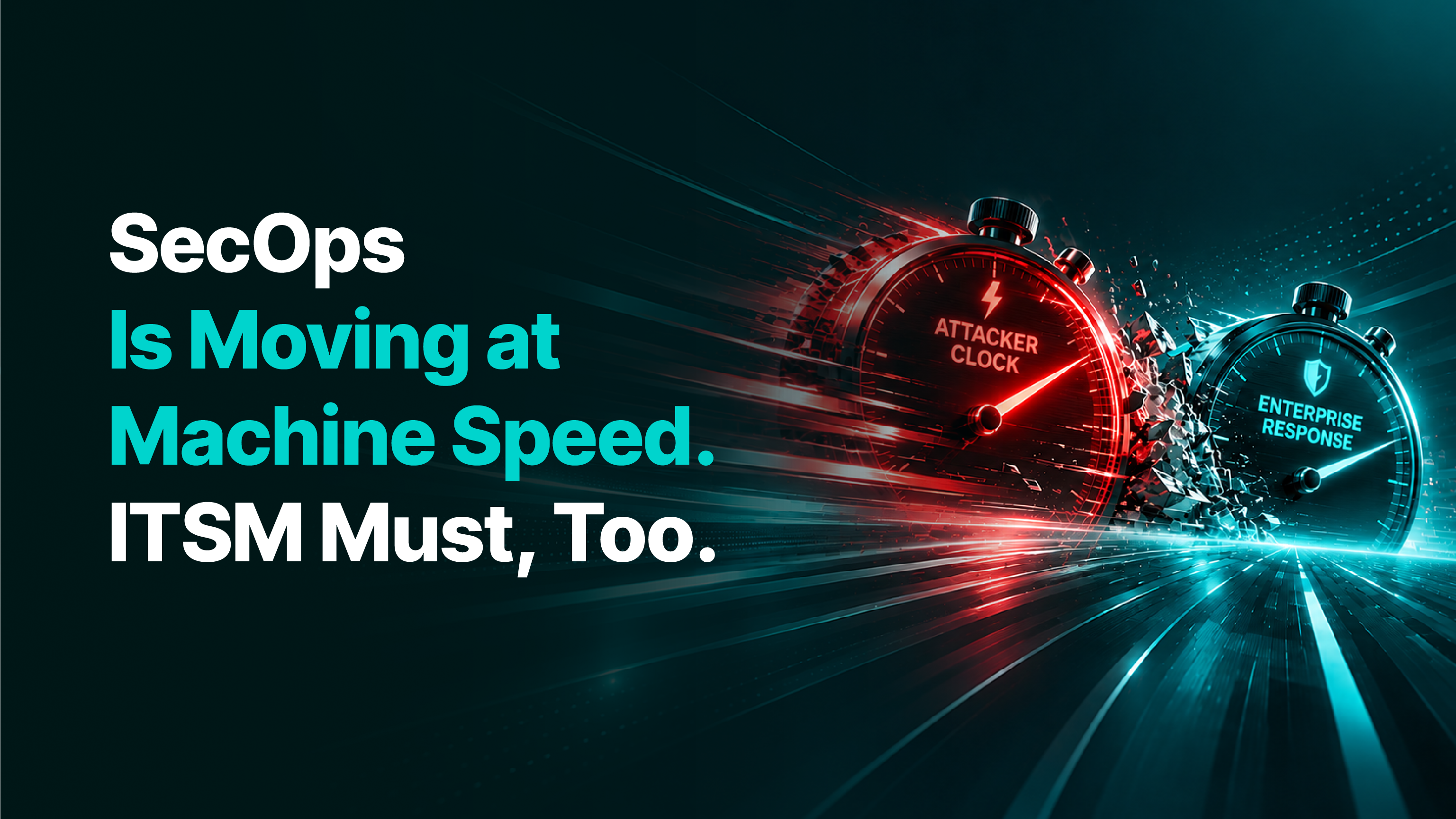
SecOps Is Moving at Machine Speed. ITSM Must, Too.
Different reports measure different populations and attack stages, but the operational implication is hard to ignore - The attacker's clock is accelerating, but the enterprise response clock is not keeping up with it.

Key takeaways
- What many organizations still have is a shortage of fast, coordinated action after the signal arrives.
- The difficult part is often not just seeing the risk but operationalizing the appropriate response. And, a legacy operating model creates latency
- A modern ITSM platform at the SecOps intersection needs at least four new capabilities.
- For the next generation, the central capability will increasingly be the governed agentic loop.
Part 1 of the series From Security Signal to Governed Action
Cybersecurity has gotten dramatically better at detection in the recent decade. Enterprises now have vulnerability scanners continuously identifying exposures. These include EDR platforms watching endpoints, SIEMs correlating events, identity platforms monitoring access, cloud security tools finding misconfigurations, and threat intelligence feeds tracking active campaigns.
We do not have a shortage of security signals. What many organizations still have is a shortage of fast, coordinated action after the signal arrives.
Verizon's 2026 Data Breach Investigations Report says that vulnerability exploitation became the leading breach entry point in its dataset, accounting for 31% of breaches. Verizon also says threat actors are using AI to accelerate exploitation of known vulnerabilities, shortening attack windows from months toward hours.[^1]
CrowdStrike's 2026 Global Threat Report points to the same broader shift from a different dataset: the average e-Crime breakout time it observed fell to 29 minutes in 2025, while the fastest observed breakout was 27 seconds. CrowdStrike also reported an 89% year-over-year increase in attacks by AI-enabled adversaries.[^2]
Different reports measure different populations and attack stages, but the operational implication is hard to ignore - The attacker's clock is accelerating, but the enterprise response clock is not keeping up with it.
That is why the intersection between SecOps and IT service management is becoming strategically important.
The problem begins after detection
Consider what happens when a vulnerability scanner identifies a critical CVE on a production system. The scanner may know the vulnerability, severity, affected software and asset, etc. But the enterprise still needs to answer a much wider set of questions. Most common ones are listed below;
- Is the vulnerable component actually reachable or exploitable in our environment?
- Is there evidence of exploitation in the wild?
- Is the asset internet-facing?
- Which application and business service depend on it?
- How critical is that service?
- Who owns the system?
- Are compensating controls already in place?
- Are there active incidents or changes involving the asset?
- What is the safest remediation?
- What could break if we apply it?
- Does the change require approval?
- When can it be deployed?
- How will we verify that the vulnerability is really gone?
- Can we prove later who decided what, why, and when?
Those are not simply vulnerability-scanner questions. They cross security operations, infrastructure, endpoint management, asset management, configuration management, service ownership, change management, employee support and audit.
In other words, the difficult part is often not just seeing the risk but operationalizing the appropriate response. And, a legacy operating model creates latency
Traditional ITSM was designed for a world in which records move through processes largely coordinated by people.
A scanner generates a finding, someone reviews it, and a ticket is created. Then that ticket is routed, a resolver identifies the asset owner, and another team evaluates the application impact. Then a change request is created, an approval is requested, a patch is scheduled, and so on.
Control by individuals in the above process-chain may be sensible. But the problem is the waiting time between them. In the legacy model, this process-chain looks something like this;
Signal → Ticket → Queue → Human → More context gathering → Change → Approval → Execution → Manual verification
However, the future needs to look much closer to this;
Signal → Context → Reasoning → Governed action → Verification → Evidence
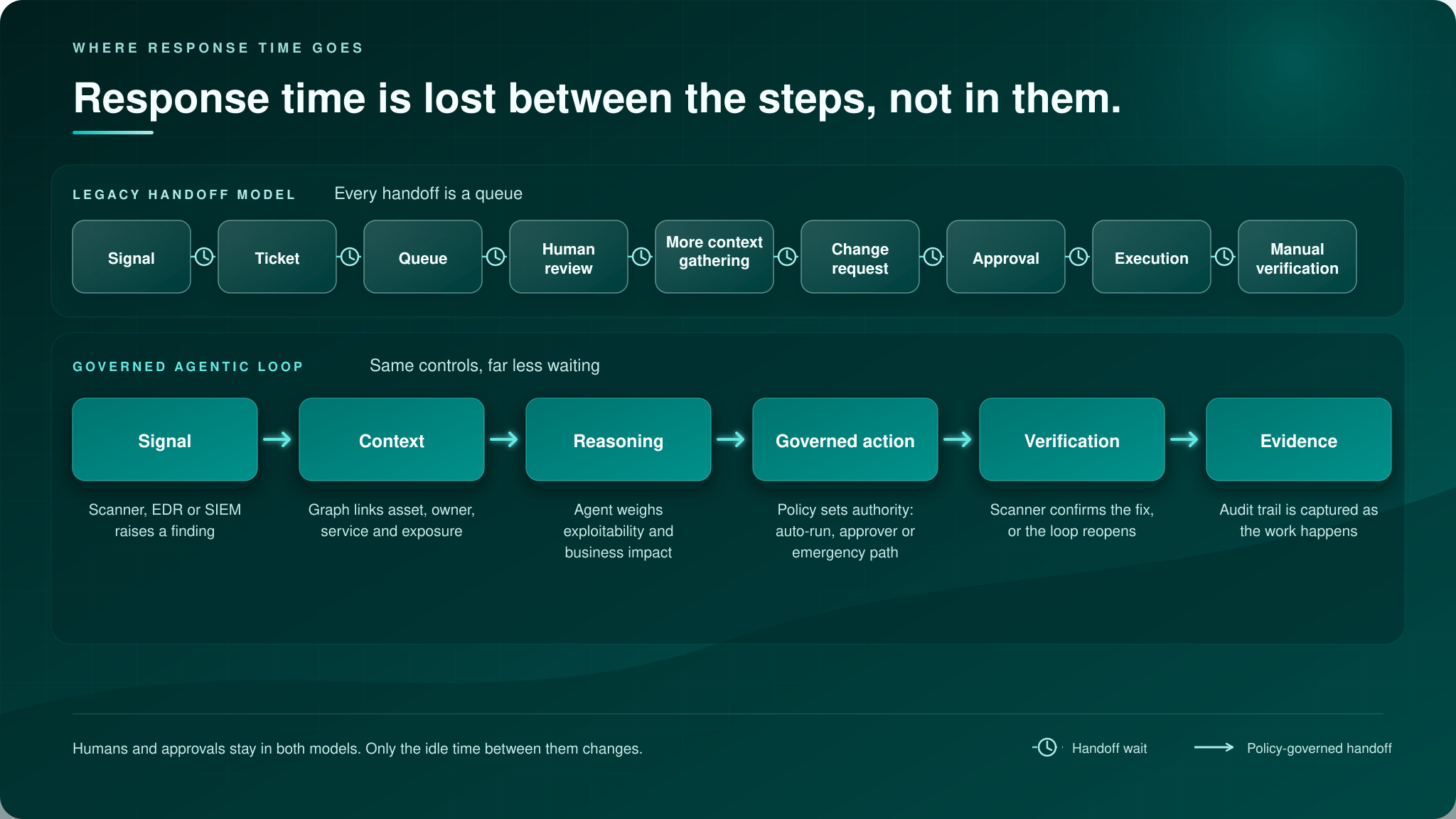 Legacy handoff model vs Governed Agentic loop
That does not mean eliminating humans or controls. It means eliminating unnecessary latency around them.
SecOps does not need another ticketing system
Here, the answer is not for ITSM to become a SIEM, an EDR platform or a vulnerability scanner. Those systems have specialized jobs and should remain authoritative in their domains.
The opportunity for the next generation of ITSM is different.
It can become the reasoning, orchestration and governance layer between security detection and enterprise action. That is a much more consequential role than simply creating a ticket when a security tool raises an alert.
See what Agent Governance looks like when built-in
Rezolve.ai delivers AI ticketing with class-leading Agent Governance
From systems of record to systems of reasoning and action
The central objects in ITSM have traditionally been records - incidents, problems, changes, assets, configuration items, requests and knowledge articles. Those records still matter, and so does their governance and auditability.
But a record-centric architecture is not enough when the system needs to continuously answer questions that span many sources and relationships.
A modern ITSM platform at the SecOps intersection needs at least four new capabilities.
1. A dynamic enterprise context graph
A traditional CMDB tells you that a server exists and stores attributes about it. A security decision needs much more context.
The platform needs to understand relationships such as;
Asset → software → vulnerability → identity → owner → application → business service → dependency → exposure → security control → incident → change
This is why the CMDB has to evolve from a relatively static inventory into a dynamic context graph grounded in authoritative enterprise systems.
The graph does not need to replace every system of record. It needs to connect them so that agents and humans can reason over the relationships.
A vulnerability's technical severity may be identical on two machines, while the enterprise risk is completely different because one supports a public, Tier-1 service and the other is isolated in a test environment.
Without the graph, that context has to be discovered manually. With the graph, it can be part of the decision from the start.
2. An agent plane that can investigate and reason
Rules are excellent when the decision is known in advance. For example: if a specific class of endpoint misses a defined patch deadline, notify the owner and escalate after 24 hours.
But many security decisions require investigation across internal and external sources.
An AI agent may need to combine;
- scanner findings
- CVSS severity
- active exploitation information
- exploit-likelihood signals
- threat intelligence
- internet exposure
- asset and service criticality
- dependency relationships
- identity privilege
- compensating controls
- recent incidents and changes
The important shift is from workflow automation to contextual reasoning. The agent is not simply calling an API because a condition matched. It is assembling evidence, evaluating the situation, proposing an action, explaining why, and then operating within the authority granted by enterprise policy.
3. Agentic change management
Finding a security issue is often easier than changing production safely. That is where ITSM becomes especially important.
Today, change records frequently require people to manually gather information that already exists somewhere in the enterprise:
- impacted assets and services
- owners and approvers
- dependency and blast-radius analysis
- maintenance windows
- historical change success
- implementation steps
- testing procedures
- rollback plans
An agentic change process can assemble much of this automatically, reason about the risk, generate a change plan and route the decision appropriately.
The goal here is not uncontrolled autonomous change but governed autonomy.
Low-risk, well-understood remediation may be approved by policy for automatic execution. A high-risk production change may still require a named human approver. An actively exploited vulnerability may invoke an emergency change path.
AI provides intelligence, and policy defines authority.
4. Closed-loop verification and evidence
A workflow should not consider a security issue resolved merely because a patch command returned success.
NIST defines enterprise patch management as including not only identifying, prioritizing, acquiring and installing patches, but also verifying their installation.[^3]
The operating loop should become:
Detect → Contextualize → Prioritize → Plan → Approve → Remediate → Verify → Prove
If the authoritative scanner or security platform says the vulnerability remains, the loop should reopen automatically.
The system should also preserve the evidence generated along the way: what information the agent used, why a priority was assigned, who approved the change, what actions were executed, whether exceptions occurred, and what ultimately verified the fix.
Audit evidence becomes a by-product of the process instead of a reconstruction exercise months later.
People are part of the architecture too
This operating model is not limited to servers and cloud infrastructure. Endpoints make the human dimension obvious.
Suppose an urgent update is required on 5,000 employee laptops. A traditional security process may know which devices are exposed. But successful remediation may require communicating with each employee, scheduling a reboot, collecting diagnostics when installation fails and confirming compliance afterward.
An employee-facing agent could say;
A security update is required on your laptop. Installation takes about eight minutes and requires a restart. I can install it now or schedule it for later today.
If the update fails, the same agent can collect logs, run approved remediation, update the ITSM record and escalate only the cases that actually need a technician.
That is where SecOps, DEX, endpoint management and employee support begin to converge.
A new division of labor
The architecture becomes easier to understand when the roles are explicit:
- Security platforms detect.
- The context graph establishes meaning.
- Agents investigate and reason.
- Policy governs authority.
- ITSM coordinates the operational process.
- Automation platforms execute.
- Security platforms verify.
The result is a closed operational loop rather than a collection of loosely connected queues.
This is bigger than just vulnerability management
Vulnerability remediation is an excellent place to see the model because the workflow is concrete and measurable.
But the architecture applies much more broadly:
- security incident response
- privileged-access operations
- identity exposure
- configuration risk
- endpoint security remediation
- emergency change
- audit and compliance evidence
The common pattern is the same:
Signal → Context → Reasoning → Governed action → Verification → Evidence
And that points to a larger change in what ITSM needs to become. For the last generation, the central object of ITSM was the ticket.
For the next generation, the central capability will increasingly be the governed agentic loop.
Because when attackers operate at machine speed, a critical security finding sitting in a queue while humans manually coordinate the next five systems is no longer a sustainable operating model.
The next generation of ITSM has to do more than record the work.
It has to help understand the work, govern the work, execute the work and prove that the risk is gone.
Coming next
Part 2: Beyond Tickets: The Architecture Agentic ITSM Needs for SecOps
We will go deeper into the architectural building blocks: the dynamic enterprise graph, the agent plane, agentic change management, policy-based autonomy, execution, verification and continuous evidence.
Sources and further reading
[^1]: Verizon, 2026 Data Breach Investigations Report and related summary. https://www.verizon.com/business/resources/reports/dbir/ and https://www.verizon.com/about/news/breach-industry-wide-dbir-finds
[^2]: CrowdStrike, 2026 Global Threat Report. https://www.crowdstrike.com/en-us/press-releases/2026-crowdstrike-global-threat-report/
[^3]: NIST SP 800-40 Rev. 4, Guide to Enterprise Patch Management Planning: Preventive Maintenance for Technology. https://csrc.nist.gov/pubs/sp/800/40/r4/final
Last updated on September 25, 2026
Get summary with:
See the agentic service desk in action
Watch Rezolve.ai autonomously resolve real IT and HR tickets: governed, auditable, glass-box.
Frequently asked questions
1. Why is detection no longer the main cybersecurity challenge?
Most enterprises already have plenty of tools spotting threats, like scanners, EDR platforms, and SIEMs. The real gap is what happens next: turning those signals into fast, coordinated action before attackers can take advantage.
2. How fast are attackers moving today?
Very fast. CrowdStrike's 2026 report found average eCrime breakout time fell to 29 minutes, with the quickest at just 27 seconds. Verizon also notes that AI is helping attackers shrink exploitation windows from months toward hours.
3. Does this mean ITSM should replace security tools like SIEM or EDR?
Not at all! Those tools should stay authoritative in their own areas. The opportunity for ITSM is to become the reasoning, orchestration, and governance layer that connects security detection to real enterprise action.
4. Will AI agents make changes without human approval?
Only where policy allows it. The goal is "governed autonomy," so low-risk fixes might run automatically while high-risk production changes still need a named human approver. As the blog puts it, AI provides intelligence and policy defines authority.
5. How do you know a vulnerability is actually fixed?
A successful patch command isn't enough. The process should confirm the fix with the authoritative scanner and automatically reopen the issue if the vulnerability remains. Evidence is captured along the way, so audits become simple rather than a scramble months later.