Agentic AI Architecture Explained: Components, Workflows, and Design Principles
Explore Agentic AI architecture, from autonomous planning and tool integration to layered design, memory, and real-world use cases. Learn how AI agents execute complex tasks with adaptability.

Key takeaways
- Agentic AI goes beyond prompt-response: agents interpret goals, plan multi-step work, call tools and revise from feedback.
- The core building blocks are a goal interpreter, planner, memory, tool interface and feedback loop, arranged in layers.
- LLMs supply the reasoning while RAG grounds agents in real-time enterprise information.
- Rezolve.ai applies agentic architecture to IT and HR service desk workflows inside Microsoft Teams.
Article Sneak Peak
Agentic AI is the next leap in artificial intelligence. In this article, you’ll explore its architecture, key components like memory and planners, real-world applications, and how platforms like Rezolve.ai are putting agentic systems into practice.
AI has evolved from passive tools into systems that can reason, act, and adapt to complex environments. One of the most powerful expressions of this evolution is Agentic AI. This paradigm enables machines to become active participants in achieving their goals, rather than just responding to prompts.
Agentic AI marks a shift from simple prompt-response systems to intelligent agents that can interpret goals, plan their actions, use external tools, and refine their behavior through feedback. These agents don’t just answer questions; they follow through, adjust strategies, and complete tasks with purpose and autonomy.
Understanding how these systems work reveals the building blocks behind their intelligence, including layered architectures, planning modules, memory systems, tool integrations, and feedback loops.
Agentic AI combines these elements to deliver flexible, self-directed performance across industries, from enterprise automation to personalized digital assistants.
Let us closely understand the agentic AI architecture in this architecture!
What Is Agentic AI?
Agentic AI refers to goal-oriented systems that plan, act, and adapt autonomously. These systems don’t simply generate a one-off response. They initiate, coordinate, and complete multi-step tasks. They proactively interact with data, APIs, tools, and environments to fulfill complex objectives.
Unlike conventional AI, which relies on user guidance at each stage, Agentic AI agents understand intent, formulate plans, access relevant information, and revise strategies based on feedback. They can handle ambiguity, correct mistakes, and continue operating without constant human supervision.
New to Agentic AI?
Before diving deeper into the architecture, explore the core concepts, evolution, and use cases of agentic AI.
Read: Agentic AI – A Complete Guide
Types of Agentic AI
Agentic AI systems can be categorized based on their range, specialization, and adaptability. Here are five core types:
#1. Single-Function Agents
These agents perform one specific task, such as summarizing text or converting files. They are simple, reliable, and ideal for repetitive or well-defined actions.
#2. Multi-Function Agents
Designed to handle related tasks in sequence, multi-function agents manage workflows such as customer support, onboarding, or reporting from start to finish.
#3. Horizontal Agents
These generalist agents can operate across various domains, switching between tasks such as writing, scheduling, or data analysis without requiring specialized expertise.
#4. Vertical Agents
Focused on a single domain, vertical agents are deeply integrated with specific tools and rules, offering expert-level performance in areas like HR, legal, or finance.
#5. Hybrid Agents
Hybrid agents blend breadth and depth, adapting to the task by acting broadly when necessary and switching to specialized behavior in complex or sensitive contexts.
The Agentic Workflow
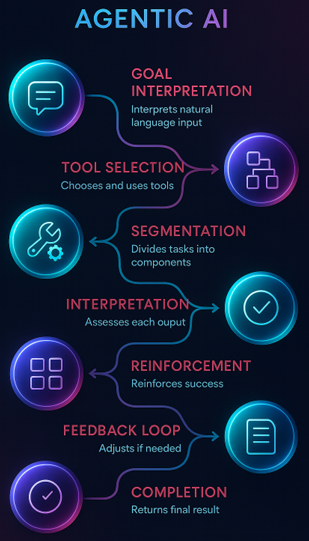
The image below shows a typical agentic AI workflow which can be applied to a variety of scenarios.
-
Goal Interpretation: The system begins by interpreting natural language input into structured objectives.
-
Task Planning: Once the goal is understood, it forms a sequence of tasks that may branch or be conditional, depending on the context.
-
Tool Selection and Execution: The agent determines which tools to use and when, such as querying a database, calling APIs, generating summaries, or writing files.
-
Segmentation: Tasks are broken into logical components to handle complex workloads incrementally.
-
Interpretation: Each output is assessed for progress, coherence, and alignment with the goal.
-
Reinforcement and Reflection: Reinforcement involves reinforcing successful decisions, while reflection is the agent analyzing its output to identify and correct weaknesses, either during the process or across sessions.
-
Feedback Loop: If something fails or underperforms, the agent adjusts its plan and continues to operate. This loop enables self-improvement over time.
-
Completion: Once all subtasks are complete, the agent returns the final result, which may be a report, insight, file, or update.
Core Components of Agentic AI
Agentic AI relies on a combination of components that work together in an orchestrated architecture:
● Goal Interpreter
Converts natural language into structured actions. This component is crucial for translating human instructions into machine-readable goals, allowing the agent to operate with minimal ambiguity.
● Planner
Creates multi-step sequences based on dependencies, constraints, and available tools. It ensures logical task progression and helps agents respond effectively to dynamic contexts or changing requirements.
● Tool Interface
Handles interactions with external systems, including APIs, databases, file stores, and services. A robust tool interface expands the agent's capability and allows seamless integration into enterprise ecosystems.
● Memory
Tracks context across sessions and stores outputs, knowledge, and user preferences. Memory enables agents to personalize responses, maintain long-term consistency, and improve efficiency over time.
● Evaluator / Feedback Loop
Assesses the quality of outputs and identifies when to retry, escalate, or revise a task. This ongoing self-assessment mechanism ensures continuous learning, correction, and refinement of the agent’s behavior.
🔍 Want to See Agentic Architecture in Action?
Explore the leading tools and frameworks that bring planning modules, memory, and tool use to life.
Layers of Agentic AI Architecture
Agentic AI is built on a layered architecture for modularity and performance:
Interface Layer: Receives user goals and provides outputs. It acts as the entry point for interactions and ensures clarity in communication between humans and AI.
Cognition Layer: Interprets, plans, and sequences tasks (powered by LLMs and reasoning engines). This is where agents reason through goals and decide on the best course of action.
Action Layer: Executes tasks using tool integrations. It facilitates the activation of agents and manages communication with APIs, external systems, or internal services.
Memory Layer: Maintains persistent knowledge, temporary state, and contextual embeddings. This layer ensures continuity across sessions and helps personalize actions over time.
Feedback Layer: Performs evaluation, reflection, and dynamic adjustment. It empowers agents to assess performance, learn from past behavior, and evolve through iterative self-improvement.
The Role of LLMs in Agentic AI
Large Language Models (LLMs) are foundational to Agentic AI. These are advanced machine learning models trained on vast datasets to understand and generate human language. LLMs interpret user input, derive meaning, and generate coherent responses, serving as the engine that powers an agent’s reasoning and communication.
In Agentic AI, LLMs are more than just language generators; they are central to planning, versatile decision-making, and context retention. They help translate complex instructions into structured plans and facilitate the agent’s ability to adapt its behavior based on changing input, history, or feedback.
Retrieval-Augmented Generation (RAG) in Agentic AI
A critical enhancement in Agentic AI is RAG (Retrieval-Augmented Generation). RAG combines LLM reasoning with a retrieval mechanism that fetches relevant documents or facts before generating a response. This boosts accuracy, grounding, and domain-specific reliability.
In an agentic context, Agentic RAG goes a step further: retrieval is not a single query but a dynamic, iterative process guided by the agent’s planning. The agent may retrieve documents, filter them, ask clarifying questions, and refine its generation based on an evolving understanding of the information.
Design Principles in Agentic Systems
Designing effective agentic systems requires more than technical capability. It depends on clear principles that guide behavior, modularity, and adaptability:
● Modularity
Each component of the system should function independently and be easily replaceable or upgradable. This ensures scalability, maintainability, and integration across varied environments. Modular design also facilitates experimentation and innovation without disrupting the entire system.
● Human-in-the-Loop (HITL)
Incorporating human oversight at key decision points ensures that agents operate ethically, safely, and in line with human expectations. HITL offers accountability and enables corrective interventions. This principle is especially vital in high-stakes applications such as healthcare or finance.
● Reinforcement and Reflection
Agents should reinforce effective decisions and reflect on suboptimal outcomes to improve over time. Reflection allows agents to self-diagnose weaknesses and make iterative improvements across interactions. This cyclical learning process builds resilience and long-term performance gains.
● Explainable AI
Actions, decisions, and outcomes should be understandable to users. Providing explanations builds trust and enables debugging, auditing, and informed oversight. Explainability also aids developers and stakeholders in evaluating agent behavior and decision rationale.
● Task Decomposition
Agentic systems should be designed to break complex goals into smaller, manageable tasks. This enables clarity, increases success rates, and makes error correction easier at each step of the process. Effective decomposition also enhances collaboration between multiple agents or agent-tool interactions.
Together, these principles form a foundation for building reliable, adaptive, and human-centered Agentic AI systems that can solve complex, evolving problems in the real world.
CNNs, ViTs, and Visual Agents
While much of Agentic AI focuses on text and structured data, vision-based agents are emerging that rely on Convolutional Neural Networks (CNNs) and Vision Transformers (ViTs).
-
CNNs are ideal for localized feature detection, which is helpful in agents that analyze images, detect defects, or extract information from screenshots.
-
ViTs are better at interpreting global patterns in high-resolution or multi-context images, which can enhance agents in fields like medical imaging or spatial analysis.
These visual agents can be integrated into workflows, for example, an agent could read a chart, identify anomalies, retrieve related documentation, and generate a summary.
Real-World Workflows Using Agentic AI
Agentic AI is already enhancing productivity and intelligence in various sectors by autonomously managing workflows that would otherwise require intensive human effort:
-
IT Helpdesk Automation: An agent can interpret a user’s issue, query internal systems, and attempt resolutions like resetting passwords or provisioning access. The system adapts over time by learning from resolved tickets.
-
Sales Prospecting: Agentic systems can identify leads, gather insights, and draft outreach emails tailored to each recipient. They optimize messaging strategies based on engagement data.
-
Enterprise Reporting and Compliance: Agents can generate reports using data from multiple departments and check compliance benchmarks. This reduces manual effort while improving accuracy.
-
Customer Experience in Retail: From shopping assistance to issue resolution, agentic systems improve satisfaction and retention. Agents can suggest alternatives or update customers on the status of their deliveries.
These use cases demonstrate how agentic AI systems transform traditional workflows into intelligent, responsive, and scalable operations. As adoption grows, more sectors are expected to develop tailored workflows powered by specialized agents.
🚀 How Is Agentic AI Used in the Real World?
Once you understand the architecture, see how businesses are applying it, from HR automation to intelligent IT agents.
👉 Explore 10+ Agentic AI Use Cases
Future of Agentic AI Architecture
Agentic AI is evolving rapidly, with architectural decisions influencing how autonomous systems will scale and adapt across various industries. As these systems mature, certain forward-looking principles will guide their continued development:
-
Autonomy with Alignment: Agents will gain greater independence but must remain aligned with user goals and system constraints. This ensures their outputs stay consistent with human intent even as they become more self-directed.
-
Modularity for Scale: Architectures will become more plug-and-play, allowing teams to compose systems from reusable agent blocks. Modular agents can be easily configured for different tasks and reused across domains.
-
Domain Adaptation: Agents will learn to operate within specialized domains using fine-tuned models and curated memory systems. This enables more profound expertise and better contextual reasoning.
-
Real-Time Performance: With edge processing and optimized inference, agents will operate more quickly and responsively. Reduced latency will be critical for time-sensitive applications.
-
Explainable AI: Even as autonomy grows, observability and explainability will be central, ensuring trust and traceability. Users will need clear insights into how decisions are made and actions executed.
These guiding ideas will help ensure that Agentic AI architecture continues to support scalable, transparent, and practical solutions across evolving technological landscapes.
In Closing
Agentic AI represents a foundational advancement in the design of intelligent systems. With the ability to interpret goals, sequence tasks, access tools, and reflect on outcomes, these agents introduce a new level of autonomy and adaptability into digital workflows. As tools and frameworks evolve, these agents will play an increasingly central role in enterprise operations, personal assistants, and domain-specific applications, ushering in a future where software doesn't just respond, but collaborates
🚀 See Agentic AI Architecture in Action
✅ Key Takeaways
-
Agentic AI goes beyond traditional AI by autonomously interpreting goals, planning actions, and adapting through feedback.
-
It’s built on a layered architecture with components like planners, memory, tool interfaces, and evaluators working in sync.
-
LLMs and RAG power intelligent behavior, enabling agents to reason, retrieve relevant information, and generate accurate responses.
-
Design principles like modularity and explainability ensure scalable, transparent, and human-aligned agent systems.
-
Platforms like Rezolve.ai apply Agentic AI to automate IT and HR workflows directly inside Microsoft Teams, boosting enterprise productivity.
FAQs on Agentic AI
1. What is Agentic AI? Agentic AI refers to intelligent systems that can understand goals, plan tasks, use tools, and adapt to changing conditions, operating with autonomy rather than relying on step-by-step prompts.
2. How is Agentic AI different from traditional AI? Traditional AI responds to specific inputs, while Agentic AI agents proactively manage complex workflows, make decisions, and improve over time using feedback.
3. What are the key components of Agentic AI architecture? Essential components include a goal interpreter, planner, memory, tool interface, and feedback loop, working together to deliver intelligent and adaptive task execution.
4. How does Rezolve.ai use Agentic AI in enterprise service delivery? Rezolve AI leverages Agentic AI to automate IT and HR service desk workflows inside Microsoft Teams, enabling intelligent agents to resolve tickets, access tools, and continuously learn from interactions.
5. What roles do LLMs, and RAG play in Agentic AI? Large Language Models (LLMs) power reasoning and language understanding, while Retrieval-Augmented Generation (RAG) brings in real-time information to ensure accurate, grounded responses.
Last updated on August 27, 2026
Get summary with:
See the agentic service desk in action
Watch Rezolve.ai autonomously resolve real IT and HR tickets: governed, auditable, glass-box.