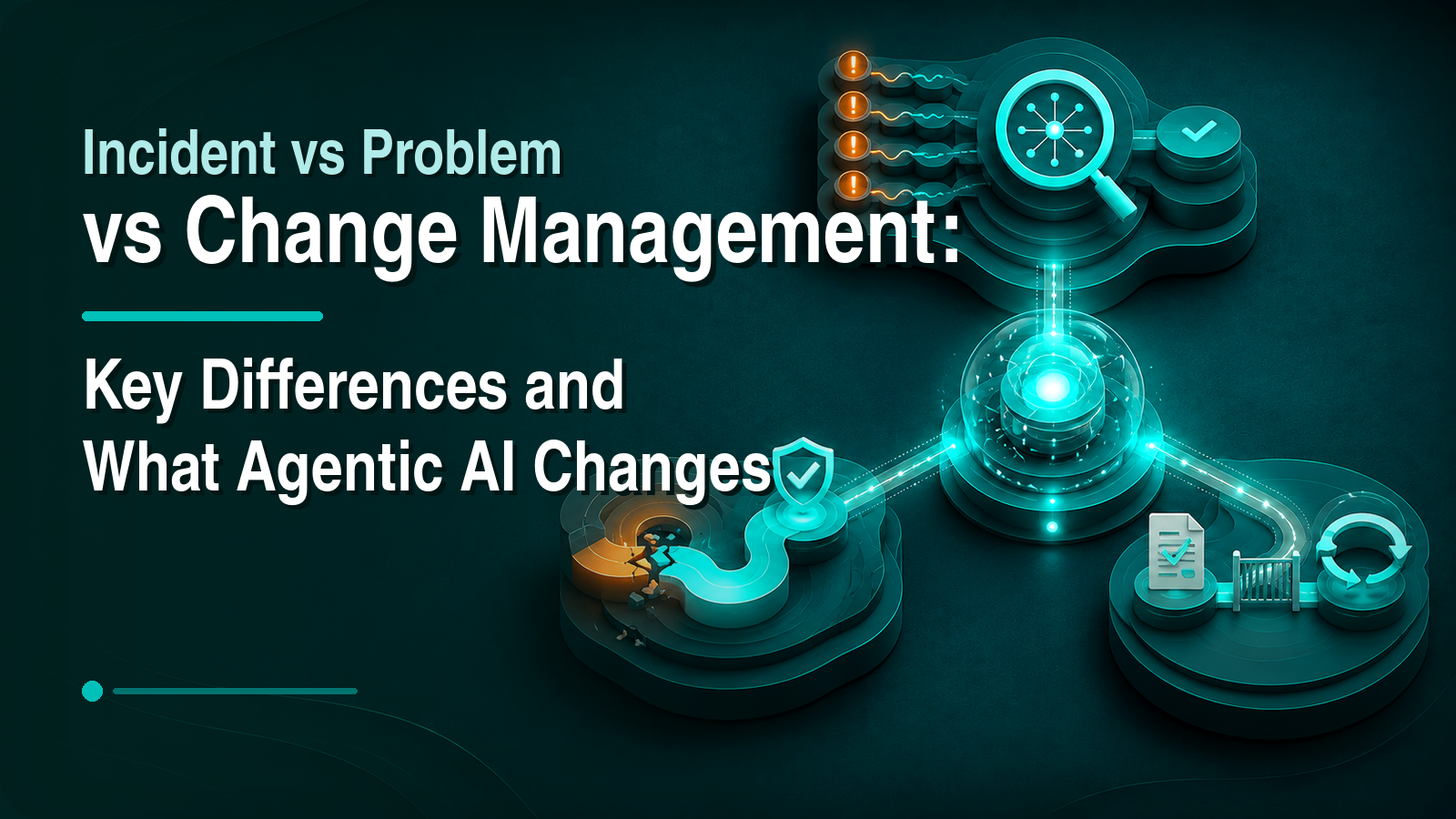
Incident vs problem vs change management: key differences and what agentic AI changes
Discover the differences between incident, problem, and change management, how they work together, and trends like GenAI reshaping ITSM best practices.

Ask an IT director what keeps them up and you rarely hear "ticket volume." You hear about the Tuesday the VPN went down and nobody realized for forty minutes because the reports came in one at a time, to three different queues. You hear about the change that looked routine and took out a payroll run. You hear about the same fault being fixed by four different people in four different weeks, none of whom knew about the other three.
Those are failures in four different practices. Most people who work in IT can define incident, problem and change management well enough to pass an audit. Fewer could tell you why the distinction matters on a bad day, and fewer still have thought hard about what happens to these practices when the software stops being a filing cabinet and starts paying attention.
Let's do both. Definitions first, then the part that is genuinely changing.
The four practices, and what they cost when they go wrong
Two things people routinely get wrong. End users never raise problems. They report incidents, and the IT team identifies problems from the pattern across them. ITIL 4 renamed the practice from change management to change enablement and treats all four as practices rather than processes. Most organizations still use the older names, so both appear here.
What agentic AI is actually contributing
Not speed for its own sake. The four practices above all depend on something IT has never had much of: the ability to see across thousands of individual events quickly enough for the pattern to still be useful.
A service desk agent sees one ticket. A good shift lead sees maybe a few dozen and starts to sense a theme. Nobody sees all of it, in real time, alongside the change calendar and the CMDB and last quarter's incident history. That limit is why major incidents get declared late, why problem management gets skipped, and why change risk gets assessed by whoever happens to remember what else is running that weekend.
Removing that limit is the interesting part. It shows up as faster reaction, lower risk, and better service, but the underlying shift is peripheral vision.
See the four practices working together
Discover incident detection, problem identification and change-risk assessment in one auditable system.
Incident management: from routing to resolving
Capture, classify, route, resolve. Three of those four steps are administration, and they are where most of the elapsed time goes.
What changes first is volume. Requests that never needed a person get handled outright rather than queued: access granted, password reset, license assigned, laptop enrolled. What is left gets classified on content rather than on whichever category the user picked from a dropdown, and routed on skills and current workload rather than a static assignment group that was accurate in 2019.
The useful metric here is not average resolution time. It is what proportion of volume reaches a human being at all.
AI major incident management: the practice that runs on adrenaline
A major incident is one with serious business impact, handled under a separate, accelerated procedure. The definition is easy. Recognizing one in time is not, and most organizations discover they are in a major incident somewhere between the twentieth ticket and the first phone call from a senior stakeholder.
A major-incident threshold can be defined precisely instead: how many tickets of what kind, arriving inside what window. When the threshold trips, the system raises it and the service desk confirms the call, because declaring a major incident has real cost and that judgment should stay with a person.
After that the protocol runs on its own. A war room is created and the right people are invited, texted and called rather than tracked down. The room opens with the context already in it: affected services, linked tickets, what changed recently. The AI works inside the room as an assistant, and produces the summary afterward, which is the artifact everyone needs and nobody wants to write at three in the morning.
Meanwhile, every user reporting the same fault is told it is already being worked on. That one behavior cuts a large share of the ticket volume a major incident generates, and it changes how the outage feels to the several thousand people who are not in the war room.
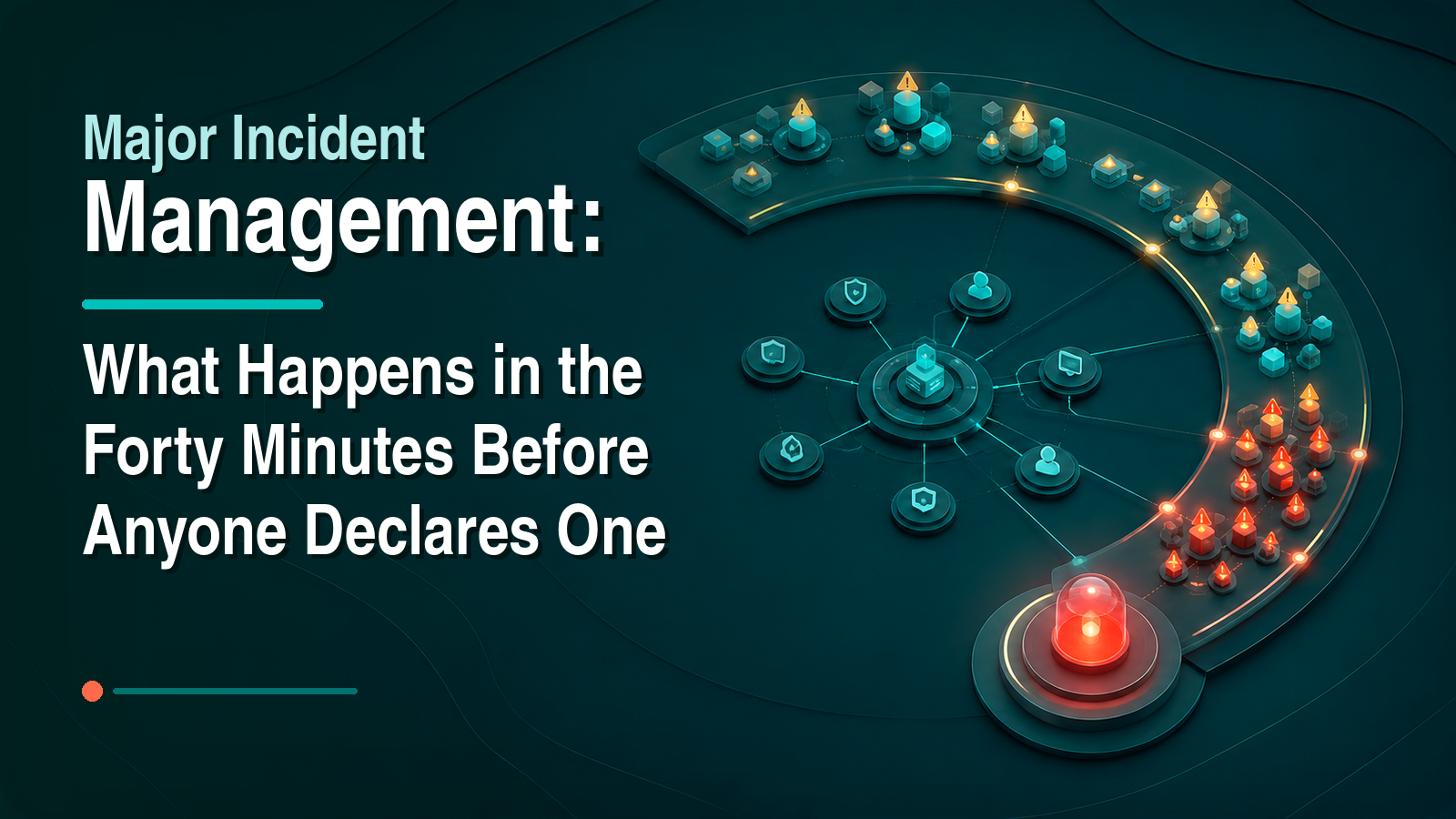
Forty minutes of not knowing is where major incidents get expensive. That is the interval this removes. For a closer look at that interval—from the first related tickets to declaration and the war room- read our guide to major incident management
Agentic AI problem management: the practice everyone has and almost nobody staffs
Worth being honest about this one.
Incidents have SLAs and a queue that makes noise. Changes have a board and a calendar. Problem management has neither, so it loses every week to work with a deadline attached. Plenty of organizations have a mature problem management practice on paper and a handful of stale problem records in the system.
That is not indiscipline. Somebody had to notice that twenty tickets spread over three weeks shared one underlying fault, gather them, write it up, and find an owner. It was always the first thing to go when the week got busy.
Agentic AI removes the noticing. The system spots the linked incidents, shows the pattern for confirmation, and, once confirmed, creates a single problem record with the evidence already assembled, links every related incident to it, and assigns it on skills and availability.
Twenty tickets stop being twenty pieces of work. They become one, which is all they ever were.

Agentic AI change management: from a form to an advisor
You want to take a server down between 2 p.m. and 3 p.m. on a Sunday. Today that is a form, an approval queue, and a certain amount of hope. Everything needed to assess it properly is scattered: the change policy, the infosec policy, the CMDB relationships, the other six changes booked that weekend, and the memory of the one person who was there last time this went badly.
That assessment now happens before you submit. The system reads the change and infosec policies, checks the CMDB for configuration items your change touches or depends on, looks at what else is scheduled in the window, and tells you where the actual risk sits. Where there is risk, it helps you write the CAB request properly, rather than returning a rejection three days later with a one-line reason.
After approval it follows through, allocating work orders, tracking completion, then summarizing what was done and updating the records. That last part matters more than it sounds. Record accuracy is the first thing to decay, and every future change assessment is only as good as the CMDB it reads.
Change enablement stops being a gate and starts being what it was meant to be, which is an informed opinion about risk offered by something that has read everything.
What has actually changed
The four practices are unchanged, and no amount of automation collapses them into one. Restore, coordinate, prevent, alter. Those are still the right divisions of work.
What has changed is how much of each you can afford to do properly. Problem management was never optional in theory and always optional in practice. Major incidents were coordinated by whoever was awake. Change risk was assessed by whoever remembered.
None of those were decisions anyone made. They were what happened when a small number of people had to watch a very large number of events.
So the question to put to your own service desk is not which of the four practices you run. It is which one you quietly stopped running, and whether the reason still holds
Last updated on October 26, 2026
Get summary with:
See the agentic service desk in action
Watch Rezolve.ai autonomously resolve real IT and HR tickets: governed, auditable, glass-box.
Frequently asked questions
What is the difference between incident management and problem management?
Incident management restores service as quickly as possible after a disruption. Problem management finds and removes the underlying cause of one or more incidents so the disruption does not recur.
Do end users create incidents or problems?
End users report incidents. The IT team creates problem records after it identifies a pattern or underlying cause across incidents.
What makes an incident a major incident?
A major incident has serious business impact and is handled through a separate, accelerated procedure. Organizations should define a measurable threshold, such as a number of related incidents or affected users inside a time window, and keep the declaration decision with a person.
Is change management now called change enablement?
Yes. ITIL 4 uses the term change enablement and describes it as a practice. Many organizations still use change management, so both terms remain common.
Does agentic AI replace problem management?
No. Agentic AI can detect patterns, assemble evidence, create and link records, and suggest ownership. People still confirm the pattern, investigate root cause and decide the permanent fix.
What is agentic AI problem management?
Agentic AI problem management spots recurring or related incidents, assembles the evidence, proposes a problem record and links the incidents for human confirmation. It removes the detection and record-building work; people still own root-cause analysis and the permanent fix.
How does agentic AI change management work?
An AI agent reads change and security policies, CMDB relationships, the change calendar and prior outcomes to flag risk before submission. It can help prepare, execute and document the change, while approval and high-impact decisions remain human.
How does AI major incident management detect an outage?
The system watches for a defined threshold of related incidents inside a time window. When the threshold trips, it proposes a major-incident declaration for human confirmation, then opens the war room, notifies responders and assembles the context.