
.png)
TL; DR
The agentic AI moment is a chance for IT leaders to do better than the bits-and-pieces stack the last decade of ITSM left behind. Viewed through the lens of the emerging agentic architecture, a System of Intelligence that houses the agents and the business logic, working alongside the existing System of Record, can let specialized agents operate as a team and let new capabilities ship as configuration rather than another procurement cycle.
Introduction
At any reasonable enterprise scale, IT operations leaders stopped counting the tools in the stack a long time ago. A virtual agent from a leading vendor, a few agent-assist features bolted onto ServiceNow or another ITSM, a DEX product, an RMM platform, a handful of RPA bots, and so on.
Nobody sets out to assemble that stack. Each tool solved a real problem at the time it was bought or built. The patchwork was a by product of decisions made well, one by one, over several years.
This is what we like to call the “Bits and Pieces” strategy. It is worth examining now because agentic AI is bringing a new wave of single-purpose solutions, and the cost of repeating the pattern in the agentic era is materially higher than it was in the last one. This piece walks through what the strategy is, where it works, where it falls short, and how the emerging agentic architecture can help IT leaders think about the choices ahead.
What is the “Bits and Pieces” strategy?
The Bits and Pieces strategy is the cumulative outcome of buying or building point solutions for individual IT operations problems as they emerge, rather than adopting a single platform that covers most of them. It is rarely a deliberate choice. It is more often the natural result of decisions taken in sequence, with the technology landscape shifting underneath those decisions.
There are real reasons IT leaders end up here, and not all of them are bad ones.
It can enable faster execution. When a specific problem becomes acute, buying a tool that addresses it directly is often quicker than waiting for a comprehensive platform to mature. Organizations that take this approach may capture value sooner than peers who wait, although faster procurement does not always translate into faster results.
It can be the only realistic option in a fragmented market. No single vendor covers every category in IT operations, and the categories that exist today did not all exist five years ago. When the market itself is fragmented, assembling point solutions is sometimes the only practical way to address a problem that no single platform yet solves well.
Specialization can lift the quality of individual pieces. Even when a platform covers a category, there is no guarantee its implementation matches the depth of a dedicated specialist. A focused DEX vendor, for example, may outpace the DEX feature inside a broader ITSM platform on depth, breadth, and roadmap.
These advantages are real. They are also why the pattern persists.
Where the strategy falls short
The downsides of a Bits and Pieces strategy tend to emerge over time, and three of them dominate.
A. Operational complexity. A stack of single-purpose tools has more moving parts than a stack built around a single platform. Each tool brings its own integrations to maintain, its own administrative interface, its own release cycle, and its own security review. The work to keep all of it running is real and recurring.
B. Accountability. When deflection or resolution time misses its target, the chatbot vendor may point to the knowledge base, the knowledge vendor to the ITSM team, the ITSM team to the integration, and the IT leader spends weeks running a triage that should not have been necessary.
C. Total cost of ownership (TCO). Licenses are typically a fraction of the lifetime cost of a fragmented stack. The rest is integration build and maintenance, per-vendor security review, vendor management overhead, and the staff time required to keep everything pointed in the same direction. The stack that looks affordable in the procurement spreadsheet is often more expensive on the operating P&L.
Weighed against one another, the upsides of a Bits and Pieces strategy tend to be front-loaded and short-term, while the downsides compound. Faster initial procurement is real, but over a multi-year horizon the operational drag, the diffuse accountability, and the total cost of ownership often outweigh it, particularly once a more unified solution becomes available. The strategy can be the right call when there is no realistic alternative. It is harder to defend when there is.
Why the agentic era raises the stakes
Agentic AI is bringing a new wave of point solutions, and the temptation to add them to an already-fragmented stack is strong. Vendors are launching specialized offerings for every emerging category. Each one is real. Each one has a procurement pitch.
The risk of repeating the Bits and Pieces pattern is materially higher this time. The value of an agentic system depends on agents being able to coordinate with one another: the change agent talking to the incident agent, the knowledge agent feeding the technician agent, the major incident agent pulling context from all of them during a P1. Agents that live in separate products, with separate context windows and separate data access patterns, cannot do this well. They tend to produce parallel monologues rather than coordinated work, and the capability ceiling on a fragmented stack ends up much lower than the demos suggest.
Gartner has made a related point. The firm forecasts that over 40 percent of agentic AI projects will be canceled by the end of 2027, citing escalating costs, unclear business value, and inadequate risk controls. Those failure modes are not inherent to agentic AI. They often follow from deploying agentic AI on top of a stack that was not built to support it.
The capability landscape today
To think about the choices clearly, it helps to look at the AI Ops capability landscape through two lenses: mature technologies that are widely deployed and well understood, and emerging technologies that are just arriving and still evolving.
Mature technologies
These categories have been in production deployments for at least a year or two, have meaningful market adoption, and are now in their third or fourth iteration of vendor offerings. The verdict on how they perform is largely in.
Emerging technologies
These are recent arrivals. Adoption is still low, vendor maturity varies widely, and most are still finding their place.
The category also carries some definitional noise. Gartner has coined the term “agentwashing” to describe the common practice of labeling AI assistants as agents, and advises enterprise leaders to define the term carefully before deploying.
From the breadth of this landscape, one can see how it becomes possible to fall into the trap of a Bits and Pieces strategy in the agentic era. Each capability above is a candidate for a separate purchase, and each separate purchase adds to the stack.
The emerging agentic architecture
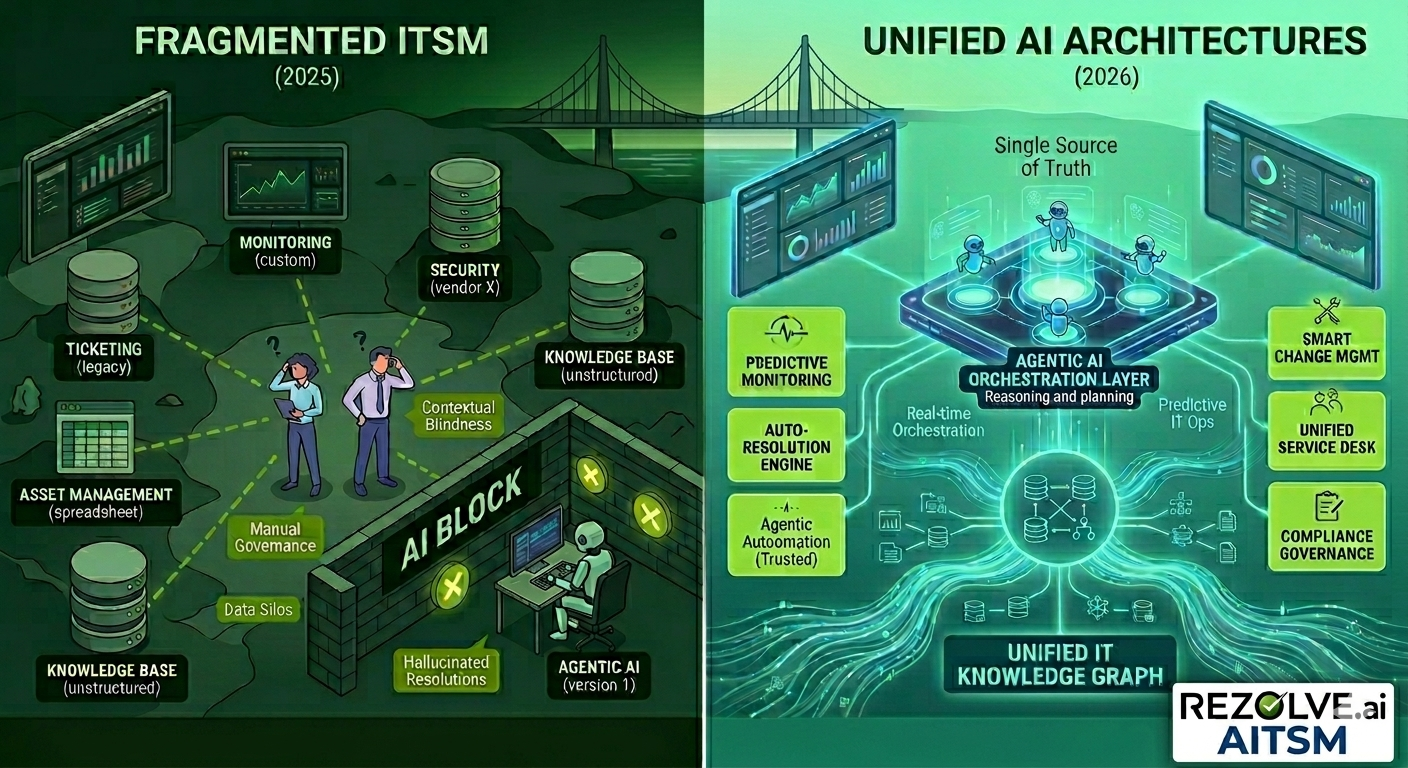
A useful way to make sense of the landscape is through the emerging agentic architecture that Rezolve.ai and others are building toward. This is not a recommendation about how to buy. It is a way to see how the capabilities relate to one another, and what each part of the stack is responsible for.

The emerging agentic architecture maps how AI capabilities relate to one another, with the System of Intelligence as the home for agents and business logic, the System of Record as the service management foundation, and a shared execution and experience layer connecting them.
While the architecture above explains how agentic systems coordinate intelligence, execution, and workflows, the practical value becomes clearer when you see how enterprise teams can actually build and deploy automations without writing code.
See how Rezolve.ai enables IT teams to create agentic AI workflows and automations visually across ITSM operations. Watch Now!
The System of Record is the service management foundation. It is the ITSM or ESM platform that holds the service management data, including incident, problem, change, the service catalog, the CMDB, and the historical record of every ticket and every stage it has moved through. ServiceNow, Jira Service Management, Freshservice, and ManageEngine are common examples. Its function is to track work accurately. It is structurally limited when it comes to doing the work.
The System of Intelligence is where most of the intelligence and business logic resides. This is the agentic layer where specialized agents are built, orchestrated, governed, and held accountable for outcomes. It is the operating layer for AI-driven work, and it provides a single place to govern agents regardless of the channel they work through or the system they read from. The need for this layer grows over time. Rezolve.ai today has roughly eight to ten agents in production and anticipates that a typical service desk could require close to 100 agents by the end of 2027. Every one of those agents needs a place to live, to be governed, and to coordinate with others.
The execution layer is where intelligence connects to the systems that carry out the work. It contains the workflows and automations that agents trigger, the APIs and integrations that reach into enterprise systems, and the Model Context Protocol (MCP) and agent-to-agent (A2A) connections that let agents act through other systems and communicate with one another. When one agent hands context to another, that exchange runs through this layer. A unified execution layer, rather than a set of point-to-point connectors, is what allows new capabilities to be added at low cost rather than as another integration project.
The experience layer is where employees and technicians meet the system. It spans Microsoft Teams, Slack, email, the service portal, voice, and the web. The same intelligence shows up consistently across every channel because the intelligence itself is the same.
When a single product can cover most of these layers and most of the components within them, the result can be disproportionately better than assembling the same capability from separate vendors. The reason is what becomes possible when the layers actually work together.
How the layers work together
The case for a unified architecture is easier to see in a concrete example.
Consider an IT manager who wants to identify laptops that are likely to create cost and ticket volume in the next six months. The query crosses three layers and at least three different systems.
The manager asks a virtual agent for the laptops that are more than three years old and have also generated incidents in the last three months. The agent reads the asset management records in the System of Record to identify candidates by age, queries the incident history to filter for the ones that have caused trouble, and then asks a DEX agent to run diagnostics on those laptops and flag the ones showing significant degradation across boot time, crash frequency, and hardware metrics.
In a few minutes, the manager has a ranked list of laptops worth replacing proactively. From the same conversation, the agent can draft business cases for the affected users, create change requests, route approvals, and trigger procurement.
This is what coordination across layers makes possible, and it is what a fragmented stack struggles to produce. If the asset management AI, the incident AI, the DEX AI, and the virtual agent each live in separate products, with separate context windows and separate data access patterns, the workflow above is no longer a short conversation. It becomes a multi-week project across four vendor relationships, and many IT teams will quietly choose not to attempt it.
The disproportionate benefit of a unified architecture comes from these compounding interactions. The cost of a Bits and Pieces strategy, in the agentic era, is their absence.
Explore how Rezolve.ai Agentic SideKick and Rezolve.ai VoiceIQ work together across IT and HR support channels.
The strategic implication
The Bits and Pieces strategy made sense in the era of single-purpose tools, when there was often no realistic alternative. In the agentic era, the calculation shifts. The intelligence layer has to work as a whole. The agents have to coordinate. The experience has to stay consistent across the channels employees and technicians actually use.
This is consistent with where Gartner sees the market heading. In the same forecast cited earlier, the firm projects that 33 percent of enterprise software applications will include agentic AI by 2028, up from less than 1 percent in 2024. The capability is arriving quickly. The open question is whether it lands on a stack that compounds the value or one that fragments it.
In an environment where agent capabilities will build on one another, a unified strategy is not only operationally simpler. It can be materially more valuable than the sum of its parts.
A note on scope
This piece focuses on the shared service functions: IT operations, HR operations, FinOps, and the adjacent areas that run on a service desk model. Rezolve.ai is not suggesting that a single AI agent platform should run every function across the entire enterprise. That is not realistic, and this article is not making that claim.
Sales, marketing, legal, customer service, and other lines of business each have nuances that may justify their own agentic strategies. The choices that work for IT and HR will not always translate cleanly.
With careful design, a large enterprise can usually resolve to three or four broad strategy buckets rather than fifteen or thirty separate products. Some elements, enterprise knowledge being the most obvious, can and should be common across all of them. The goal is not one platform for everything. It is to avoid the proliferation of point solutions inside any one bucket, particularly the shared services bucket where the Bits and Pieces risk is most acute.
Seeing this in practice



.webp)

.png)









.webp)