.png)

In 2025, help desk software has evolved significantly with AI-powered platforms leading the transformation. Rezolve.ai stands out with its agentic AI that autonomously resolves up to 70% of tickets through Agentic SideKick 3.0. ServiceNow remains the enterprise standard for comprehensive ITSM but requires significant resources. Freshservice offers the best balance of functionality and ease of use for SMBs. Jira Service Management excels for Atlassian-heavy organizations, while Zendesk serves dual customer/employee support needs. The key differentiator in 2025 is AI automation capability—platforms that can deflect tickets and resolve issues autonomously deliver the highest ROI by freeing IT teams to focus on complex, high-value work.
Introduction
The landscape of employee support has evolved dramatically over the past few years. Remote and hybrid work models have become the norm rather than the exception, creating new demands for IT service delivery. Employees expect instant support across multiple channels—whether they're reaching out via Microsoft Teams during a video call, sending a quick Slack message, or picking up the phone for urgent issues. Additionally, the rise of artificial intelligence has fundamentally changed what's possible in help desk automation, with modern platforms now capable of resolving a significant percentage of tickets without human intervention.
When evaluating help desk software for your IT team in 2025, several critical factors should guide your decision. First, consider the platform's AI and automation capabilities—can it genuinely reduce ticket volume through intelligent self-service and autonomous resolution? Second, assess the integration ecosystem—does it connect seamlessly with your existing ITSM tools, enterprise applications, and communication platforms? Third, examine the user experience from both the agent and end-user perspectives—is the interface intuitive and the self-service portal genuinely helpful? Finally, evaluate scalability, security compliance, and the vendor's track record for innovation and support.
Top Help Desk Software Platforms for 2025
1. Rezolve.ai
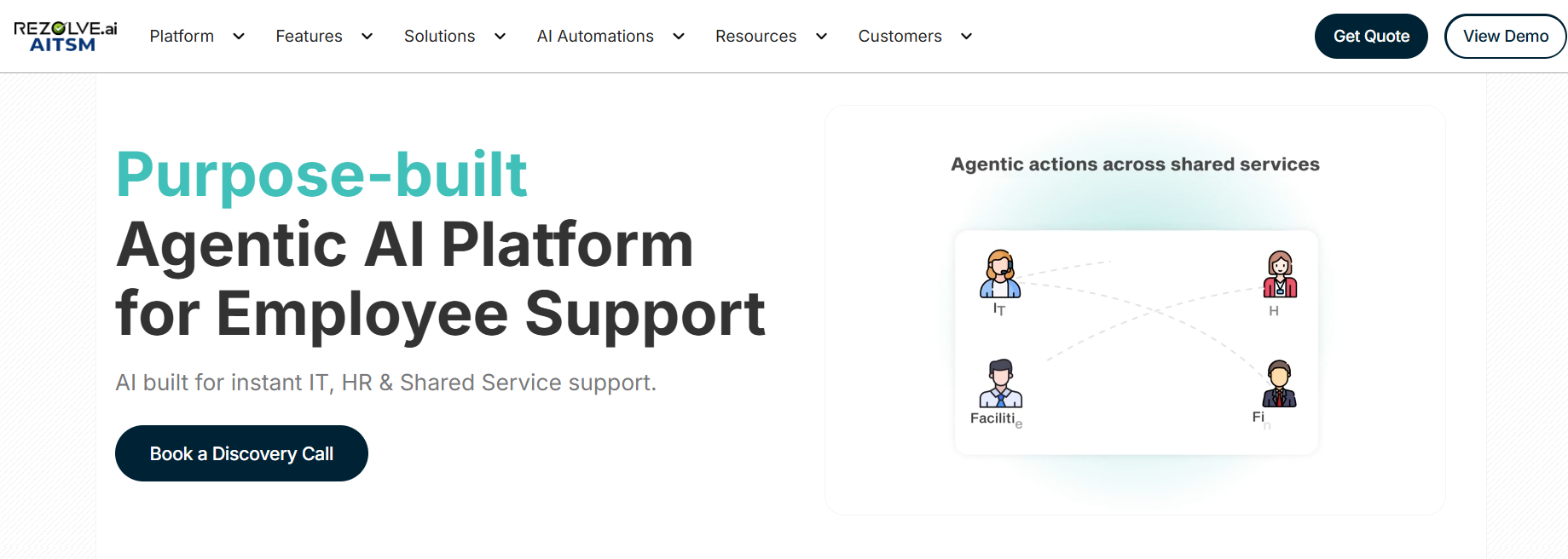
Overview: Rezolve.ai represents the next generation of help desk software, built from the ground up as an agentic AI platform for employee support. Unlike traditional help desk solutions that have bolted on AI features as afterthoughts, Rezolve.ai's architecture is fundamentally AI-native, designed to leverage autonomous agents that can understand context, take actions, and resolve issues independently across multiple channels.
Key Features:
The platform's cornerstone is Agentic SideKick 3.0, a sophisticated multi-agent system that doesn't just suggest answers but actually resolves tickets autonomously. This technology achieves resolution rates of up to 70% for common IT requests, dramatically reducing the burden on human agents. What sets it apart is its ability to handle complex, multi-step workflows—for example, automatically resetting passwords, provisioning access, updating user profiles, and notifying relevant stakeholders, all without human intervention.
Rezolve.ai's omnichannel support capabilities are truly comprehensive, covering Microsoft Teams, Slack, email, phone, web portals, and mobile applications. This means employees can reach out through whatever channel is most convenient at the moment, and the AI maintains context across all interactions. The platform's VoiceIQ feature deserves special mention—it enables natural voice conversations where employees can describe their issues conversationally, and the AI understands intent, extracts relevant details, and takes appropriate action.
The AI-first ITSM platform includes intelligent ticket summarization that automatically generates concise summaries of complex ticket threads, making it easy for agents to quickly understand context when they need to step in. SearchIQ provides contextual enterprise search that goes beyond simple keyword matching to understand what users are actually looking for across knowledge bases, tickets, and documentation.
Perhaps most importantly, Rezolve.ai employs a multi-LLM architecture with built-in explainability and hallucination prevention. Rather than relying on a single language model, the platform orchestrates multiple specialized models and includes verification mechanisms to ensure responses are accurate and grounded in actual knowledge base content. Every AI-generated response includes attribution to source materials, giving both agents and end-users confidence in the information provided.
Pricing:
Rezolve.ai uses custom pricing based on organization size, feature requirements, and expected ticket volumes. This approach ensures enterprises pay for what they actually need rather than being locked into rigid tier structures.
Best For:
Rezolve.ai is ideal for enterprises that are serious about AI-driven automation and want a help desk platform that will continue to evolve with advances in AI technology. It's particularly well-suited for organizations with high ticket volumes, complex ITSM requirements, and a commitment to providing exceptional employee experiences through technology.
2. ServiceNow
Overview: ServiceNow has long been the gold standard for enterprise IT service management, offering a comprehensive platform that extends far beyond basic help desk functionality into full ITSM, ITOM, and even enterprise service management capabilities.
Key Features:
ServiceNow provides comprehensive ITSM capabilities covering incident, problem, change, and asset management with deep configurability. The platform's workflow automation engine is powerful and mature, allowing organizations to codify complex business processes. The self-service portal is highly customizable, and the reporting and analytics capabilities are extensive, with advanced dashboards and custom report builders.
However, ServiceNow's strength—its comprehensiveness—can also be a weakness. The platform is notoriously complex to implement and requires significant resources to configure and maintain. Many organizations find they need dedicated ServiceNow administrators and developers to fully leverage the platform's capabilities.
Pricing:
ServiceNow operates on enterprise pricing that typically requires significant investment, with costs that can reach hundreds of thousands of dollars annually for large deployments.
Best For:
ServiceNow is best suited for large enterprises with complex IT operations, substantial budgets, and the technical resources to manage a sophisticated ITSM platform. It's particularly strong for organizations that need deep integration with IT operations management and want a platform that can scale across multiple service domains beyond IT.
3. Freshservice
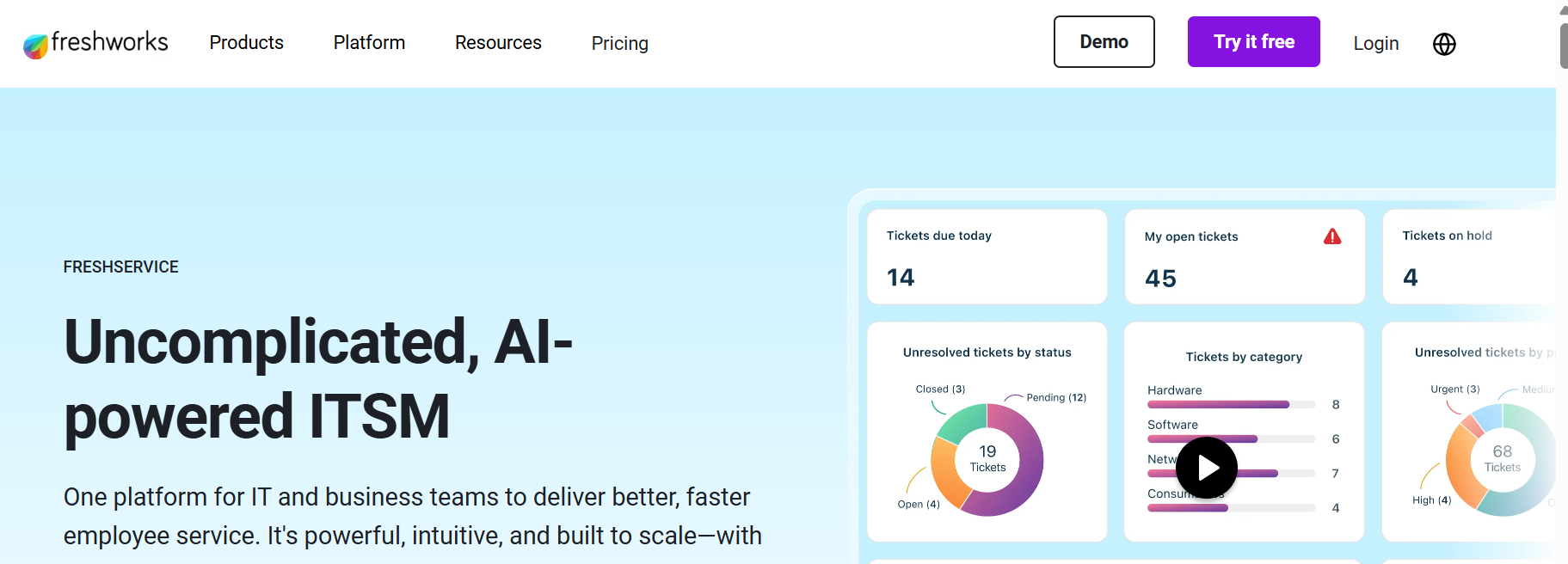
Overview: Freshservice positions itself as a cloud-based IT service desk solution that balances functionality with ease of use, targeting small to mid-sized businesses that need solid ITSM capabilities without enterprise complexity.
Key Features:
Freshservice covers core ITSM needs with incident management, asset management, and a knowledge base. The platform offers reasonable integration capabilities and a clean, modern interface that most IT teams can adopt quickly. Implementation is relatively straightforward compared to enterprise platforms, and the vendor provides good documentation and support resources.
The platform has added AI features in recent years, though these tend to be more focused on agent assistance and basic automation rather than autonomous resolution. The asset management capabilities are particularly strong for a mid-market solution, with good discovery and tracking features.
Pricing:
Starting at $19 per agent per month, Freshservice offers predictable pricing that scales with team size, making it accessible for smaller organizations.
Best For:
Freshservice is an excellent choice for small to mid-sized businesses that need professional ITSM capabilities without the complexity and cost of enterprise platforms. It's particularly well-suited for growing IT teams that want to establish proper service management practices without overcomplicating their operations.
4. Jira Service Management

Overview: Built on the Atlassian platform that many development teams already use for project management, Jira Service Management brings ITSM capabilities into an ecosystem familiar to technical teams.
Key Features:
Jira Service Management provides solid incident and problem management capabilities, along with change management features that integrate naturally with development workflows. The platform's greatest strength is its integration with Jira Software, allowing IT teams to seamlessly coordinate with development teams when issues require code changes or deployments. Workflows are highly customizable, leveraging Atlassian's flexible workflow engine.
The platform works particularly well for organizations that have already adopted Atlassian tools for software development. The shared user base, authentication, and interface conventions reduce friction for users who already work in Jira daily. However, organizations without existing Atlassian investments may find the platform less compelling than purpose-built help desk solutions.
Pricing:
Jira Service Management offers a free tier for up to 3 agents, with paid plans starting at $20 per agent per month, providing a low-barrier entry point for small teams.
Best For:
Jira Service Management is ideal for teams already using the Atlassian ecosystem, particularly organizations where IT and development teams work closely together. It's also a good option for technically-oriented IT teams who appreciate Jira's flexibility and customization capabilities.
5. Zendesk

Overview: Originally built as a customer service platform, Zendesk has expanded into employee support with capabilities designed to serve both external customers and internal teams.
Key Features:
Zendesk offers multi-channel support with a mature ticketing system that has been refined over many years. The knowledge base functionality is robust, and the platform includes automation and AI features that help deflect common inquiries. The interface is polished and generally user-friendly for both agents and end-users.
However, Zendesk's customer service heritage means it sometimes feels like an external support tool adapted for internal use rather than a purpose-built employee support platform. Some ITSM-specific features may require additional configuration or third-party apps from the Zendesk marketplace.
Pricing:
Plans start at $55 per agent per month, positioning Zendesk at a higher price point than some competitors.
Best For:
Zendesk works well for organizations that need to serve both customer support and internal IT support use cases from a single platform. It's also suitable for IT teams that prioritize user experience and want a polished, well-established solution.
Key Features to Compare
AI and Automation Capabilities
The AI capabilities of help desk platforms in 2025 vary dramatically, ranging from basic chatbots to sophisticated autonomous agents. Rezolve.ai leads the pack with its multi-agent architecture that can actually resolve tickets end-to-end, achieving resolution rates up to 70%. This isn't just about answering questions—it's about taking actions like resetting passwords, provisioning access, and updating configurations autonomously.
ServiceNow has incorporated AI through its Now Intelligence features, offering predictive capabilities and automated categorization, though these are typically more focused on assisting agents rather than fully autonomous resolution. Freshservice and Jira Service Management offer more basic AI features like suggested responses and automated ticket routing. Zendesk's AI capabilities focus on intent detection and answer suggestions from the knowledge base.
When evaluating AI capabilities, look beyond marketing claims to understand what the AI can actually do. Can it handle multi-step workflows? Does it verify its responses against trusted sources? Can it explain its reasoning? Does it gracefully escalate to humans when it encounters something outside its capabilities? Platforms like Rezolve.ai that were built AI-first typically excel in these areas compared to platforms where AI was added later.
Integration Ecosystem
No help desk platform operates in isolation—integration capabilities determine how well the solution fits into your existing technology stack. ServiceNow offers the deepest integration capabilities, with pre-built connectors to hundreds of enterprise applications and a robust platform for building custom integrations. However, implementing these integrations often requires significant technical expertise.
Rezolve.ai provides strong integration capabilities specifically focused on the modern workplace, with deep integrations into Microsoft Teams, Slack, and common ITSM tools. The platform's API-first architecture makes it relatively straightforward to connect with enterprise applications. Freshservice, Jira Service Management, and Zendesk all offer integration marketplaces with varying levels of depth and breadth.
For communication platform integrations specifically, Rezolve.ai stands out with native, bi-directional integration with both Teams and Slack that feels like a natural part of those platforms rather than a bolt-on feature. This matters because employees are far more likely to request help through channels they already use daily rather than navigating to a separate portal.
User Experience
User experience encompasses both the agent interface and the end-user self-service experience. For agents, the interface should provide quick access to relevant information, make it easy to take common actions, and help them work efficiently through queues. Freshservice and Zendesk generally receive high marks for agent interface design, with clean, modern layouts that don't require extensive training.
For end-users, the self-service experience is critical because it directly impacts ticket deflection rates. Rezolve.ai's conversational AI interface lets users describe issues naturally rather than navigating through forms and categories. ServiceNow's service portal is highly customizable but can feel dated without significant design investment. Jira Service Management's user portal works well for technical users but may feel less polished for non-technical employees.
Mobile accessibility has become essential with distributed workforces. Platforms should offer full-featured mobile apps for both agents (who may need to respond to urgent issues outside business hours) and end-users (who may need to request support from anywhere). Rezolve.ai, Freshservice, and Zendesk all offer solid mobile experiences.
Reporting and Analytics
Understanding help desk performance requires robust reporting and analytics capabilities. ServiceNow offers the most comprehensive analytics out of the box, with extensive pre-built reports and dashboards covering virtually every aspect of ITSM operations. However, creating custom reports requires familiarity with ServiceNow's reporting tools.
Rezolve.ai provides AI-powered insights that go beyond traditional metrics to identify patterns and opportunities for improvement. The platform can automatically surface trends like increasing ticket volumes for specific categories or common issues that might benefit from knowledge base articles.
Freshservice, Jira Service Management, and Zendesk all offer reasonable reporting capabilities with customizable dashboards. Jira Service Management benefits from Atlassian's analytics platform, which many organizations already use for project tracking. When evaluating reporting features, consider not just what reports are available but how easily stakeholders can access the insights they need without requiring technical expertise.
Pricing Comparison
Help desk software pricing models vary significantly, making direct comparisons challenging. Freshservice's straightforward per-agent pricing starting at $19/month provides predictability and transparency. Jira Service Management offers a free tier and competitive per-agent pricing starting at $20/month. Zendesk starts at $55/agent/month, positioning itself as a premium option.
ServiceNow and Rezolve.ai both use enterprise pricing models where costs depend on organization size, requirements, and deployment complexity. While this makes it difficult to quote specific numbers, it also allows for pricing structures that better align with actual value delivered.
When evaluating total cost of ownership, consider factors beyond subscription fees. Implementation costs can range from minimal for solutions like Freshservice to significant for ServiceNow deployments. Ongoing maintenance and administration costs vary based on platform complexity. Most importantly, calculate the potential savings from ticket deflection and automation—a platform like Rezolve.ai that resolves 70% of tickets autonomously can deliver substantial ROI through reduced agent workload.
ROI factors to evaluate include ticket volume reduction through AI automation, decreased mean time to resolution, improved employee satisfaction and productivity, and reduced burden on IT staff. Organizations implementing AI-driven platforms often find that agents can handle more complex, high-value work rather than responding to routine requests.
Implementation and Support
Implementation complexity varies dramatically across platforms. Freshservice and Jira Service Management can typically be deployed relatively quickly, with basic functionality up and running in weeks. These platforms work well for teams that want to start simple and add complexity over time.
ServiceNow implementations are substantial undertakings that typically require months of planning, configuration, and testing. Organizations usually need to engage ServiceNow consultants or have dedicated internal resources. However, this investment results in a highly tailored solution aligned with specific business processes.
Rezolve.ai's implementation approach focuses on rapid time-to-value, with the AI platform learning from existing knowledge bases and tickets to become effective quickly. The vendor typically provides implementation support to ensure integrations with communication platforms and ITSM tools are configured correctly.
Training requirements depend on platform complexity and how different the new solution is from existing tools. Platforms with intuitive interfaces require less formal training, while complex solutions like ServiceNow may require extensive training programs for both agents and administrators.
Vendor support quality matters, especially during initial implementation and when issues arise. Evaluate whether the vendor offers dedicated support contacts, response time commitments, and proactive account management. Also consider the quality of documentation, community forums, and self-service resources.
Security and Compliance
Security and compliance are non-negotiable for enterprise help desk solutions that handle sensitive IT information and often have privileged access to critical systems. All major platforms offer SOC 2 Type II certification, demonstrating strong security controls. GDPR compliance is standard for platforms serving European markets, while HIPAA compliance matters for healthcare organizations.
ISO 27001 certification indicates a comprehensive information security management system. ServiceNow and Rezolve.ai both maintain ISO 27001 certification. When evaluating security, also consider encryption practices (both in transit and at rest), access controls and authentication options (including single sign-on and multi-factor authentication), and audit logging capabilities.
Data privacy considerations include where data is stored, who has access to it, and how it's used (particularly important for platforms with AI features). Rezolve.ai's multi-LLM architecture with hallucination prevention helps ensure AI responses don't inadvertently expose sensitive information. Some organizations may require on-premises or private cloud deployment options, which ServiceNow can accommodate but most other platforms cannot.
Customer Reviews and Ratings
Analyzing user feedback across platforms reveals consistent patterns. ServiceNow receives praise for comprehensiveness and scalability but criticism for complexity and cost. Users appreciate the platform's capabilities but often note the significant resources required to maximize value.
Freshservice generally earns positive reviews for ease of use and value, with users appreciating the balance between functionality and simplicity. Some users note limitations when requirements become more complex or when deep customization is needed.
Jira Service Management receives strong feedback from organizations already using Atlassian tools, who value the integrated ecosystem. However, organizations without existing Atlassian investments sometimes find the interface less intuitive than purpose-built help desk solutions.
Zendesk users typically praise the polished interface and robust ticketing capabilities but sometimes note that ITSM-specific features feel less developed than dedicated IT service management platforms.
Rezolve.ai receives particularly strong feedback on AI capabilities and ticket deflection rates, with users reporting significant reductions in agent workload. The platform's ability to handle complex workflows autonomously is frequently cited as a differentiator.
Industry-specific considerations matter—healthcare organizations prioritize HIPAA compliance and integration with health IT systems, financial services firms focus on security controls and audit capabilities, and educational institutions often need solutions that can scale across multiple departments with limited IT resources.
In Closing
Selecting the right help desk software in 2025 requires carefully matching platform capabilities to organizational needs. For enterprises seeking cutting-edge AI automation and autonomous ticket resolution, Rezolve.ai represents the future of employee support with its agentic AI platform that delivers measurable ROI through ticket deflection and improved efficiency.
Large enterprises with complex ITSM requirements and the resources to support a comprehensive platform should consider ServiceNow, particularly if needs extend beyond basic help desk functionality into broader IT operations management.
Small to mid-sized businesses seeking balance between functionality and ease of use will find Freshservice delivers solid ITSM capabilities without overwhelming complexity. Organizations already invested in the Atlassian ecosystem should evaluate Jira Service Management for its natural integration with existing development workflows.
Teams requiring both customer support and employee support from a single platform should consider Zendesk, particularly if a polished user experience is a priority.
Looking ahead, AI-powered IT support will continue to evolve rapidly. The platforms that succeed will be those that can genuinely reduce agent workload through autonomous resolution while maintaining accuracy and security. The gap between AI-native platforms like Rezolve.ai and traditional help desk solutions with AI features bolted on will likely widen as AI technology advances.
The future of help desk software lies not just in better ticket management but in proactive issue prevention, predictive insights, and truly conversational experiences where employees can get help as easily as asking a colleague a question. Organizations that invest in modern, AI-driven platforms now will be better positioned to meet the evolving expectations of their workforce.
Next Steps for You
As you evaluate help desk software for your IT team, start by clearly defining your specific needs. What are your current pain points? What percentage of tickets could potentially be automated? What integrations are essential? What's your budget for both implementation and ongoing costs?
Take advantage of demos and trials offered by vendors. Most platforms, including Rezolve.ai, Freshservice, and Jira Service Management, offer trial periods or product demonstrations. Use these opportunities to test the platforms with realistic scenarios from your environment. Involve both IT agents and end-users in the evaluation process to ensure the solution works well for all stakeholders.
For more information on the platforms discussed in this article, visit their websites to explore features in detail, access case studies, and request demonstrations. Rezolve.ai offers comprehensive information about their agentic AI capabilities at their website, including details about SideKick 3.0 and their multi-LLM architecture.
Remember that help desk software is not just a technology purchase—it's an investment in your IT team's effectiveness and your organization's employee experience. Choose wisely, and you'll reap benefits in reduced ticket volumes, faster resolution times, and happier employees for years to come.
Frequently Asked Questions
What's the main difference between traditional help desk software and AI-powered platforms like Rezolve.ai?
Traditional help desk software primarily routes and tracks tickets, requiring human agents to resolve each issue. AI-powered platforms like Rezolve.ai use autonomous agents that can understand, reason, and resolve tickets without human intervention—deflecting up to 70% of routine requests. This means faster resolution times for employees and dramatically reduced workload for IT teams, who can focus on complex problems rather than password resets and basic troubleshooting.
How much should we budget for help desk software implementation?
Budget varies widely based on platform choice and organization size. Simple solutions like Freshservice ($19/agent/month) or Jira Service Management ($20/agent/month) have minimal implementation costs and can be deployed in weeks. Enterprise platforms like ServiceNow require significant implementation investments (often $100K+) and months of deployment time. Rezolve.ai uses enterprise pricing models focused on rapid time-to-value. Calculate total cost of ownership including subscription fees, implementation costs, ongoing maintenance, and potential savings from ticket deflection—platforms with high automation rates often deliver positive ROI within months.
Can help desk software integrate with our existing tools like Microsoft Teams, Slack, and other ITSM platforms?
Yes, modern help desk platforms offer extensive integration capabilities. Rezolve.ai provides native omnichannel support across Teams, Slack, email, and phone with bidirectional ITSM integrations (ServiceNow, Jira, Freshservice). ServiceNow offers the most comprehensive integration ecosystem but requires development work. Freshservice, Jira Service Management, and Zendesk all provide pre-built integrations with popular business tools. When evaluating platforms, verify that your critical integrations are supported and understand whether they require custom development or work out-of-the-box.
How do we measure the success of help desk software after implementation?
Key metrics include ticket deflection rate (percentage of issues resolved without agent intervention), mean time to resolution (MTTR), first contact resolution rate, employee satisfaction scores (CSAT or NPS), and agent productivity metrics. For AI-powered platforms like Rezolve.ai, autonomous resolution rate is critical—the platform's ability to handle 70% of tickets independently represents significant cost savings. Also track knowledge base effectiveness, self-service adoption rates, and ticket volume trends. The most important measure is business impact: are employees getting faster support, and are IT teams freed up for strategic initiatives?


.webp)

.png)











.webp)