
How OpenAI’s autonomous assistant, emerging agent frameworks, and specialized tools like Rezolve.ai fit into the 2025 service desk roadmap
Article Sneak Peak
OpenAI’s new ChatGPT Agent goes beyond chat. It executes complex tasks using tools like a browser, code interpreter, and app connectors. It’s powerful for general-purpose automation but lacks deep enterprise integration, memory, compliance controls, and scalability assurances. Meanwhile, Rezolve.ai’s Agentic Sidekick 3.0 is purpose-built for IT and HR, with native support for enterprise systems (like Intune, Jira, HRIS), ticket resolution, and audit compliance.
The smartest approach? Use both. ChatGPT Agent is ideal for creative, flexible workflows. Sidekick is built for structured, policy-aligned, high-stakes operations. CIOs and CHROs should match the tools to needs and forge strategies accordingly.
Introduction
In July 2025, OpenAI introduced a major expansion to its ChatGPT product line: ChatGPT Agent, a step forward that redefines how generative AI can execute tasks. The agent isn't just conversational—it acts. It browses the web, runs code, accesses applications, and completes multi-step workflows, often with little user intervention beyond a prompt and confirmation. For CIOs, CTOs, and CHROs, this signals a paradigm shift.
So, where does this leave enterprise operations?
- What enterprise needs can ChatGPT Agent address effectively?
- Where is a domain-specialized solution still the better fit?
This article offers a grounded perspective on where general-purpose AI agents like ChatGPT shine and where enterprise-specific tools like Rezolve.ai’s Agentic Sidekick continue to deliver higher value.
What Is ChatGPT Agent, and What Makes It Different?
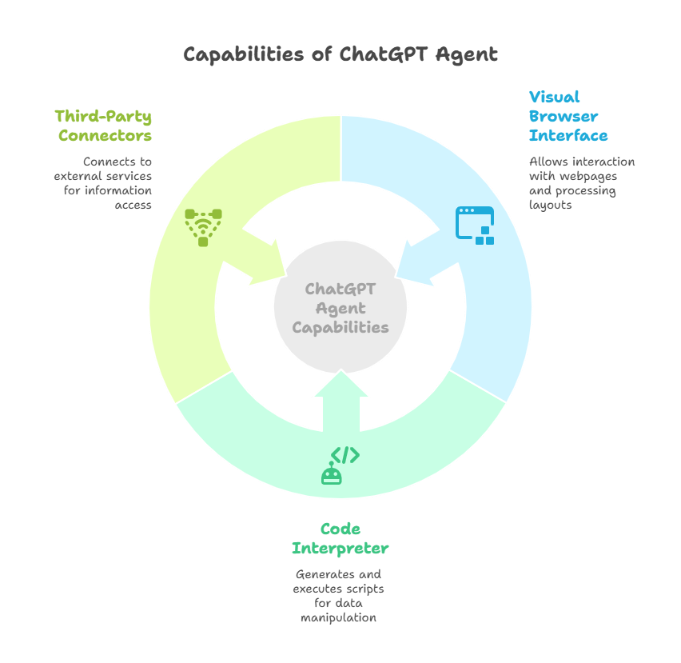
At its core, ChatGPT Agent is a task-executing AI system layered on top of GPT-4. It’s more than a chatbot with a few tricks—it uses three coordinated tools:
- Visual browser interface: it can click through real webpages, interact with buttons, and process layouts.
- Code interpreter: it can generate and execute scripts to parse data, perform calculations, or transform files.
- Third-party connectors: it connects to services like Google Calendar or Gmail to act on user-authorized information.
Combined, these make ChatGPT Agent capable of:
- Finding products, analyzing reviews, and building side-by-side comparisons.
- Preparing meeting summaries, based on calendars and external news sources.
- Completing multi-step processes like ordering supplies or drafting reports.
What sets it apart? It doesn’t just answer questions, it can carry out a series of digital actions, keeping track of state as it moves through them. And that’s a big deal.
ChatGPT Agent’s Strengths in an Enterprise Context
In practice, this could mean less time compiling market research, fewer steps when planning events, and faster prep for exec briefings. It’s early, but promising.
Gaps That Still Matter to Tech Leaders
Let’s be direct: as of today, the ChatGPT Agent doesn’t check every enterprise box.
Integration limitations
Out-of-the-box support for enterprise platforms—think ServiceNow, Workday, Intune—isn’t available yet. API extensions help, but they require planning and technical oversight.
No built-in enterprise memory
Unless fed mid-session, it doesn’t know your company policies, HR documents, or device setup guides. That kind of context matters when workflows aren’t general.
Compliance and audit controls
It can log what it’s doing in a chat. But exporting an immutable, permissioned audit trail for security review? That’s not its strong suit.
Error handling
Agents are deterministic. If they don’t understand the data or page structure, they’ll act based on flawed assumptions. You’ll want backup plans.
Scalability remains unproven
No major deployments across 10,000+ employees have been published yet. That doesn’t mean it won’t scale—it just hasn’t been pressure-tested in large orgs.
Context: Everyone Is Building Agents
Let’s not miss the forest. This isn’t just OpenAI leading the way—other players are moving fast:
- Microsoft: pushing Copilot into every Office app, with deeper workflow automation coming via Azure agents.
- Google: integrating Gemini into Workspace, with rumors of a browser-based “do this for me” feature.
- IBM: Watsonx Orchestrate enables HR and finance teams to build no-code agents tuned for business logic.
- Startups: Claude (Anthropic), Cohere North, and open-source agent chains are evolving in parallel.
The shift is bigger than any one company. We’re entering the age of action, not just information.
Why Support Teams Still Need Specialization
Here’s the challenge: in IT and HR, the margin for error is smaller, and the expectations for governance are higher.
In short: ChatGPT Agent is flexible, but Rezolve.ai is purpose-built. If you're accountable for resolution SLAs, not just chat engagement, that matters.
Why Agentic Sidekick 3.0 for Enterprise Level IT and HR?
Sidekick isn’t just a chatbot, it’s a digital support analyst with domain fluency. Real-world capabilities include:
- Resolving 70% of Level-1 tickets via automation.
- Proactively suggesting next actions based on workflows.
- Executing access changes and license provisioning inside Teams.
- Explaining why an action was taken and linking to the source policy.
- Detecting sensitive data patterns and triggering alerts.
It also connects directly to platforms like Azure AD, Intune, SharePoint, and Jira. No patchwork needed.
Measurable Outcomes Enterprises Are Seeing
What’s the business case? Customers using Sidekick report:
- 40–60% reduction in MTTR (mean time to resolution)
- After-hours tickets down by 90%
- Onboarding time for new employees cut in half
- Improved visibility for service leaders via detailed agent logs
These aren’t projections—they’re performance stats from live environments.
These Tools Can Work Side by Side
Let’s not turn this into a zero-sum game. Smart teams are already exploring both.
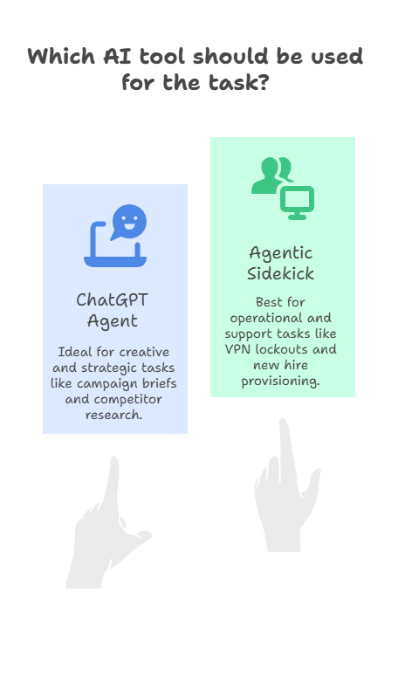
Use ChatGPT Agent when:
- Your marketing lead needs to prep a campaign brief.
- Your product team wants research done on competitors.
- You need a first draft of an outbound email.
Use Agentic Sidekick when:
- Your help desk is flooded with VPN lockout requests.
- A new hire needs 12 tools provisioned by 9 AM.
- Your HR team wants 401(k) questions answered with zero tickets.
They complement each other. One’s a powerful desk companion. The other’s a mission-ready colleague.
Ask These Six Questions Before You Commit
- What are the 10 most repeated questions your team gets?
- How are you logging and auditing automated decisions today?
- Where does institutional knowledge live—and is it accessible?
- Do you need full traceability or is speed your priority?
- How will your AI systems get better over time—who owns that feedback loop?
- Is “general-purpose” good enough for high-visibility workflows?
Not every answer needs to point to the same solution. But the exercise is worth doing.
Final Thoughts: Zoom Out Before You Jump In
ChatGPT Agent is an exceptional innovation. It has changed the conversation about what AI can do again. And it will keep improving. But its strengths are still best deployed where flexibility matters more than specificity.
In contrast, enterprise-grade operations thrive on clear roles, workflows, and accountability. And that’s where Rezolve.ai shines.
The real strategy isn’t to choose. It’s to understand what you need, and when.
If what you need is fewer tickets, faster resolutions, and systems that align with real policies—Agentic Sidekick is built for that.
Want to see what that looks like? We’ll show you.
© 2025 Rezolve.ai. Agentic AI for Work


.webp)

.png)









.webp)