
TL; DR
Future-proofing ITSM in 2026 requires CIOs to move beyond tools and adopt a unified, AI-driven platform strategy that integrates people, processes, and technology. Prioritizing agentic AI, scalability, security, and employee experience enables proactive, resilient operations. The real advantage lies in continuous improvement, predictive capabilities, and aligning ITSM with long-term business strategy.
Introduction
Presently, the responsibility of a CIO extends far beyond just managing the IT infrastructure. The focus is now on ensuring that IT Service Management services remain resilient and adaptable in the face of constant change. Future-proofing is no longer a luxury but a survival strategy for enterprises that rely on complex digital ecosystems. Achieving this requires a deep understanding of how to leverage the best IT Service Management software to drive continuous value and innovation.
As organizations navigate the challenges of a decentralized workforce and AI-driven workflows, the choice of IT Service Management software becomes a foundational decision. A future-proof strategy involves more than just selecting a tool; it requires a holistic approach to people, proc esses, and technology. This guide explores the essential steps a CIO must take to ensure that their IT Service Desk Management software and broader IT Service Management software solutions are prepared for the demands of the next decade.
Embrace a platform approach to IT Service Management software
The days of using fragmented, siloed tools for support are long gone. To future-proof operations, a CIO must adopt a unified platform approach. This means selecting IT Service Management software that acts as a single source of truth for the entire organization. When IT Service Management services are integrated into a central platform, visibility increases and data silos are eliminated. This integration allows for a more cohesive strategy when deploying IT Service Management software solutions across various departments.
A unified platform ensures that IT Service Desk Management software can communicate effortlessly with other enterprise systems, such as HR, Finance, and Security. This interoperability is a hallmark of the best IT Service Management software available in 2026. By centralizing operations, a CIO can ensure that the organization remains agile and capable of responding to new business requirements without the need for constant, expensive re-platforming. The right IT Service Management software provides the flexibility needed to scale as the business grows.
Invest in agentic AI and autonomous workflows
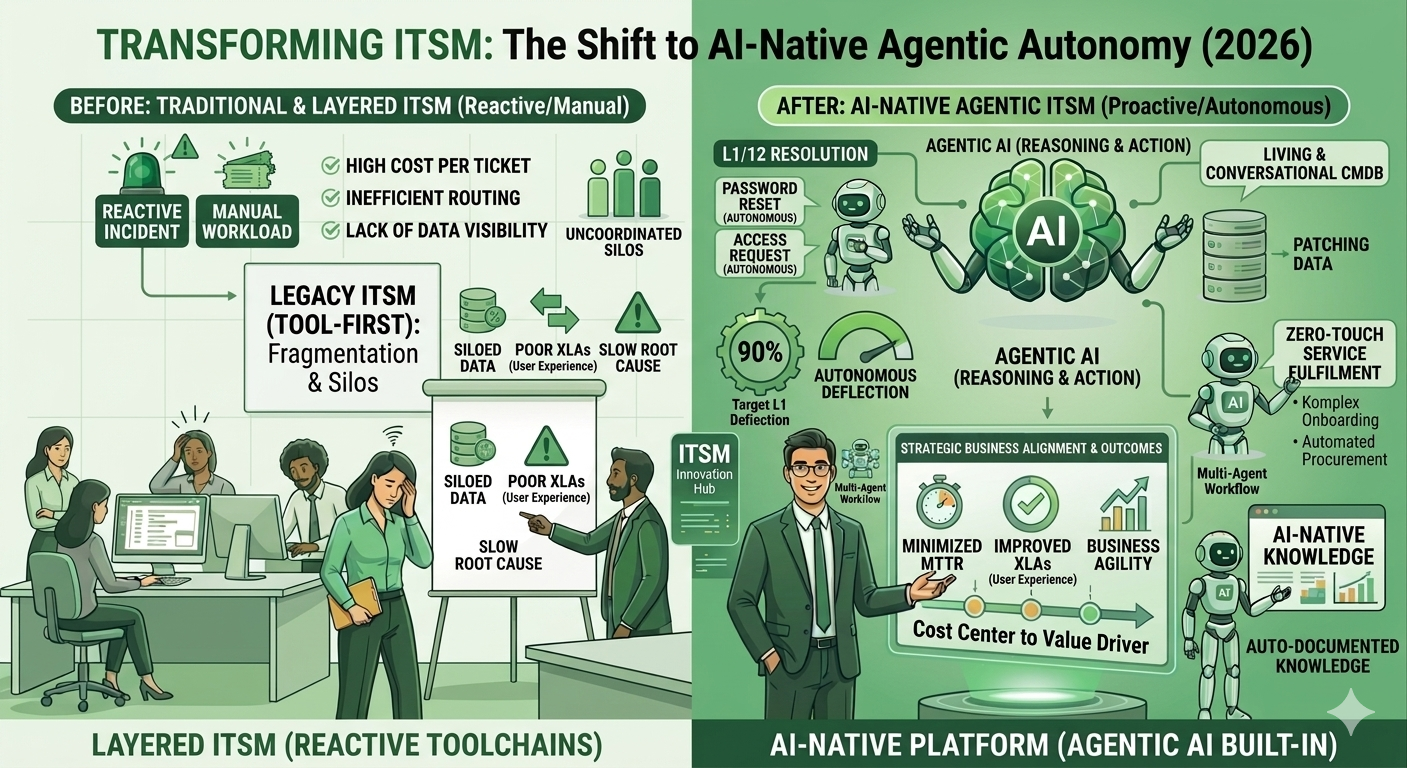
One of the most significant shifts in recent years is the rise of agentic AI within IT Service Management software solutions. Unlike traditional automation, agentic AI can reason and take action independently. For a CIO, future-proofing means moving away from simple "if-then" logic and toward autonomous IT Service Management services. The best IT Service Management software now features these intelligent agents as a core component of the workflow.
By implementing agentic capabilities in IT Service Desk Management software, organizations can significantly reduce manual intervention. These agents can handle complex tasks such as root cause analysis, security patching, and resource optimization. This shift allows human talent to focus on high-level strategy while the IT Service Management software manages the routine complexities. Investing in IT Service Management software solutions that prioritize autonomy is a critical step in staying ahead of the competition in 2026.
Prioritize the experience level agreement in IT Service Management services
Traditional Service Level Agreements (SLAs) are no longer sufficient to measure the success of IT operations. A forward-thinking CIO must shift the focus toward Experience Level Agreements (XLAs). This approach measures the actual impact of IT Service Management services on employee productivity and satisfaction. High-quality IT Service Management software should provide the telemetry needed to track these experiences in real time.
When evaluating IT Service Desk Management software, it is important to consider how the tool enhances the daily lives of employees. The best IT Service Management software offers intuitive, frictionless interfaces that reduce the time spent on administrative tasks. By prioritizing the user experience within IT Service Management software solutions, a CIO can foster a more engaged and productive workforce. This human-centric approach is vital for any organization looking to future-proof its IT Service Management software investments.

Ensure scalability and flexibility in IT Service Management software solutions
The only constant in the modern enterprise is change. Therefore, the best IT Service Management software must be inherently scalable. A CIO must ensure that the chosen IT Service Management software can handle increasing volumes of data and users without a degradation in performance. Future-proofing involves selecting IT Service Management software solutions that are built on modern, cloud-native architectures.
Flexibility is equally important. The IT Service Desk Management software used today must be capable of supporting the technologies of tomorrow. Whether it is the integration of quantum computing resources or the management of edge computing nodes, the IT Service Management services must be adaptable. Choosing IT Service Management software with a robust API ecosystem ensures that the platform can evolve alongside the rest of the technology stack.
Build a culture of continuous service improvement
Future-proofing is not a destination but a continuous process of refinement. A CIO must foster a culture where IT Service Management services are constantly evaluated and optimized. The best IT Service Management software provides the analytics and reporting tools necessary to drive this continuous service improvement (CSI). By analyzing the data generated by IT Service Desk Management software, teams can identify areas for growth and efficiency.
Regularly auditing the effectiveness of IT Service Management software solutions ensures that the organization is getting the maximum return on its investment. This proactive approach prevents the technical debt that often accumulates when IT Service Management software is neglected. A commitment to CSI ensures that the IT department remains a value driver for the business, rather than just a cost center. The best IT Service Management software platforms make this ongoing optimization a seamless part of the daily workflow.
Strengthen security and compliance within IT Service Management software
As cyber threats become more sophisticated, security must be integrated into every aspect of IT Service Management services. A CIO should look for IT Service Management software solutions that offer built-in security features, such as automated threat detection and compliance logging. The best IT Service Management software in 2026 treats security as a core functional requirement, not an add-on.
Integrating security into IT Service Desk Management software ensures that every change and incident is tracked through a lens of risk management. This approach, often referred to as DevSecOps for service management, is essential for future-proofing. By using IT Service Management software to enforce security policies, an organization can maintain compliance with global regulations while protecting its most valuable data. Secure IT Service Management software solutions are the foundation of a resilient enterprise.
“Organizations that fail to modernize ITSM in 2026 risk rising operational costs, fragmented employee experiences, and slower business innovation.” — Manish Sharma, CTO of Rezolve.aiLeverage predictive analytics for proactive IT Service Management services
The ability to anticipate issues before they impact the business is a superpower for the modern CIO. Predictive analytics, powered by the best IT Service Management software, allows IT teams to move from a reactive to a proactive stance. By analyzing historical data from IT Service Desk Management software, these systems can identify patterns that precede a failure.
Implementing predictive capabilities within IT Service Management software solutions reduces downtime and improves overall system reliability. This proactive management of IT Service Management services ensures that the business remains operational even during times of stress. Future-proofing requires a move away from "fixing what is broken" toward "ensuring it never breaks." This transition is made possible by the advanced data processing capabilities of modern IT Service Management software.
Struggling with slow internal search and poor employee experience? Watch Rezolve.ai Search IQ in Action
Focus on talent development and AI literacy
Technology is only one part of the future-proofing equation. A CIO must also invest in the people who manage and use the IT Service Management software. As AI becomes more prevalent, the skills required for IT service professionals are shifting. Future-proofing involves ensuring that the team is proficient in using the best IT Service Management software to its full potential.
Training programs should focus on AI literacy and the orchestration of IT Service Management software solutions. When the workforce understands how to interact with intelligent IT Service Desk Management software, the entire organization becomes more efficient. Promoting a culture of learning ensures that the team remains capable of managing the evolving IT Service Management services of the future.
Simplify and standardize IT Service Management software solutions
Complexity is often the biggest hurdle to future-proofing. A CIO should strive to simplify and standardize the processes within their IT Service Management software. Standardizing workflows across the organization makes it easier to manage and scale IT Service Management services. The best IT Service Management software facilitates this by providing templates and best practices.
By reducing the number of custom configurations in IT Service Desk Management software, an organization can decrease its maintenance burden. Simple, standardized IT Service Management software solutions are easier to upgrade and less likely to break during transitions. This focus on simplicity ensures that the IT Service Management software remains a lean and effective tool for business growth.
Align IT Service Management services with long-term strategy
Finally, every decision regarding IT Service Management software must be aligned with the long-term strategic goals of the organization. A CIO must ensure that the IT Service Management software solutions they implement today will support the business five or ten years down the line. This requires a deep understanding of the corporate roadmap and how IT Service Management services can facilitate its execution.
The best IT Service Management software is a strategic asset that enables innovation and agility. By selecting IT Service Desk Management software that supports the broader business mission, a CIO ensures that IT remains a critical partner in corporate success. Future-proofing is ultimately about building a resilient foundation with IT Service Management software that empowers the organization to thrive in an uncertain future.
Closing note
Future-proofing IT Service Management services in 2026 is a multi-faceted challenge that requires a blend of technological foresight and strategic leadership. By selecting the best IT Service Management software, embracing agentic AI, and prioritizing the user experience, a CIO can build a resilient and efficient IT organization. The key lies in choosing IT Service Management software solutions that are flexible, secure, and aligned with business outcomes.
With the right IT Service Desk Management software and a commitment to continuous improvement, the IT department can navigate the complexities of the digital age with confidence. The future belongs to those who view IT Service Management software not just as a tool for support, but as a platform for enterprise-wide transformation.
FAQs
What is the future of ITSM?
The future of ITSM is centered around AI-driven automation, predictive analytics, autonomous workflows, and employee-centric service experiences. Modern ITSM platforms are evolving into intelligent ecosystems that proactively resolve issues and improve operational efficiency.
How is AI transforming IT Service Management?
AI is transforming ITSM by automating ticket resolution, enabling conversational support, predicting incidents before they occur, and optimizing workflows through real-time analytics. This helps IT teams reduce manual workloads and improve service delivery.
What is agentic AI in ITSM?
Agentic AI in ITSM refers to intelligent AI systems capable of independently analyzing situations, making decisions, and executing actions without constant human intervention. These systems help automate complex IT operations and service management tasks.
Why is predictive analytics important in ITSM?
Predictive analytics allows IT teams to identify potential system failures and performance issues before they impact business operations. This proactive approach improves uptime, reduces downtime, and enhances overall service reliability.
How does Rezolve.ai support future-ready ITSM?
Rezolve.ai helps organizations modernize ITSM with agentic AI, conversational service management, autonomous workflows, enterprise search, and predictive automation that improve employee experience and operational efficiency.


.webp)

.png)








.webp)