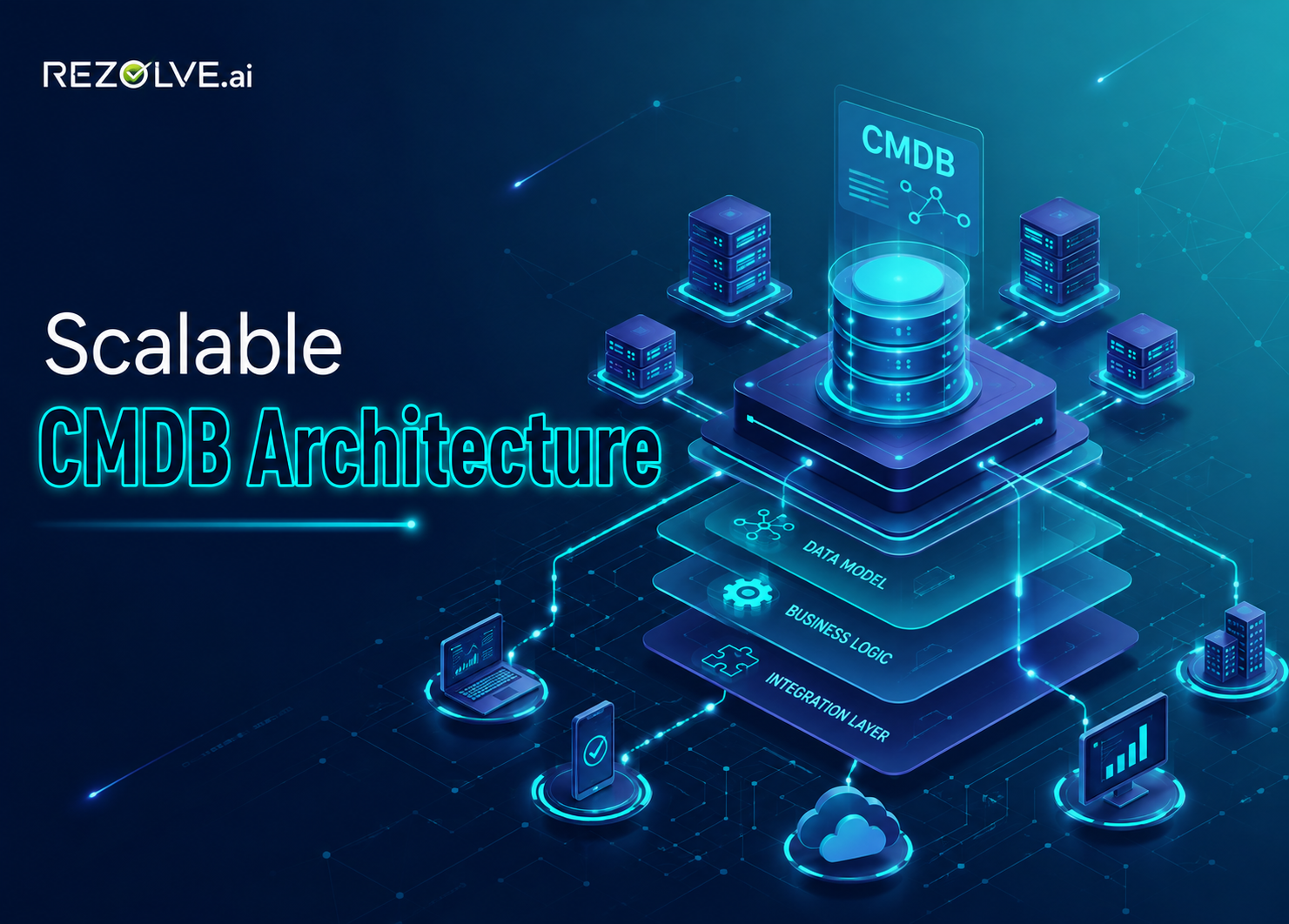
CMDB Architecture: Designing One That Survives Contact With Reality
Most CMDBs do not fail because they were too small. They fail because the design assumed a stable estate, a single authoritative source, and someone whose job it was to keep it tidy. Design principles for the estate you actually have.

Key takeaways
- Model the decisions the CMDB must support, then derive the schema, never the reverse
- Assume multiple disagreeing sources from day one; reconciliation is architecture, not configuration
- Ephemeral infrastructure needs a different lifecycle model than hardware, in the same graph
- Every CI needs an owner and a last-verified timestamp, or the data becomes unfalsifiable
A CMDB is a graph database with an unusually hostile operating environment: the thing it describes changes constantly, several systems describe it differently, nobody is accountable for its accuracy, and its failure mode is silent.
Scalability here is not primarily about row counts. Modern platforms handle millions of configuration items without complaint. The thing that fails to scale is accuracy, and accuracy degrades with estate size, rate of change, number of sources and organizational distance between the data and the people who depend on it.
These are the design decisions that determine whether it survives.
1. Derive the schema from the decisions
The most consequential decision is made early and usually by default: what is a CI?
The instinct is to model everything discoverable. This produces a schema of hundreds of classes, most sparsely populated, none confidently owned.
Work backwards instead. Write the questions the CMDB must answer:
- What does this change affect?
- What depends on this component?
- Which business service is degraded right now?
- Who owns this, and who approves changes to it?
- What is out of support, unpatched or unlicensed?
Then model only what those questions require. Every class you add is a permanent maintenance obligation and a new opportunity for the data to be wrong.
A rule that holds up well: if no decision changes based on an attribute, it does not belong in the CMDB. Put it in the discovery tool's raw store, where it costs nothing to keep and nobody mistakes it for truth.
2. Design for multiple disagreeing sources
The single-authoritative-source assumption is the root cause of most CMDB architecture failures. It is never true past a certain scale.
You will have discovery scanners, cloud inventory APIs, endpoint management, identity, HR (for ownership), procurement (for cost and warranty), and manual entry for whatever the rest cannot see. They will disagree about hostnames, ownership, environment classification and whether something still exists.
Reconciliation therefore belongs in the architecture, not in a configuration screen:
Attribute-level precedence. Authority is per-attribute, not per-source. The cloud API is authoritative for instance type; the HR system for owner; procurement for warranty. A source-level priority list is too coarse and produces absurd outcomes.
Explicit conflict handling. Conflicts should be recorded and surfaced, not silently resolved. A CMDB that quietly picks a winner is hiding exactly the signal that tells you a source has broken.
Absence is not deletion. When a source stops reporting a CI, that could mean decommissioned, unreachable, credentials expired, or scanner misconfigured. Treat these differently. A CMDB that deletes on absence will eventually delete your production estate because a service account expired on a Friday.
Provenance on every attribute. Which source, when, and how confident. Without it, you cannot debug a disagreement or age out stale values.
Ready to put your configuration data to work? Explore Rezolve.ai CMDB for a connected view of assets and relationships.
3. Two lifecycles in one graph
Hardware and long-lived VMs change slowly, are individually meaningful and are worth tracking by identity. A container that exists for ninety seconds is none of those things, and trying to record each one individually will fill the CMDB with millions of tombstones while telling you nothing useful.
The workable pattern is to model ephemeral infrastructure at the level of the thing that persists: the service, the deployment, the cluster, the scaling group. Individual instances live in the observability and cloud-inventory layer, where their lifecycle is native and free.
The CMDB records that a service exists, what it depends on, who owns it, and where its instances run. It does not attempt to record each instance.
This distinction has to be deliberate. Left implicit, discovery will try to create a CI for everything it sees, and the graph becomes unusable within a quarter.
4. Ownership, or the data becomes unfalsifiable
Every CI needs a named owner: a person or a team with an on-call rotation, not a department.
This sounds like governance boilerplate. It is actually a load-bearing architectural requirement, because an unowned CI cannot be verified, corrected or retired. It exists in the graph forever, in an unknown state, and it silently poisons every impact analysis it participates in.
Practical enforcement: make ownership mandatory at creation, expire it when the owner leaves the organization, and report unowned CIs as a defect queue rather than a statistic. Orphaned CIs are the leading indicator of CMDB decay, well before anybody notices the data is wrong.
Pair it with a last-verified timestamp per attribute and surface staleness in the interface. Data presented without an age is data presented as equally true regardless of whether it was confirmed this morning or in 2023.
5. Federate the things you should not copy
Copying data creates a synchronization obligation forever. Sometimes that is the right trade; often it is not.
Copy what you need for graph traversal, impact analysis and offline reporting, the relationship structure and the small set of attributes that decisions depend on.
Federate (that is, link out and query at read time), for high-cardinality, fast-changing or authoritative-elsewhere data: detailed cloud configuration, licence entitlements, real-time metrics, full patch state.
The failure mode of over-copying is a CMDB that is permanently slightly wrong about everything. The failure mode of over-federating is that nothing works when a dependency is down. Federate the detail, copy the structure.
6. Make the CMDB a participant, not a destination
A CMDB nobody consults decays, because nothing surfaces the errors. The architectural implication is that it must be embedded in workflows rather than presented as a portal:
- Change requests auto-populate impact from the graph
- Incidents show the dependency chain without anyone navigating to it
- Discovery discrepancies open tickets rather than filling a report
- Agentic resolution reads the CMDB to decide whether an action is safe
That last one raises the stakes considerably. A human reading a stale record often catches it. They remember that box was decommissioned. An agent acting on the same record does not know and proceeds anyway. Once software acts on this data, CMDB accuracy stops being a reporting concern and becomes a control.
Which is also the opportunity: reconciling conflicting sources, chasing unowned CIs and flagging implausible relationships is high-volume, rule-adjacent judgment work that has always been too expensive to staff properly and is now automatable.
What scaling actually requires
Not sharding. Not a bigger instance.
Bounded scope so growth in estate does not mean proportional growth in schema. Reconciliation that is real architecture rather than a settings page. Ownership enforced as a defect queue. Two lifecycle models so ephemeral infrastructure does not drown the graph. Federation for what should not be copied.
Get those right and a CMDB grows with the estate. Get them wrong and it degrades regardless of how much infrastructure you put underneath it, which is why the organizations with the largest CMDBs are so often the ones that trust them least.
Last updated on October 26, 2026
Get summary with:
See the agentic service desk in action
Watch Rezolve.ai autonomously resolve real IT and HR tickets: governed, auditable, glass-box.
Frequently asked questions
How do you design a CMDB that stays accurate?
Scope the schema to the decisions it must support, treat reconciliation between disagreeing sources as architecture rather than configuration, enforce a named owner per CI, record a last-verified timestamp per attribute, and embed the CMDB in workflows so errors surface through use.
How should a CMDB handle containers and ephemeral infrastructure?
Model at the level of the thing that persists (the service, deployment, cluster or scaling group), and leave individual instances in the observability and cloud-inventory layer where their lifecycle is native. Creating a CI per container fills the graph with tombstones and tells you nothing.
Should a CMDB copy data or federate it?
Copy the relationship structure and the small set of attributes decisions depend on, since those are needed for graph traversal and impact analysis. Federate high-cardinality, fast-changing or authoritative-elsewhere data such as detailed cloud configuration, licence entitlements and real-time metrics.