.png)
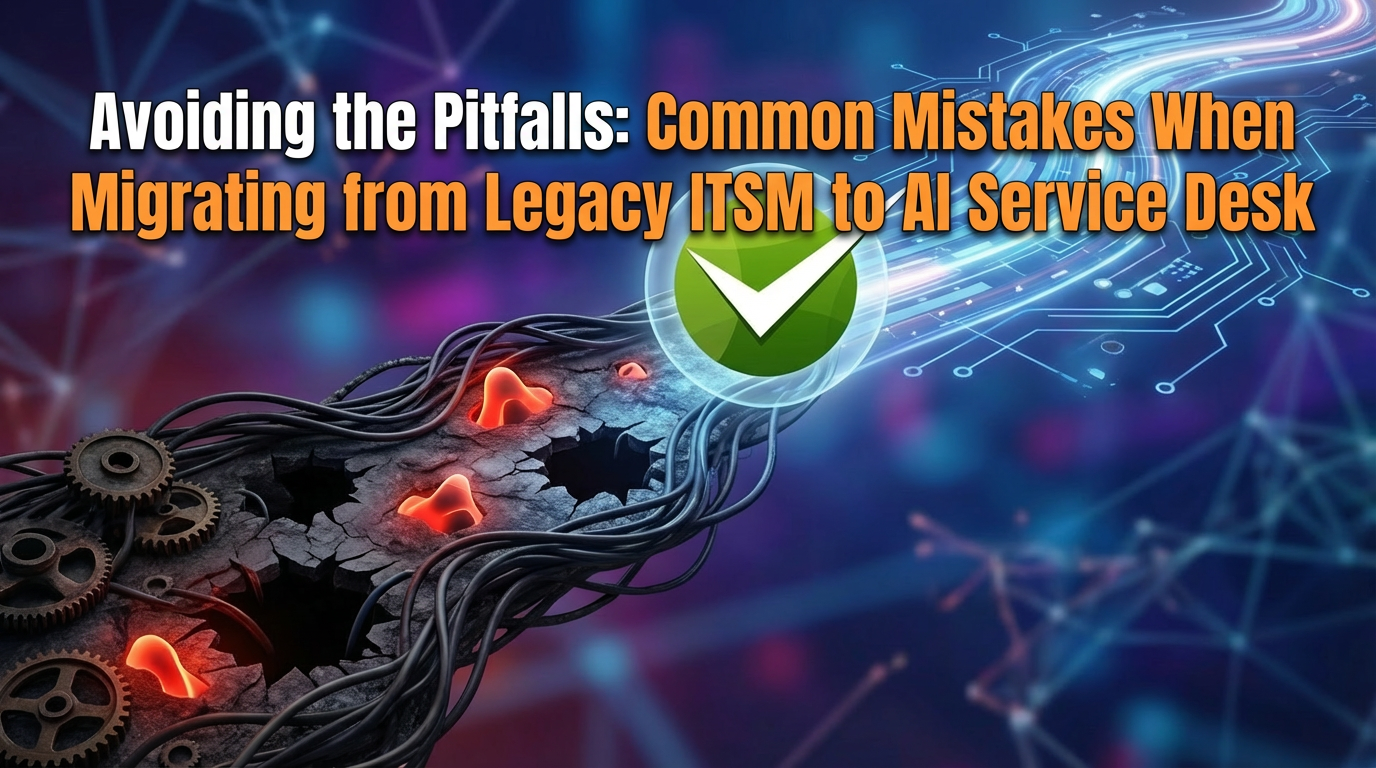
Migrating from legacy ITSM to an AI service desk often fails not because of technology, but because organizations carry forward outdated models. Common mistakes include treating AI as an add-on, copying legacy workflows, automating too broadly too soon, and measuring success with ticket-centric metrics instead of outcomes.
This blog explains the most common mistakes organizations make when migrating from legacy ITSM to an AI service desk—and how to avoid them to achieve real automation, trust, and measurable outcomes.
Mistake 1: Treating AI as an Add-On Instead of a New Operating Model
One of the most common mistakes is positioning AI as a layer on top of an existing ITSM setup.
In this model, tickets remain central. Queues still define work. Agents continue to execute most resolutions. AI is introduced only to assist with triage, suggestions, or knowledge retrieval.
While this may improve efficiency at the margins, it does not change outcomes in a meaningful way. The core bottleneck remains the same.
An AI service desk should own resolution wherever possible, not just assist humans. That requires shifting from ticket-first thinking to outcome-first thinking.
A useful checkpoint during migration is to ask:
- What percentage of requests should never become tickets at all?
- Which decisions can safely be owned by AI?
- Where is human judgment truly required?
If these questions are not being addressed, AI will remain an accessory rather than a transformation.
Mistake 2: Copy-Pasting Legacy Processes into an AI Environment
Legacy ITSM processes were designed around human limitations. Over time, they accumulate complexity in the form of approvals, categories, exception handling, and manual checkpoints.
A common migration error is attempting to replicate these workflows inside an AI service desk.
This usually results in:
- Overly constrained automation
- Excessive escalation
- AI that appears slow or indecisive
Before migrating workflows, organizations need to simplify them.
A practical way to approach this is:
- Identify the intent behind each process
- Remove steps that exist only to manage human load
- Redefine approval requirements based on risk, not habit
AI does not need guardrails built for people. It needs clarity, authority boundaries, and well-defined outcomes.
Mistake 3: Expecting Immediate, Broad Automation
There is often pressure to demonstrate rapid impact after deploying an AI service desk. This leads some teams to push for aggressive automation across a wide range of scenarios from day one.
The risk here is trust erosion.
Not all requests are equally ready for automation. Some are repetitive and well understood. Others are ambiguous, context-heavy, or dependent on inconsistent data.
When AI attempts to automate the wrong scenarios too early, failures become visible quickly. Employees lose confidence. Adoption drops. Escalations increase.
A better approach is phased automation.
Start with scenarios that meet three criteria:
- High frequency
- Low risk
- Clear resolution paths
Examples typically include password resets, access provisioning, and common troubleshooting flows.
As confidence grows, automation can expand organically.
Mistake 4: Underestimating Data Readiness
AI service desks depend heavily on data quality and contextual signals. Legacy ITSM environments, however, often suffer from fragmented and inconsistent data.
Common issues include:
- Poorly maintained knowledge bases
- Inconsistent ticket categorization
- Outdated asset and application inventories
- Unclear ownership of systems and services
If these problems are not addressed, AI systems struggle to reason accurately. They may misinterpret intent, choose incorrect actions, or escalate unnecessarily.
Successful migrations treat data readiness as a core workstream, not a background task.
This typically involves:
- Rationalizing knowledge content
- Aligning identity, asset, and application data
- Prioritizing data quality for high volume scenarios first
Perfect data is not required. Relevant and reliable data is.
Mistake 5: Relaxing Governance in the Name of Speed
In the excitement of adopting AI, some organizations loosen controls too much, assuming the system will behave responsibly on its own.
This is a serious miscalculation.
Enterprise support involves sensitive actions, including access changes, configuration updates, and compliance-sensitive workflows. Without clear governance, even a single incident can undermine trust in the entire system.
AI service desks must operate within explicit boundaries.
Key governance considerations include:
- Role-based permissions for autonomous actions
- Approval thresholds for sensitive changes
- Comprehensive audit logs
- Clear escalation rules for exceptions
Autonomy does not mean lack of oversight. It means well-defined, enforceable guardrails.
Mistake 6: Ignoring the Human Side of the Migration
Technology is only one part of the equation. People are the other.
An AI service desk changes how employees seek help and how IT teams operate. Without thoughtful change management, resistance is inevitable.
Common human challenges include:
- Agent anxiety around job security
- Employee skepticism toward automated support
- Manager uncertainty about new performance indicators
Organizations that manage this well communicate early and often.
They clarify that AI is intended to remove repetitive work, not eliminate roles. They show how agent responsibilities shift toward higher-value problem solving. They involve teams in shaping automation policies and escalation rules.
Trust is built through transparency and participation, not announcements.
Mistake 7: Measuring Success Using Legacy ITSM Metrics
Many organizations continue to judge AI service desks using the same metrics they used for legacy ITSM.
While metrics like ticket volume and average handling time still have relevance, they do not reflect the true value of AI-driven support.
More meaningful indicators include:
- Autonomous resolution rate
- Time to resolution from the employee’s perspective
- Quality of escalations
- Reduction in repeat issues
- Employee satisfaction with support experience
When metrics remain ticket-centric, teams unintentionally optimize for ticket creation rather than ticket elimination.
Redefining success metrics is essential to reinforce the right behaviors.
Mistake 8: Treating Migration as a One-Time Event
AI service desks are not static systems. They improve through continuous learning, tuning, and expansion.
Organizations that treat migration as a one-time project often see early gains followed by stagnation.
Sustainable success requires:
- Ongoing scenario expansion
- Regular review of automation performance
- Feedback loops from employees and agents
- Clear ownership of AI service desk evolution
The most effective organizations treat AI service desk adoption as a long-term program, not a deployment milestone.
A Practical Checklist for Avoiding Migration Pitfalls
Before and during migration, organizations should be able to confidently answer the following:
- Have we defined which outcomes AI should own end to end?
- Have we simplified workflows before automating them?
- Are we starting with high-confidence scenarios?
- Is our data good enough for AI to reason effectively?
- Do we have clear governance and auditability?
- Are we actively managing change with our people?
- Have we updated success metrics to reflect autonomy?
- Do we have a plan for continuous improvement?
If several of these answers are unclear, the migration is likely at risk.
The Bigger Shift: From Managing Support to Delivering Service
At its core, moving from legacy ITSM to an AI service desk is about changing the purpose of support.
Legacy ITSM focuses on managing demand through tickets and queues. AI service desks focus on delivering outcomes as directly and autonomously as possible.
This shift requires letting go of long-held assumptions about control, productivity, and value. It requires trust in systems designed for reasoning, not just execution.
But for organizations willing to make that shift, the payoff is substantial.
Closing Note
The migration from legacy ITSM to an AI service desk is not a race. It is a transition.
Most failures stem from trying to preserve old models while adopting new technology. Success comes from recognizing that AI demands a new way of thinking about support.
By avoiding these common pitfalls and approaching migration with intention, enterprises can move beyond incremental improvements and unlock the true potential of AI-driven service delivery.
An AI service desk is not simply the next version of ITSM. It is a fundamentally different way of serving the enterprise.


.webp)

.png)










.webp)