
Are your HR systems still stuck answering the same basic questions while your organization needs strategic insight? The era of reactive, FAQ-driven HR support is ending. Modern workplaces with distributed teams, fast hires, hybrid schedules, and global offices need systems that understand context, make decisions, and execute multi-step workflows. That’s where agentic AI comes in: autonomous, goal-oriented intelligence that transforms HR from an administrative cost center into a strategic partner. Rezolve.ai is one of the companies shipping this future today.
In this blog, we will see how agentic AI moves far beyond chatbots. It reasons, coordinates multiple specialists, and executes end-to-end HR workflows across systems. The result: faster onboarding, shorter recruitment cycles, dramatic ticket deflection, better compliance, and a freed-up HR team that can focus on talent strategy and culture.
The Bottlenecks Plaguing Traditional HR Systems
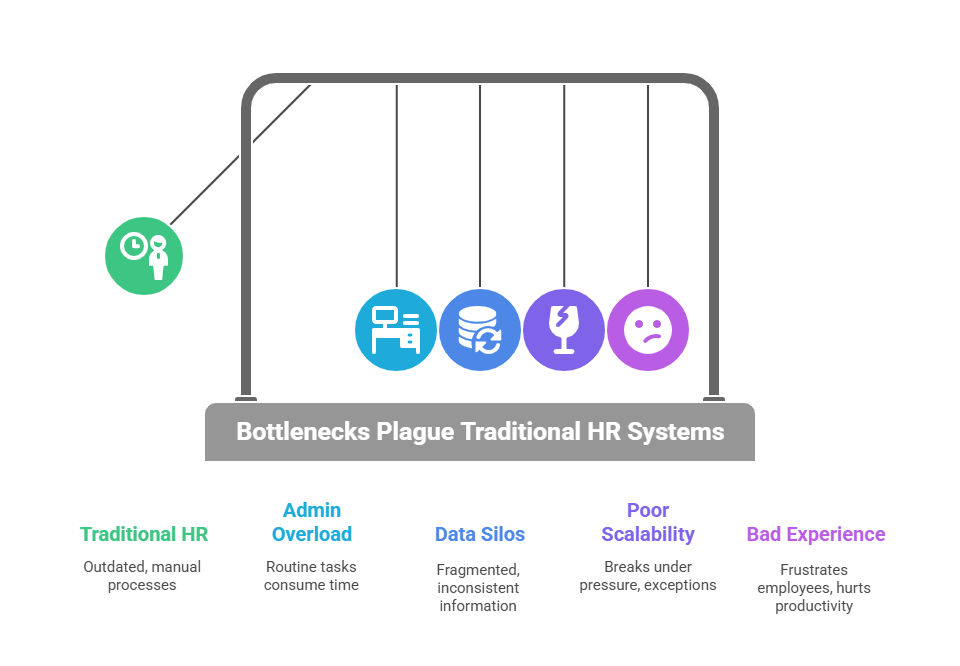
Modern HR teams are held back by four recurring problems:
1. Unmanageable administrative load
A huge portion of HR time is spent on routine inquiries, manual data entry, and repetitive approvals. That drains capacity for strategic initiatives.
2. Fragmented systems and data silos
Organizations use many HR tools—HRIS, ATS, LMS, payroll, identity systems—which creates fragmented information and inconsistent answers.
3. Poor scalability and low responsiveness
Rule-based automation breaks under scale or exceptions. Global teams need 24/7 support and multilingual assistance, which traditional tools struggle to provide.
4. Bad employee experience
Multiple logins, confusing processes, and generic responses frustrate employees and hurt productivity.
Real-world examples show the impact: long recruitment cycles, slow payroll runs, and onboarding workflows that require weeks of manual coordination. These are the exact kinds of problems agentic AI is built to solve.
What is Agentic AI — and How is it Different from Chatbots?
At its simplest, agentic AI is a system that can set and pursue goals autonomously, adapt to changing situations, and coordinate across multiple tools and stakeholders.
Key differences from chatbots
- Autonomy: Agentic AI can take actions (e.g., create accounts, push approvals, schedule training), not just return links or static replies.
- Contextual reasoning: It considers role, team load, past interactions, policies, and business priorities when deciding what to do.
- Multi-step orchestration: Multiple specialized agents can work together—authentication, approvals, provisioning—without human handoffs.
- Learning: It continuously improves from interactions rather than relying on manual script updates.
Why HR Workflows are Inherently Complex
HR isn’t a set of isolated tasks. It’s an interconnected lifecycle that spans recruitment, onboarding, performance, development, mobility, and separation. These processes involve multiple teams (HR, IT, facilities, finance, managers), regulatory rules, and exception handling.
Examples of complexity:
- Onboarding: Requires identity provisioning, equipment allocation, training enrollment, manager checklists, access approvals, and benefits enrollment. Steps vary by role, location, and employment type.
- Performance-to-pay workflows: A review can trigger development plans, compensation changes, and approvals across finance and HR.
- Offboarding: Must ensure asset return, access revocation, final settlements, and knowledge transfer—often under tight timelines.
Traditional automation struggles because these processes require decision-making under nuance, exceptions, and evolving policies. That’s where agentic AI’s reasoning and orchestration pay off.
Agentic AI in Action — What it Delivers
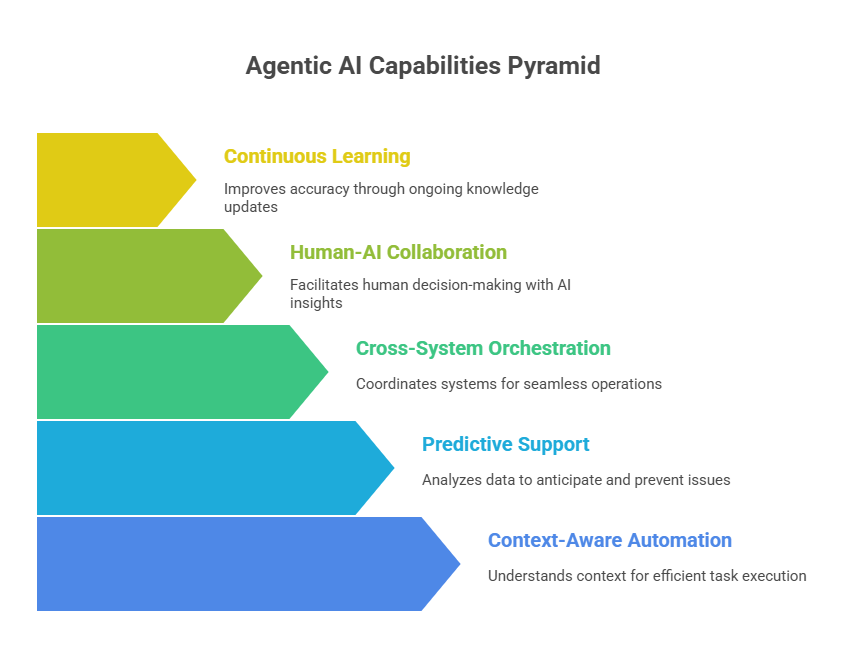
1. Context-aware automation
Agentic AI understands the who, why, and how. For example, when a manager requests a hiring requisition, the system checks budgets, headcount, similar open roles, and historical time-to-hire to recommend the fastest path and auto-create the ATS job requisition.
2. Predictive and proactive support
By analyzing behavior and signals—engagement drops, altered communication patterns—agentic AI can flag retention risks, suggest manager check-ins, or recommend development actions before problems escalate.
3. Cross-system orchestration
Agentic agents coordinate provisioning across HRIS, identity management, device inventory, and calendars—so new joiners receive access and equipment on time, without manual reminders.
4. Improved human–AI collaboration
When issues require human judgment, agentic AI compiles context, drafts recommended actions, and passes a clean, summarized handoff to an expert—saving hours of back-and-forth.
5. Continuous learning and accuracy
Retrieval-augmented reasoning enables the system to surface precise policy interpretations and avoid hallucinations by grounding decisions in verified company knowledge.
Concrete Benefits and Business Impact
Organizations that adopt modern agentic automation report measurable improvements:
- Time savings: Recruitment cycles shrink from weeks to days; onboarding timelines compress from weeks to days.
- Productivity gains: Large-scale automation of routine HR and IT requests deflects high volumes of tickets and reduces mean time to resolution.
- Cost reduction: Cost per transaction for repetitive HR tasks drops substantially.
- Employee experience: Instant, contextual support improves satisfaction and inclusion (multilingual assistance, 24/7 availability).
- Compliance and accuracy: Integrated audit trails, consistent policy application, and fewer manual errors reduce risk.
Case studies highlight these results: organizations have dramatically reduced processing times for promotions, onboarding, and other HR lifecycle events by applying intelligent automation.
Rezolve.ai: How Agentic SideKick 3.0 and Reasoning RAG Power Agentic HR
Rezolve.ai’s platform provides a practical example of agentic AI tailored for enterprise support:
- SideKick multi-agent architecture: Multiple specialized agents collaborate to execute workflows—authentication, approvals, provisioning, and follow-ups—while maintaining context across the conversation.
- Reasoning RAG: Instead of simple retrieval, the system performs step-wise reasoning across company knowledge bases (policies, wikis, documents) to make accurate, policy-compliant recommendations.
- Native integrations: Direct support inside collaboration tools (Teams, Slack) lets employees interact with HR via their natural workflows—submit requests, attach files, and track approvals without switching apps.
- Advanced assist features: Human agents receive AI summaries, suggested responses, and sentiment insights to handle escalations faster and with better quality.
- Security and compliance: Enterprise-grade controls—encryption, access governance, audit logs—ensure sensitive HR data is protected.
Implementation: How Organizations Should Approach the Adoption of Agentic AI in 2026
- Start with clarity: Define specific business objectives—faster onboarding, improved time-to-hire, reduced ticket volume—and choose pilot use cases with clear ROI.
- Pilot and measure: Launch small pilots, measure outcomes, and iterate. Early wins build momentum and stakeholder buy-in.
- Integrate, don’t replace: Agentic AI should orchestrate existing systems—HRIS, ATS, IAM—rather than rip-and-replace.
- Focus on change management: Train HR teams to work with AI—how to interpret recommendations, when to take control, and how to maintain governance.
- Monitor and govern: Maintain oversight on decision logic, audit trails, and compliance; continuously refine models with human feedback.
Key Takeaways
- Traditional HR tools stall on complexity; they waste time and frustrate employees.
- Agentic AI brings autonomy, contextual reasoning, and multi-agent orchestration—far beyond chatbots.
- Real ROI shows up in faster hires, shorter onboarding, ticket deflection, and higher employee satisfaction.
- Rezolve.ai’s SideKick and Reasoning RAG illustrate practical, secure implementations that integrate with Teams/Slack and existing HR systems.
- Successful adoption requires clear objectives, pilots, integration-first thinking, and strong change management.

Conclusion
The path from FAQ to full autonomy is clear: agentic AI turns HR from a reactive cost center into a proactive strategic partner. By combining reasoning, orchestration, and seamless system integration, platforms like Rezolve.ai deliver measurable efficiency and a better employee experience—freeing HR to focus on what truly matters: people.
FAQs
Q: How is agentic AI different from a traditional chatbot?
Traditional chatbots follow scripted replies. Agentic AI reasons, makes decisions, coordinates multiple systems, and executes workflows autonomously while learning over time.
Q: Which HR processes benefit most from agentic AI?
Onboarding, offboarding, recruitment workflows, promotion processing, complex approval chains, and personalized development planning are high-impact areas.
Q: How should companies begin implementing agentic AI?
Start with clear business goals, select a focused pilot, integrate with existing systems, and invest in change management and governance to scale successfully.
Q: What is Rezolve.ai’s Agentic AI SideKick 3.0?
A: SideKick 3.0 is Rezolve.ai’s multi-agent platform that coordinates specialized agents (for authentication, workflow orchestration, document retrieval, approvals, notifications) to resolve employee requests autonomously and end-to-end while preserving context and audit trails.
Q: How does Rezolve.ai avoid hallucinations or incorrect policy answers?
A: Rezolve.ai uses a Reasoning RAG approach — it retrieves authoritative content from enterprise sources (policies, wikis, SharePoint) and reasons over those documents step-by-step to ground its outputs. The system surfaces source references and can be configured to require human sign-off on sensitive actions.


.webp)

.png)









.webp)