.png)
Traditionally, Human Resources (HR) is burdened with repetitive administrative tasks, managing payroll, processing leave requests, filing compliance reports, and onboarding paperwork. While these tasks are critical, they often prevent HR leaders from focusing on what really matters: building a thriving workforce. Enter HR Automation, a game-changing approach that transforms HR from an administrative cost center into a hub of intelligence, strategy, and innovation.
The shift isn’t just about replacing manual processes with bots; it’s about using automation to unlock insights, improve employee experience, and align HR with business goals. As enterprises embrace this evolution, the question becomes: How can HR move from Ops to Intelligence?
HR is no longer about paperwork and compliance. With HR Automation, organizations can go beyond admin to deliver predictive insights, intelligent employee support, and workforce strategies that drive business growth. This blog explores the evolution of HR automation, key benefits, performance metrics, and the path toward HR intelligence.
The Evolution of HR Automation: From Admin to Strategy
The first wave of HR technology focused on digitization. Systems like payroll software, applicant tracking systems (ATS), and self-service portals were designed to reduce paperwork and streamline processes. However, they were limited in scope: automating tasks rather than transforming HR’s role.
Today, HR Automation is evolving into an intelligent ecosystem:
- Traditional Automation (Ops Focus): Managing transactions like benefits enrollment, time-off approvals, and compliance reporting.
- Intelligent Automation (Intelligence Focus): Leveraging AI, machine learning, and predictive analytics to deliver workforce insights, forecast turnover, and personalize employee experiences.
This evolution parallels what we’ve seen in IT Service Management (ITSM). Just as ITSM automation shifted from ticketing to intelligent service delivery, HR is moving from “supporting the workforce” to “strategically shaping the workforce.”
Why HR Automation Matters Now
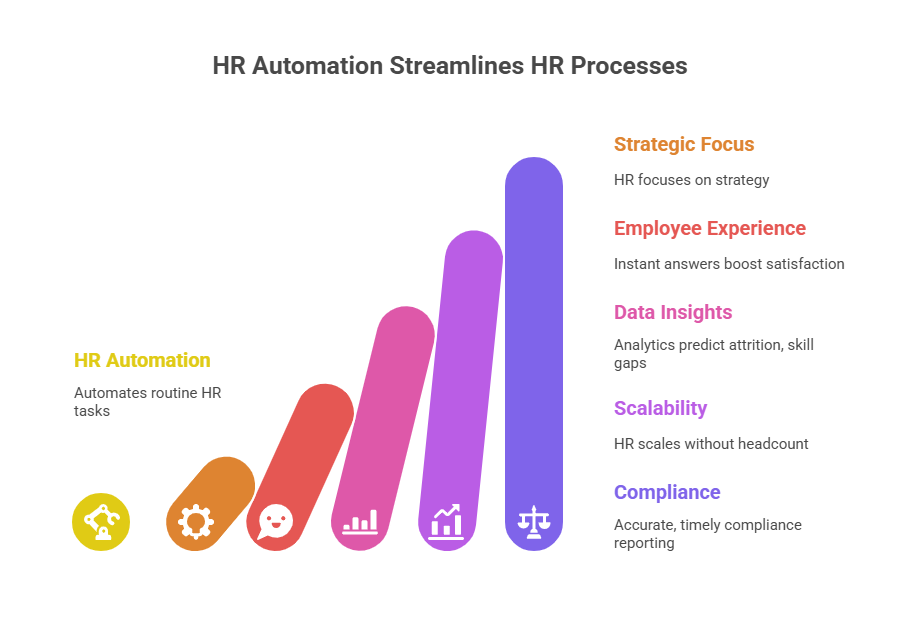
HR leaders face increasing complexity: hybrid work, skills shortages, DEI goals, and rising employee expectations. Traditional admin-focused HR can’t keep up. HR Automation addresses these pressures by:
- Freeing HR Teams for Strategy: Automation reduces time spent on routine queries and approvals, allowing HR professionals to focus on talent strategy, culture, and leadership development.
- Improving Employee Experience: Instant answers via AI-powered chatbots or self-service platforms boost employee satisfaction.
- Data-Driven Insights: Automated systems generate analytics that help predict attrition, identify skill gaps, and align workforce planning with business growth.
- Scalability: As organizations grow, automation ensures HR can scale without ballooning headcount.
- Compliance & Risk Mitigation: Automated workflows ensure accurate, timely compliance reporting, reducing exposure to fines or legal risk.
HR Automation Use Cases: Beyond the Basics
1. Recruitment and Onboarding
- Automated resume screening using AI to match candidates to job descriptions.
- Digital onboarding journeys with pre-populated forms, training modules, and compliance acknowledgments.
- Personalized “day-one” experiences driven by intelligent workflow triggers.
2. Employee Lifecycle Management
- Automated leave approvals, expense reimbursements, and policy updates.
- Predictive attrition modeling to flag at-risk employees.
- Personalized learning recommendations based on career goals and skills gaps.
3. Payroll and Benefits
- Real-time error detection in payroll processing.
- Automated tax compliance updates.
- Self-service portals for benefits enrollment and adjustments.
4. Performance Management
- Continuous feedback systems that automate reminders and insights.
- Predictive performance analytics to identify high-potential employees.
- AI-assisted career pathing for employee development.
5. Employee Support and HR Helpdesk
- AI chatbots are integrated into Slack, Teams, or intranets to answer FAQs.
- Automated ticket routing for complex cases.
- Sentiment analysis on employee queries to track morale trends.
Together, these use cases shift HR from reactive support to proactive workforce intelligence.
Automating Employee Case Management
One of the biggest drains on HR teams is repetitive case management, policy clarifications, payroll queries, or benefit questions. Modern HR Automation platforms centralize and automate these requests, cutting down manual back-and-forth. Instead of routing tickets manually, AI agents categorize, prioritize, and often resolve queries instantly. This frees HR professionals to handle complex, human-centered issues. By embedding automation within collaboration tools like Teams or Slack, employees get faster resolutions without added bureaucracy.
- Example: Automated payroll queries reduce HR inbox volume by up to 40%.
- AI-driven routing ensures priority cases (e.g., medical leave) get handled first.
- Case categories can be auto-tagged for compliance reporting.
- Integrations with collaboration tools eliminate the need for separate HR portals.
The Data Advantage for Admins and HRMs
Automation isn’t just about doing tasks faster; it’s about doing them smarter. HR Intelligence emerges when automation generates actionable insights. For example:
- Attrition Forecasting: By analyzing leave requests, engagement surveys, and performance data, automation can predict flight risks.
- Workforce Planning: AI-driven scenario modeling helps HR anticipate hiring needs and budget impacts.
- Diversity & Inclusion Metrics: Automation surfaces representation gaps and monitors progress toward DEI goals.
- Employee Sentiment Trends: By mining chatbot queries or pulse surveys, HR gains real-time visibility into workforce morale.
This intelligence layer redefines HR as a business partner, shaping decisions around growth, culture, and resilience.
Key Metrics to Track HR Automation Performance
Just like ITSM, HR needs to measure automation effectiveness. Here are underutilized but powerful HR Automation metrics:
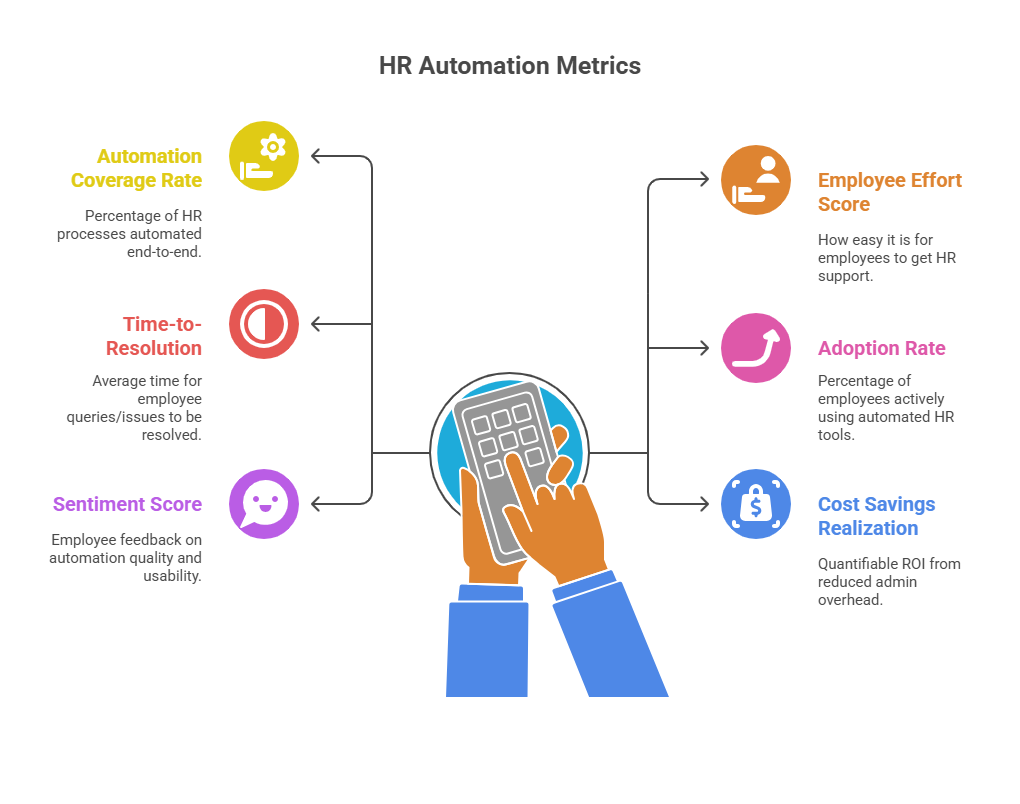
- Automation Coverage Rate: % of HR processes automated end-to-end.
- Employee Effort Score (EES): How easy it is for employees to get HR support.
- Time-to-Resolution (TTR): Average time for employee queries/issues to be resolved.
- Adoption Rate: % of employees actively using automated HR tools.
- Sentiment Score: Employee feedback on automation quality and usability
- Cost Savings Realization: Quantifiable ROI from reduced admin overhead.
These metrics don’t just prove efficiency; they demonstrate HR’s role in employee satisfaction and business growth.
Driving HR Intelligence with Predictive Insights
The transition from HR Ops to HR Intelligence means leveraging automation not only for efficiency but also for foresight. Predictive analytics allows HR teams to anticipate challenges like turnover spikes, disengagement, or emerging training needs. Rather than reacting to problems, HR gains the ability to intervene proactively, strengthening workforce stability and culture. By analyzing patterns across engagement surveys, attendance, and performance data, HR Automation transforms raw data into actionable intelligence.
- Predictive attrition models highlight at-risk employees before exit interviews.
- Engagement analysis shows departments with rising dissatisfaction.
- Training needs can be forecasted based on emerging role requirements.
- Workforce trends can guide resource allocation during seasonal demand.
Overcoming Challenges in HR Automation
Despite its benefits, HR Automation adoption isn’t seamless. Common challenges include:
- Resistance to Change: Employees may distrust automation, fearing job loss or a lack of human touch.
- Integration Complexities: Legacy HR systems often struggle to integrate with modern automation platforms.
- Bias in AI Models: Recruitment automation can unintentionally replicate human biases if not monitored.
- Over-Automation Risks: Replacing all human interaction with bots can damage employee trust and engagement.
Solution: Balance automation with empathy. HR should adopt a “human-in-the-loop” model where automation handles repetitive work but humans remain available for complex, sensitive issues.
The Future of HR Automation: Toward Agentic HR Systems
The future lies in Agentic HR Automation, systems that don’t just execute but also plan, learn, and adapt.
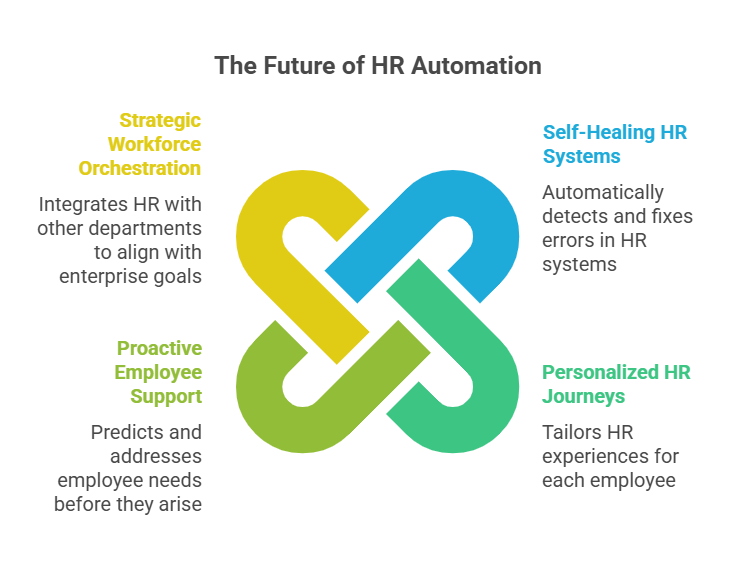
- Self-Healing HR Systems: Automatically detect and fix errors in payroll or benefits systems.
- Personalized HR Journeys: AI agents tailor experiences for each employee, from career growth to wellness support.
- Proactive Employee Support: Predict employee needs before they even ask (e.g., nudging training before a role change).
- Strategic Workforce Orchestration: Automation that integrates with finance, IT, and operations to align workforce strategy with enterprise goals.
The HR of the future won’t just process forms; it will predict, personalize, and empower.
Building Trust and Utility: The Culture of Assistive HR Automation
Successful automation adoption depends on cultural acceptance. Employees must feel AI systems are transparent, fair, and supportive, not punitive. Tools like Rezolve.ai address this by embedding compliance updates directly into AI responses, ensuring accuracy and trust. Equally important is maintaining a human touch in sensitive areas like conflict resolution. When positioned as an assistant rather than a replacement, HR Automation enhances trust and adoption. This cultural foundation determines whether automation thrives or meets resistance.
- Employees prefer explainable AI that shows the “why” behind answers.
- Compliance-driven updates reduce misinformation during policy changes.
- HR leaders often use AI to supplement, not replace, conflict resolution.
- Adoption grows when automation is framed as an enabler, not a monitor.
Closing Note
HR is no longer just about “ops.” With HR Automation, organizations can transcend administrative work and unlock true HR Intelligence, where every process is smarter, every decision data-driven, and every employee experience personalized. The shift requires not just technology but also leadership vision: balancing efficiency with empathy, compliance with innovation, and automation with human touch.
The future of HR is not about replacing humans; it’s about empowering them.

Key Takeaways
- HR Automation is evolving from task execution to intelligence-driven strategy.
- Automation frees HR for strategic roles like talent planning and culture development.
- Key metrics, like Employee Effort Score and Automation Coverage, measure real impact.
- Future HR systems will be agentic, predictive, and personalized.
- Success requires balancing automation with empathy and governance.
FAQs
1. What is HR Automation?
HR Automation uses technology (AI, chatbots, workflow engines) to automate HR tasks such as payroll, onboarding, and employee support, freeing HR teams to focus on strategy.
2. How does HR Automation improve employee experience?
By providing instant answers, reducing time-to-resolution, and personalizing support, automation reduces friction and improves workplace satisfaction.
3. What risks come with HR Automation?
Risks include over-reliance on bots, bias in AI recruitment, and lack of integration with legacy systems. These can be mitigated with governance and “human-in-the-loop” design.
4. What is the future of HR Automation?
The future is agentic: HR systems that adapt, predict, and orchestrate holistic workforce strategies, moving beyond admin into HR Intelligence.


.webp)

.png)










.webp)