

In today's dynamic workplace, HR departments are struggling to keep up. With leaders feeling overwhelmed and employees spending more time searching for documents than doing their actual work, it's clear that traditional HR processes are failing. The solution lies in refining how HR services are delivered.
An effective HR service delivery system is crucial for meeting employee expectations and staying competitive. By creating personalized, on-demand HR support, companies can eliminate frustrating roadblocks and boost overall productivity. This guide explores the essential HR service delivery models and best practices you can implement to build a more efficient and employee-centric organization.
What is HR Service Delivery?

HR service delivery is the process by which an organization's HR department provides services to and interacts with its employees. This includes all essential HR services such as onboarding and offboarding, payroll processing, employee experience management, etc. It is an ongoing process that starts as soon as hiring begins and lasts till the employee leaves.
Earlier, employees could walk to the HR department and resolve their queries. Today's service delivery model is powered by mobile applications and cloud computing. Modern day organizations use advanced Gen-AI based knowledge management for rapid and accurate data handling.
What is AI-Powered HR Service Delivery?
While traditional HR delivery relies on manual processes and human availability, an AI-powered model uses technology to automate and personalize support. It leverages a Generative AI platform, like Rezolve.ai, to understand employee requests in natural language, provide instant answers from a knowledge base, and trigger automated workflows for complex tasks like onboarding or benefits enrollment—all available 24/7.
What are the Types of HR Service Delivery Models?
There are four main categories of HR service delivery models. We have briefly mentioned their distinct features here:
.avif)
1. Traditional HR service delivery model
The traditional HR service delivery model revolves around a centralized HR department and generalist HR staff that handles all HR functions. All services are customized and provided hands-on for employees, managers, and executives.
This model is fitting for smaller organizations with a consolidated workforce. It operates with a hierarchical structure where HR professionals manage tasks such as recruitment, benefits administration, employee relations, payroll, training, and compliance from a central location.
While this is a good model for smaller organizations, larger organizations may have trouble running it. Relentless administrative tasks may lead to HR managers being overburdened, and it is also frustrating for employees who may not be able to get quick responses to their problems.
2. Shared HR service delivery model
HR generalists and specialists work as a single HR unit, but divide the workload and responsibilities amongst themselves. This model includes multiple HR roles, such as administering the transactions for day-to-day requests and inquiries. Employees can access these services via various channels, including phone and online mode.
3. Self-service HR service delivery model
Employees can manage multiple HR-related tasks independently through a self-service portal. This model leverages technology such as advanced GenAI, to provide easy access to HR information and services to reduce the reliance and burden on HR personnel for routine inquiries and transactions.
With Rezolve.ai's innovative GenAI SideKick, HR professionals can seamlessly carry out their day-to-day work without personally assisting employees. It offers HR teams easy ticket creation, intelligent routing, and a dashboard where employees can access information and create tickets for any inquiries or inconvenience.
It boasts of the following capabilities:
- Multi LLM capabilities enabling easy switch between various large language models
- MS teams interface offering a user-friendly interface enhanced by GenAI for ease of use and efficient interaction
- No code automation empowering users with no technical background with a straightforward and user-friendly interface to create workflows
4. Tiered HR service delivery model
This model is a structured approach to providing HR through multiple levels, or tiers, of support.
Tier 1: Connect with an HR generalist
Employees can directly communicate with an HR generalist who handles high-level questions and requests. If required, the request can be escalated to the next tier.
Tier 2: Escalate to an HR specialist
The cases that are unresolved in Tier 1 are escalated to Tier 2, which are primarily complex. This happens if an HR generalist does not have the proper knowledge or administrative authority to complete any requests.
Tier 3: Meet in person or virtually with an HR partner
This is the highest tier of service provided by HR business partners who offer strategic business solutions and manage high-level employee relations issues.
HR Service Delivery Powered by AI
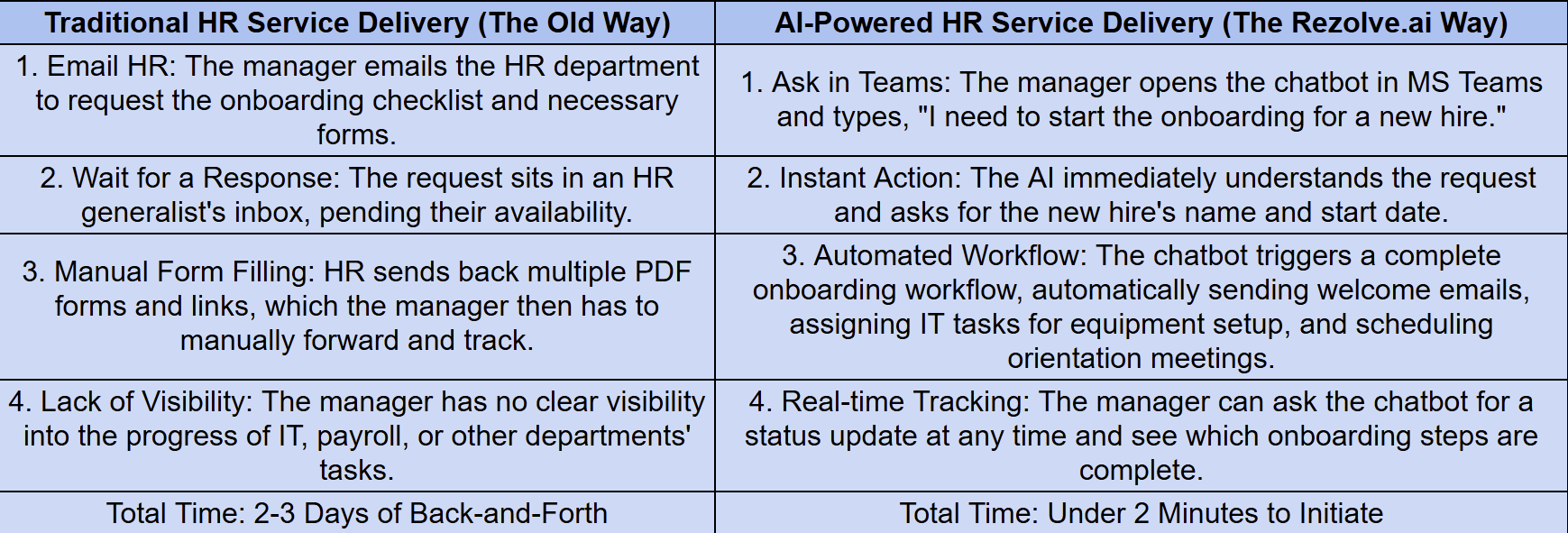
To see the real-world impact, let's compare a common HR task performed the traditional way versus with an AI-powered system.
Scenario: A newly promoted manager needs to initiate the onboarding process for a new team member.
What are 5 HR Service Delivery Best Practices?
.avif)
These HR service delivery best practices that can help you offer unmatched service:
1. Enable on-demand employee self-service
Accessing information independently is a quick way to get work done without having to speak to anyone or answering routine questions. This is a convenient and very productive approach, as employees can access the self-service portal beyond typical office hours.
The first step to effectively implement on-demand employee self-service is to identify the most common tasks and requests handled by the HR department. When you have a comprehensive idea of all your employees' needs, you can design a self-service portal that is easily accessible and user-friendly.
Don't forget to include all appropriate resources, like policy documents, FAQs, and guides to support employees in their self-service mode.
💡Pro tip: For greater employee engagement and productivity, a swift and accessible HR support tool can significantly help. Rezolve.ai's Generative AI platform caters to enterprises and provides an AI-driven HR service desk. It offers numerous features such as content personalization, auto-complete live chats and ticket responses, multi-channel support, and more to enhance various aspects of HR delivery.
2. Implement the What-Who-How Framework.
The What-Who-How framework is a helpful approach that stands for:
- What kind of services are you offering, and what can you do to make it accessible to employees?
- Who will deliver the service? (structure and roles)
- How will you deliver the service? (processes and technology)
3. Design it with the end user in mind.
When designing your HR service delivery system, here is what you need to consider:
- Gather insights about employees needs, preferences and pain points by conducting surveys or focus groups
- Make the interface easy to navigate and visually appealing
- Based on feedback and analytics, schedule a timeline to review and refine the user experience. This will help you meet the revolving employee needs
4. Integrate it with your workflows.
Utilize tools and technologies such as a helpdesk software or a GenAI knowledge management system to integrate HR services and employees' workflows seamlessly. You can also consider offering training and support to employees to help them use integrated HR tools to ensure extensive adoption and usage.
With an integrated HR tool, new hires can be guided through the onboarding process, employees can easily find answers to complex questions, make requests and get help. Also, other HR processes such as background checks, e-signature, and tax form are made simple by using intelligent AI solutions.
Case Snippet
A fast-growing tech company reduced their time-to-productivity for new hires by 30% by integrating their HR service tool with their project management and IT systems. Their automated onboarding workflow, triggered in MS Teams, automatically created user accounts, assigned starter projects, and scheduled team introductions, ensuring new employees could contribute from day one.
5. Ensure scalability
For creating a scalable HR service delivery system, consider the following points:
- Utilize a cloud-based generative AI platform that embraces expansion in terms of employee numbers, locations, and departments
- Choose a model that is flexible, adaptable and can be easily expanded
- Choose a solution with automation capabilities that support integrations and provide quick assistance to employees
- Create processes and workflows that are easily adaptable to changes as your organization grows
- Review your HR service delivery regularly to identify the need for change as your organization continues to grow
Expert Quote
"Companies often underestimate the hidden costs of inefficient HR processes—not just in wasted hours for the HR team, but in lost productivity across the entire organization. Investing in a modern, automated HR service delivery platform delivers a hard ROI by giving that time back to every single employee." - Manish Sharma, CRO, Rezolve.ai
Key Takeaways: Building a Modern HR Service Model
- Traditional Models are Breaking: Centralized, manual HR models cannot keep up with the demands of the modern workforce, leading to burnout and inefficiency.
- Self-Service is the Standard: The most effective approach is a self-service model powered by AI, allowing employees to get instant answers and resolve issues 24/7.
- Technology is the Enabler: An AI-powered platform like Rezolve.ai is essential for automating workflows, providing instant support in MS Teams, and personalizing the employee experience.
- Design for the Employee: The best systems are built with the end user in mind—they are intuitive, easy to navigate, and integrated directly into the employee's daily workflow.
- Automation Drives ROI: Automating repetitive HR tasks (like onboarding, benefits queries, and payroll support) saves countless hours for both the HR team and employees, delivering a clear return on investment.
Employee-first HR Service Delivery with Rezolve.ai
The future years are transformative for HR, where its influence will exceed the traditional scope of the function. Having seamless HR service delivery will address immediate organizational needs and pave the way for a sustainable future.
While there may be vast challenges in HR, embracing changes can help create a thriving work environment where businesses achieve the most. An innovative HR delivery can drive growth, inclusivity and resilience.
Rezolve.ai's HR self-service desk offers critical features such as chatbot support, automated onboarding, powerful engagement tools, excellent automation capabilities and more to make HR delivery seamless and practical.
Some of the top features include:
- GenAI-enabled knowledge management system:
An up-to-date knowledge base providing accurate and instant information to the employees at all times
- Sleek MS teams automation:
A user-friendly friendly interface enabling robust performance across different organizational departments
- No-code automation
Build, test and deploy custom workflows even if you have limited technical knowledge
Sign up now to know more.
Automating HR Support for a Major US Firm
A prominent US-based firm with over 4,000 employees was struggling with a high volume of repetitive HR queries, overwhelming their support staff. By implementing an AI-powered service desk within their existing workflow, they were able to provide instant, 24/7 answers to common questions about payroll, benefits, and company policies. This move successfully deflected 40% of all incoming HR tickets, freeing up the HR team to focus on more strategic initiatives while providing employees with immediate self-service support.
Frequently Asked Questions
1. What is an HR service model?
An HR service model defines how human resources are offered to employees in an organization. It includes the processes, structure, and technologies used to manage HR functions such as recruitment, payroll, and employee relations.
2. What is the role of HR in service delivery?
The HR's role in service delivery is to ensure that employees receive immediate and efficient support for their needs throughout their employment lifecycle. HR personnels focus on creating a positive employee experience that improves organizational efficiency and supports strategic goals by implementing best practices.
3. What is the HR shared service delivery model?
HR shared service delivery model includes a shared service center consisting of an HR generalist and an HR specialist. They divide their work responsibilities while working as a team.
4. How can Rezolve.ai help automate the entire employee onboarding and offboarding process?
Rezolve.ai uses no-code, drag-and-drop workflow automation. You can build a complete onboarding sequence that, once triggered, automatically sends welcome emails, provisions IT equipment, grants access to systems, and schedules orientation meetings. For offboarding, it can manage exit interviews, revoke access, and handle final payroll, ensuring a smooth and secure transition.
5. Our HR team is overwhelmed with the same questions every day. How does Rezolve.ai solve this?
Rezolve.ai's GenAI-powered chatbot acts as the first line of support. It learns from your company's policy documents, handbooks, and FAQs to provide instant, accurate answers to repetitive questions about benefits, leave policies, payroll, and more. This deflects a significant volume of tickets, freeing your HR professionals for more strategic work.
6. Can we build custom HR approval workflows in Rezolve.ai without needing developers?
Yes. Rezolve.ai features a no-code workflow builder that empowers your HR team to create, test, and deploy custom automated processes without writing a single line of code. Whether it's a multi-level leave approval or a request for a new certification, your team can easily build a workflow to match your exact business process.


.webp)

.png)









.webp)