
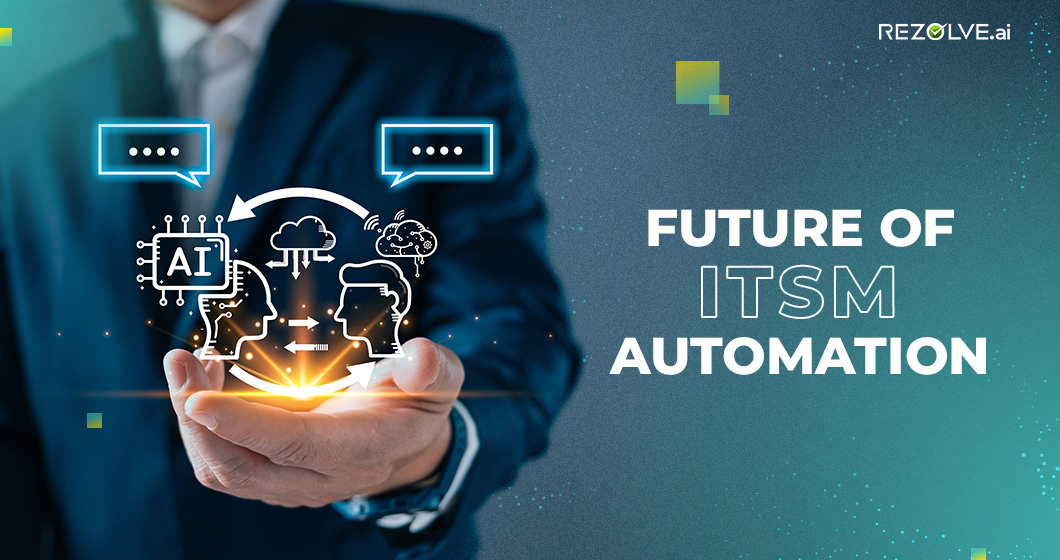
In 2025, IT is moving beyond traditional, fragmented ticketing systems to intent-based ITSM automation.
The reason is simple. IT teams are drowning in tickets. Password resets, access requests, “Is the VPN down?”—the list never ends. Traditional workflow tools shuffle each issue from queue to queue, but employees still wait, and costs keep climbing. As a result, in 2025, the conversation has shifted from ITSM automation in the old sense (rules, forms, and routing) to an intent-based service desk that hears what people actually need and fixes it right away.
That shift is happening fast. Intent-driven platforms change the game because AI can spot the real purpose of each request, grab the answer, and close the loop in seconds.
Platforms, like Rezolve.ai, show what this looks like in practice. The GenAI service desk reads a chat such as “locked out again—help!” and silently kicks off processes that ensure that the user is back inside their account before they finish the coffee run. No ticket, no queue, no manual approval chain. Employees win. IT wins.
What Is Intent-Based ITSM Automation and How Does It Work?
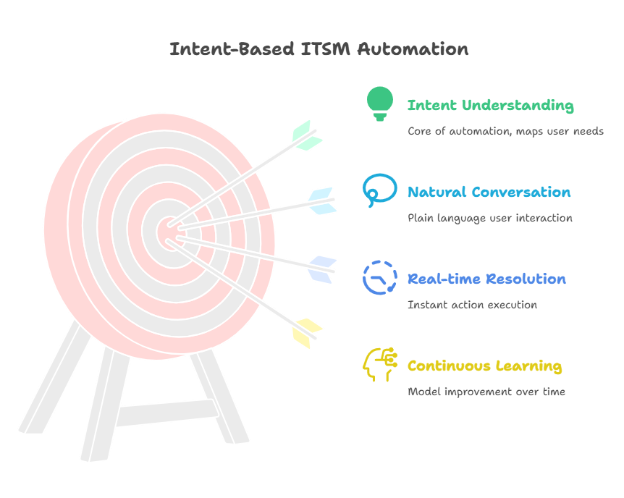
Intent-based automation uses large language models and domain knowledge to understand why an employee is asking for help. Instead of forcing the user to pick a category or fill out a lengthy form, the system reads free-text or voice, maps it to an intent (e.g., reset password, request software, check outage status), and executes the right workflow instantly.
Key traits:
- Natural conversation. Users type or speak in plain language.
- Real-time resolution. Bots trigger pre-built actions or retrieve knowledge without human hand-offs.
- Continuous learning. Each interaction improves the underlying intent model, so answers get sharper over time.
Why Is Traditional Ticketing No Longer Effective in 2025?
Every year there’s more cloud apps, more endpoints, and more remote workers. Tickets keep rising while budgets stay flat. Older systems struggle because they:
- Depend on forms. Users guess the right category; mistakes bounce around in queues.
- Move linearly. A ticket hits Level 1, passes Level 2, and so on, as the clock keeps ticking.
- Ignore patterns. Repetitive requests (password resets, payroll dates) consume analysts’ time even though answers already exist.
- Stay reactive. No insight into bubbling issues until the backlog explodes.
How Is Intent-Based Automation Different from Ticketing?
Intent-based systems replace the ticket form with a conversation and replace manual routing with AI-driven actions. Here’s how that changes day-to-day life:
- Conversation over categories. The platform listens to what the employee says, not which drop-down they pick.
- Instant answers. If knowledge exists, it is sent back in the same chat. If action is needed—reset a password, spin up a VM—the bot does it.
- Personal context. The system knows who the user is, their device, their permissions, and tailors the fix.
- Proactive nudges. Spotting trends (VPN failures in one office) lets IT warn users before tickets spike.
Benefits of Moving Beyond Workflow Automation
The jump from form-based workflows to intent-driven support is not about shiny new tech—it is about measurable business gains that show up in every monthly report. Here is what organizations see once AI handles the repetitive load:
- Resolution time drops from hours to seconds. When the bot spots the intent and fires the right action, common fixes (password resets, software installs) complete while the user is still in the chat, slicing average handle time by as much as 50 %.
- Cost per request shrinks toward zero. Self-service and end-point automation remove the human labor that drives the typical ticket resolution price. Savings scale linearly with volume, freeing budget for strategic projects.
- Employee experience turns proactive. Instead of waiting in a queue, users get conversational answers or completed tasks on the spot, boosting satisfaction scores and reducing follow-up pings.
- Automation understands purpose, not just rules. AI parses natural language, user identity, and device context, so the right workflow runs without brittle form triggers.
- Analysts reclaim time for higher-value work. Routine fixes disappear from the queue, letting Level 2 and Level 3 teams focus on security hardening, cloud migrations, and innovation initiatives.
Beyond pure cost, the time saved cascades into higher productivity and lower turnover, because employees no longer dread the ticket treadmill.
What Makes Intent-based Automation Different?
- Predictive, context‑aware actions. The intent engine looks at identity, permissions, device telemetry, and live service health to launch fixes before users open a ticket.
- Single brain across every channel. One model drives chat, voice, e‑mail, and mobile, so employees enjoy the same experience everywhere and you maintain only one knowledge corpus.
- Low‑code extensibility for the service desk. Analysts drag and drop new intents or update policies without waiting for developer sprints, keeping automation in lock‑step with business change.
- Policy‑first guardrails. Role‑based scope, step‑level approvals, and signed logs are baked in, so every automated action meets audit and security requirements.
- Self‑improving feedback loop. Thumbs‑up/‑down signals and outcome data retrain the model weekly, driving incremental accuracy without manual re‑labeling.
- Cross‑domain reach. A single intent can touch IT, HR, and Finance systems in one flow, eliminating hand‑offs that slower, siloed bots cannot bridge.

Case Snippet of ITSM Automation in Action
Black Angus: From Panic Calls to Peace of Mind
When the restaurant group rolled out an AI-powered desktop assistant, after-hours support calls crashed from 90 % of total volume to just 10 % in under two months. Rezolve.ai’s end-point automation lets staff reset POS devices, retrieve schedules, and file maintenance requests on their own—no midnight hotline required. The result? A self-service culture, smoother collaboration across shifts, and managers who can focus on guests instead of troubleshooting laptops.
Expert Insights: The Shift to Intent-Based ITSM
“Intent-based automation is the next milestone for service desks. It gives employees answers straight away and lets IT teams focus on bigger problems.”
— Manish Sharma, Chief Revenue Officer, Rezolve.ai
Comparison: Traditional vs. Intent-Based Service Desk
Before deciding whether to keep the old ticket queue or jump to an intent-first model, it helps to see how they differ across every stage of support—not just resolution time.
In summary, traditional ticketing relies on forms, manual routing, and static FAQs, so users fill fields, wait in multi‑level queues, and often get generic answers; resolution takes hours or days, costs stay high, trend insight arrives monthly, and analysts remain stuck on repetitive fixes. An intent‑based desk flips this model: employees speak naturally in chat or voice; AI detects purpose, runs end‑to‑end actions tailored to the user’s role and device, or escalates with full context, delivering answers in seconds. Real‑time anomaly alerts replace slow reports, fully automated flows drive per‑request costs toward zero, and service teams refocus on strategic projects instead of ticket triage.
Rezolve.ai: How It Powers Intent-Driven ITSM
Rezolve.ai plugs straight into Microsoft Teams or Slack, turning the chat tool everyone already uses into the first stop for help. Here’s what’s going on under the hood after an employee types a question:
- Intent engine. Pre-trained on hundreds of thousands of IT conversations, then fine-tuned with your own data to recognize even niche requests (“restore yesterday’s finance.xlsx from OneDrive”).
- Action library. Out-of-the-box automation capabilities to handle password resets, software installs, VPN unlocks, badge access, and more. Each action talks to the right system—Active Directory, SCCM, Workday—without a single swivel-chair move.
- Gen AI knowledge assistant. Instead of linking to a 20-page policy, Rezolve.ai extracts the exact paragraph the user needs and drops it into the chat, fully cited, in less than a second.
- Analytics & live dashboards. Real-time views show what users ask, how many requests the bot solved, average handle time saved, and emerging problem hotspots.
- Low code automation builder. Drag-and-drop blocks let service-desk teams add new intents or automate niche tasks without waiting for developer cycles.
- Enterprise-grade security. SOC 2 Type II, ISO 27001 controls, full encryption, granular role-based access, etc.
- Continuous learning loop. Thumbs-up/-down feedback feeds a re-trainer that tunes intent accuracy weekly, not annually, so precision climbs with usage.
Key Takeaways & Next Steps
Why intent‑based ITSM wins in 2025
- 60–70 % of requests resolved automatically in chat. Routine fixes disappear from queues, shrinking ticket volumes almost overnight.
- Seconds, not hours. Common tasks (password resets, software installs) complete while the user is still typing, cutting average handle time by up to 90 %.
- Happier users, leaner budgets. Instant help boosts satisfaction scores and drives per‑request costs toward near‑zero.
- Works inside the tools you already trust. Pre‑built connectors for Microsoft Teams, Slack, Jira, ServiceNow, and more drop AI into existing workflows instead of forcing a rip‑and‑replace.
- Improves itself every week. Continuous learning and a low‑code automation builder let service‑desk teams add new intents on the fly, so coverage and accuracy climb without developer bottlenecks.
Next steps to capture the upside
- Benchmark the pain. Pull baseline metrics on ticket volume, average handle time, and cost per request to set a clear before‑and‑after.
- Pilot high‑impact use cases. Start with top repeat offenders—password resets, VPN unlocks, access requests—inside Teams or Slack for quick wins.
- Loop in compliance early. Map role‑based approvals and audit requirements so automated actions meet security and governance standards from day one.
- Upskill the service desk. Train analysts on the low‑code builder so they own new intents, keeping automation aligned with fast‑changing business needs.
- Track and iterate. Review intent accuracy, resolution speed, and user‑feedback dashboards weekly; feed insights back into the model to push the 60–70 % automation rate even higher.
Adopt these steps and you replace ticket churn with instant, conversational resolution—unlocking time, budget, and morale for the work that drives the business forward.
In Closing
Intent-based ITSM is no longer a nice-to-have. It has proven that smart conversation, instant action, and continuous learning can wipe out routine backlogs and lift employee morale in weeks, not quarters. Service desks that shift now spend less on low-value tasks and gain time for the projects that really move the business forward.
If smoother operations, happier users, and leaner costs are on your roadmap, the next step is simple. Ready to see intent-driven ITSM in action? Book a Rezolve.ai demo today.
FAQs on Rezolve.ai’s ITSM Automation Capabilities
- How does Rezolve.ai reduce ticket volumes?
It shifts routine issues—passwords, software requests, etc., —from agent queues to instant self-service. In customer rollouts, automation has absorbed 60–70 percent of inbound requests within the first quarter.
- Can Rezolve.ai integrate with current ITSM tools?
Yes. The platform syncs with ServiceNow, Jira Service Management, Freshservice, and other systems. Tickets that still need human review are created automatically with full chat context.
- How long to go live?
Smaller organizations often launch within four weeks; larger enterprises average six to eight, including security reviews and change management.
- What are common IT tasks Rezolve.ai can automate?
Password resets, software installs, VPN unlocks, access provisioning, device diagnostics, and new‑hire or off‑boarding checklists—all handled end‑to‑end without human touch.
- Does Rezolve.ai work inside Microsoft Teams and Slack?
Yes. Employees chat in Teams or Slack and get instant resolutions without leaving the channel, while admins manage everything from the same workspace.
- Is AI‑based automation secure for ITSM tasks?
Rezolve.ai enforces role‑based scopes, encrypted tokens, and signed audit trails, and is SOC 2 Type II and ISO 27001 compliant, so every automated action meets enterprise security standards.
- Can I replace ServiceNow or just integrate with it?
Both. Many customers use Rezolve.ai as a chat‑first front end that syncs data back to ServiceNow, while others phase out legacy modules once automation coverage is high.


.webp)

.png)









.webp)