
.jpg)
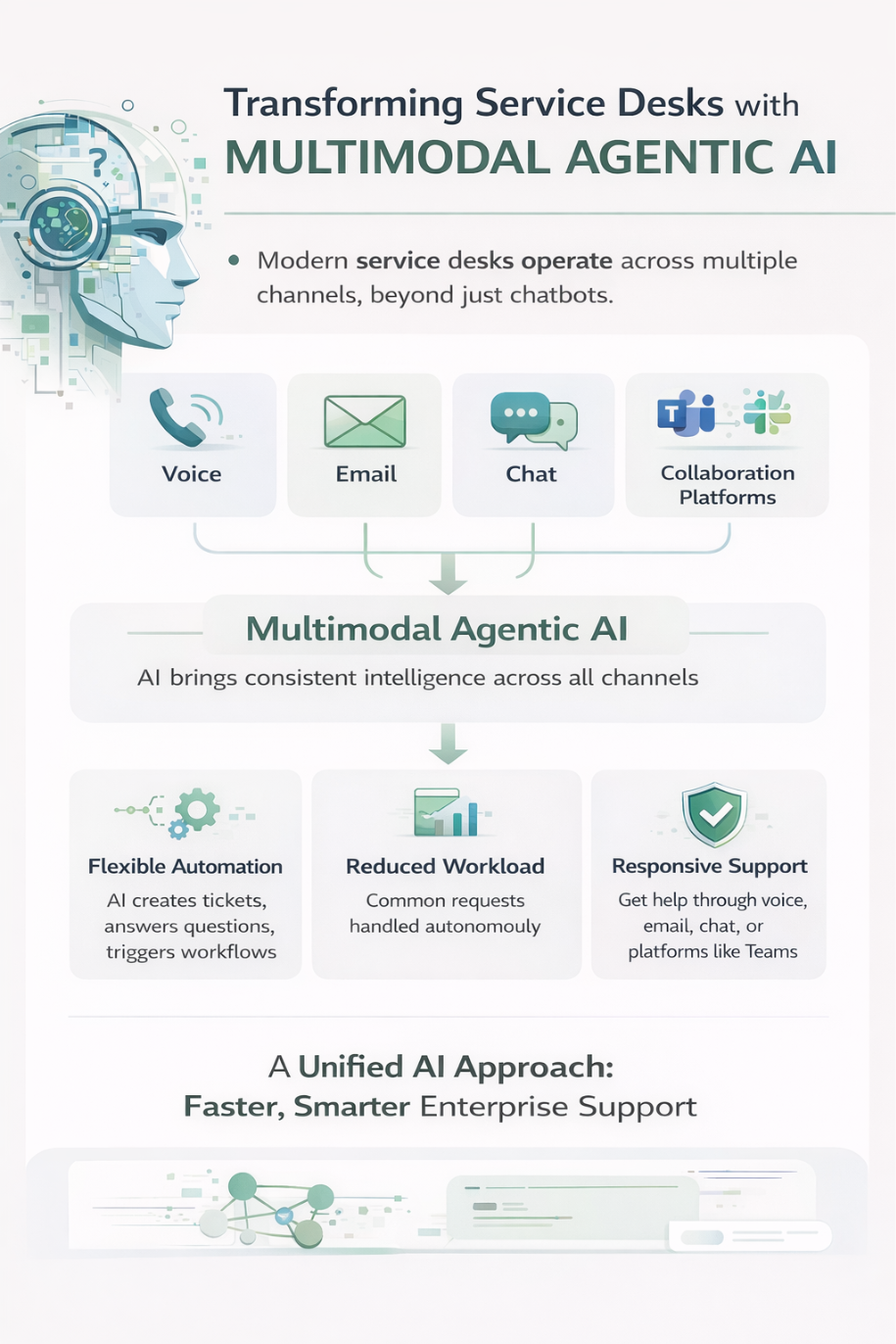
Modern service desks operate across multiple channels such as voice, email, chat, and collaboration platforms, not just chatbots. Multimodal agentic AI brings consistent intelligence across all these channels, allowing employees to get help in the way that suits them best. AI can understand requests, create tickets, answer questions, and trigger workflows regardless of the channel used. This unified approach improves automation, reduces support workload, and enables faster, more scalable enterprise support.
Introduction
Early IT support relied heavily on phone calls and email tickets. Then came service portals, knowledge bases, and self-service systems designed to reduce the load on support teams.
The next wave introduced chatbots and virtual agents. These systems appeared inside collaboration platforms such as Microsoft Teams or Slack and promised to answer common questions automatically. Employees could ask a bot about password resets, software access, or system outages without opening a ticket.
This was an important step forward. Chat based support reduced ticket volumes and helped organizations automate repetitive requests.
But as many IT leaders quickly discovered, chatbots alone do not represent the full reality of how employees seek help.
Even today, service desks receive requests through many different channels.
- Employees call support lines when they are locked out of systems.
- They send emails describing complex issues.
- Some open tickets through service portals.
- Others ask questions directly through collaboration platforms.
The modern service desk is not built around a single communication channel. It operates across several channels simultaneously.
This is where the next generation of AI-driven service desks is emerging. Instead of focusing on one interface such as chat, organizations are adopting multimodal AI support that works across voice, email, chat, and collaboration tools at the same time.
Agentic AI makes this possible by bringing the same intelligence to every channel an employee might use.
What is Multimodal Support?
Multimodal support refers to an AI system that can communicate and operate across multiple interaction channels while maintaining consistent intelligence and context. These channels typically include chat interfaces, email systems, voice interactions, and collaboration platforms such as Teams or Slack.
From the user’s perspective, the interaction should feel seamless. Regardless of the channel they choose, the system should understand their request, access the same knowledge sources, and perform the same actions.
If an employee asks for help resetting a password through chat, email, or voice, the system should be able to respond in the same intelligent way.
“The goal of multimodal support is not simply to add more interfaces. The goal is to ensure that every interface is connected to the same operational intelligence.”
Without this consistency, organizations end up with fragmented support systems where different channels operate with different levels of automation. A truly modern service desk treats every channel as an entry point into the same intelligent support system.
Evolution of Voice AI Support
Voice support has always played an important role in enterprise service desks. Many employees still prefer to speak to someone when dealing with urgent issues or complex problems. However, traditional voice support systems were often frustrating.
Older interactive voice response systems relied on rigid menus and keyword recognition. Users had to navigate through multiple prompts just to reach the right support queue. These systems struggled with natural speech and frequently misunderstood requests.
As a result, many employees developed a negative perception of automated voice systems.
Advances in speech recognition and AI have changed that landscape significantly.
Modern voice AI systems are conversational rather than menu driven. They understand natural language, interpret context, and respond in a way that resembles human conversation. More importantly, these systems are now becoming agentic.
Instead of simply answering questions, voice AI for support like Rezolve VoiceIQ can take action. It can create support tickets, retrieve system information, and initiate automated workflows. The interaction begins to feel less like navigating an automated menu and more like speaking with an intelligent assistant.
Another important capability of AI for voice support is multilingual support. Large organizations often operate across many regions, and employees prefer to interact in their native language. Modern voice systems can understand and respond in multiple languages, making global support far more accessible.
This combination of conversational interaction and operational capability transforms voice support from a simple routing tool into an intelligent service desk interface.
Smart Mailbox: AI for Email Support
Email remains one of the most widely used channels for enterprise support requests.
Employees often prefer email when they need to describe a problem in detail or attach supporting information such as logs, screenshots, or documents.
Traditional service desks process these emails using rule-based automation. Messages are routed based on keywords or predefined patterns. While this approach can help categorize requests, it still requires human agents to interpret the message and determine the appropriate action.
Modern AI-driven systems take a different approach.
A smart mailbox uses natural language understanding to analyze the content of incoming emails. The AI system identifies the user’s intent, extracts relevant information, and determines the appropriate response.
If the email contains a simple question, the system may provide an automated answer based on the knowledge base. If the request requires action, the AI can create a service ticket and route it to the appropriate team.
In some cases, the AI may ask the user for additional information needed to process the request.
Because the system understands context rather than relying on rigid rules, it can handle a wide variety of requests without requiring manual classification.
This significantly reduces the workload for service desk teams and accelerates response times for employees.
Channel Strengths and Limitations
Each support channel serves a different purpose within the service desk ecosystem.
Voice interactions are ideal for urgent issues or quick requests. Employees can explain their problem immediately and receive guidance in real time. However, voice is not well suited for long explanations or detailed technical instructions.
Email works well for structured requests and situations where documentation or attachments are needed. At the same time, email conversations can become slow when multiple back and forth exchanges are required.
Chat interfaces inside collaboration platforms are excellent for interactive problem solving. They allow employees to ask follow up questions and receive responses quickly. Yet chat systems depend on users being logged into the collaboration platform.
“No single channel is perfect for every situation. This is why service desks benefit from having multiple communication options available”
Business Benefits of Multimodal AI Support
For organizations, multimodal AI support delivers several important advantages.
- First, it enables a much higher level of automation within service desks. Many routine requests can be handled entirely by AI across multiple channels. Password resets, ticket status updates, access requests, and common troubleshooting tasks can often be resolved without human intervention. This reduces the need for large first level support teams and allows skilled technicians to focus on more complex issues.
- Second, multimodal AI reduces operational costs. When repetitive requests are automated, organizations can handle growing support volumes without expanding support staff.
- Third, multilingual AI capabilities allow organizations to provide global support from centralized teams. Employees in different regions can interact with the system in their preferred language while the underlying support infrastructure remains unified.
The result is a more efficient, scalable, and responsive support environment. For instance, tools like Rezolve.ai can create smart support tickets from Microsoft Teams chats, voice telephony, email, and even dedicated portals. Thanks to its Agentic SideKick 3.0, enterprise can deflect 50-85% of the tickets and service requests autonomously.
Closing Note
The evolution of service desks is closely tied to how employees communicate with support systems.
Chatbots introduced an important new interface, but they addressed only one part of the service desk ecosystem. Voice calls and email requests continue to play a major role in how employees seek assistance.
The next generation of service desk technology recognizes this reality.
By combining voice, email, chat, and collaboration platforms into a unified AI driven support system, organizations can create truly intelligent service desks that meet employees wherever they are.
Agentic AI enables this shift by bringing consistent intelligence and operational capability to every channel.
Rezolve.ai can enable powerful multimodal Agentic AI support for IT, HR, and shared services for your enterprise. Discover its capabilities and ROI potential in a personalized demo - Book a Demo


.webp)

.png)









.webp)