.png)

More than a billion AI agents will be actively operating, assisting, automating, resolving, monitoring, and learning across multiple domains and industries. In fact, many analysts, vendors, and enterprises are laying track for exactly that kind of proliferation. The rise of AI agents in ITSM and digital workplaces promises not merely incremental efficiency, but a wholesale shift in how support gets delivered, how work is managed, and how organizations scale.
“Digital workplace AI 2026” is rapidly becoming an operational imperative for enterprises aiming for resilience, speed, and adaptability. As we approach that inflection point, it’s critical for ITSM leaders, workplace strategists, and enterprise architects to understand not just what’s possible, but what is plausible - both in terms of opportunity and the challenges ahead.
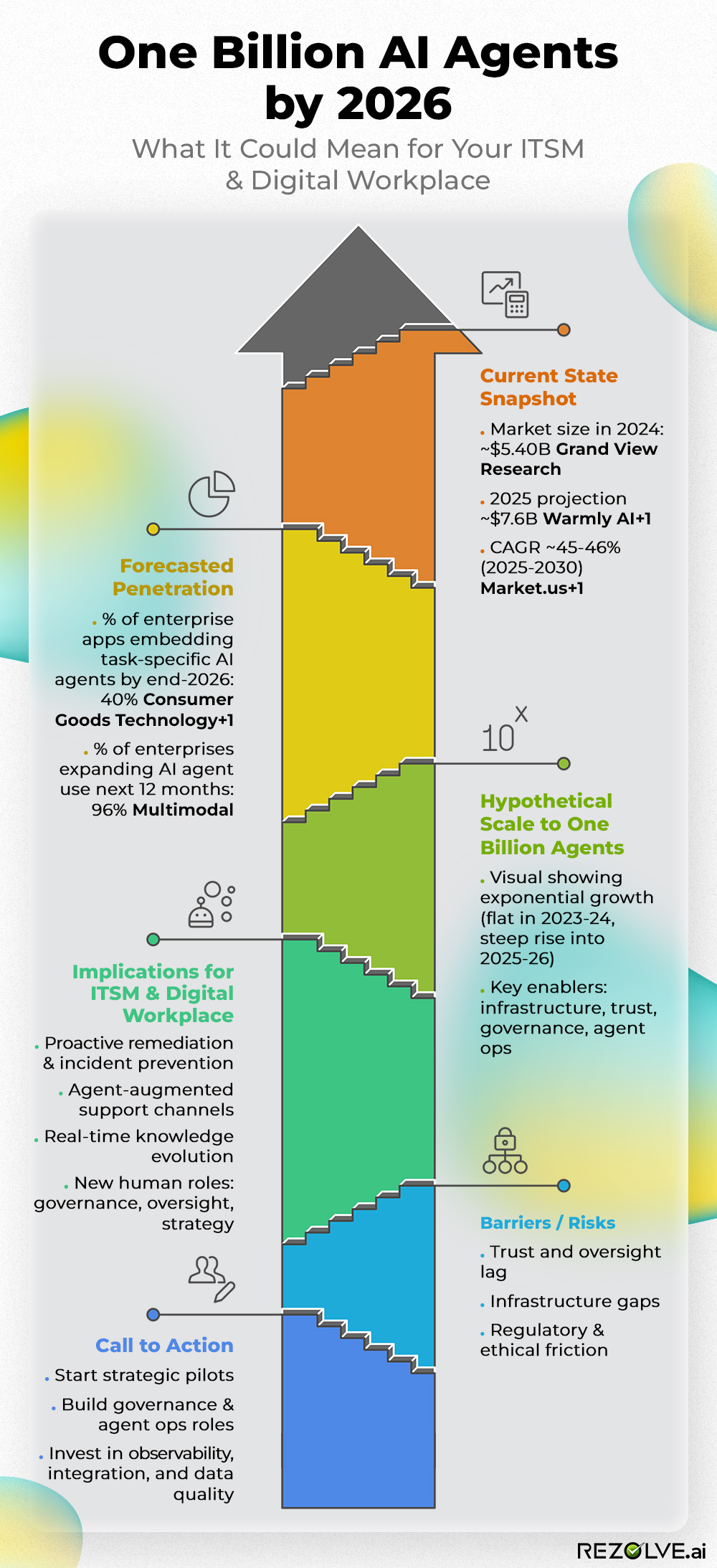
By 2026, forecasts suggest that AI agents will become deeply embedded in enterprise systems, enabling widespread automation, proactive issue detection, and even autonomous decision-making. With enterprise apps adopting task-specific AI agents (estimates of ~40% of apps by 2026), and market growth surging (CAGR ~45-50%), the digital workplace and ITSM functions will see changes in roles, workflows, and expectations. The era of reactive support will shift toward predictive, agent-driven operations. But scaling to “one billion AI agents” will require thoughtful governance, infrastructure, trust, and human-agent symbiosis.
What Do We Mean by “One Billion AI Agents”?
Before we go deeper, it’s worth defining terms. An AI agent here refers to an autonomous or semi-autonomous piece of software that can perceive its environment (logs, tickets, dashboards, user inputs), make decisions, act (execute scripts, escalate issues, remediate, etc.), and ideally learn from outcomes.
When people talk about “one billion AI agents,” they generally mean a scale where every significant workflow, process, support role, or endpoint in the digital workplace has an associated agent or set of agents—so that the number is not just in hundreds or thousands but scaled globally, across devices, services, and interactions.
Current Trends & Forecasts: What the Data Says
Let’s anchor in what the latest research is showing including today’s reality, what is projected, and what gaps we already see.
- Prevalence of AI Agents in Enterprise Applications
Gartner predicts that by the end of 2026, 40% of enterprise applications will incorporate task-specific AI agents, up from less than 5% currently. Consumer Goods Technology+1 This suggests a rapid rise in agents embedded into the tools people use every day.
- Market Growth Projections
The global AI agents market was valued at USD 5.40 billion in 2024 and is projected to reach USD 50.31 billion by 2030, at a CAGR around 45.8% over the forecast period. Grand View Research Also, some forecasts expect $7.6 billion in 2025, up from $5.4B in 2024. Warmly AI+1
- Enterprise Interest & Expansion
A survey by Cloudera in early 2025 (1,484 IT decision-makers across 14 countries) found that 96% of enterprises plan to expand their use of AI agents over the next 12 months. Multimodal
- Challenges & Attrition
Gartner warns that over 40% of agentic AI projects may be scrapped by 2027, often due to unclear business value, cost overruns, or poor alignment. Reuters Trust, infrastructure, and culture are frequently cited as barriers. ITSM.tools+1
- Adoption Gaps & Confidence
Though many enterprises are experimenting, few have truly scaled. For example, in ITSM specifically, ~41% of organizations report having some budget allocation for AI initiatives; but less than half trust AI systems to make decisions without human oversight. In the survey ITSM.Tools 2025, 55% don’t trust AI to decide alone. ITSM.tools
These data points together paint a picture that might support the ambition of a billion agents or at least push us close. However, none of the reports explicitly projects “one billion agents by 2026” with strong empirical backing. Many estimate adoption curves, agent embedding in apps, or market size, but not the absolute counts of agents deployed globally.
What Would One Billion AI Agents Mean for ITSM?
Assuming the realization or approach toward “one billion AI agents” in or by 2026, here are likely implications for ITSM and digital workplace operations. These are trend-based reflections, not predictions set in stone.
1. Continuous Proactive Support
Instead of being reactive and waiting for incidents, complaints, tickets, etc., ITSM systems will become proactive. Agents embedded across device endpoints, cloud services, user apps, and infrastructure will monitor for anomalies and act (or flag) before users even notice problems.
Example: A user’s cloud storage starts seeing latency. An AI agent notices it, isolates cause (e.g., misconfiguration, resource spike), triggers remedial actions, and confirms resolution - all without a human ticket being raised.
2. Massive Scalability & Real Time Response
With potentially millions or even hundreds of millions of agents running, support becomes massively scalable. Agents can work in parallel, share learnings, detect patterns across regions. Response times drop dramatically; many "standard" issues may resolve in seconds.
3. Shift in Human Roles
Humans in ITSM won’t disappear, but their roles will shift. More emphasis on oversight, governance, exception handling, ethics, and designing agent ecosystems. The highest value work becomes: defining what agents can and cannot do, training agents on domain knowledge, ensuring alignment to policy, managing change and trust.
4. Governance, Trust & Risk Becomes Critical
As agents proliferate, governance is no longer optional. Issues of privacy, compliance, auditability, bias, and unintended side effects become multiplying risks. Trust in automated decisions is fragile. Oversight, logging, redress, explainability must scale.
5. Digital Workplace Transformed
From virtual assistants to full-blown intelligent coworkers. Agents in collaboration tools, employee onboarding systems, knowledge bases, HR support, scheduling, procurement — the agents will be everywhere. The digital workplace will start to feel like an organism — its agents collaborating, monitoring, and acting.
6. Operational and Infrastructure Load
Running many agents across networks, cloud, devices means infrastructure matters: compute, data flow, security, orchestration. Latency, availability, cost, energy consumption will figure very large. Enterprises will need robust architectures to support scale, perhaps shifting toward edge-AI, hybrid agent deployment, on-device processing.
Potential Barriers on the Road
Even with intense momentum, scaling to one billion active agents globally by 2026 faces several realistic hurdles.
- Ambiguous metrics & definitions. What counts as an “agent”? A simple alerting bot? A fully autonomous agent? Without clarity, numbers get inflated or misinterpreted.
- Trust & oversight. Many organizations are still reluctant to give agents critical decision-making power. As noted, large shares of respondents do not trust AI to act without human oversight. ITSM.tools
- Return on investment (ROI) uncertainty. Scaling pilots to production at scale, and ensuring cost savings or business value, remains difficult. Gartner’s warning about agentic AI projects being scrapped underlines this. Reuters
- Infrastructure & data readiness. Data silos, inconsistent quality, security, latency, integration barriers. Many enterprises report needing upgraded infrastructure. Gmelius+1
- Regulatory, ethical, and labor concerns. Autonomous agents intersect with regulations, supply chain risk, user privacy, bias, and social pushback. Also, what about job impact? Ethical deployment will require ensuring that the workforce is upskilled, displaced tasks are managed, and social contract is respected.
What Should Organizations Be Doing Now?
To be prepared for (or contributing to) this shift toward possibly one billion AI agents in digital workplaces, enterprises should plan strategically. Here are actions grounded in what the data suggests.
- Define Agent Boundaries & Governance Frameworks Early
Decide where agents are allowed to act autonomously vs where human oversight is required. Build audit logs, rollback mechanisms, ethical guidelines. This reduces risk and boosts trust.
- Pilot Strategically with High-Impact Use Cases
Choose areas where volume, repeatability, and measurable outcomes exist. E.g. incident detection, password resets, resource optimization. Get wins quickly to build internal momentum.
- Invest in Infrastructure & Integration
Agents need clean data, reliable access, secure pipelines, integration to monitoring/orchestration tools. Without this plumbing, scale leads to brittleness, inefficiency, or failures.
- Focus on Human-Agent Collaboration & Roles
Train staff in “agent ops” — roles that monitor, train, refine, govern agents. Clarify that AI isn’t replacing humans but evolving their roles. Change management is essential.
- Measure & Monitor ROI, Trust, and Impact
Put in place metrics that capture not just cost saving but user satisfaction, trust in agent behavior, incident prevention, error rates, compliance issues.
- Plan for Scale
As more agents are deployed across functions (ITSM, HR, finance, workplace tools), architecture must support orchestration, agent life cycle management, safety, and performance. Think about decentralization (edge), hybrid cloud/on-device, etc.
Case Signals: Early Adopters & Directional Insights
Here are real signals from enterprises and regions that show early movement.
- In Indian enterprises, 93% of business leaders say they plan to deploy AI agents to enhance workforce capabilities in the next 12–18 months. The Economic Times
- Gartner estimates (again) that by 2026, 40% of enterprise apps will include task-specific agents. Consumer Goods Technology+1
- Cloudera’s survey showing 96% of enterprises intend to expand AI agent use in a year. Multimodal
These don’t by themselves confirm one billion agents, but they validate direction, pace, ambition, and awareness.
What This Means for the Future of ITSM & Digital Workplaces
Putting together the forecasts, trends, and early signs, here’s how ITSM and digital workplaces are likely to look when (or if) we approach the scale of one billion AI agents in 2026.
- Service desks will be re-architected: Many tier-1 and tier-2 tickets could be handled entirely by agents. Humans become exception handlers.
- Knowledge bases & documentation will evolve in real time: Agents will not only reference KBs; they will generate, update, improve, and prune content continuously based on feedback and outcomes.
- Support channels become more intelligent: Voice, chat, email will be routed, mediated, or handled by agents that know the history, context, and state of systems.
- Monitoring tools will feed agents: Agents will not just wait for tickets; they will monitor metrics, telemetry, logs, even unusual user behavior and initiate remediation.
- User experience becomes predictive: Rather than complaining about downtime or issues, users will often see issues corrected before noticing them, or receive proactive alerts (“We are seeing higher load in server X, fixing it”).
- Digital workplace tools will incorporate agent-centric workflows: Office suites, collaboration tools, HR systems, procurement, scheduling – all become platforms with embedded agents that assist with task automations, approvals, policy enforcement, etc.
Forecast Check: Is One Billion Agents by 2026 Realistic?
Given all this momentum, how realistic is the “one billion agents by 2026” narrative?
- On one hand, many indicators (CAGR of ~45-50%, rapid enterprise intent, increasing embedding of agents in apps) lean toward exponential growth.
- On the other, scaling that high in just ~1–2 years (from 2025 to end-2026) faces friction: infrastructure, trust, cost, regulation, definition issues.
- Some statements (e.g., posts claiming Microsoft expects “1 billion AI agents by 2026” in certain contexts) exist but are often speculative, marketing, or projections rather than confirmed counts. I did not find a reliable source that definitively states “one billion active AI agents globally by 2026” in production.
Thus, while “one billion” is an aspirational benchmark, enterprises should treat it as directional: the pace is likely steep but hitting that exact number is uncertain. What matters more is how many agents instances each organization has, how they are managed, and how robust the supporting systems are.
Conclusion
The march toward proliferation of AI agents in ITSM and the digital workplace is well underway. Whether or not the world reaches “one billion agents by 2026,” the trends, forecasts, and enterprise behavior all point to massive scaling. For digital workplaces, this means support will increasingly shift from reactive to proactive; roles will evolve; governance will become a core capability; infrastructure will be tested; and trust will be the currency of adoption.
Enterprises that take strategic action on boundaries, infrastructure, people, governance will be the winners when scale hits. Those that wait will risk being overwhelmed by complexity, risk, or falling behind competitively.


.webp)

.png)










.webp)