.png)
For years, IT support has relied on ticket deflection, steering users toward helpdesk portals or FAQs. But that often results in unresolved issues and wasted time. Now, in 2025, SideKick 3.0, the agentic AI platform built for service desks, is redefining support by resolving issues autonomously, not just avoiding tickets.
This blog delves into how SideKick 3.0 moves beyond deflection, explores the agentic architecture that powers it, and explains why true autonomous resolution is game-changing for enterprise IT.
Most enterprise chatbots aim to deflect tickets, not resolve them. SideKick 3.0 changes the game by delivering true autonomous resolution directly inside Microsoft Teams or Slack. It uses agentic AI to understand user intent, execute multi-step workflows, and fix issues without human involvement. From password resets to software deployments, it handles routine support tasks in real time, reducing downtime and ticket volume. Its architecture is explainable, secure, and designed for enterprise needs - offering real productivity gains, not just surface-level automation.
From Deflection to Full Resolution
Traditional Bots Fall Short of Expectations
For years, enterprise IT support has leaned heavily on automation tactics like ticket deflection—redirecting users to helpdesk portals, knowledge-base articles, or chatbot flows. On paper, this strategy reduces ticket volume. But in reality, it rarely solves the user's problem. Employees are often left clicking through outdated articles, guessing which dropdown to pick in a service form, or still waiting for a human to step in. The result? Frustration builds, productivity drops, and IT’s promise of "self-service" feels like smoke and mirrors.
Deflection Isn’t the Same as Resolution
There’s a crucial distinction between deflecting a ticket and actually resolving the issue. When users are bounced between articles or forms without a meaningful solution, business productivity takes the hit. Employees lose time navigating systems instead of doing their jobs, while IT teams remain stuck in reactive loops. Deflection, in this sense, is a band-aid—not a cure. The deeper problem persists: support isn’t moving fast enough, and users still need help. That’s where SideKick 3.0 turns the narrative on its head.
The New Paradigm: Agentic SideKick 3.0
SideKick 3.0 is built to resolve issues end-to-end, utilizing agentic AI that understands intent, runs workflows, and learns over time. It acts like a digital technician embedded in collaboration tools, requiring minimal supervision and delivering results instantly.
What Is SideKick 3.0?
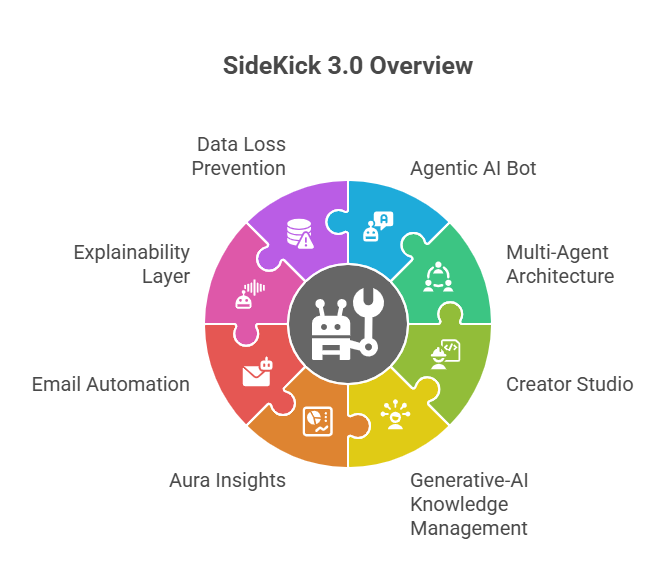
SideKick 3.0 is a next-generation support engine built directly into Microsoft Teams or Slack. Rather than relying solely on scripted flows, it combines conversational AI, multi-agent orchestration, automated workflows, and analytics to autonomously manage IT and HR issues.
Core components include:
- Agentic AI Bot: Understands natural language, detects intent, and triggers the right workflow. Operates within Teams/Slack.
- Multi-Agent Architecture: Specialized bots collaborate to handle tasks, ranging from password resets to onboarding, by drawing on a shared memory layer.
- Creator Studio: A no-code, drag‑and‑drop automation builder for creating new workflows and knowledge skills in hours.
- Generative-AI Knowledge Management: A reasoning RAG engine that searches internal knowledge (wikis, SharePoint, cloud files) and traces its reasoning without hallucinations.
- Aura Insights: Dashboard analytics that reveal patterns in ticket behavior, ticket volume, response time, and SLA risk.
- Email Automation: Automatically drafts triggers, responses, and follow-ups via email channels when necessary.
- Explainability Layer: Every action is transparent; users and admins see intent, triggers, and logic behind each response. No black-box AI.
- Data Loss Prevention: Sensitive information is detected in real-time chats and masked to prevent leaks.
Together, these integrations and features give SideKick unprecedented autonomy, transparency, and adaptability.
The Agentic Advantage: Beyond Static AI
Agentic vs. Traditional AI
Rather than waiting for user input and following scripts, SideKick’s agents proactively plan, act, reflect, and learn. This agentic capability means:
- Goal-based workflows: Once given a task, the agent executes multi-step plans.
- Tool orchestration: It interfaces with Active Directory, endpoint systems, ITSM tools, and internal knowledge, across domains and systems.
- Self-correction: If a step fails, the agent retries or escalates, mimicking human troubleshooting.
Endpoint Automation That Works
Built into the agentic architecture is the ability to run scripts directly on devices, such as PowerShell for Windows, remote policy enforcement, registry edits, cache flushes, and updates. That means outages get fixed silently and immediately.
High-Impact Use Cases
1. Automated Password Resets
Employee: “I forgot my password.”
SideKick: Authenticates users, resets via AD connector, notifies users, all within Teams.
Result: No ticket, instant fix.
2. VPN Connectivity Issues
User: “VPN isn’t connecting.”
SideKick: Checks device policy via endpoint manager, resets client configuration or network credentials, and resolves connection.
Result: No escalation, only a success message.
3. Software Installation On Demand
User: “Can I install Excel?”
SideKick: Verifies eligibility, triggers deployment, confirms completion, updates asset database.
Result: Real-time service.
4. Proactive Incident Prevention
SideKick monitors system dashboards via observability tools. If it detects anomalies (e.g., disk thresholds exceeded, certificate expiry), it auto-remediates or warns users proactively, before service is disrupted.
Why Integrations Matter?
SideKick’s effectiveness depends on deep, native integration with:
- ITSM tools (ServiceNow, Jira, Freshservice): For automatic ticket creation, tracking, and resolution logging.
- Identity management (Azure AD and on-prem AD): Enables secure authentication and password resets via PowerShell execution.
- Endpoint management (Intune, JAMF): Facilitates remote fixes, software installs, and device diagnostics.
- Internal knowledge systems (SharePoint, cloud storage, wikis): Enable accurate and auditable knowledge retrieval via generative RAG search.
- Email and Notification channels: Handles automated follow-ups, escalations, and approvals via email or chat.
These integrations enable SideKick to transition from answering to acting, resolving issues in the digital workplace without human intervention.
Insights That Drive Improvement with Aura Insights
SideKick equips managers with actionable data:
- Autonomy rates: Percent of issues handled without any human assistance.
- Mean Time to Resolution (MTTR): Time saved compared to traditional tickets.
- Top interaction topics: Reveals recurring issues or knowledge gaps.
- SLA risk alerts: Predict high-latency problem areas before they escalate.
- Sentiment and feedback analysis: Captures employee satisfaction trends and sentiment.
This visibility enables continuous service improvement and refinement of automation.
Security, Explainability & Data Protection
SideKick is built with enterprise trust at its core:
- Explainable AI: Every decision and workflow is traceable, and admins can audit which rule, intent, or knowledge source triggered a response.
- DLP by design: The agent detects PII or confidential information in messages, masks it, logs attempts, and prevents privacy leaks in real-time.
- No black-box logic: Admins can override decisions, review intents, or adjust bot behavior as needed.
These controls help enterprises deploy SideKick confidently and responsibly within complex regulatory environments.
The ROI of Autonomous Support
Reduce Ticket Load
SideKick typically resolves 30–70% of IT and HR requests independently, dramatically reducing support overhead and decreasing reliance on manual ticket handling.
Boost Efficiency & Productivity
Employees receive instant fixes, eliminating portal navigation, delays, and downtime. Resolution happens where they work, in seconds.
Scale Without Headcount
One SideKick instance in Teams/Slack can handle thousands of simultaneous requests, freeing IT teams from repetitive tasks and enabling global, 24/7 support without extra hires.
Improve SLAs & CSAT
With faster resolution times and consistent performance, support KPIs such as first-contact resolution, response time, and customer satisfaction naturally rise.
Drive Strategic Focus
IT and HR teams gain time freed from routine tasks to focus on innovation, cybersecurity improvements, architectural planning, and people-oriented initiatives.
Enhance Knowledge & Insight
Systematically surfacing unanswered questions and sentiment trends drives better documentation, faster fixes, and smarter policy decisions.
Who Benefits Most?
Agentic SideKick 3.0 is particularly transformational for:
- Enterprises using Teams or Slack as primary collaboration platforms, seeking seamless service support.
- Managed Service Providers (MSPs) looking to scale support without heavy staffing, offering premium AI SLAs.
- Global organizations with multilingual needs require consistent and empathetic support across regions.
- Compliance-sensitive sectors (finance, healthcare) that need explainable resolution, audit trails, and built‑in DLP.
Real-World Impact
Organizations deploying SideKick have eliminated the L1 support backlog while enabling proactive support models:
- Support teams shrink, but performance soars.
- Employees stay productive, with fewer interruptions, and faster satisfaction.
- IT budgets stretch further, shifting from operational cost centers to strategic enablers.
Looking Ahead: The Autonomous ITSM Vision
SideKick 3.0 represents the first wave. The future of ITSM involves:
- Proactive resolution: issues are resolved before being reported.
- Cross-domain agents: handling IT and HR issues in a unified conversational interface.
- Low-code extension: business teams designing custom automations via Creator Studio.
- Multimodal interfaces: voice, mobile, Slack, Teams, email.
- Predictive automation: flagging emerging risks, burnout signals, or compliance gaps in real-time.
In a nutshell, AI will no longer just support service desks; it will transform them into self-healing, data-driven engines.
Closing Note
Rezolve.ai’s SideKick 3.0 pushes IT support beyond ticket deflection into genuine autonomous resolution. Its agentic architecture, knowledge-driven reasoning, explainability tools, and security-first design elevate support from reactive backlog management to proactive, scalable service delivery.
In a world where time is money and delay costs value, Rezolve.ai SideKick 3.0 isn’t just a tool, it’s the future of modern enterprise support.

Key Takeaways
- SideKick 3.0 resolves issues end-to-end, not just deflects them
- It works directly within Microsoft Teams and Slack
- Uses agentic AI to automate multi-step workflows without human help
- Built-in tools include Creator Studio, knowledge retrieval, and DLP
- Helps enterprises cut down ticket volumes by up to 70 percent
- Boosts SLA performance and employee satisfaction with faster resolution times
- Designed with explainability and security controls for enterprise trust
FAQs
1. What is agentic AI?
Agentic AI refers to systems that can understand a goal, plan steps, execute actions, and learn from the outcome without needing constant instructions. SideKick 3.0 uses this to handle IT and HR tasks automatically.
2. Does SideKick replace human agents?
No. It automates repetitive L1-level support but escalates complex issues to human teams. This frees agents to focus on high-impact work.
3. How is it different from a regular chatbot?
Typical bots follow scripted flows and redirect users to articles. Rezolve.ai SideKick 3.0 executes actual workflows, like resetting passwords, installing software, or resolving VPN issues, all within the chat interface.
4. Is it secure for regulated industries?
Yes. Rezolve.ai SideKick 3.0 includes real-time data masking, audit trails, and full explainability for every AI-driven action. It is designed with compliance and enterprise data security in mind.

.webp)

.png)









.webp)