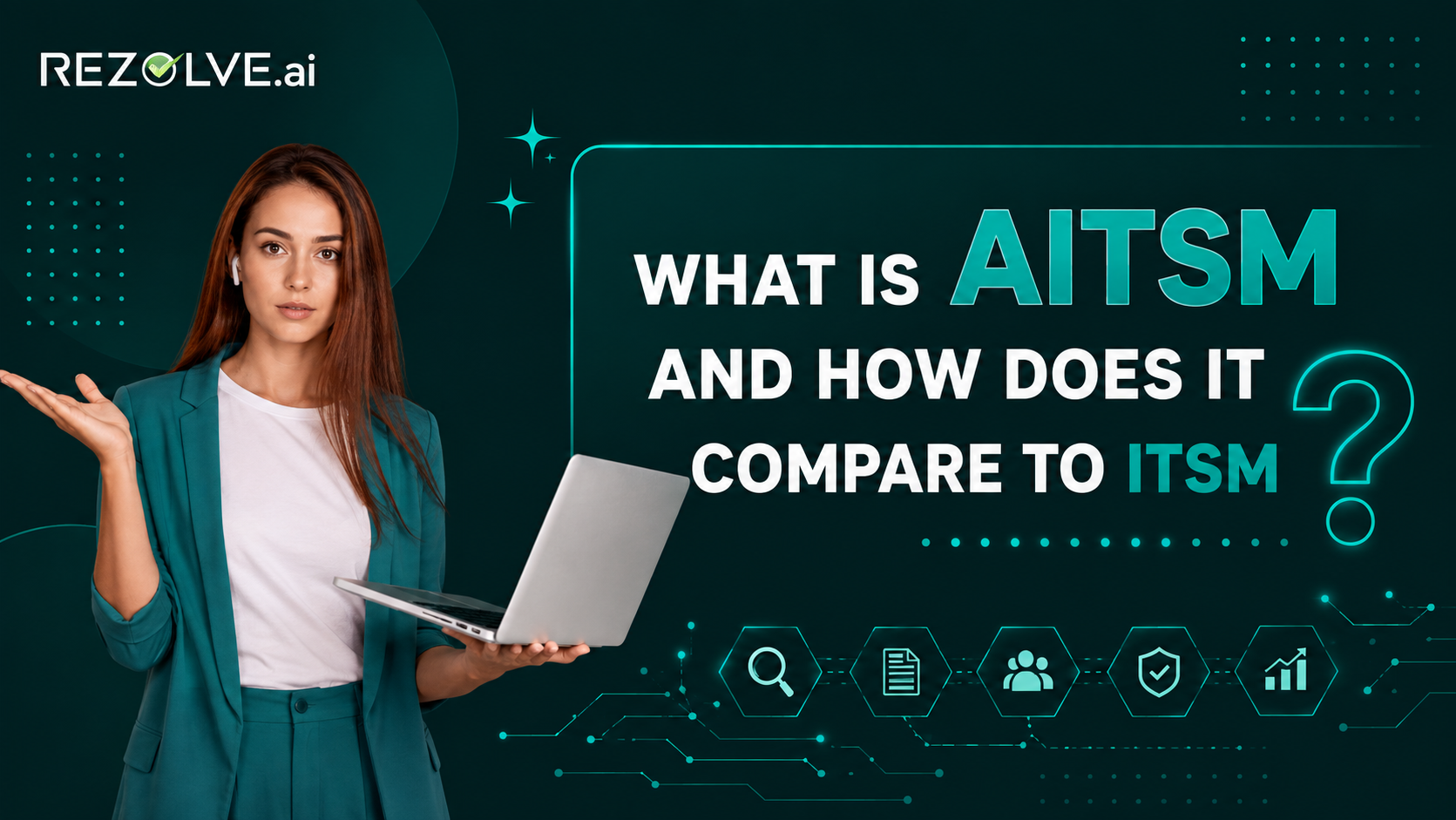
What Is AITSM, and How Does It Compare to ITSM?
AITSM is not ITSM with a copilot bolted on. The difference shows up in what the system is for, recording work versus doing it, and that difference reaches all the way down to which metrics mean anything.

Key takeaways
- ITSM is a system of record; AITSM is a system of action built on top of one
- The four layers (record, knowledge, execution, governance), arrive in order, and skipping the second is the common failure
- Metrics designed for queue management stop describing a desk where most requests never enter the queue
- AITSM does not remove the need for service design; it changes who executes it
ITSM is the discipline of managing IT services as services: defining them, delivering them, measuring them, improving them. It is thirty years old, it is codified in ITIL, and it works.
AITSM is what happens when the execution layer of that discipline stops being human.
That is a smaller claim than the marketing usually makes and a bigger one than it sounds. AITSM does not replace service management. It does not make ITIL obsolete. What it changes is the answer to a specific question: when a request arrives and the resolution is known, who performs it?
For thirty years the answer was a person, working a queue, following a runbook. The apparatus of ITSM (categorization, prioritization, assignment, SLAs, escalation paths), exists mostly to allocate that scarce human attention fairly and measurably.
AITSM answers the same question with software that can read the runbook, decide it applies, and carry it out. Everything downstream of that answer changes.
The four layers
Think of it as a stack rather than a product category. Each layer depends on the one below it, and organizations that skip a layer tend to discover the omission expensively.
Layer 1: The system of record
Tickets, assets, configuration items, change history. This does not go away. Something has to hold the authoritative state of what exists, what happened, and what was approved. AITSM makes the record more important, not less, because software acting on your behalf generates far more entries that need to be attributable.
Layer 2, The knowledge layer
Every answer an agent gives has to trace back to a document you own and can correct. This is the layer that gets skipped, and it is the one that determines whether the whole stack is trustworthy.
The uncomfortable part: most organizations discover their knowledge base is in worse shape than they believed roughly two weeks into a deployment. That discovery is a feature. It is also work that no vendor can do for you.
Layer 3, The execution layer
Agents that take action in the systems holding the data, identity, HRIS, endpoint management, the ticketing system itself. This is where AITSM stops being analytics and starts being service management.
The distinction between "AI in ITSM" and AITSM lives here. A summarization feature in a ticket view is AI in ITSM. An agent that provisions the access, updates the record and closes the request is AITSM.
Layer 4: Governance
Access, ownership, auditability. Who can the agent act as, what is it permitted to do, who reviews it, and what does the trail look like when someone asks in nine months.
This layer is often treated as a compliance afterthought. It is more usefully understood as the thing that makes layer 3 deployable at all, organizations that cannot answer governance questions do not get to turn on execution.
What actually differs
| ITSM | AITSM | |
|---|---|---|
| Primary job | Record and route work | Resolve work; record what was resolved |
| Where resolution happens | Human, in a queue | Software, under policy: human for the exceptions |
| Knowledge base role | Reference material for agents | Live substrate the system reasons over |
| Scaling model | Add headcount | Extend coverage |
| Governance concern | Access to the tool | Access the tool exercises on your behalf |
| Headline metric | MTTR, first response time | Adoption, autonomous resolution |
The last row is the one that causes the most trouble internally.
The metrics problem nobody warns you about
Most service desk metrics were designed to manage a queue. When most requests stop entering the queue, those metrics start describing a smaller and stranger population.
Mean time to resolution gets worse, and that is usually correct. If software resolves the routine requests instantly, they leave the MTTR calculation. What remains is the hard residue, the genuinely complex tickets that always took longest. Your MTTR can rise while every individual outcome improves. Leaders who have not pre-agreed this read the dashboard as a failure.
First response time stops discriminating. When the first response is immediate by construction, the metric no longer separates good performance from bad.
Ticket volume becomes a demand signal rather than a workload signal. Volume falling is not automatically good. It can mean people stopped asking because the last three answers were wrong. Pair it with adoption.
The metrics worth moving to: autonomous resolution rate (what fraction of requests were completed without a human), adoption rate (what fraction of employees actually use it, repeatedly), and escalation quality (when it hands off, was the handoff correct).
What AITSM does not change
Service definitions still have to exist. Somebody has to decide what "access to the finance drive" means, who is entitled to it, and what approval it requires. An agent executing an undefined policy is just a faster way to make an inconsistent decision.
Change management still applies, and arguably tightens. Software that can act needs the same change discipline as any other production system: more, because its behaviour is probabilistic rather than deterministic.
And the organizational work is unchanged. The hardest part of every deployment we see is not technical. It is the negotiation over which actions the software is permitted to take without a human in the loop, and that negotiation is between people.
Where to start
Not with a platform decision. Start by picking the ten highest-volume request types on your desk and asking, for each: is the resolution knowable from documents we own, and is the action performable through an API we control?
The ones where both answers are yes are your AITSM scope. The ones where the first answer is no are a knowledge project. The ones where the second is no are an integration project.
That exercise takes an afternoon and tells you more about your readiness than any vendor evaluation will.
Last updated on August 27, 2026
Get summary with:
See the agentic service desk in action
Watch Rezolve.ai autonomously resolve real IT and HR tickets: governed, auditable, glass-box.
Frequently asked questions
Is AITSM just ITSM with AI features?
No. A summarization feature inside a ticket view is AI in ITSM. AITSM is when the execution layer changes: software resolves the request in the systems that hold the data, rather than assisting a human who does. The test is whether the resolution happens without a person in the loop.
Does AITSM replace ITIL?
No. Service definitions, approval policy, change control and audit all still apply. What changes is who executes the defined process. An agent executing an undefined policy is just a faster route to an inconsistent decision.
Why does MTTR get worse after an AITSM deployment?
Because the easy requests leave the calculation. If software instantly resolves routine work, the tickets that remain are the genuinely complex ones that always took longest. MTTR can rise while every individual outcome improves, agree this with leadership before the first dashboard review.