.png)

Chatbots were a useful steppingstone in ITSM, but by 2026 they’ve been outpaced by autonomous AI agents. Unlike scripted bots, AI agents perceive signals, reason through problems, act independently, and learn continuously functioning like digital colleagues rather than ticket deflectors. This shift matters because enterprises can no longer rely on reactive, human-heavy IT support in sprawling, complex infrastructures. AI agents deliver resilience by reducing downtime, self-healing systems, and freeing human teams for innovation. With multi-agent systems, direct integrations, and governance frameworks, 2026 marks the tipping point where autonomy moves from pilots to enterprise-wide adoption.
When chatbots first entered IT Service Management (ITSM), they were hailed as revolutionary. Employees could finally type a query into a window and get an instant response without waiting on hold and without digging through manuals. For a while, it felt like the future had arrived. But by 2026, the industry has learned that chatbots were only the opening act. They automated the front-end of IT support but never truly transformed it.
The real shift is happening now, with AI agents in ITSM 2026. These are not digital parrots trained to recite scripted answers. They are autonomous AI entities that perceive complex situations, reason through choices, act independently, and learn from every outcome. Comparing chatbots vs AI agents in ITSM is like comparing an office FAQ document with a skilled colleague who not only answers your question but also solves the problem, fixes the system, and updates the process so it doesn’t happen again.
The future of IT support automation is no longer about faster responses. It is about outcomes achieved reliably, safely, and at a scale without human intervention.
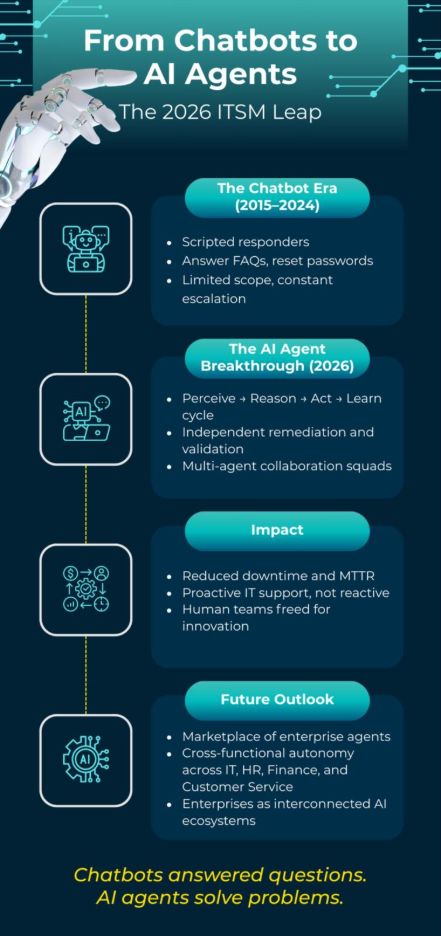
The Chatbot Era
To appreciate the scale of today’s transformation, it helps to revisit the chatbot era with a clear lens. Chatbots were essentially conversational interfaces sitting on top of workflows and knowledge bases. Their role was to deflect tickets by answering routine questions or guiding employees through basic fixes like resetting a password or connecting to Wi-Fi. For many enterprises, the introduction of chatbots shaved down the overwhelming flood of low-level tickets that swamped service desks. They provided 24/7 availability, reduced wait times, and created the illusion of “smart” IT support.
But cracks soon appeared. Chatbots were only as good as their scripts. If an employee phrased a problem differently than expected, the chatbot faltered. If the issue was slightly outside its pre-defined scope, escalation became inevitable. What started as a promise of seamless automation often ended in frustration, as employees were bounced from bot to human without resolution.
Most importantly, chatbots were never designed to take action. They could suggest, inform, or redirect, but they could not fix. That fundamental limitation meant they remained a quick-fix band-aid solution.
The Emergence of AI Agents in ITSM 2026
By 2026, a new generation of technology has rewritten the rules. An AI agent in ITSM 2026 is not a chatbot dressed in more advanced language. It is a fundamentally different construct.
An AI agent is built on the principle of autonomy. It perceives signals from multiple sources like logs, tickets, monitoring dashboards, conversations, even telemetry from devices. It reasons about what those signals mean, weighing historical data, contextual knowledge, and business impact. Then it acts. It applies patches, reconfigures systems, executes scripts, or updates access rights without waiting for a human to press “approve.” Afterward, it validates the results and learns from the process, so it performs even better next time.
This cycle of perceiving, reasoning, acting, and learning makes the agent a digital colleague, not just a front-end interface. It is the difference between a receptionist who takes messages and an operations manager who resolves problems independently.
Why the Agentic AI Shift Matters?
The transformation from chatbots to AI agents matters because the demands on IT have outpaced human capacity. Enterprises are now running sprawling ecosystems of cloud workloads, SaaS applications, hybrid infrastructures, IoT devices, and edge systems. Managing this complexity manually is no longer feasible. Even with chatbots, IT teams were still firefighting, reacting to tickets as they came in.
With autonomous AI agents, the game changes. Incidents are not just acknowledged; they are resolved before they escalate. Changes are not just scheduled; they are validated, executed, and rolled back automatically if anomalies appear. Knowledge is not just retrieved; it is curated and rewritten dynamically based on real outcomes.
The future of IT support automation is therefore not about efficiency alone. It is about resilience. When every second of downtime can cost millions in lost revenue and reputation, autonomous operations are the only viable model.
How AI Agents Outperform Chatbots?
The difference between chatbots vs AI agents in ITSM becomes obvious when we examine outcomes. A chatbot can tell an employee, “Here’s how you might fix your VPN issue.” An AI agent can detect the root cause, execute the fix, confirm the VPN is stable, and update the knowledge base, without a single human action.
Another example is patch management. Chatbots could only remind IT teams that a patch was available. AI agents can analyze potential impact, schedule the patch during low-traffic windows, execute it, and roll back automatically if needed.
Where chatbots depend on constant human backup, AI agents reduce reliance on humans to edge cases and governance oversight. Where chatbots cut costs at the margins, AI agents unlock entirely new levels of business continuity and innovation.
Why 2026 Is the Breakthrough Year for Agentic AI?
Several forces converged to make 2026 the tipping point for AI agents in ITSM.
First, large language models matured beyond simple Q&A into contextual reasoning engines. They can now evaluate multiple signals at once and predict outcomes, not just retrieve answers. Second, multi-agent systems became practical. Instead of one bot handling everything, enterprises now deploy squads of AI agents, each with specialized functions: diagnosis, remediation, validation, documentation. Together, they behave like a digital IT team. Third, integration layers improved dramatically. Agents are no longer siloed; they plug directly into orchestration engines, monitoring systems, and ITSM platforms, enabling seamless end-to-end autonomy.
Finally, culture has caught up. Enterprises no longer see AI as an experiment. They see it as an existential requirement. The pressure to reduce downtime, manage talent shortages, and scale IT without exponential headcount has created urgency. 2026 is the year when pilots turn into full deployments.
The Business Case: Economics of Autonomy
CIOs and CFOs evaluating AI agents find the economics compelling. Reduced downtime is the most obvious driver. If one hour of outage costs a large enterprise several million dollars, slashing Mean Time to Resolve from hours to minutes translates directly into bottom-line savings.
Beyond downtime, workforce optimization matters. Instead of staffing large Tier-1 teams to manage routine tickets, enterprises can redeploy talent into higher-value roles. The IT workforce shifts from reactive support to proactive governance and innovation. Scalability also improves. As organizations expand globally, AI agents scale with demand without proportional hiring.
Perhaps the most overlooked benefit is innovation enablement. Freed from firefighting, IT teams can focus on digital transformation initiatives, cloud migrations, and new business services. Autonomy doesn’t just save money; it creates capacity for growth.
Governance: Autonomy with Guardrails
Of course, granting autonomy to machines raises important questions of control. Enterprises adopting AI agents in ITSM 2026 must design governance frameworks that balance speed with accountability.
Agents operate with confidence thresholds: they act autonomously when probability of success is high but escalate to humans when uncertainty is significant. Audit trails are mandatory and every action an agent takes is logged, explainable, and reversible. Kill switches ensure humans can override agents instantly if needed. Regulatory alignment is non-negotiable, especially in industries like banking or healthcare where compliance is critical.
The key is not to avoid risk but to design systems where risks are contained and correctable. In fact, one of the strengths of agentic AI is its ability to self-correct faster than humans ever could.
From ITSM to Enterprise-Wide Autonomy
Although ITSM is the proving ground, the ripple effects are wider. Once enterprises see the benefits of autonomous IT operations, they begin extending AI agents into other domains. In HR, agents can onboard employees, process benefits, and resolve policy questions autonomously. In finance, they can audit expenses, detect anomalies, and enforce compliance. In customer service, they can resolve issues before customers even raise them.
By 2030, enterprises will operate interconnected ecosystems of AI agents across all functions. The line between ITSM, HRSM, and CSM will blur into one autonomous mesh. ITSM is simply the first domino to fall.
Rezolve.ai: Pioneering Agentic AI for ITSM and Employee Support
At Rezolve.ai, we have always argued that chatbots were a transitional technology, not the destination. Our vision aligns with the broader movement toward autonomy. SideKick 3.0 exemplifies multi-agent orchestration, moving from single-bot interactions to squads of collaborating AI entities. VoiceIQ extends autonomy to voice channels, where employees can resolve issues in natural conversations without ever speaking to a human. SearchIQ transforms knowledge access into actionable outcomes, not just retrieval. And DeskIQ provides the visibility and ROI tracking that CIOs need to trust autonomy at scale.
For us, the debate of chatbots vs AI agents in ITSM is already settled. Chatbots answered questions. AI agents solve problems.
The Future of IT Support Automation
The future of IT support automation will not be measured by how many tickets a chatbot deflects. It will be measured by how few tickets exist in the first place because agents resolved issues before they were noticed. It will not be about scripts and flows but about predictive, learning-driven autonomy.
By the end of the decade, enterprises will shop for AI agents the way they once shopped for SaaS apps - from marketplaces offering specialized agents for SAP, Salesforce, cybersecurity, or compliance. These agents will plug into the enterprise mesh seamlessly, creating a self-sustaining operational ecosystem.
What began with chatbots deflecting tickets in ITSM will culminate in enterprises where AI agents run entire operational layers. For organizations willing to make the leap, 2026 is the moment to begin.
In Closing
The journey from chatbots to AI agents in ITSM tells the story of enterprise evolution. Chatbots brought convenience but also highlighted the limitations of scripted automation. AI agents in ITSM 2026 deliver something far greater: true autonomy, where systems perceive, reason, act, and learn.
The future of IT support automation will not belong to the organizations that cling to chatbots as “good enough.” It will belong to those that embrace AI agents as the foundation of resilient, proactive, and autonomous operations. The age of conversation has ended. The age of action has begun.


.webp)

.png)










.webp)