
.png)
For decades, IT Service Management (ITSM) has been about managing tickets, following playbooks, and responding when something goes wrong. While these processes work, they’re inherently reactive, meaning problems must occur before they can be solved.
Today this is no longer enough. Business productivity is now tied directly to how quickly IT can prevent and resolve issues. That’s where Contextual AI and AI for ITSM comes in, powered by long-term memory, persona awareness, and predictive nudges, with the added boost of self-healing automation.
Rooted in Agentic AI principles, this approach changes the very nature of IT support, enabling systems to understand context, act autonomously, and improve continuously.
Contextual AI transforms ITSM from reactive to proactive by combining long-term memory, persona-based customization, and predictive nudges that can trigger self-healing actions. This combination reduces ticket volume, speeds resolution times, and delivers personalized, business-aware support at scale.
Memory: The Long-Term Context & Remembrance Engine
Persistent Operational Memory
In traditional ITSM, every ticket is isolated. A password reset on Monday has no bearing on the same request Thursday. This lack of continuity wastes time and frustrates users.
AI-powered memory changes this by retaining relevant details over time, such as - identifying recurring problems (e.g., VPN disconnects every Monday morning), offering the solution a user typically chooses (e.g., SMS reset vs. security questions), and cross-channel continuity.
With this continuity, agents and AI systems can start interactions already halfway to resolution, reducing Mean Time to Resolution (MTTR) significantly. AI for ITSM with strong memory and remembrance capabilities can store patterns, context, and solutions, enabling faster resolutions for recurring issues.
Remembrance: Going Beyond Facts
While memory stores the what, remembrance stores the why and how, it’s about retaining semantic meaning and situational context:
- Semantic context: Knowing a “VPN error” occurred on public Wi-Fi during travel, not just that it happened.
- User-specific learning: Understanding that a developer wants raw logs while a marketing manager prefers visual guides.
- Linking institutional knowledge: Recognizing that today’s problem mirrors one resolved six months ago and pulling that solution instantly.
This capability aligns with Agentic AI’s feedback loop, where outcomes from past actions directly influence future decisions.
Organizational Pattern Learning
Memory doesn’t just help individual users; it helps the whole IT organization:
- Incident clustering: Spotting spikes in certain errors to flag potential outages.
- Expert routing: Sending incidents to agents who’ve resolved similar ones fastest in the past.
- Knowledge base optimization: Promoting KB articles with the highest resolution rates.
This turns ITSM into a continuously learning system, one that grows more effective the longer it runs.
Real-World Memory Example
A global retailer found that 15% of its help desk tickets were repeat issues from the same employees. By implementing AI with memory, the system began offering personalized fixes based on prior incidents, reducing repeat tickets by 42% in six months.
Personas: Tailored Interactions at Scale
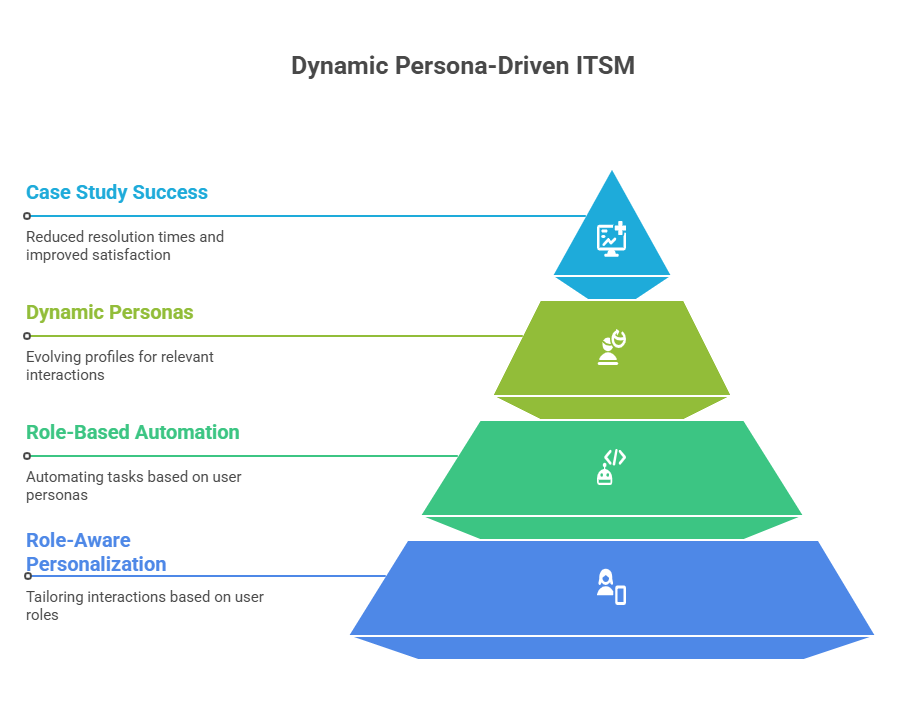
Role-Aware Personalization
Users interact differently with IT support based on their role, skill level, and urgency:
- Developers: Expect API references, scripts, and system logs.
- Non-technical staff: Prefer clear instructions and visual aids.
- Executives: Need concise updates and priority handling.
By assigning personas, the AI tailors not only the content but also the tone, urgency, and automation options for each user type.
Role-Based Automation & Knowledge Delivery
Personas allow ITSM platforms to automate intelligently:
- Auto-filled forms: Reducing repetitive data entry.
- Custom escalation paths: Routing high-impact issues from certain roles directly to Tier 2 or 3.
- Targeted KB access: Giving advanced troubleshooting only to authorized staff.
Dynamic Personas in Action
Unlike static profiles, dynamic personas evolve:
- A new hire starts with “novice” status but can progress to “intermediate” as they solve more issues independently.
- A power user might have permissions expanded automatically after repeated successful resolutions.
This adaptability keeps interactions relevant and efficient.
Persona Case Study
A healthcare provider used persona-driven ITSM to route clinical software issues to specialized Tier 2 teams automatically. This reduced resolution times by 35% and improved staff satisfaction scores by 22% in under a year.
Predictive Nudges: From Anticipation to Self-Healing
Proactive Support Suggestions
Predictive nudges use real-time monitoring and historical patterns to prevent incidents before they happen:
- Offering a VPN reconnect when network instability is detected.
- Warning users of low storage before a system crash.
- Prompting a password reset before an impending expiry.
These nudges work because they combine memory (past issues), persona (user needs), and real-time telemetry (current status).
Self-Healing Automation: Closing the Loop
Self-healing takes predictive nudges to the next level by executing the fix automatically:
- Automated remediation: Restarting a stalled service without waiting for a ticket.
- Configuration rollback: Reverting an unstable patch before it disrupts business.
- Continuous monitoring loops: Identifying and fixing performance anomalies instantly.
By 2027, 25% of IT operations will be self-healing, cutting MTTR by half (Gartner).
Nudge + Self-Healing Workflow Example
- AI detects a critical service running at 95% CPU.
- Predictive nudge asks, “Shall I optimize this process now?”
- If the user approves, or if policy allows automatic action, self-healing scripts run immediately.
- System confirms action taken and documents it for compliance.
Impact of Predictive Nudges & Self-Healing
A financial services firm reported that integrating self-healing into their ITSM reduced their critical downtime incidents by 40% year-over-year, saving millions in potential revenue losses.
Synergy: The Closed-Loop Context Engine
When these elements combine, AI in ITSM becomes a proactive, intelligent ecosystem:
- Memory & Remembrance: Captures historical data and contextual meaning.
- Personas: Shapes how AI communicates and escalates.
- Predictive Nudges: Anticipates user needs and offers solutions.
- Self-Healing: Executes solutions instantly.
- Feedback Loop: Updates memory to refine future accuracy.
This synergy ensures that every interaction, whether AI-driven or human-led, gets smarter over time.

Business Value & ROI
- 60% ticket volume reduction possible with Agentic AI-enabled ITSM (ITSM.Tools).
- 30–50% faster resolutions thanks to predictive nudging and automation.
- Improved user satisfaction through tailored, anticipatory service.
- Better resource allocation with automation handling routine fixes.
- Enhanced compliance via role-based access and action logging.
Challenges & Best Practices
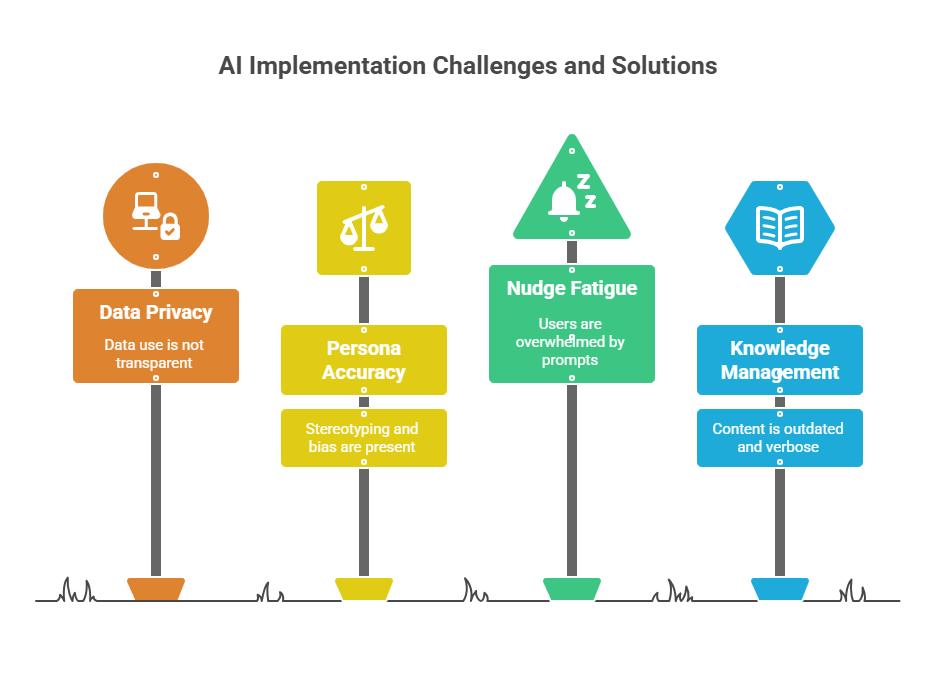
Data Privacy & Governance
- Implement strict retention policies.
- Encrypt stored data.
- Be transparent about what the AI remembers and why.
Persona Accuracy & Bias Prevention
- Build personas from observed behaviors.
- Allow user adjustments to avoid stereotyping.
Nudge Fatigue
- Limit the frequency of prompts.
- Prioritize high-confidence suggestions.
Knowledge Base Management
- Regularly audit KB content.
- Remove or update low-success articles.
- Use AI summarization to keep content concise and up-to-date.
Integration with Existing ITSM Platforms
One of the most common concerns for IT leaders considering Contextual AI is how it will fit into their current ITSM ecosystem. The good news is that modern contextual AI solutions are built for seamless integration, often using APIs, webhooks, and native connectors to embed intelligence into the tools teams already use.
For example, a ServiceNow environment can be enhanced with:
- Memory and Remembrance Layers: Storing interaction history outside the core ticketing system but surfacing it contextually within agent workspaces.
- Persona Tagging: Syncing user profile data from HR systems to automatically tailor support flows.
- Predictive Nudge Triggers: Using system logs, monitoring tools, or endpoint telemetry to anticipate incidents before tickets are created.
- Self-Healing Actions: Automating ServiceNow workflows or orchestrating scripts directly on affected devices.
Jira Service Management or Freshservice users can benefit similarly. The AI layer doesn’t replace these platforms; it augments them, adding proactive intelligence to existing workflows rather than requiring a full rip-and-replace.
This means organizations can adopt Contextual AI incrementally, starting with high-impact use cases (like proactive password resets or recurring VPN fixes) and expanding as they see tangible results.
The Future of Contextual AI in ITSM
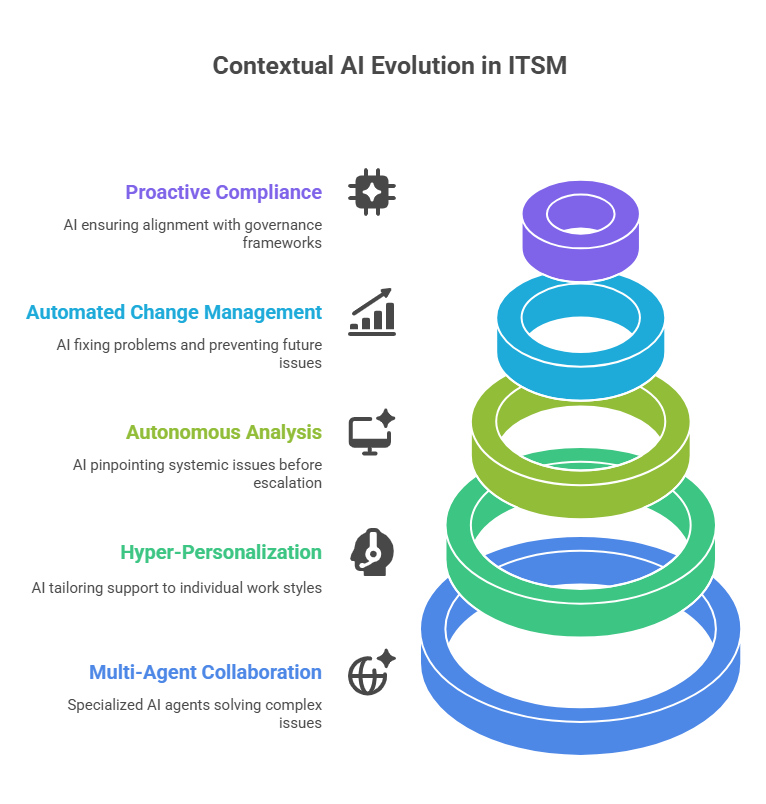
While Contextual AI is already transforming ITSM, its next evolution will be even more transformative, driven by advances in large language models (LLMs), multi-agent AI systems, and real-time contextual reasoning.
In the next three to five years, we can expect:
- Deeper Multi-Agent Collaboration: Specialized AI agents for networking, security, and application support work together to solve multi-layered issues in real time.
- Hyper-Personalized Experiences: AI tailoring support not just by role, but by work style, preferred tools, and even time-of-day productivity patterns.
- Autonomous Root Cause Analysis: Contextual AI using remembrance to connect the dots between incidents and system telemetry, pinpointing systemic issues before they escalate.
- End-to-End Automated Change Management: Self-healing will evolve into self-optimizing systems, where the AI not only fixes problems but makes approved changes to prevent them entirely.
- Proactive Compliance Enforcement: AI ensures that changes and fixes automatically align with governance frameworks like ITIL, HIPAA, or ISO 27001.
This evolution will push AI for ITSM toward a self-regulating, continuously learning system, where human intervention is reserved for only the most complex, novel, or business-critical scenarios. Organizations that start building their contextual AI capabilities today will be best positioned to leverage these advances for competitive advantage.
Closing Note
By uniting memory with remembrance, persona-driven workflows, and predictive nudges enhanced by self-healing, AI for ITSM is redefining ITSM. Rooted in Agentic AI frameworks, it turns IT from a reactive support function into a proactive, adaptive, and user-focused partner in productivity.
The result is not just fewer problems, it’s a smarter, continuously improving ITSM ecosystem that learns from every interaction and keeps the enterprise moving forward.
Sources:
Gartner. Gartner Predicts 25% of IT Operations Will Use Self-Healing by 2027. Gartner, 2023, www.gartner.com/en/newsroom/press-releases/2023-06-15-gartner-predicts-25-percent-of-it-operations-will-use-self-healing-by-2027.
ITSM.Tools. “6 Ways Agentic AI Is Replacing Level 1 ITSM Tasks.” ITSM.Tools, 2 July 2025, itsm.tools/agentic-ai-itsm/.
Key Takeaways
- Memory + remembrance creates personalized, faster ITSM interactions.
- Personas ensure relevance, tone, and priority alignment.
- Predictive nudges + self-healing shift ITSM from reactive to proactive.
- The combination leads to fewer tickets, faster fixes, and happier users.
- AI for ITSM leverages memory, personas, and predictive nudges to transform IT support from reactive to proactive.
FAQs
1. How does remembrance improve AI memory in ITSM?
It adds semantic and contextual layers, enabling AI to understand why an issue occurs and tailor solutions accordingly.
2. Is self-healing AI risky for critical environments?
Not when combined with predictive nudges, confidence thresholds, and comprehensive logging.
3. Can predictive nudges work without personas?
Yes, but personas make them far more relevant and less intrusive.
4. How quickly can organizations see ROI?
Most see measurable improvements in ticket volume and MTTR within 6–12 months of deployment.

.webp)

.png)









.webp)