

.png)
Most enterprises did not choose to become dependent on ServiceNow. They invested in it for good reasons, built workflows around it over years, and then discovered that the cost, complexity, and pace of change had quietly outgrown the value they were getting back. Ripping it out is rarely a real option. The investment is too large, the migration risk is too high, and the workflows are too embedded. The more pragmatic path is to reduce dependency on the parts that drive cost and friction while keeping ServiceNow as the system of record. The outcome enterprises want is lower cost of service, autonomous auto resolution, and reduced operational risk. An AI layer is how that outcome is delivered without a multi-year migration.
This is a modernization question, not a replacement question. The discussion below sets out what over-dependence looks like, what an AI layer adds, and a phased path that protects the existing investment.
The ServiceNow dependency problem is real
Over-dependence shows up in recognizable ways. Routine requests still queue behind human fulfillers despite years of workflow configuration. Every new capability seems to require another module, another administrator, or another statement of work. And the running cost keeps climbing in ways that are hard to forecast.
The cost picture is the part finance leaders feel most acutely. ServiceNow does not publish list pricing, and independent estimates should be read as ranges rather than quotes, but the published research is consistent in direction. Industry analysis suggests ITSM licensing commonly falls in a band of roughly $100 to $200 per fulfiller each month, implementation often costs three to five times the first-year license fee, and AI add-ons can layer a further uplift on the base tier. Total cost of ownership, once administration and customization are included, regularly runs several times the headline license number. None of this is an indictment of the product. It is simply the reality that drives leaders to look for a way to get more outcome without more spend.
Explore our detailed breakdown of ServiceNow pricing, licensing, implementation expenses, and total cost of ownership before evaluating modernization options.
Why not just replace it? Because for most enterprise IT teams, replacement carries the highest risk of any option on the table. The system of record holds incident, problem, change, and configuration data that the business depends on daily. The sensible move is to reduce dependency on the expensive, friction-heavy layers while leaving the system of record in place.
What ServiceNow does well, and where the gap appears
ServiceNow is a capable system of record. It manages the ITIL disciplines of incident, problem, change, request, and configuration with depth, and it gives large organizations structure and governance at scale. Those strengths are real and worth preserving.
The gap is between workflow and intelligence. A workflow engine routes and tracks work. It does not, on its own, understand a request and finish it. Native AI capabilities have advanced, but the autonomous auto resolution of common requests at scale, across the channels employees actually use, is where many organizations find they want more than the base configuration provides. This is the workflow-versus-intelligence distinction, and it is exactly the space an AI layer fills.
Looking for a deeper comparison of modern AI-powered service desks? Explore our guide to ServiceNow alternatives and discover how organizations are modernizing IT support without disruptive migrations.
The AI layer approach: adding intelligence without migration
An AI layer sits on top of ServiceNow and adds an agentic front line for employee support. Employees ask for help in Microsoft Teams or Slack, an AI agent interprets the request, acts on connected systems through workflows and automations, and auto resolves it. ServiceNow remains the system of record behind the scenes, capturing the ticket, the action, and the audit trail.
Looking to extend AI beyond ticket automation? Explore Rezolve.ai VoiceIQ, and Rezolve.ai Agentic Studio to deliver intelligent search, voice support, and enterprise AI agents across the employee journey.
The practical question leaders ask is what stays where. Routine, repeatable requests are auto resolved at the AI layer before they ever consume a fulfiller's time. Complex, judgement-heavy, or sensitive work is routed into ServiceNow for a human to handle, with full context attached. The system of record keeps its job. The AI layer takes on the volume.
This short explainer from Rezolve.ai CRO and cofounder Manish Sharma walks through how Rezolve.ai is added to the stack without ripping out ServiceNow, Watch Now!
Rezolve.ai connects to ServiceNow through a deep, ready-to-go integration that supports bidirectional ticket management, knowledge access, and configuration data, as described on its integrations page. The architecture is agentic in nature and is built as feature-packed, modern AITSM that complements an existing system of record rather than competing with it.
Four ways to reduce ServiceNow dependency with an AI layer
The four moves below are ordered to deliver cost relief first, autonomous outcomes second, and risk reduction throughout.

First, auto resolve tier-0 and tier-1 requests before they reach ServiceNow workflows, which removes the highest-volume, lowest-value work from the human queue and from the metered parts of the stack. Second, provide a capable agentic front line in the channels employees already use, so support happens in Teams and Slack rather than through a separate portal. Third, surface knowledge through AI so employees get accurate answers without navigating module complexity, which reduces both ticket volume and time to answer. Fourth, drive approval and fulfilment steps through automations triggered by the AI agent, so routine processes complete without manual handoffs.
Curious how Rezolve.ai compares directly with ServiceNow? See a feature-by-feature breakdown of where each platform fits within a modern ITSM strategy. Compare Rezolve.ai VS Servicenow
The modernization path: a phased approach
A modernization program works best in deliberate phases, each with a clear outcome and a defined stakeholder group. The stakeholders most often overlooked, and the ones whose early involvement most reliably predicts success, are InfoSec, the CTO, the CIO, the fulfillers who will work alongside the agents, and the end users whose experience defines whether the program is judged a success.
Phase one is a proof of value. The organization selects two or three high-volume request types, measures the current cost and MTTR for those types inside ServiceNow, and runs the AI layer alongside the existing setup to establish a like-for-like comparison. This phase is about evidence, not scale, and it gives the steering group a defensible number to act on.
Phase two is expansion. With the proof of value validated, coverage widens to additional request categories and additional channels. Fulfillers begin to feel the change as repeatable work leaves their queue, and the program starts to show up in cost-per-ticket reporting. This is also the phase where InfoSec and the CIO confirm that governance and audit hold up under real volume.
Phase three is AI-first service delivery. The AI layer becomes the front line for common requests across IT, HR, and FinOps, while ServiceNow settles into its role as the back-end system of record. Dependency on the expensive, friction-heavy layers falls, the system of record investment is preserved, and the organization has modernized without a disruptive migration.
How Rezolve.ai works as a ServiceNow AI layer
Rezolve.ai is designed to extend an existing ServiceNow investment rather than displace it. Its pre-built ServiceNow integration handles tickets, knowledge, and configuration data bidirectionally, so the agentic front line and the system of record stay in sync.
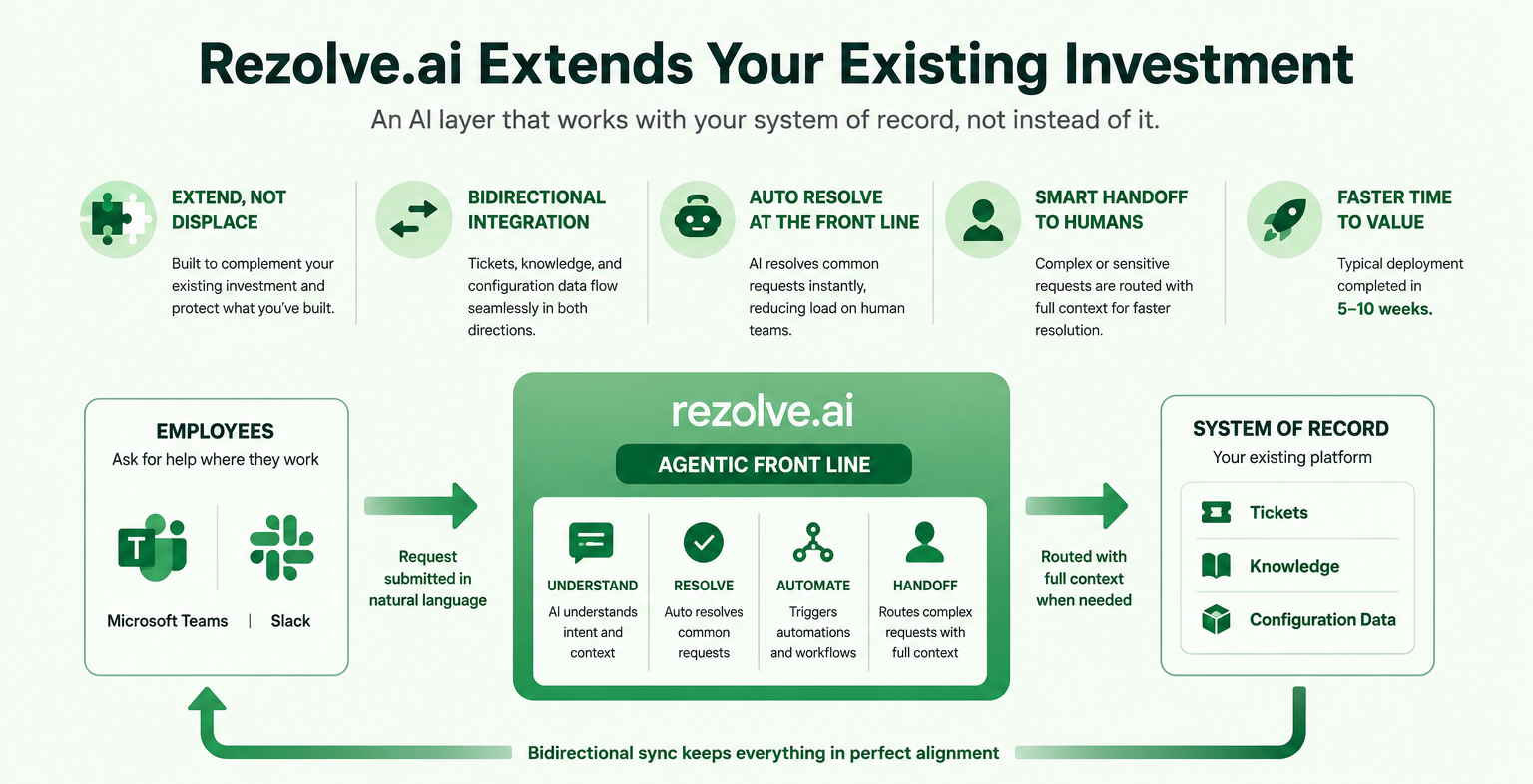
Rezolve.ai auto resolves common requests at the front line and routes everything that needs a human into ServiceNow with context intact. A typical deployment runs in a 5 to 10 week window, which is what makes the modernization path realistic rather than aspirational. The broader approach is set out in Rezolve.ai's overview of governed agentic ITSM and its primer on agentic AI in ITSM.
Expert Insight
"The framing that traps most teams is replace or do nothing. There is a third path. Keep the system of record, reduce dependency on the layers that drive cost and friction, and add intelligence on top. The goal is a lower cost of service and autonomous auto resolution with less operational risk, achieved in weeks rather than a migration measured in years."
Manish Sharma, Chief Revenue Officer, Rezolve.ai
The business case: a buyer's view of the evaluation
For leaders building the internal case, it helps to map the buying cycle explicitly, because a modernization decision touches more functions than a typical tool purchase. The cycle for this kind of program commonly runs a 90 to 180 day cycle.
Confirming legal and commercial viability and reviewing pricing before a proof of value, rather than after, keeps the evaluation efficient and avoids late surprises. Checking the vendor roadmap protects against a short-term fix that becomes a long-term constraint.
Modernize without the migration. See how Rezolve.ai adds an agentic AI layer on top of ServiceNow to auto resolve common requests while preserving the system of record. Book a discovery call to model the cost and risk reduction for your environment.


FAQs
What does ServiceNow do?
ServiceNow is an enterprise system of record for IT service management and adjacent functions, managing incident, problem, change, request, and configuration data at scale.
Can you add AI on top of ServiceNow?
Yes. An AI layer such as Rezolve.ai integrates with ServiceNow to auto resolve common requests at the front line while ServiceNow remains the system of record.
What is a ServiceNow option that does not require migration?
Adding an agentic AI layer reduces dependency on the high-cost, high-friction layers without replacing the system of record, which avoids the risk and cost of a full migration.
How do you reduce IT helpdesk costs without replacing ServiceNow?
Auto resolve tier-0 and tier-1 requests at an AI front line, surface knowledge through AI, and trigger routine fulfilment through automations, so fewer requests reach the expensive parts of the stack.
What is ServiceNow used for?
It is used to structure, route, track, and govern IT and enterprise service work, holding the authoritative record of that work for large organizations.


.webp)

.png)











.webp)