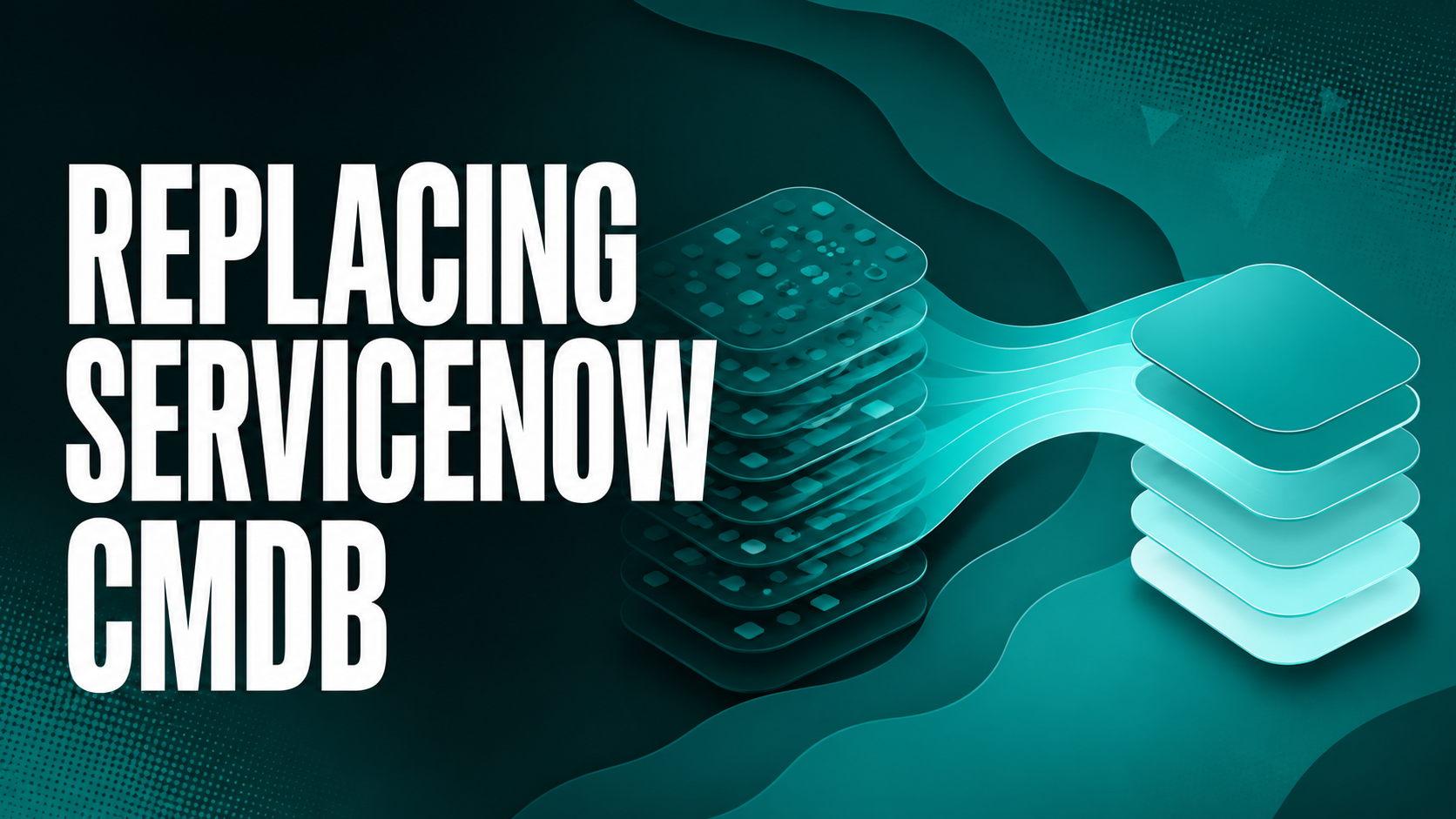
Replacing ServiceNow CMDB: How IT Ops Teams Modernize Configuration Data
The CMDB is usually the reason a ServiceNow migration stalls: not because the data is hard to move, but because nobody is certain which parts of it are true. A sequence that works, and the honest case for staying.

Key takeaways
- Migrate the reconciliation design first; the data is the easy part
- Never migrate CIs you cannot re-derive from a live source: port discovery, not history
- Run both CMDBs in parallel against the same discovery feed and compare, rather than cutting over on a date
- If the CMDB is genuinely load-bearing for regulated change control, staying is often the right answer
In most ServiceNow migrations, the CMDB is where the programme slows down.
Incidents and changes are relatively easy to move. They are records with a lifecycle, and most of their value is historical. The CMDB is different, because it is load-bearing right now. Change approval consults it. Impact analysis depends on it. Audit evidence is drawn from it. You cannot move it in a maintenance window and hope.
The deeper problem is rarely technical. It is that almost nobody can say with confidence which parts of their CMDB are accurate. Migration forces that question into the open, which is uncomfortable and, in the end, the most valuable part of the exercise.
Start by not migrating most of it
The instinct is to plan a full extract. Resist it. You will spend months moving records that were wrong in the source and will be wrong, with more provenance, in the destination.
Sort every CI class into three piles:
Re-derivable. Anything a discovery tool can rebuild from the live estate: servers, endpoints, cloud resources, network devices, installed software. Do not migrate these. Point discovery at the estate and let the new CMDB build them fresh. The result is accurate by construction and you have skipped the hardest data-quality argument entirely.
Human-authored and irreplaceable. Business service definitions, ownership assignments, criticality ratings, support group mappings, the manually curated relationships that encode real institutional knowledge. This is the genuinely valuable content and it is usually a small fraction of the row count. Migrate it deliberately, with review.
Historical. Decommissioned CIs, superseded relationships, audit trail. Do not migrate. Archive the ServiceNow instance in read-only form and keep it for as long as your retention policy requires. Trying to carry history into a new graph corrupts the new graph's meaning.
The typical outcome surprises people: the pile that must actually be migrated is often under 10% of the CI count and nearly all of the CMDB's real value.
Migrate the reconciliation design before the data
Your ServiceNow CMDB embodies years of accumulated decisions about which source wins for which attribute, how identification rules match a discovered device to an existing CI, and which discrepancies are tolerated. Much of that lives in the Identification and Reconciliation Engine and in rules nobody has read since the person who wrote them left.
That logic is the actual asset. Extract it and write it down as a specification (in plain language, per attribute), before choosing a destination.
Two things fall out of that exercise, both useful:
You will find rules that no longer make sense: precedence favouring a source that was decommissioned in 2022, identification rules with exceptions for a datacentre that no longer exists.
You will find the requirements that should drive product selection. If your reconciliation genuinely needs attribute-level precedence across six sources, that eliminates several candidates immediately, and it is much cheaper to learn that now than in month four.
Run parallel against the same feed
Do not plan a cutover date. Plan an overlap.
Point discovery at both CMDBs simultaneously and let them build independently from the same feed. Then compare, continuously, and treat every disagreement as an investigation rather than a defect in the new system.
Disagreements resolve into three categories, and all three are worth knowing:
- The new system is right and ServiceNow was stale, the most common result, and the one that builds confidence to proceed
- ServiceNow is right and the new system's discovery has a gap (a real finding, fix before proceeding
- Both are wrong), the most valuable finding, and the one you would never have surfaced without the comparison
Run this long enough to cover a full change cycle and at least one month-end. Cut over when the disagreement rate is boring, not when the calendar says so.
Sequence the consumers
The CMDB is not consumed in one place, and the consumers have very different risk profiles. Move them in order of reversibility:
- Reporting and dashboards: wrong output, no operational consequence. Move first.
- Impact analysis for incidents, advisory to a human who will sanity-check it.
- Change approval, now it is load-bearing. Only after the disagreement rate is genuinely low.
- Automated and agentic action: last, always.
That last one deserves emphasis. An agent that provisions, patches or decommissions based on configuration data has no intuition about whether a record looks wrong. A human approver often catches a stale CI because they remember the box was retired last spring. Software does not, and proceeds. Do not connect autonomous action to a CMDB whose accuracy you are still establishing.
What modernizing actually buys you
Assuming the migration is done well, the gains are specific rather than generic:
Discovery that reaches further, multi-cloud, containers, network and OT estate that scan-based enterprise discovery has historically covered unevenly.
Reconciliation you can read. If the rules are expressed in something a service owner can review, the CMDB stops being a black box that only two people understand.
Maintenance that is automatable. Chasing unowned CIs, resolving source conflicts, flagging implausible relationships and drafting the follow-up is high-volume, rule-adjacent judgment work: exactly what agentic automation is good at, and exactly what has always been too expensive to staff.
Cost that scales differently. Enterprise CMDB licensing and the specialist configuration skills around it are a large, permanent line item. That is often the trigger for the review in the first place, and it is a legitimate reason.
The honest case for staying
Three situations where migrating is the wrong call:
Your CMDB is genuinely load-bearing for regulated change control, and it works. The risk-adjusted return on replacing a functioning control that auditors already accept is frequently negative.
The CMDB is deeply woven into custom ServiceNow workflows. If the CMDB is the substrate for hundreds of scoped applications, you are not migrating a CMDB, you are migrating a platform. Price that honestly.
Nobody owns configuration data today. Migration will not fix that, and a new CMDB with no owner decays exactly as fast as the old one did. You will simply have paid to restart the clock.
If the reason for leaving is cost or capability, migration is a reasonable answer. If the reason is that the CMDB is untrustworthy, fix ownership and reconciliation first. Otherwise you will rebuild the same problem on a different platform and learn the same lesson two years later.
Related: CMDB architecture and scalability, CMDB tools compared, and moving beyond ServiceNow without losing governance.
Last updated on August 27, 2026
Get summary with:
See the agentic service desk in action
Watch Rezolve.ai autonomously resolve real IT and HR tickets: governed, auditable, glass-box.
Frequently asked questions
Should you migrate CMDB data when leaving ServiceNow?
Migrate as little as possible. Anything a discovery tool can rebuild from the live estate (servers, endpoints, cloud resources, network devices), should be re-derived rather than moved, which makes it accurate by construction. Migrate only human-authored content such as service definitions, ownership and criticality, and archive history in a read-only instance.
How long should you run two CMDBs in parallel?
Long enough to cover a full change cycle and at least one month-end, and until the rate of disagreement between the two is boring. Cut over on the disagreement rate, not on a calendar date.
When is replacing ServiceNow CMDB the wrong decision?
When it is load-bearing for regulated change control and working, when it underpins hundreds of custom scoped applications so you are really migrating a platform, or when nobody owns configuration data today, in that last case a new CMDB decays exactly as fast as the old one.