.png)
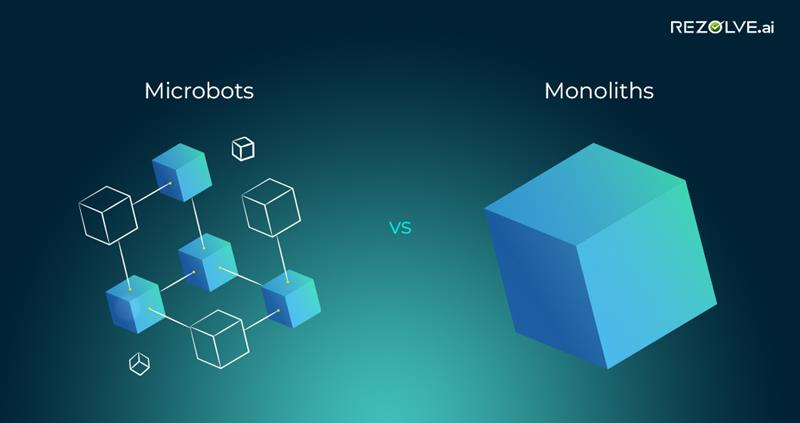
As enterprise IT and HR helpdesks evolve, artificial intelligence has shifted from simple ticket deflection tools to dynamic, autonomous agents capable of resolving complex issues. But one challenge remains at the forefront: scale. Should organizations invest in microbots, lightweight, narrowly focused AI agents, or monoliths, large, multifunctional AI platforms that handle a wide range of tasks?
This debate goes to the heart of helpdesk performance. Right-sizing AI agents is no longer a purely technical decision; it’s a matter of efficiency, cost, employee satisfaction, and long-term scalability.
- Microbots specialize in solving one or two issues with precision. They’re fast, modular, and easily replaceable.
- Monoliths act as all-in-one platforms, offering broad coverage but risking complexity and rigidity.
- The best-performing helpdesks blend both—deploying microbots for agility while leveraging monoliths for enterprise-wide governance and integration.
The Evolution of Helpdesk AI
Traditional chatbots once dominated IT and HR service desks. Their primary function was ticket deflection, answering FAQs, or routing employees to the correct support tier. But as GenAI, retrieval-augmented generation (RAG), and agentic AI frameworks matured, the helpdesk gained the ability to:
- Automate complex workflows (e.g., password resets, software provisioning).
- Predict and resolve incidents proactively.
- Integrate with enterprise apps like Microsoft Teams, Slack, or ServiceNow.
- Deliver personalized support using memory, context, and personas.
This progression represents more than just a technological upgrade; it marks a philosophical shift in how organizations view employee support. What was once reactive and transactional is now dynamic, context-aware, and strategic. The helpdesk has evolved into a critical productivity layer, where AI agents act less like tools and more like digital coworkers.
Yet, this evolution also forces a pivotal decision: do you pursue microbot-driven modularity, with specialized agents tackling discrete tasks, or invest in monolithic platforms capable of handling end-to-end employee journeys? Each path carries trade-offs in scalability, governance, and agility, making the choice central to future helpdesk strategy.
Microbots: The Case for Specialization
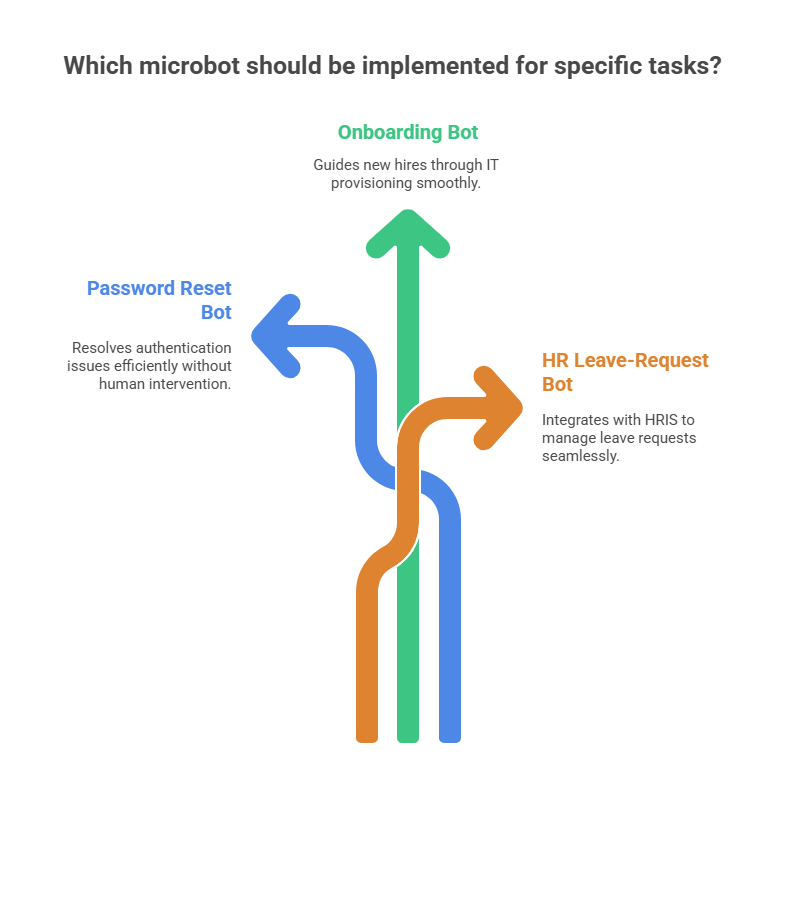
Microbots are small, purpose-built agents designed to handle specific tasks. For example:
- A password reset bot that resolves authentication issues without human intervention.
- An onboarding bot that guides new hires through IT provisioning.
- An HR leave-request bot that integrates with the HRIS.
Advantages of Microbots
- Agility and Modularity
- Quick to deploy and replace.
- Teams can experiment with low risk.
- Precision at Scale
- Each microbot is trained for one function, boosting accuracy.
- Lower error rates than generalized systems.
- Lower Costs for Niche Use Cases
- No need for enterprise-wide deployment.
- Budget-friendly for small to mid-sized organizations.
Limitations of Microbots
- Siloed Functionality: Employees may interact with multiple bots, leading to fragmented experiences.
- Integration Challenges: Without orchestration, microbots risk creating data silos.
- Scaling Limits: Managing dozens of bots becomes burdensome as enterprises grow.
Monoliths: The Case for Consolidation

Monoliths are enterprise-grade AI platforms that unify multiple functions into a single agent. Think of them as the “all-in-one” AI helpdesk solution.
Advantages of Monoliths
- Unified Experience
- One interface for employees, no matter the issue.
- Consistent branding and tone across IT and HR support.
- Enterprise Governance
- Built-in compliance, audit trails, and ITIL alignment.
- Easier to enforce data security and privacy policies.
- Cross-Functional Intelligence
- Monoliths leverage broad datasets, improving predictive accuracy.
- Capable of handling complex, multi-step workflows.
Limitations of Monoliths
- Slower Deployment: Monolith rollouts require significant upfront investment.
- Vendor Lock-In: Limited flexibility if the platform underdelivers.
- Risk of Bloat: Trying to “do everything” may reduce speed and accuracy.
The Hybrid Model: Best of Both Worlds
Enterprises don’t need to choose strictly between microbots and monoliths. A hybrid approach often delivers the strongest results:
- Microbots for agility: Ideal for fast-moving teams or niche use cases.
- Monolith for governance: Provides the backbone of enterprise compliance, integration, and security.
For instance, an IT department could deploy a monolithic AITSM platform for incident management while layering microbots for high-demand tasks like printer fixes or VPN troubleshooting.
Why Right-Sizing Matters for Performance?
Choosing the wrong model leads to real costs:
- Too many microbots lead to fragmented employee experiences and higher maintenance.
- Too much reliance on monoliths leads to slow innovation and expensive vendor contracts.
Right-sizing AI agents allows enterprises to:
- Optimize Mean Time to Resolution (MTTR).
- Improve Employee Effort Score (EES) by reducing friction.
- Maximize ROI through balanced investment in agility and governance.
Beyond technical performance, right-sizing also impacts organizational trust and scalability. A carefully balanced ecosystem prevents “AI fatigue” by ensuring employees aren’t bouncing between disjointed bots while avoiding vendor lock-in from oversized platforms. It creates an adaptive foundation where microbots can flexibly scale new workflows, while monolithic intelligence anchors governance, compliance, and reliability.
This synergy ensures IT leaders don’t just deploy AI, they orchestrate it for measurable, sustainable performance.
Future of Helpdesk AI: From Static to Agentic
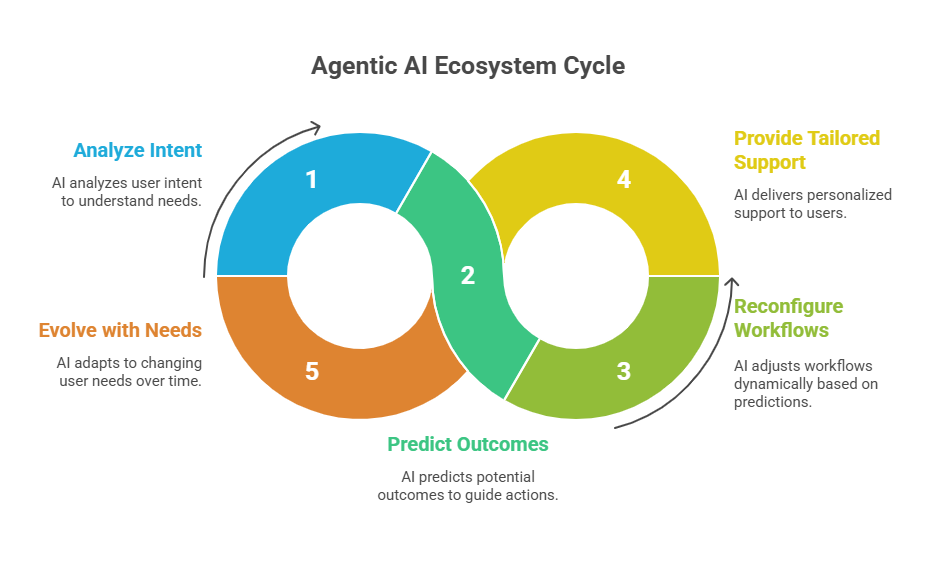
The next wave of AITSM will combine microbots and monoliths into agentic ecosystems. These systems will:
- Self-orchestrate microbots: Allowing small bots to collaborate seamlessly.
- Scale monolithic intelligence: Feeding contextual knowledge back into micro-agents.
- Adapt dynamically: Choosing the “right-sized” agent for each problem in real time.
What makes this evolution powerful is the shift from static, preprogrammed workflows to adaptive decision-making loops. Instead of merely executing tasks, agentic AI can analyze intent, predict likely outcomes, and reconfigure workflows on the fly, bridging efficiency with personalization. As organizations move toward this model, the helpdesk transforms from a reactive service function into a proactive, experience-driven ecosystem, where employees receive tailored, context-rich support that evolves with their needs. Enterprises adopting agent-based AI in ITSM will redefine helpdesk performance from ticket resolution to holistic employee experience.
Challenges in Measuring KPIs for Microbots vs. Monoliths
When it comes to AITSM metrics, the way you track performance often depends on whether your organization leans toward microbot-driven support or a monolithic AI agent. Each model creates its blind spots:
- Microbots: Because microbots are lightweight and task-specific, they generate lots of small, distributed data points. This can make it harder to capture holistic KPIs such as end-to-end resolution time or employee effort score. Leaders often underestimate the number of micro-interactions required to resolve a single case.
- Monoliths: Monolithic AI agents tend to centralize performance data, but they can mask inefficiencies in handoffs or over-promise on automation success rates. For example, a monolith may resolve an issue technically but force users through longer conversations, inflating “success” metrics.
- Hybrid Ecosystems: Many enterprises now run a mix of both. This creates duplication risks (e.g., both a microbot and a monolith attempt the exact password reset) and makes attribution tricky. Which agent should get “credit” for the resolution?
- SLA vs. Experience Metrics: Microbots often excel in speed but miss the human sentiment side, while monoliths may optimize for context but fall short on agility. Tracking the wrong KPI for the wrong model skews results.
The challenge isn’t just choosing KPIs but right-sizing them to the architecture. A microbot ecosystem needs lightweight, real-time metrics (like interaction effort and escalation efficiency), while monoliths need deeper contextual KPIs (like predictive accuracy and sentiment scoring).
How to Measure AI Agent Effectiveness in Practice?
To operationalize AI in the helpdesk:
- Integrate Analytics into AI Tools: Choose platforms that embed real-time dashboards.
- Correlate AI KPIs with Business Outcomes: Example—link predictive incident accuracy to employee uptime.
- Blend Quantitative + Qualitative Metrics: Pair hard numbers with sentiment analysis from employee surveys.
- Benchmark Over Time: Continuously compare AI resolution and escalation metrics to track maturity.
Common Mistakes to Avoid
Even forward-looking enterprises fall into traps when adopting microbots or monoliths:
- Chasing Vanity Metrics: Counting ticket volumes without assessing the quality of resolution.
- Ignoring Context: AI must respect role-based permissions and compliance.
- Over-Automation: Bots that refuse to escalate damage trust.
- Failure to Communicate Success: Without framing metrics in terms of downtime saved or hours recovered, leadership undervalues AI.
The Role of Leadership in Right-Sizing AI Agents
IT and HR leaders must balance innovation with responsibility. Their responsibilities include:
- Defining clear AI governance policies.
- Ensuring AI strategies align with ITIL and compliance standards.
- Communicating AI wins in terms of employee experience and business impact.
- Establishing cross-functional steering committees to help prevent the siloed adoption of microbots.
But leadership goes beyond governance. Right-sizing AI agents requires strategic vision and cultural stewardship. Leaders must set expectations for how AI augments, not replaces, human expertise. This includes promoting transparency in AI decision-making, ensuring that escalation paths are seamless, and creating feedback loops where employees feel heard when automation falls short. Strong leaders also advocate for continuous learning and retraining agents as business needs evolve instead of treating AI as a “set-and-forget” investment. By prioritizing accountability, inclusivity, and measurable outcomes, leadership ensures AI adoption enhances, not complicates, helpdesk performance and builds long-term trust across the workforce.
Conclusion
The future of helpdesk performance doesn’t lie in choosing between microbots and monoliths. Instead, it depends on right-sizing AI agents to balance agility, governance, and scalability. Microbots bring precision, monoliths bring structure, and together they create resilient, adaptive ecosystems.
Organizations that master this balance won’t just reduce tickets; they’ll transform their helpdesk into a strategic enabler of employee productivity and satisfaction.

Key Takeaways
- Microbots excel at agility and precision, but can create silos if unmanaged.
- Monoliths offer governance and scalability but risk being slow and rigid.
- A hybrid approach delivers the best helpdesk performance.
- Measuring underlooked KPIs, such as AI escalation efficiency and employee effort score, ensures real business value.
- Leadership plays a critical role in aligning AI adoption with compliance and employee experience.
FAQs
1. Are microbots or monoliths more cost-effective?
Microbots are cheaper for niche use cases, while monoliths offer better long-term ROI for large enterprises.
2. How do microbots and monoliths impact employee satisfaction?
Microbots improve speed but can fragment experiences. Monoliths improve consistency but may feel rigid. A hybrid balances both.
3. What KPIs should we track to measure helpdesk AI performance?
Automation success rate, predictive incident accuracy, employee effort score, and escalation efficiency are among the most important.
4. Can enterprises switch from microbots to monoliths easily?
It depends on vendor flexibility. Modular adoption strategies are often recommended to avoid vendor lock-in.


.webp)

.png)









.webp)