

Enterprise service management in 2026 is defined by three forces: conversational interaction, intelligent orchestration, and seamless integration. Organizations are no longer satisfied with adding chatbots to legacy ticketing systems. They expect AI to function as an operational layer that spans channels, systems, and workflows.
Rezolve.ai’s enhanced capabilities in 2026 reflect this shift. With advanced multimodal AI, a powerful integration fabric in MCP Hub, and the evolution of Agentic Studio, the platform moves beyond automation into true enterprise orchestration.
This is not a feature expansion. It is a structural transformation of how service delivery operates.
Let’s explore more on this!
Multimodal AI: One Intelligence, Multiple Channels
Employees do not engage with enterprise systems through a single channel. They use chat, voice, email, collaboration platforms, and sometimes traditional ticket portals. Historically, each channel required separate handling, separate routing logic, and often separate teams.
Rezolve.ai unifies these interactions under a single intelligence layer.
The result is multimodal AI that operates consistently across:
- Virtual agent interactions in Microsoft Teams
- Rezolve VoiceIQ for voice and telephony
- Email-based service requests
- Rezolve SearchIQ for self-service knowledge support
Instead of fragmenting support, Rezolve.ai centralizes understanding and execution.
Virtual Agent in Microsoft Teams
The virtual agent inside Microsoft Teams remains the core interaction layer for many enterprises.
In 2026, this agent is no longer limited to answering scripted queries. It understands intent contextually, retrieves data across enterprise systems, and initiates complex workflows.
Employees can:
- Request software access
- Ask about policy clarifications
- Initiate onboarding processes
- Check ticket status
- Report technical issues
- Trigger cross-department approvals
All within the Teams interface they already use daily.
The key enhancement in 2026 is deeper contextual memory and cross-interaction continuity. If a user begins a request in chat and later escalates it to voice, the system retains context seamlessly.
The virtual agent does not behave like a bot. It operates as an intelligent service gateway embedded in the digital workplace.
Rezolve VoiceIQ: Voice and Telephony Reimagined
Voice remains critical in enterprise support. Many service desks still rely on telephony channels for urgent or complex issues.
Rezolve VoiceIQ extends the AI-first philosophy into voice interactions.
Unlike traditional IVR trees that force users through rigid menu options, Rezolve VoiceIQ uses natural language understanding to interpret spoken requests. Callers explain their issue in their own words. The system:
- Authenticates the caller
- Understands spoken intent
- Retrieves contextual enterprise data
- Executes relevant workflows
- Creates and routes tickets if necessary
- Attaches full transcripts to cases automatically
For example, a password reset can be resolved during the call without agent intervention. A hardware escalation can be logged with contextual device data pre-attached. A ticket status inquiry can be answered instantly.
For human agents, Rezolve VoiceIQ provides real-time transcription and AI-suggested responses.
Voice becomes an intelligent channel, not a legacy constraint.
Email as an Intelligent Entry Point
Email remains one of the most widely used communication channels in enterprises. Traditionally, email-based support required manual triage. Messages were read, categorized, forwarded, and then turned into tickets.
In 2026, Rezolve.ai transforms email into an intelligent intake layer.
When an employee sends a request via email:
- The AI analyzes intent and urgency
- Extracts structured information automatically
- Maps content to workflows
- Triggers automation where possible
- Creates enriched tickets if needed
- Responds with contextual updates
Email conversations remain conversational but are backed by agentic reasoning.
The advantage of multimodal AI is that the intelligence layer is unified. A request initiated via email can continue in Teams or escalate to Rezolve VoiceIQ without losing context.
The channel becomes irrelevant. The intelligence remains consistent.
Why Multimodal Matters?
In 2026, employee expectations are shaped by consumer technology. They expect flexibility in how they communicate. Organizations cannot dictate a single channel. They must support all of them intelligently.
Rezolve.ai’s multimodal architecture ensures:
- Unified case context across channels
- Consistent automation logic
- Reduced duplication
- Seamless transitions between chat, voice, and email
This eliminates channel silos and creates a cohesive service experience.
MCP Hub: Integration Without Fragility
Modern enterprises operate across dozens of systems. ERP, HRIS, CRM, identity management, telephony, cloud infrastructure, collaboration platforms. Integrating these systems traditionally required complex connectors and brittle workflows.
MCP Hub addresses this challenge with a structured integration fabric.
In 2026, MCP Hub consists of three core components:
- MCP Connections
- Agent-to-Agent communication
- API integrations
Together, these enable scalable, context-aware integration across the enterprise ecosystem.
MCP Connections
MCP Connections provide standardized pathways for contextual data exchange.
Unlike traditional APIs that simply transmit data fields, MCP Connections preserve operational context. User roles, request history, workflow state, and system metadata travel together.
This allows Rezolve.ai to make informed decisions rather than isolated API calls.
For example, when initiating a software access workflow, MCP Connections ensure the system understands:
- The requester’s role
- Prior approvals
- Security policies
- License availability
- Organizational hierarchy
This context-aware integration reduces configuration overhead and improves automation accuracy.
Agent-to-Agent Communication
Agent-to-Agent, or A2A, communication enables Rezolve.ai’s AI agents to collaborate with other intelligent systems.
Instead of only calling APIs, agents can:
- Exchange structured reasoning outputs
- Request decision support from other AI services
- Coordinate multi-step workflows across platforms
- Maintain synchronized context
This is particularly valuable in environments where different departments deploy AI systems independently.
A procurement agent can collaborate with a finance AI agent, or an HR automation can coordinate with an identity management agent. A2A transforms integrations from data exchange into intelligent collaboration.
API Integrations
While MCP and A2A enable advanced orchestration, traditional API integrations remain foundational.
Rezolve.ai supports secure API connections to:
- ITSM platforms
- Identity providers
- ERP systems
- CRM applications
- Telephony solutions
- Custom enterprise software
The difference in 2026 is not whether APIs exist. It is how they are orchestrated through an intelligent decision layer.
APIs execute actions. Agentic AI determines when and why to execute them. MCP Hub ensures integrations are scalable, resilient, and future-ready.
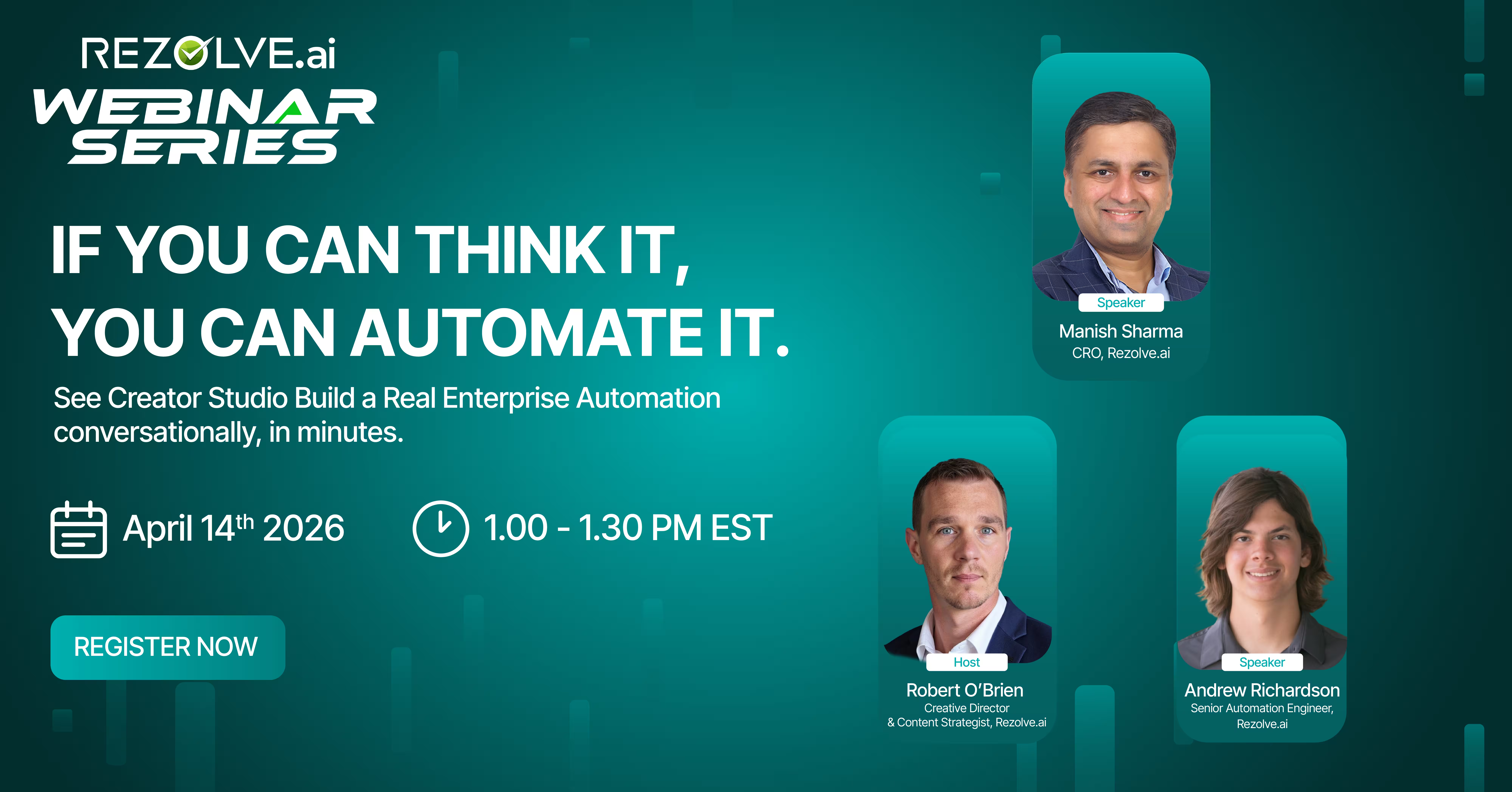
Agentic Studio: If You Can Think It, You Can Automate It
Perhaps the most transformative enhancement in 2026 is the evolution of Agentic Studio.
Traditional automation builders require visual workflow editors, conditional logic blocks, and explicit rule definitions. They are powerful but require structured planning and technical fluency.
Agentic Studio redefines this model.
Organizations can create agentic AI automations simply by describing processes conversationally to an AI agent. If you can articulate the workflow, you can automate it.
For example:
An administrator explains:
“When a remote employee changes locations, validate their eligibility, update payroll tax records, notify facilities, adjust access permissions, and inform their manager.”
Agentic Studio translates that description into:
- Intent recognition logic
- Context validation steps
- Cross-system integrations
- Conditional approvals
- Notification workflows
- Audit logging
The AI agent assists in refining edge cases, clarifying triggers, and optimizing execution paths.
Automation design becomes conversational.
Dynamic Reasoning and Adaptive Workflows
Agentic Studio does not generate static scripts. It builds adaptive workflows that reason through context.
Instead of rigid if-then rules, agentic automations can:
- Detect missing information and request clarification
- Adjust pathways based on real-time data
- Coordinate across multiple systems simultaneously
- Learn from interaction patterns
This dramatically reduces the time required to deploy complex automations. It also reduces dependency on highly specialized workflow engineers. Business users can collaborate directly with AI to design processes.
Governance and Control
Despite its conversational simplicity, Agentic Studio operates within structured governance frameworks.
Administrators retain control over:
- Role-based automation permissions
- System integration boundaries
- Approval policies
- Audit trails
- Compliance logging
Automation does not bypass governance. It accelerates compliant execution. This balance is essential for enterprise adoption.
Convergence of Multimodal, Integration, and Automation
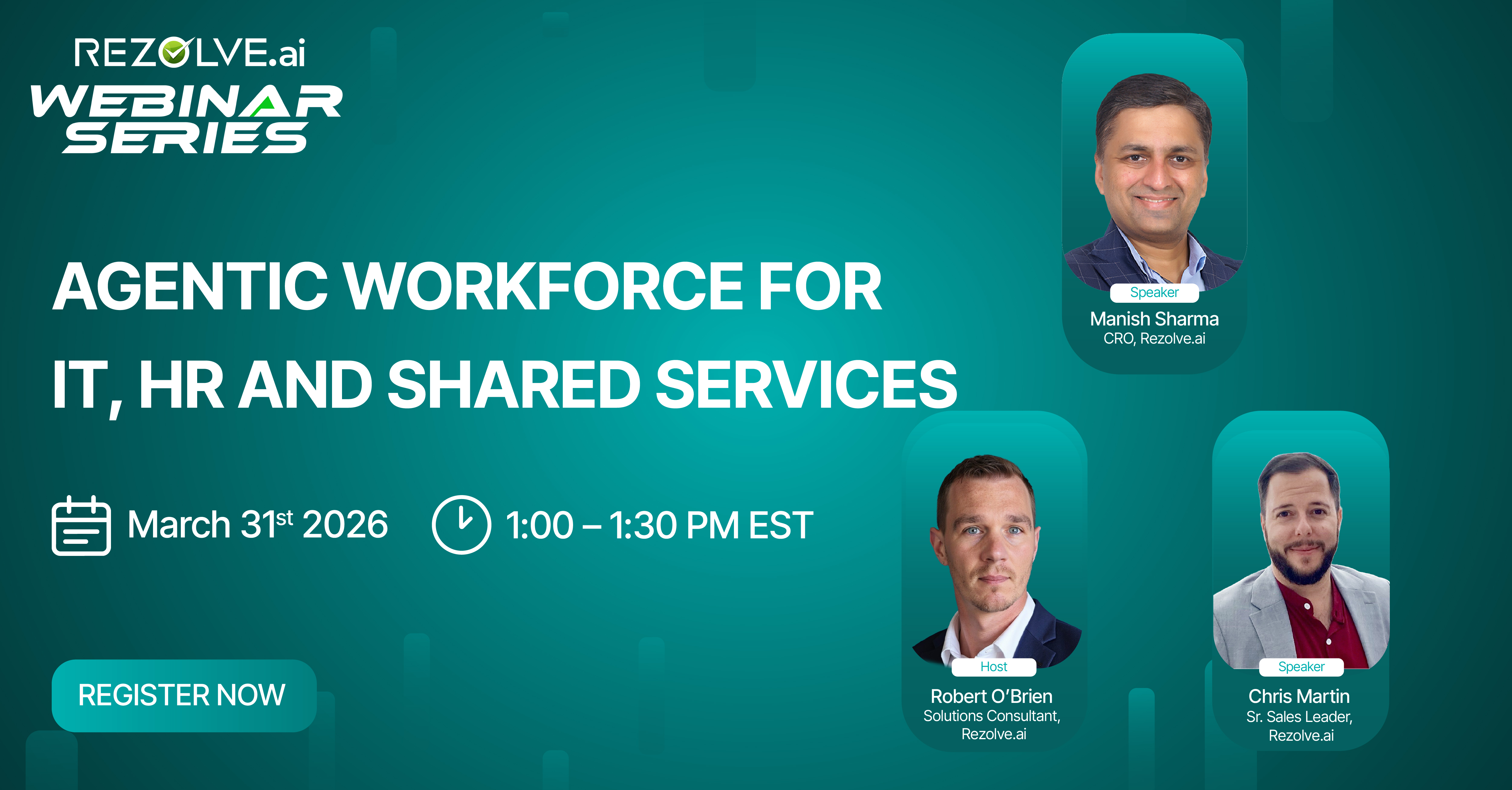
The true power of Rezolve.ai’s 2026 enhancements lies in convergence. Multimodal AI ensures consistent interaction across Teams, Rezolve VoiceIQ, and email.
MCP Hub ensures these interactions can trigger intelligent, context-aware integration across enterprise systems.
Agentic Studio ensures organizations can continuously create and refine new automations without traditional development cycles.
Together, these capabilities enable:
- Frictionless employee interactions
- Faster cross-department workflows
- Reduced ticket volumes
- Lower operational costs
- Scalable automation coverage
This convergence transforms the service desk into a distributed orchestration platform.
Strategic Impact for Enterprises
In 2026, digital transformation is measured not by tool adoption but by operational simplicity.
Rezolve.ai’s enhanced capabilities deliver simplicity through intelligence.
Employees experience:
- Faster resolution
- Flexible communication channels
- Reduced administrative friction
- Context-aware support
IT and operations teams experience:
- Lower manual workload
- Faster automation deployment
- More resilient integrations
- Enhanced visibility into service performance
Leadership experiences:
- Improved cost efficiency
- Better employee experience metrics
- Scalable automation infrastructure
- Future-ready integration architecture
Closing Note
Rezolve.ai in 2026 is defined by three pillars:
- Multimodal AI that unifies Microsoft Teams, Rezolve VoiceIQ, and emails into a single intelligence layer.
- MCP Hub that enables structured MCP Connections, Agent-to-Agent collaboration, and scalable API integrations.
- Agentic Studio transforms automation from a configuration task into a conversational design experience.
Together, these capabilities move AI ITSM from enhancement to transformation.
Service management becomes conversational, integration becomes intelligent, and automation becomes accessible.
And most importantly, enterprise support evolves into a seamless, adaptive, and scalable digital experience aligned with the realities of modern work.
Stay tuned for more new features and capabilities as we test them and rollout in production.
Book a Demo to see Rezolve.ai in action


.webp)

.png)










.webp)